HomeMCPWorkbenchSkills
HomeWorkbenchNotificationsMe
llms.txt · MCP GuidePrivacy Policy · Terms of Service · Supportv1.8.3
  1. Home
  2. /Compound

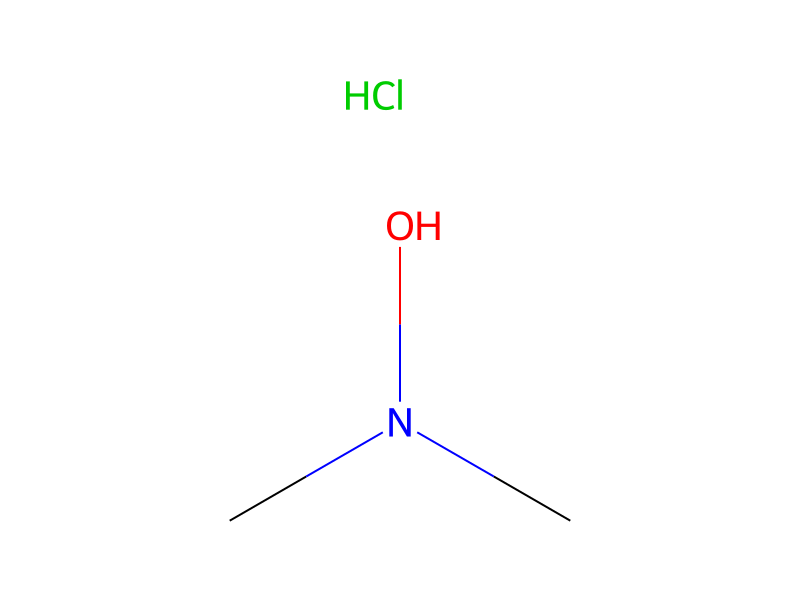
N,N-dimethylhydroxylamine hydrochloride

HCID 27969
New reaction
Print
Basic informationNames & identifiersPropertiesSafety & regulationChemistry & industryRelated reactionsCompound notes
Substructure searchFind similar structures

Basic information

CAS
16645-06-0
Standard SMILES
CN(C)O.Cl
InChIKey
HWWVAHCWJLGKLW-UHFFFAOYSA-N
Molecular formula
C2H7NO.ClH
Average molar mass
97.54 g/mol
Monoisotopic mass
97.0294416

Names & identifiers

Preferred name
N,N-dimethylhydroxylamine hydrochloride
IUPAC
N,N-dimethylhydroxylamine;hydrochloride
English name
N,N-Dimethylhydroxylamine hydrochloride
Molecular formula
C2H8ClNO
Molecular weight
97.54

Names & synonyms

N,N-Dimethylhydroxylamine hydrochlorideRefChem:83013316645-06-0N-Hydroxy-N,N-dimethylamine hydrochlorideMFCD00012600N,N-dimethylhydroxylamine;hydrochloriden,n-dimethylhydroxylaminehydrochlorideN,N-dimethylhydroxylamine HClMethanamine, N-hydroxy-N-methyl-, hydrochloride (9CI)dimethylhydroxylamine hydrochlorideNSC-45353EINECS 240-691-8
Show more names
DIMETHYLHYDROXYLAMINEHYDROCHLORIDEN,N-Dimethylhydroxylamine hydrochloride 99%N,N-Dimethylhydroxylamine hydrochloride 99%Methanamine,N-hydroxy-N-methyl-, hydrochloride (9CI)
dimethylhydroxylamine HClDimethyl hydroxylamine HClSCHEMBL9537Methanamine, N-hydroxy-N-methyl-, hydrochlorideDimethylhydroxylamine HCl saltDimethylhydroxyamine hydrochlorideDTXSID30168107dimethylhydroxylarnine hydrochloride

Database identifiers

CAS
16645-06-0
PubChem CID
27969
DTXSID
DTXSID30168107
UNII
K3T329Q2L7
EC Number
240-691-8

Properties

Computed structural properties

Topological polar surface area
23.5 Ų
Hydrogen bond donors
2
Hydrogen bond acceptors
2
Rotatable bonds
0
Heavy atoms
5
Formal charge
0
Complexity
13.5

Experimental & physicochemical properties

Chemical ClassesNitrogen Compounds -> Hydroxylamines
Vapor Pressure21.2 [mmHg]
Physical DescriptionLight yellow hygroscopic crystals; [Sigma-Aldrich MSDS]

Physicochemical properties

Melting point
107 · 107-109 °C (lit.)
form
solid
BRN
3905683 · 3905683
InChI
InChI=1S/C2H7NO.ClH/c1-3(2)4;/h4H,1-2H3;1H
InChIKey
HWWVAHCWJLGKLW-UHFFFAOYSA-N
SMILES
N(O)(C)C.Cl
UNSPSC Code
12352100 · 12352100
NACRES
22 · NA.22
Symbol(GHS)
7 · GHS07
Signal word
Warning
Hazard statements
315 · H315-H319

Safety & regulation

Safety information is for reference only and does not replace the supplier’s Safety Data Sheet (SDS), applicable regulations, or professional assessment.

GHS classification

GHS Classification · 4 items

Warning

H315 (100%): Causes skin irritation [Warning Skin corrosion/irritation]

P264, P264+P265, P280, P302+P352, P305+P351+P338, P321, P332+P317, P337+P317, and P362+P364 (click each P-code to see the statement)

Aggregated GHS information provided per 39 reports by companies from 1 notifications to the ECHA C&L Inventory. Each notification may be associated with multiple companies.

Hazard information

Regulatory InformationChemical: Methanamine, N-hydroxy-N-methyl-, hydrochloride
Hazards SummaryAn irritant; [Sigma-Aldrich MSDS]
Hazard Classes and CategoriesSkin Irrit. 2 (100%)

Safety data

F
3
PPE
dust mask type N95 (US), Eyeshields, Gloves
wgk
3
risk_code
36/38
Signal word
Warning
Symbol(GHS)
GHS07
hazard_code
Xi
safety_code
26-36
Storage Class
11 - Combustible Solids
Hazard statements
H315-H319
Hazard Classifications
Eye Irrit. 2Skin Irrit. 2
Precautionary statements

Chemistry & industry

Applications

UsesN,N-Dimethylhydroxylamine hydrochloride was used in the synthesis of 4,4-dimethyl-2,5,5-triphenyl-l.3-dioxa-4-azonia-2-bora-5-boratacyclopentane. It was also used as a polymer-chain terminator.

Preparation methods · 1 item

Preparation(a) Preparation of N,N-Dimethyl~(a-phenylethyl)amine Oxide. To a flask containing 11.0 g (0.074 mole) of N,N-dimethyl(a-phenylethyl)amine is added dropwise 18.3 g (0.19 mole) of 35% aqueous hydrogen peroxide, and the mixture is stirred for 11 hr at room temperature. The excess hydrogen peroxide is decomposed by stirring the mixture with 8 sqcm2 clean platinum foil until the evolution of oxygen ceases. Most of the water is removed by distillation at 35 mm Hg, at a bath temperature of 45-55°C. The material that condenses in the dry-ice trichloroethylene trap is saved for recovery in Procedure (b). The residual syrup is diluted with 25 ml of absolute ethanol, and the process is repeated twice while a capillary ni­trogen ebulliator is used. The resulting amine oxide is a viscous syrup and has a slight odor of styrene. (b) Decomposition of N,N-Dimethyl-(a-phenylethyl)amine Oxide to Ν,Ν-Dimethylhydroxylamine. A 100 ml round bottom flask equipped with a capillary nitrogen inlet, and containing the preceding amine oxide is connected by a large-diameter tube to a condenser set for distillation with two receivers. Each receiver is cooled in a mixture of dry ice and trichlo­roethylene. The system is evacuated to 5 mm, and the flask is immersed in an oil bath at 85°C. The bath temperature is raised slowly to 115°C over a 35-min period, in which time most of the material distilled over. The bath temperature is finally raised to 150°C, in order to complete the (decom­position) distillation process. The residue remaining averages 0.35 g. The distillate in the dry-ice trap here and from Procedure (a) are combined, pentane is added as a solvent, and the mixture is washed with dilute hydrochloric acid. The acid solution is extracted with pentane, the latter washed with water until neutral. The product is obtained from the combined aqueous layers containing hydrochloric acid by concentration under reduced pressure, to give a crys­talline residue. The latter, upon drying in a vacuum desiccator over P2O5 averages 6.73 g (94% yield), m.p. 101-101°C (sealed capillary). Recrys-tallization several times from a mixture of absolute ethanol and ether gives white, hygroscopic needles, m.p. 106.5-109°C (sealed capillary).
Related reactions

43 records
New reaction record
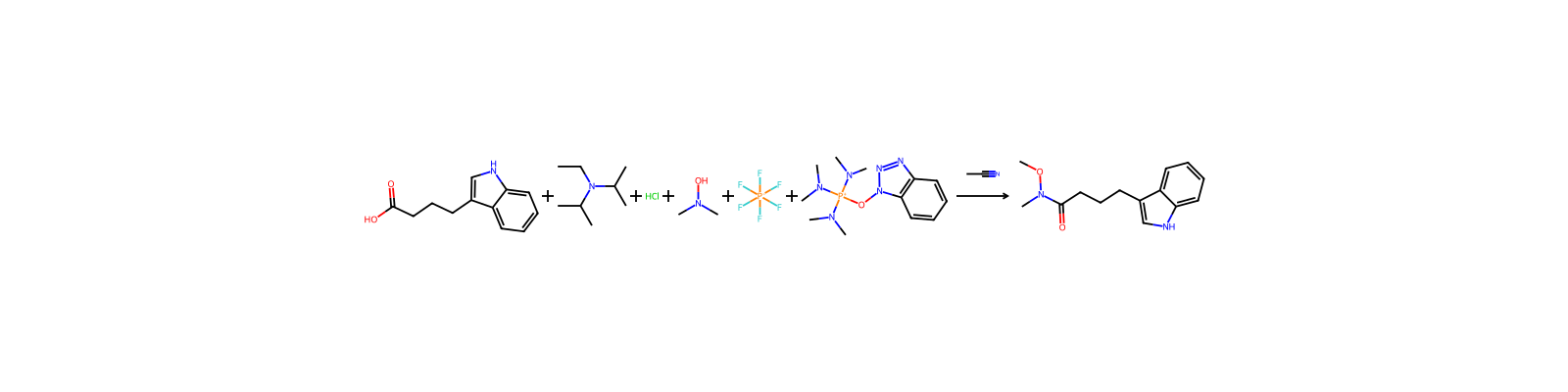
HRID 883 reaction equation
HRID 883As reactant
HRID 53563 reaction equation
HRID 53563As reactant
HRID 58832 reaction equation
HRID 58832As reactant
HRID 82744 reaction equation
HRID 82744As reactant
HRID 445932 reaction equation
HRID 445932As reactant
HRID 646247 reaction equation
HRID 646247As reactant
HRID 658478 reaction equation
HRID 658478As reactant
HRID 876425 reaction equation
HRID 876425As reactant
PreviousPage 1 of 6

Compound notes

On this pageBasic informationNames & identifiersPropertiesSafety & regulationChemistry & industryRelated reactionsCompound notes
Precautionary statements
264 · P264-P280-P302+P352-P305+P351+P338-P332+P313-P337+P313
PPE
95 · dust mask type N95 (US), Eyeshields, Gloves
Hazard Codes
Xi
Risk Statements
36 · 36/38
Safety Statements
26 · 26-36
WGK Germany
3 · 3
F
3 · 3
Storage Class
11 · 11 - Combustible Solids
Hazard Classifications
2 Skin · Eye Irrit. 2Skin Irrit. 2
P264-P280-P302+P352-P305+P351+P338-P332+P313-P337+P313

Upstream & downstream products

Downstream products

tert-Butyl (S)-1-(N-methoxy-N-methylcarbamoyl)-2-hydroxyethylcarbamateBenzamide, 2-fluoro-N-methoxy-N-methyl-3-(trifluoromethyl)-