
HRID 71017As reactant
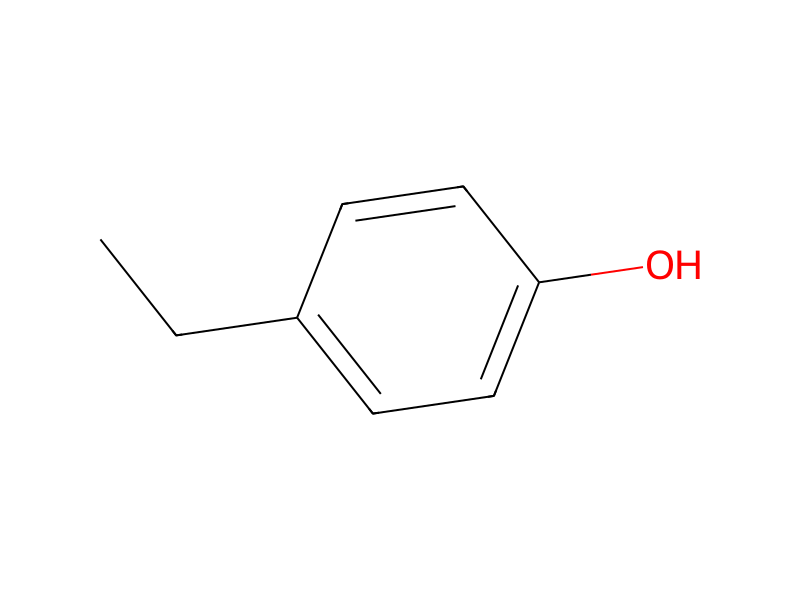
123-07-9CCc1ccc(O)cc1HXDOZKJGKXYMEW-UHFFFAOYSA-N4-ethylphenol is a member of the class of phenols carrying an ethyl substituent at position 4. It has a role as a fungal xenobiotic metabolite.
123-07-9、29471-88-3DTXSID4021977CHEMBL108475CHEBI:49584Log Kow = 2.58
2.580
2.4
POWERFUL WOODY-PHENOLIC, YET SOMEWHAT SWEET
MEDICINAL, PHENOLIC
Safety information is for reference only and does not replace the supplier’s Safety Data Sheet (SDS), applicable regulations, or professional assessment.
This chemical does not meet GHS hazard criteria for 0.4% (7 of 1875) of reports.
Danger
H314 (86%): Causes severe skin burns and eye damage [Danger Skin corrosion/irritation]
P260, P264, P264+P265, P280, P301+P330+P331, P302+P361+P354, P304+P340, P305+P354+P338, P316, P317, P321, P363, P405, and P501 (click each P-code to see the statement)
Aggregated GHS information provided per 1875 reports by companies from 14 notifications to the ECHA C&L Inventory. Each notification may be associated with multiple companies.
Danger
Chemical: Phenol, 4-ethyl-
Commission Regulation (EC) No 1565/2000 (Repealed by Com. Implementing Reg. (EU) No 872/2012)
Phenol, 4-ethyl- is listed on the EPA's Chemical Data Reporting (CDR) system. Manufacturers and importers of Phenol, 4-ethyl- are required to report information about their production and use of this chemical to the EPA under the Toxic Substances Control Act (TSCA). (40 eCFR Part 711)
REACH registered substance: 4-ethylphenol (EC: 204-598-6)
Phenol, 4-ethyl-: Does not have an individual approval but may be used under an appropriate group standard
Phenol, 3(or 4)-ethyl-: Does not have an individual approval but may be used as a component in a product covered by a group standard. It is not approved for use as a chemical in its own right.
THE MIN INHIBITORY CONCN (MIC) OF 4-ETHYLPHENOL AGAINST ESCHERICHIA COLI WAS 695 UG/ML. 4-ETHYLPHENOL CAUSES AN INCR IN THE PERMEABILITY OF THE CELL MEMBRANE TO MOLECULES SMALLER THAN TRICARBOXYLIC ACID CYCLE INTERMEDIATES, RESULTING IN AN APPARENT UNCOUPLING EFFECT.
FROM A DOSE OF 100 MG/KG /ETHYLBENZENE/ ADMIN ORALLY TO RAT... URINARY METABOLITES P-ETHYLPHENOL...ABOUT 0.3%, & SMALLER QUANTITIES OF 1- & 2-PHENYLETHANOL...
YIELDS P-ETHYLANISOLE IN THE GUINEA PIG. /FROM TABLE/
4-Ethylphenol has known human metabolites that include (2S,3S,4S,5R)-6-(4-ethylphenoxy)-3,4,5-trihydroxyoxane-2-carboxylic acid.
DATA OBTAINED FROM MEASUREMENTS OF DESORPTION OF PHENOLIC CMPD FROM HUMAN STRATUM CORNEUM WERE TREATED TO GIVE ESTIMATES OF STRATUM CORNEUM-H20 PARTITION COEFFICIENTS AND OF THE RELATIVE DIFFUSION COEFFICIENTS OF PHENOLIC CMPD IN STRATUM CORNEUM.
Used as a flavor and to make pharmaceuticals, dyes, and antioxidants (used in rubber and polymers); [HSDB]
SYNTHETIC FLAVOR
4-Ethylphenol is contained in the xylenol fraction boiling between ca. 205 and 225 °C obtained from tar phenols, which is used, for example, for the production of phenolic resins. A xylenol fraction boiling between 216 and 218 °C containing predominantly 3- and 4-ethylphenol is obtained from brown coal low-temperature tar and used in the varnish industry.
Pure 4-ethylphenol is the starting material for the production of 4-vinylphenol and of various antioxidants (eg, 2,6-di-t-butyl-4-ethylphenol and 2,2'-methylenebis(6-t-butyl-4-ethylphenol)), which are used in rubber and polymers. 4-Ethylphenol is an intermediate for pharmaceuticals and dyes.


SLIGHTLY SOL IN WATER; SOL IN ALC, ETHER, & BENZENE; SOL IN CARBON DISULFIDE, & ACETONE
In water, 4.90X10+3 mg/l at 25 °C
slightly soluble in water; soluble in oils
very soluble (in ethanol)
104 °C
219 °F (104 °C) (Open Cup)
2 - Materials that, under emergency conditions, can cause temporary incapacitation or residual injury.
1 - Materials that must be preheated before ignition can occur. Materials require considerable preheating, under all ambient temperature conditions, before ignition and combustion can occur.
0 - Materials that in themselves are normally stable, even under fire conditions.
Skin Corr. 1C (86%)
Acute toxicity - category 4
Serious eye damage/eye irritation - Category 1
SRP: At the time of review, criteria for land treatment or burial (sanitary landfill) disposal practices are subject to significant revision. Prior to implementing land disposal of waste residue (including waste sludge), consult with environmental regulatory agencies for guidance on acceptable disposal practices.
TERRESTRIAL FATE: Based on a recommended classification scheme(1), an estimated Koc value of 600(SRC), determined from a measured log Kow(2) and a recommended regression-derived equation(3), indicates that p-ethylphenol will have low mobility in soil(SRC). Based on limited data, biodegradation of this compound is likely. A system where water was passed through contaminated soil (initial p-ethylphenol concentration = 4000 ug/l) and then through an upflow aerated column was capable of 76% removal in 37 days(4). p-Ethylphenol's values for vapor pressure(5) and Henry's Law constant(5,6,SRC) indicate that volatilization from dry and moist soil surfaces is possible, but will not be a major fate process for this compound(SRC).
AQUATIC FATE: Based on a recommended classification scheme(1), an estimated Koc value of 600(SRC), determined from a measured log Kow(2) and a recommended regression-derived equation(3), indicates that p-ethylphenol may adsorb to suspended solids and sediment(SRC) in water. Based on limited soil study data, biodegradation of this compound is likely. 76% removal of p-ethylphenol in 37 days was seen in a soil column study(4). p-Ethylphenol should volatilize from water surfaces based on an estimated Henry's Law constant of 1.2X10⁻⁶ atm-cu m/mole(SRC), calculated from experimental values for vapor pressure(5) and water solubility(6). Estimated half-lives for a model river and model lake are 33 and 245 days, respectively(3,SRC). An estimated BCF value of 54(3,SRC), from an experimental log Kow(2), suggests that p-ethylphenol may bioconcentrate in aquatic organisms(SRC) according to a recommended classification scheme(7).
ATMOSPHERIC FATE: According to a suggested classification scheme(1), a measured vapor pressure of 0.0372 mm Hg at 25 °C(2) indicates that p-ethylphenol will mainly exist in the vapor phase in the ambient atmosphere(SRC). Vapor-phase p-ethylphenol is degraded in the atmosphere by reaction with photochemically produced hydroxyl radicals(SRC); the half-life for this reaction in air is estimated to be about 9 hours(3,SRC).
p-Ethylphenol was detected in industrial wastewater from the following industries: timber products (1 in 30 extracts), iron and steel manufacturing (1 in 7 extracts), petroleum refining (1 in 21 extracts), organics and plastics (1 in 49 extracts), rubber processing (1 in 18 extracts), mechanical products (1 in 26 extracts), and publicly-owned treatment works (1 in 44 extracts)(1). A coal-derived liquid taken from a non-catalytic direct liquefaction pilot plant contained p-ethylphenol at unreported concentrations(2). m- and p-ethylphenol (mixed) were detected in cigarette smoke at 1.2-2.8 mg/100 cigarettes(3). p-Ethylphenol was detected in a sample of finished water from the Blue Plains advanced waste treatment plant, Washington, DC in September 1974(4).
The Koc of p-ethylphenol is estimated as approximately 600(SRC), using a measured log Kow of 2.58(1) and a regression-derived equation(2,SRC). According to a recommended classification scheme(3), this estimated Koc value suggests that p-ethylphenol has low mobility in soil(SRC).
4-Ethylphenol (CAS # 123-07-9) was evaluated for acute oral toxicity. The test substance was administered to 6 rats (sex and strain not indicated) at a dosage level of 5000 mg/kg. One rat died and there were no signs of toxicity.
4-Ethylphenol (CAS # 123-07-9) was evaluated for acute dermal toxicity. The test substance was administered to 4 rabbits (sex and strain not indicated) at a dosage level of 5000 mg/kg. There were no toxic signs or mortalities.
4-Ethylphenol (CAS # 123-07-9) was evaluated for primary dermal irritation. The test substance was administered to 4 rabbits (sex and strain not indicated) at a dose volume of 0.5 ml/kg. Mild dermal irritation consisted of very slight erythema without edema (2 rabbits), and slight erythema with or without edema (2 rabbits).
4-Ethylphenol (CAS # 123-07-9) was evaluated for primary eye irritation. The test substance was administered to 4 rabbits (sex and strain not indicated) at a dose volume of 0.1 ml/kg. At 24 hours, severe ocular irritation consisted of moderate to severe conjunctival irritation (redness, chemosis, discharge, necrosis); iritis; corneal opacity; stippling; and ulceration. By Day 7, severe irritation was still evident in all animals, with 2 animals exhibiting pannus and 1 animal exhibiting hair loss around the eye.
BY CATALYTIC REACTION BETWEEN PHENOL & ETHYLENE OR ETHANOL; BY HEATING 8-CHLORO-3-ETHYLBENZENE WITH SODIUM HYDROXIDE IN THE PRESENCE OF COPPER POWDER.
A mixture of m-ethylphenol and p-ethylphenol is produced from low temperature tar using the coalite process.
4-Ethylphenol is produced industrially by sulfonation of ethylbenzene under mild (kinetically controlled) conditions and subsequent alkali fusion of the 4-ethylbenzenesulfonic acid obtained.
Fragrance Ingredients
Flavouring Agent -> FLAVOURING_AGENT -> JECFA Functional Classes
Flavoring Agents -> JECFA Flavorings Index
Flavouring Agent -> FLAVOURING_AGENT -> JECFA Functional Classes
Soap, Cleaning Compound, and Toilet Preparation Manufacturing
Phenol, 4-ethyl-: ACTIVE
Phenol, 3(or 4)-ethyl-: INACTIVE
/SYNTHETIC FLAVORS/ BAKED GOODS 0.20 PPM; MARGARINE 0.20 PPM.
FLAVORS USEFUL IN: SMOKE FLAVORS.
FIFTEEN CMPD STRUCTURALLY RELATED TO P-CRESOL, AN OVIPOSITION ATTRACTANT OF AEDES TRISERIATUS WERE TESTED ON THIS SPECIES. ATTRACTANT ACTIVITY WAS SHOWN BY P-ETHYLPHENOL.
Description4-Ethylphenol (4-EP) is a phenolic compound with the formula C8H10O. It is colorless or white needles with a powerful woody-phenolic and yet somewhat sweet odor and tends to be yellow on exposure to light. It is slightly solouble in water, solouble in alcohol, ether and benzene and carbon disulfide. It is found in arabica coffee and can be produced in wine and beer by the spoilage yeast Brettanomyces. It is the starting material for the production of 4-vinylphenol and of various antioxidants and can also be used as an intermediate for pharmaceuticals and dyes. It is an industrially versatile commodity chemical widely applied in the pharmaceutical and food industries.
OccurrenceReported found in yellow passion fruit, smoked fish, lean fish, beer, cognac, rum, whiskey, cider, sherry, grape wines and coffee
Uses4-Ethylphenol is suitable for use in the determination of 4-ethylguaiacol and 4-ethylphenol in the aroma of red wines using headspace-solid-phase microextraction method. It is a chemical reagent used in the synthesis of 5-HT1A receptor agonists endowed with antinociceptive activity in vivo. It is also used in the preparation of isopropylamides as potent and noncovalent proteosome inhibitors.
General Description4-Ethylphenol is a volatile phenol. It has been synthesized from p-coumaric acid by employing a synthetic medium containing Dekkera bruxellensis ISA 1791. It has been identified as an aroma compound in red wine.
Preparation4-Ethylphenol is prpared by catalytic reaction between phenol and ethylene or ethanol; by heating 8-chloro-3-ethylbenzene with NaOH in the presence of copper powder.
DefinitionChEBI: 4-ethylphenol is a member of the class of phenols carrying an ethyl substituent at position 4. It has a role as a fungal xenobiotic metabolite.