
HRID 3668As reactant
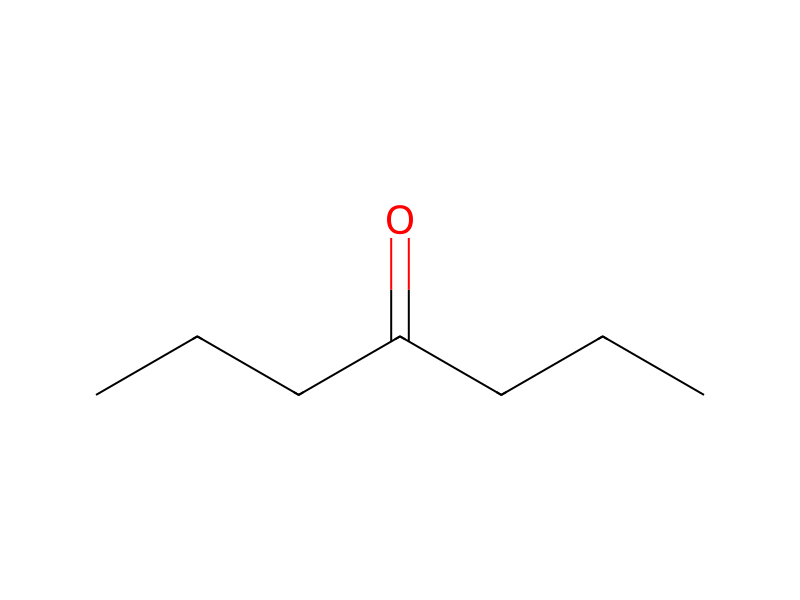
123-19-3CCCC(=O)CCCHCFAJYNVAYBARA-UHFFFAOYSA-NDipropyl ketone appears as a colorless liquid with a pleasant odor. Insoluble in water and less dense than water. Flash point 120 °F. Toxic by inhalation. A skin irritant. Used to make flavorings and as a solvent.
123-19-3DTXSID6047650CHEBI:89484log Kow = 2.04
2.04
0.82 (NIOSH, 2024) - Less dense than water; will float
0.8174 g/cu cm at 20 °C
Bulk density: 6.79 lb/gal at 20 °C
Relative density (water = 1): 0.8
Safety information is for reference only and does not replace the supplier’s Safety Data Sheet (SDS), applicable regulations, or professional assessment.
Warning
H226: Flammable liquid and vapor [Warning Flammable liquids]
P210, P233, P240, P241, P242, P243, P261, P271, P280, P303+P361+P353, P304+P340, P317, P370+P378, P403+P235, and P501 (click each P-code to see the statement)
This chemical does not meet GHS hazard criteria for < 0.1% (1 of 1945) of reports.
Warning
H226 (> 99.9%): Flammable liquid and vapor [Warning Flammable liquids]
Chemical: 4-Heptanone
4-Heptanone is listed on the EPA's Chemical Data Reporting (CDR) system. Manufacturers and importers of 4-Heptanone are required to report information about their production and use of this chemical to the EPA under the Toxic Substances Control Act (TSCA). (40 eCFR Part 711)
REACH registered substance: Heptan-4-one (EC: 204-608-9)
4-Heptanone: Does not have an individual approval but may be used under an appropriate group standard
The New Jersey Worker and Community Right to Know Act requires public and private employers to provide information about hazardous substances at their workplaces. (N.J.S.A. 34:5A-1 et. seq.)
Excerpt from ERG Guide 128 [Flammable Liquids (Water-Immiscible)]:
· HIGHLY FLAMMABLE: Will be easily ignited by heat, sparks or flames.
Flammable. Above 49 °C explosive vapour/air mixtures may be formed.
Excerpt from ERG Guide 128 [Flammable Liquids (Water-Immiscible)]:
... After establishing analytical methods for all postulated metabolites, /the authors/ analyzed (i) plasma samples from 50 patients on haemodialysis and 50 controls; (ii) urine samples from 100 diabetic patients and 100 controls; and (iii) urine samples from 10 controls receiving DEHP intravenously. 4-Heptanone concentrations in urine did not differ between controls (128.6+/-11.4 ug/L, mean+/- SEM) and diabetic patients (131.2+/-11.6 ug/L) but were significantly elevated in plasma from hemodialysis patients (95.9+/-9.6 ug/L) compared with controls (10.4+/-0.5 ug/L). Exposure to DEHP led to a significant increase (P<0.001) of the metabolite 4-heptanone and all the proposed intermediates in urine of healthy persons within 24 hr. CONCLUSIONS: These studies show that 4-heptanone is not associated with diabetes but is a major DEHP metabolite in humans...
2-Ethylhexanol was efficiently absorbed following oral administration to rats. Carbon-14 associated with 2-ethyl(1-14C)hexanol was rapidly excreted in respiratory CO2 (6-7%), feces (8-9%) and urine (80-82%), with essentially complete elimination by 28 hr after administration. The amount of label recovered in (14)CO2 matched the amount of unlabelled 2-heptanone plus 4-heptanone recovered from urine, suggesting that both types of metabolite may have been derived form the major urinary metabolite, 2-ethylhexanoic acid, by decarboxylation following partial beta-oxidation...
Used as a solvent for organic chemicals and surface coatings; [ACGIH]
Painting (Solvents) [Category: Paint]
Solvent for nitrocellulose, raw and blown oils, resins, and polymers; lacquers; flavoring.
2023: 75,000 - <500,000 lb
Production volumes for non-confidential chemicals reported under the Inventory Update Rule. [Table#7740]
Production volume for non-confidential chemicals reported under the 2006 Inventory Update Rule. Chemical: 4-Heptanone. Aggregated National Production Volume: 1 to < 10 million lbs.


0.814-0.817 (20 °C)
0.82
CAUTION: Petroleum crude oil (UN1267) may contain TOXIC hydrogen sulphide gas.
2710 128
2710 128
Excerpt from ERG Guide 128 [Flammable Liquids (Water-Immiscible)]:
Use alcohol-resistant foam, dry powder, carbon dioxide. In case of fire: keep drums, etc., cool by spraying with water.
Fresh air, rest. Refer for medical attention.
Rinse skin with plenty of water or shower.
First rinse with plenty of water for several minutes (remove contact lenses if easily possible), then refer for medical attention.
Rinse mouth. Refer for medical attention .
· CALL 911. Then call emergency response telephone number on shipping paper. If shipping paper not available or no answer, refer to appropriate telephone number listed on the inside back cover.
· ELIMINATE all ignition sources (no smoking, flares, sparks or flames) from immediate area.
Excerpt from NIOSH Pocket Guide for Dipropyl ketone:
General First Aid:
(General first aid procedures)
If material on fire or involved in fire: Do not extinguish fire unless flow can be stopped. Use water in flooding quantities as fog. Solid streams of water may be ineffective. Cool all affected containers with flooding quantities of water. Apply water from as far a distance as possible. Use foam, dry chemical, or carbon dioxide. Keep run-off water out of sewers and water sources.
Personnel protection: Wear appropriate chemical protective gloves, boots, and goggles. Wear positive pressure self-contained breathing apparatus when fighting fires involving this material. If contact with the material anticipated, wear appropriate chemical protective clothing.
Carbon dioxide, dry chemical, alcohol foam, fog, and mist.
Suitable extinguishing media: For small (incipient) fires, use media such as "alcohol" foam, dry chemical, or carbon dioxide. For large fires, apply water from as far as possible. Use very large quantities (flooding) of water applied as a mist or spray; solid streams of water may be ineffective. Cool all affected containers with flooding quantities of water. Special protective equipment for fire-fighters: Wear self contained breathing apparatus for fire fighting if necessary. Use water spray to cool unopened containers.
Personal precautions: Use personal protective equipment. Avoid breathing vapors, mist or gas. Ensure adequate ventilation. Remove all sources of ignition. Beware of vapors accumulating to form explosive concentrations. Vapors can accumulate in low areas. Environmental precautions: Do not let product enter drains. Methods and materials for containment and cleaning up: Contain spillage, and then collect with non-combustible absorbent material, (e.g. sand, earth, diatomaceous earth, vermiculite) and place in container for disposal according to local / national regulations. Keep in suitable, closed containers for disposal.
SRP: The most favorable course of action is to use an alternative chemical product with less inherent propensity for occupational harm/injury/toxicity or environmental contamination. Recycle any unused portion of the material for its approved use or return it to the manufacturer or supplier. Ultimate disposal of the chemical must consider: the material's impact on air quality; potential migration in soil or water; effects on animal and plant life; and conformance with environmental and public health regulations.
SRP: Wastewater from contaminant suppression, cleaning of protective clothing/equipment, or contaminated sites should be contained and evaluated for subject chemical or decomposition product concentrations. Concentrations shall be lower than applicable environmental discharge or disposal criteria. Alternatively, pretreatment and/or discharge to a permitted wastewater treatment facility is acceptable only after review by the governing authority and assurance that "pass through" violations will not occur. Due consideration shall be given to remediation worker exposure (inhalation, dermal and ingestion) as well as fate during treatment, transfer and disposal. If it is not practicable to manage the chemical in this fashion, it must be evaluated in accordance with EPA 40 CFR Part 261, specifically Subpart B, in order to determine the appropriate local, state and federal requirements for disposal.
Personal protection: filter respirator for organic gases and vapours adapted to the airborne concentration of the substance. Remove all ignition sources. Ventilation. Collect leaking and spilled liquid in sealable containers as far as possible. Absorb remaining liquid in sand or inert absorbent. Then store and dispose of according to local regulations.
Dipropyl ketone was detected in 12.4% of 387 samples of expired air collected from 54 individuals in Chicago, IL with a reported geometric mean concentration of 0.074 ng/L(1). Dipropyl ketone was detected in 35 out of 46 composite samples from the US EPA 1982 National Human Adipose Tissue Survey (NHATS) repository. Dipropyl ketone was detected in samples corresponding to all age groups and geographic regions(2). The reported concentration of dipropyl ketone ranged from 27 to 1044 ng/mL (median = 188 ng/mL)in the urine of 51 healthy individuals and from 17 to 978 ng/mL (median = 179 ng/mL) in 92 diabetic patients(3). During a study of the occurrence of volatile organic compounds in human milk samples from five industrial US cities, dipropyl ketone was detected in one milk sample collected in Jersey City, NJ(4,5).
TERRESTRIAL FATE: Based on a classification scheme(1), an estimated Koc value of 178(SRC), determined from a log Kow of 2.04(2) and a regression-derived equation(3), indicates that dipropyl ketone is expected to have moderate mobility in soil(SRC). Volatilization of dipropyl ketone from moist soil surfaces is expected to be an important fate process(SRC) given an estimated Henry's Law constant of 2.4X10⁻⁴ atm-cu m/mole(SRC), derived from its vapor pressure, 5.2 mm Hg at 20 °C(4), and water solubility, 3.19X10+3 mg/L (5). Dipropyl ketone is expected to volatilize from dry soil surfaces(SRC) based upon its vapor pressure(4). Limited biodegradation data are available for dipropyl ketone(SRC, 2011); however, as a group n-alkyl ketones are reported to be susceptible to microbial degradation(6).
AQUATIC FATE: Based on a classification scheme(1), an estimated Koc value of 178(SRC), determined from a log Kow of 2.04(2) and a regression-derived equation(3), indicates that dipropyl ketone is expected to adsorb very little to suspended solids and sediment(SRC). Volatilization from water surfaces is expected(4) based upon an estimated Henry's Law constant of 2.4X10⁻⁴ atm-cu m/mole(SRC), derived from its vapor pressure, 5.2 mm Hg at 20 °C(5), and water soubility, 3.19X10+3 mg/L(6). Using this Henry's Law constant and an estimation method(4), volatilization half-lives for a model river and model lake are 3.7 hours and 5.4 days, respectively(SRC). According to a classification scheme(7),an estimated BCF of 9.7(SRC), from its log Kow(2) and a regression-derived equation(3), suggests the potential for bioconcentration in aquatic organisms is low(SRC). Limited biodegradation data are available for dipropyl ketone(SRC, 2011); however, as a group n-alkyl ketones are reported to be susceptible to microbial degradation(8).
ATMOSPHERIC FATE: According to a model of gas/particle partitioning of semivolatile organic compounds in the atmosphere(1), dipropyl ketone, which has a vapor pressure of 5.2 mm Hg at 20 °C(2), is expected to exist solely as a vapor in the ambient atmosphere. Vapor-phase dipropyl ketone is degraded in the atmosphere by reaction with photochemically-produced hydroxyl radicals(SRC); the half-life for this reaction in air is estimated to be 1.7 days(SRC), calculated from its rate constant of 9.3X10⁻¹² cu cm/molecule-sec at 25 °C(SRC) that was derived using a structure estimation method(3). The maximum UV absorption of dipropyl ketone occurs near 280 nm(4), and the absorption spectrum is expected to extend beyond 290 nm; therefore, this substance may be susceptible to direct photolysis by sunlight(SRC).
The substance can be absorbed into the body by inhalation of its vapour and by ingestion.
inhalation, ingestion, skin and/or eye contact
Cough. Sore throat. Drowsiness. Lethargy. Headache.
Redness. Dry skin.
Redness.
Nausea. Vomiting. Diarrhoea. Dizziness. Drowsiness.
irritation eyes, skin; central nervous system depression, dizziness, drowsiness, decreased breath; In Animals: liver injury; narcosis
The Koc of dipropyl ketone is estimated as 178(SRC), using a log Kow of 2.04(1) and a regression-derived equation(2). According to a classification scheme(3), this estimated Koc value suggests that dipropyl ketone is expected to have moderate mobility in soil.
Dipropyl ketone's production and use as a solvent for nitrocellulose, raw and blown oils, resins, and polymers and in the production of lacquers and flavoring(1) may result in its release to the environment through various waste streams(SRC).
AEROBIC: Dipropyl ketone, present at 500 mg/L, in a Warburg repirometry flask containing 20 mL activated sludge suspension with a suspended solids concentration of 2,500 mg/L, reached 3.8% of the theoretical oxygen demand after 24 hours(1,2). Additional biodegradation data for dipropyl ketone were not located; however, as a group n-alkyl ketones are reported to be susceptible to microbial degradation(3).
An estimated BCF of 9.7 was calculated in fish for dipropyl ketone(SRC), using a log Kow of 2.04(1) and a regression-derived equation(2). According to a classification scheme(3), this BCF suggests the potential for bioconcentration in aquatic organisms is low(SRC).
Fragrance Ingredients
Flavouring Agent -> FLAVOURING_AGENT -> JECFA Functional Classes
Flavoring Agents -> JECFA Flavorings Index
Flavouring Agent -> FLAVOURING_AGENT -> JECFA Functional Classes
All Other Basic Organic Chemical Manufacturing
4-Heptanone: ACTIVE
Made by passing butyric acid over precipitated CaCO3 at 450 °C.
Description4-Heptanone is an organic ketone containing seven carbon atoms. It can be found in urine samples of human being. It arises from in vivo beta-oxidation of 2-ethylhexanoic acid (EHA) from plasticisers, which is similar to the formation of 3-heptanone from valproic acid. It is mainly used as the solvents of nitrocellulose, nitrocellulose paint and synthetic resin and as the raw materials of organic synthesis. It can also be used as a internal standard of gas chromatography-mass spectrometry for the analysis of 3-monochloro-1, 2-propane diol which is a potential carcinogen found in soy sauce. It can be synthesized during the reaction of 1-butanol over base catalysts such as MgO.
Description4-Heptanone has a penetrating odor and burning taste. It is prepared by passing butyric acid over a wood coal at 425°C and then over cerium oxide at 500°C or over thorium oxide; also over manganese oxide at 400 - 425°C.
OccurrenceReported found in apple juice, papaya, pear, cabbage, baked potato, roasted peanut, chicken fat, coffee, bachang (Mangifera foetida L ) and rooibus tea (Aspalathius linearis)
UsesSolvent for nitrocellulose, oils, resins, and polymers and in flavorings
Uses4-Heptanone is used as a solvent for nitrocellulose as well as in organic synthesis. It is involved in the preparation of flavorings. It is used as an intermediate in the synthesis of active pharmaceutical ingredients. Further, it is used in paints and coatings.
UsesDipropyl ketone (DPK) is used as a solventin oils, resins, nitrocellulose, and polymers;and as a flavoring compound.
General DescriptionA colorless liquid with a pleasant odor. Insoluble in water and less dense than water. Flash point 120°F. Toxic by inhalation. A skin irritant. Used to make flavorings and as a solvent.
PreparationBy passing butyric acid over wood coal at 425°C and then over cerium oxide at 500°C or over thorium oxide; also over manganese oxide at 400 to 425°C.
DefinitionChEBI: 4-heptanone is a dialkyl ketone that is heptane in which the two methylene protons at position 4 have been replaced by an oxo group. It has a role as a biomarker, a human xenobiotic metabolite, a human urinary metabolite and a rat metabolite. It derives from a hydride of a heptane.