Nigericin
HCID 34230
Completing data — refresh the page later to see the latest
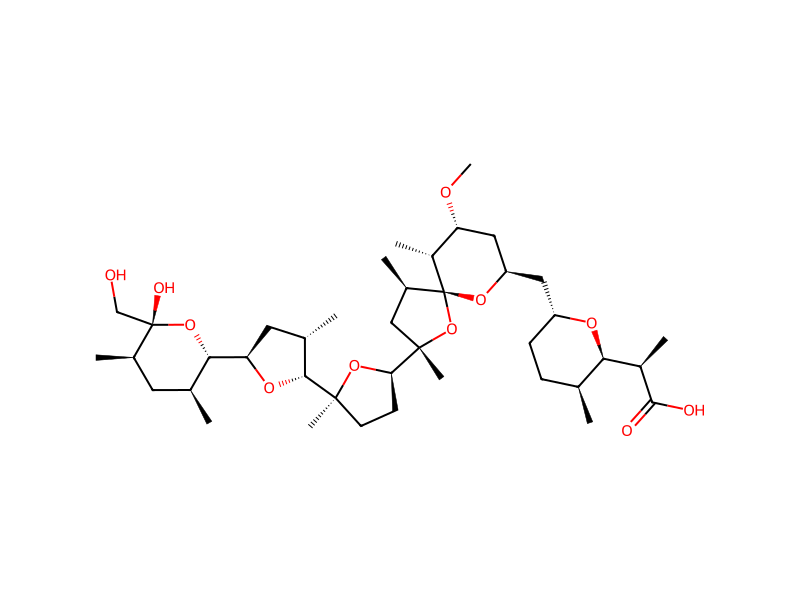
Basic information
- CAS
28380-24-7- Standard SMILES
CO[C@@H]1C[C@@H](C[C@H]2CC[C@H](C)[C@H]([C@@H](C)C(=O)O)O2)O[C@]2(O[C@](C)([C@H]3CC[C@@](C)([C@@H]4O[C@@H]([C@H]5O[C@@](O)(CO)[C@H](C)C[C@@H]5C)C[C@@H]4C)O3)C[C@H]2C)[C@@H]1C- InChIKey
DANUORFCFTYTSZ-SJSJOXFOSA-N- Molecular formula
- C40H68O11
- Average molar mass
- 725 g/mol
- Monoisotopic mass
- 724.476163
Overview
Nigericin is a polyether antibiotic which affects ion transport and ATPase activity in mitochondria. It is produced by Streptomyces hygroscopicus. It has a role as an antimicrobial agent, an antibacterial agent, a bacterial metabolite and a potassium ionophore.
Names & identifiers
- Preferred name
- Nigericin
- IUPAC
- (2R)-2-[(2R,3S,6R)-6-[[(2S,4R,5R,6R,7R,9R)-2-[(2R,5S)-5-[(2R,3S,5R)-5-[(2S,3S,5R,6R)-6-hydroxy-6-(hydroxymethyl)-3,5-dimethyloxan-2-yl]-3-methyloxolan-2-yl]-5-methyloxolan-2-yl]-7-methoxy-2,4,6-trimethyl-1,10-dioxaspiro[4.5]decan-9-yl]methyl]-3-methyloxan-2-yl]propanoic acid
- English name
- NIGERICIN SODIUM SALT
- Molecular formula
- C40H68O11
- Molecular weight
- 724.96
Names & synonyms
nigericinAzalomycin M28380-24-7Helixin CAntibiotic X-464RRU6GY95ISCHEBI:7569DTXSID9041079(2R)-2-[(2R,3S,6R)-6-[[(2S,4R,5R,6R,7R,9R)-2-[(2R,5S)-5-[(2R,3S,5R)-5-[(2S,3S,5R,6R)-6-hydroxy-6-(hydroxymethyl)-3,5-dimethyloxan-2-yl]-3-methyloxolan-2-yl]-5-methyloxolan-2-yl]-7-methoxy-2,4,6-trimethyl-1,10-dioxaspiro[4.5]decan-9-yl]methyl]-3-methyloxan-2-yl]propanoic acid(2R)-2-[(2R,3S,6R)-6-{[(2S,4R,5R,7R,9R,10R)-2-{(2S,2'R,3'S,5R,5'R)-5'-[(2S,3S,5R,6R)-6-hydroxy-6-(hydroxymethyl)-3,5-dimethyltetrahydro-2H-pyran-2-yl]-2,3'-dimethyloctahydro-2,2'-bifuran-5-yl}-9-methoxy-2,4,10-trimethyl-1,6-dioxaspiro[4.5]dec-7-yl]methyl}-3-methyltetrahydro-2H-pyran-2-yl]propanoic acid(2R)-2-((2R,3S,6R)-6-(((2S,4R,5R,6R,7R,9R)-2-((2R,5S)-5-((2R,3S,5R)-5-((2S,3S,5R,6R)-6-hydroxy-6-(hydroxymethyl)-3,5-dimethyloxan-2-yl)-3-methyloxolan-2-yl)-5-methyloxolan-2-yl)-7-methoxy-2,4,6-trimethyl-1,10-dioxaspiro(4.5)decan-9-yl)methyl)-3-methyloxan-2-yl)propanoic acid(2R)-2-((2R,3S,6R)-6-(((2S,4R,5R,7R,9R,10R)-2-((2S,2'R,3'S,5R,5'R)-5'-((2S,3S,5R,6R)-6-hydroxy-6-(hydroxymethyl)-3,5-dimethyltetrahydro-2H-pyran-2-yl)-2,3'-dimethyloctahydro-2,2'-bifuran-5-yl)-9-methoxy-2,4,10-trimethyl-1,6-dioxaspiro(4.5)dec-7-yl)methyl)-3-methyltetrahydro-2H-pyran-2-yl)propanoic acid
Properties
Computed structural propertiesFilling in
- XLogP
- 5.5
- Topological polar surface area
- 142 Ų
- Hydrogen bond donors
- 3
- Hydrogen bond acceptors
- 11
- Rotatable bonds
- 9
- Heavy atoms
- 51
- Formal charge
- 0
- Complexity
- 1,230
Experimental & physicochemical properties
DrugsPharmaceuticals -> Antibiotics
PesticidesBiocide
Physicochemical properties
- Melting point
- 183.5 · 183.5-185°
- alpha
- 24 · D24 +36.2° (c = 0.842 in CHCl3)
- Boiling point
- 779.9 · 779.9±60.0 °C(Predicted)
- Density
- 1.19 · 1.19±0.1 g/cm3(Predicted)
- storage temp.
- 2 · 2-8°C
- solubility
- 10 mg/mL, · chloroform: 10 mg/mL, clear, colorless
- form
- Solid
- pka
- 4.39 · 4.39±0.10(Predicted)
- color
- White to off-white
- InChIKey
- DANUORFCFTYTSZ-ANZYULKNSA-N
- EWG's Food Scores
- 1 · 1
Safety & regulation
Safety information is for reference only and does not replace the supplier’s Safety Data Sheet (SDS), applicable regulations, or professional assessment.
GHS classification
GHS Classification
Danger
H301 (100%): Toxic if swallowed [Danger Acute toxicity, oral]
P261, P264, P264+P265, P270, P271, P280, P301+P316, P302+P352, P304+P340, P305+P351+P338, P319, P321, P330, P332+P317, P337+P317, P362+P364, P403+P233, P405, and P501 (click each P-code to see the statement)
Aggregated GHS information provided per 146 reports by companies from 3 notifications to the ECHA C&L Inventory. Each notification may be associated with multiple companies.
Hazard information
Hazard Classes and CategoriesAcute Tox. 3 (100%)
Safety data
- F
- 10
- wgk
- 3
- rtecs
- QT6840000
- ridadr
- UN 3462 6.1/PG 3
- hs_code
- 29419090
- Toxicity
- LD50 in mice (mg/kg): 10-15 i.p. (Shoji); also reported as 2.5 i.p. (Harned)
- risk_code
- 25-36/37/38
- Signal word
- Danger
- Symbol(GHS)
- GHS06
- hazard_code
- T,Xi
- safety_code
- 26-36/37/39-45-36
- hazard_class
- 6.1(b)
- packing_group
- III
- Hazard statements
- H319-H335-H301-H315
- Precautionary statements
Chemistry & industry
Pharmacology
MeSH Pharmacological Classification
Chemical agents that increase the permeability of biological or artificial lipid membranes to specific ions. Most ionophores are relatively small organic molecules that act as mobile carriers within membranes or coalesce to form ion permeable channels across membranes. Many are antibiotics, and many act as uncoupling agents by short-circuiting the proton gradient across mitochondrial membranes.
Substances that inhibit the growth or reproduction of BACTERIA.
Applications
UsesNigericin is a polyether antibiotic produced by Streptomyces, notably S. hygroscopicus, isolated in the 1950s. Its complex structure was finally elucidated in 1968. Nigericin is an ionophore, possessing very high affinity for monovalent cations such as Na+ and K+. Nigericin disrupts membrane potential and Golgi apparatus in mitochondria. Although nigericin can be isolated as the free acid (under acidic conditions), like most ionophores it is extracted into organic solvents and is most conveniently isolated as a salt. In vitro, nigericin has broad biological activity against Gram positive bacteria, fungi, tumour cell lines and some viruses, including HIV. Nigericin is the most common member of the polyether class which are common false positives in in vitro screening bioassays using crude microbial extracts. They are thus important standards for dereplication.
Additional notes
DefinitionChEBI: A polyether antibiotic which affects ion transport and ATPase activity in mitochondria. It is produced by Streptomyces hygroscopicus.
Related reactions
0 records
No related reactions yet