Nylon-66
HCID 36070
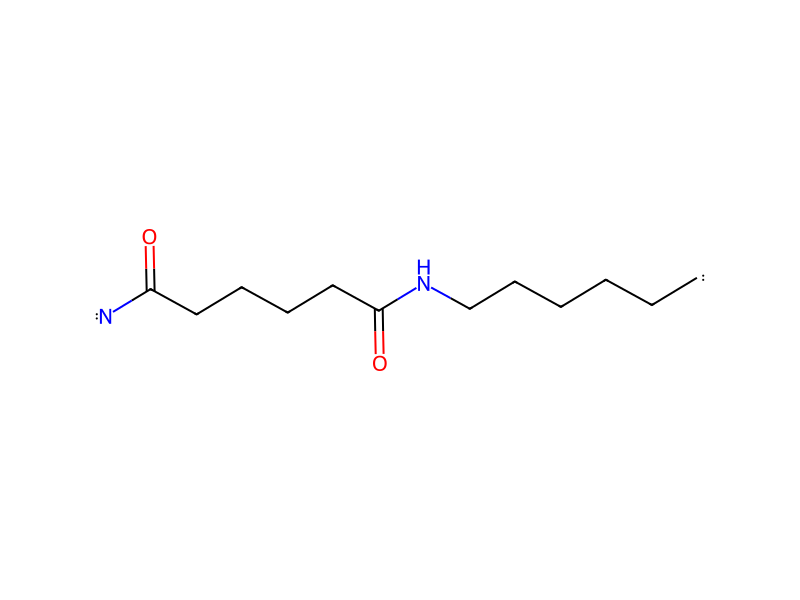
Basic information
- CAS
32131-17-2- Standard SMILES
[CH]CCCCCNC(=O)CCCCC([N])=O- InChIKey
LOCYSVHOSYQGOV-UHFFFAOYSA-N- Molecular formula
- C12H20N2O2
- Average molar mass
- 224.3 g/mol
- Monoisotopic mass
- 224.15247789
Names & identifiers
- Preferred name
- Nylon-66
- English name
- Nylon 6/6
- Molecular formula
- C36H66N6O6X2
- Molecular weight
- 678.95
Names & synonyms
Nylon-66RefChem:1093341608-706-6NYLON 6Poly[imino(1,6-dioxo-1,6-hexanediyl)imino-1,6-hexanediyl]Nylon 6/6 pelletsPOLY(HEXAMETHYLENE ADIPAMIDE)Nylon 6/6,Poly(N,N′-hexamethyleneadipinediamide, Poly(hexamethylene adipamide)Nylon 66 powderNYLON 6,6 POLYMERS[-CO(CH2)4CONH(CH2)6NH-]nPOLY(HEXAMETHYLENE DODECANEDIAMIDE)
Show more names
PA-66
Database identifiers
- CAS
32131-17-2- PubChem CID
- 36070
- EC Number
- 608-706-6
Properties
Computed structural properties
- XLogP
- 1.4
- Topological polar surface area
- 47.2 Ų
- Hydrogen bond donors
- 1
- Hydrogen bond acceptors
- 2
- Rotatable bonds
- 10
- Heavy atoms
- 16
- Formal charge
- 0
- Complexity
- 205
Experimental & physicochemical properties
Cosmetics
Cosmetic ingredients (Nylon-66) -> CIR (Cosmetic Ingredient Review)
Bulking; Viscosity controlling; Opacifying
Physicochemical properties
- Melting point
- 250 · 250-260 °C(lit.)
- Density
- 1.47 g/mL · 1.47 g/mL at 25 °C
- refractive index
- 20 · n20/D 1.565
- solubility
- strong proton donor solvents, acetic acid and phenols: soluble
- form
- pellets
- Stability
- Stable. Incompatible with strong oxidizing agents, strong bases.
- Cosmetics Ingredients Functions
- BULKINGOPACIFYINGVISCOSITY CONTROLLING
- Cosmetic Ingredient Review (CIR)
- 6 · Nylon 6/6 (32131-17-2)
- InChI
- 1S/C12H24N2O2/c1-2-3-4-7-10-14-12(16)9-6-5-8-11(13)15/h2-10H2,1H3,(H2,13,15)(H,14,16)
- InChIKey
- QDBQXOAICGSACD-UHFFFAOYSA-N
Safety & regulation
Safety information is for reference only and does not replace the supplier’s Safety Data Sheet (SDS), applicable regulations, or professional assessment.
GHS classification
GHS Classification
This chemical does not meet GHS hazard criteria for 88.5% (177 of 200) of all reports.
Warning
H315 (11.5%): Causes skin irritation [Warning Skin corrosion/irritation]
P264, P280, P302+P352, P321, P332+P317, and P362+P364 (click each P-code to see the statement)
Aggregated GHS information provided per 200 reports by companies from 2 notifications to the ECHA C&L Inventory.
Hazard information
Hazard Classes and CategoriesSkin Irrit. 2 (11.5%)
Toxicology
Toxicity SummarySafe in the present practices of use and concentration. Ingredient, concentration, and use information are available in documents discoverable at https://cir-reports.cir-safety.org
Safety data
- PPE
- Eyeshields, Gloves, type N95 (US)
- wgk
- 3
- tsca
- TSCA listed
- safety_code
- 24/25
- Storage Class
- 11 - Combustible Solids
- Autoignition Temperature
- 752 °F
Chemistry & industry
Uses & manufacturing
UsesCIR ingredient: Nylon-66
Use ClassificationCosmetics -> Bulking; Viscosity controlling; Opacifying
Applications
DescriptionNylon 6,6 was first developed in 1935 by W.H. Carothers at DuPont and patented in 1938 for use as a textile fiber. It was originally given the name Fiber #66. The fibers are known to be strong, tough, and elastic. Importantly, as opposed to traditional fibers such as cotton, wool, and rayon, nylon fibers are glossy. They are extruded through a spinneret with a circular or trilobal cross section shape. Nylon 6,6 fibers can be used individually, i.e., as monofilaments, for brushes, surgical sutures, tennis strings, and fishing lines. Nylon 6,6 fibers are used for clothing, carpets, tire cords, conveyor belts, and brushes. Nylon 6,6 exhibits excellent dyeability and are twice as durable as Cotton (see Canvasetc.com). Nylon is sometimes coated with plastic, such as vinyl, to produce thin, lightweight waterproof fabrics.
UsesNylon 6/6 can be used as nanofibers for the fabrication of support materials for osmosis membranes. It can also be used in the formation of the nanofibrous membranes as separators in lithium-ion batteries.
General DescriptionNylon 6/6 is a thermoplastic material with good mechanical properties like elastic modulus (~21 MPa) and peak stress (~6.5 MPa). It also has good thermal stability and flexibility that makes it useful in the packaging of food items.
Preparation methods
PreparationNylon 6/6 is synthesized by polycondensation of hexamethylenediamine and adipic acid with the removal of water.
Upstream & downstream products
Upstream raw materials
Related reactions
0 records
No related reactions yet