Procymidone
HCID 36242
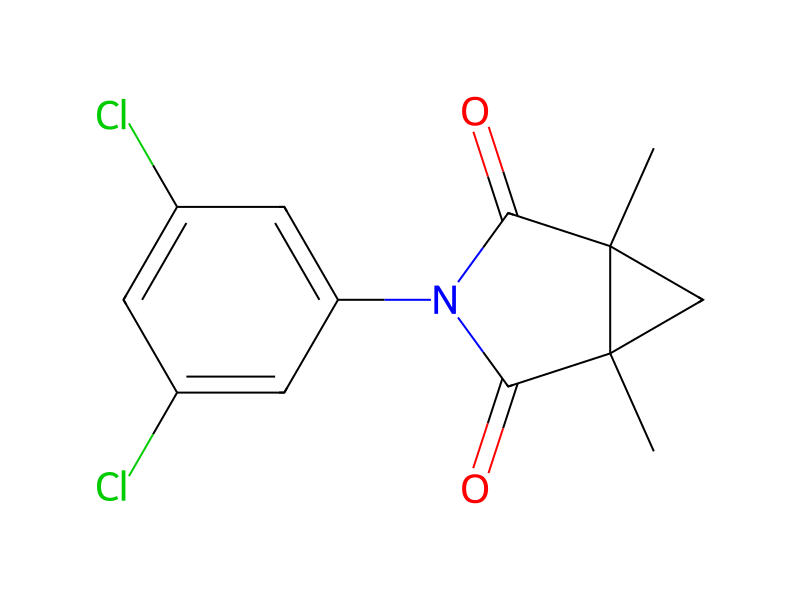
Basic information
- CAS
32809-16-8- Standard SMILES
CC12CC1(C)C(=O)N(c1cc(Cl)cc(Cl)c1)C2=O- InChIKey
QXJKBPAVAHBARF-UHFFFAOYSA-N- Molecular formula
- C13H11Cl2NO2
- Average molar mass
- 284.13 g/mol
- Monoisotopic mass
- 283.016684
Overview
Procymidone can cause cancer according to The Environmental Protection Agency (EPA).
Names & identifiers
- Preferred name
- Procymidone
- IUPAC
- 3-(3,5-dichlorophenyl)-1,5-dimethyl-3-azabicyclo[3.1.0]hexane-2,4-dione
- English name
- Procymidone
- Molecular formula
- C13H11Cl2NO2
- Molecular weight
- 284.14
Names & synonyms
PROCYMIDONE32809-16-8SumilexSumisclexProcymidox3-(3,5-Dichlorophenyl)-1,5-dimethyl-3-azabicyclo[3.1.0]hexane-2,4-dioneDicyclidineDTXSID9033923SialexProcymidorKenolexProcilex
Show more names
ISOBSIPROCYMIDONBismuth Sulfite Indicators7131PROMIX
SalithiexDTXCID7013923S 71313-Azabicyclo(3.1.0)hexane-2,4-dione, 3-(3,5-dichlorophenyl)-1,5-dimethyl-3-Azabicyclo[3.1.0]hexane-2,4-dione, 3-(3,5-dichlorophenyl)-1,5-dimethyl-S-71313-(3,5-Dichlorophenyl)-1,5-dimethyl-3-azabicyclo(3.1.0)hexane-2,4-dioneCHEBI:8450
Database identifiers
- CAS
32809-16-8- PubChem CID
- 36242
- DTXSID
DTXSID9033923- ChEMBL
CHEMBL513678- EC Number
- 251-233-1
- Nikkaji
- J1.886D
Properties
Computed structural properties
- XLogP
- 3
- Topological polar surface area
- 37.4 Ų
- Hydrogen bond donors
- 0
- Hydrogen bond acceptors
- 2
- Rotatable bonds
- 1
- Heavy atoms
- 18
- Formal charge
- 0
- Complexity
- 405
Experimental & physicochemical properties
SpringerMaterials PropertiesFusion temperature
Pesticides
Fungicides
Active substance -> EU Pesticides database: Not approved
Fungicides
Pesticide (Procymidone) -> USDA PDB
LogP3.14
Endocrine DisruptorsPotential endocrine disrupting compound
Ionization Efficiency
Positive
1.79
2.7
Agilent XCT
Electrospray ionization
formic acid (5.3nM)
Collision Cross Section
157.1 Ų [M-H]- [CCS Type: DT; Buffer gas: N2; Ionization: ESI-; Dataset: TOXCAST; Source Identifier: DTXSID9033923]
163.37 Ų [M+H]+
159.63 Ų [M+H]+ [CCS Type: TW; Buffer gas: N2; Ionization: GC-APCI+]
Physicochemical properties
- Melting point
- 166 · 166-167°C
Safety & regulation
Safety information is for reference only and does not replace the supplier’s Safety Data Sheet (SDS), applicable regulations, or professional assessment.
GHS classification
GHS Classification
This chemical does not meet GHS hazard criteria for 32.6% (14 of 43) of reports.
Warning
H332 (65.1%): Harmful if inhaled [Warning Acute toxicity, inhalation]
P261, P271, P273, P304+P340, P317, and P501 (click each P-code to see the statement)
Aggregated GHS information provided per 43 reports by companies from 3 notifications to the ECHA C&L Inventory. Each notification may be associated with multiple companies.
Danger
Hazard information
Regulatory Information
Hazard Traits - Carcinogenicity
Regulation (EC) No 1107/2009 (amended)
Procymidone is listed in the dataset of EPA Human Health Benchmarks for Pesticides under the Safe Drinking Water Act (40 eCFR 141)
2006/132/EC
Procymidone: Does not have an individual approval but may be used under an appropriate group standard
Other Safety InformationIMAP assessments - 3-Azabicyclo[3.1.0]hexane-2,4-dione, 3-(3,5-dichlorophenyl)-1,5-dimethyl-: Environment tier I assessment
Hazard Classes and Categories
Acute Tox. 4 (65.1%)
Carcinogenicity - Category 2
Toxicology
RAIS Toxicity Values
0.035
OPP
0.01339
OPP
EPA Human Health Benchmarks for Pesticides
Procymidone
Chemistry & industry
Pharmacology
MeSH Pharmacological ClassificationChemicals that kill or inhibit the growth of fungi in agricultural applications, on wood, plastics, or other materials, in swimming pools, etc.
Uses & manufacturing
Use ClassificationFungicides
Applications
DescriptionProcymidone is a moderately systemic fungicide. It is used in horticulature as a seed-dressing, pre-harvest spray or post-harvest dip for the control of various fungal diseases, such as grey mold, neck rot, brown rot, blossom blight, and twig wilt. It is applied to vegetables including onions, fruits (including peaches, plums, grapes, stone fruit, strawberries, and cherries), and ornamentals.
UsesSystemic agricultural fungicide.
UsesProcymidone is a systemic fungcide with both protective and curative activities used to control plant diseases such as fruit rots, grey mould on top fruits, vines and vegetables, and Sclerotinia rot of kidney beans and vegetable crops.
Upstream & downstream products
Upstream raw materials
Related reactions
0 records
No related reactions yet