
HRID 1928As reactant
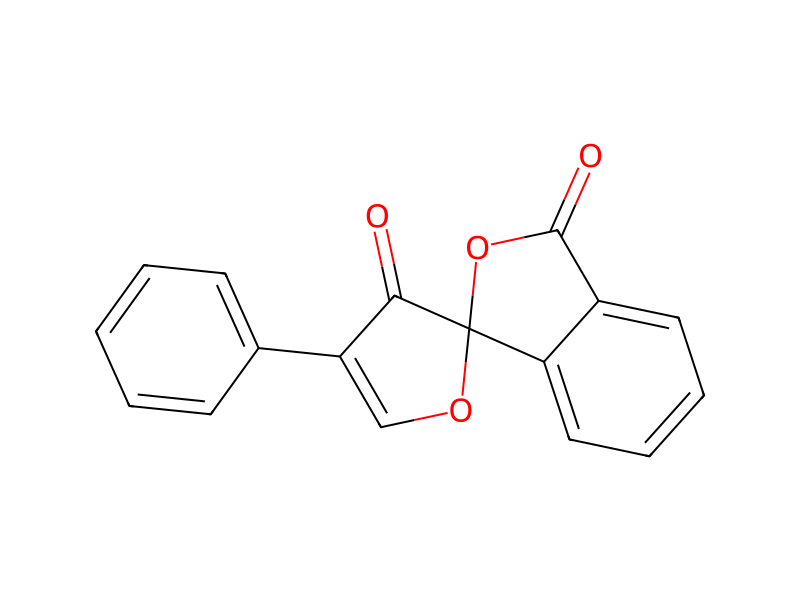
38183-12-9O=C1OC2(OC=C(c3ccccc3)C2=O)c2ccccc21ZFKJVJIDPQDDFY-UHFFFAOYSA-NA nonfluorescent reagent for the detection of primary amines, peptides and proteins. The reaction products are highly fluorescent.
38183-12-9DTXSID50872017Safety information is for reference only and does not replace the supplier’s Safety Data Sheet (SDS), applicable regulations, or professional assessment.
Warning
H319 (100%): Causes serious eye irritation [Warning Serious eye damage/eye irritation]
P261, P264+P265, P271, P280, P304+P340, P305+P351+P338, P319, P337+P317, P403+P233, P405, and P501 (click each P-code to see the statement)
The GHS information provided by 1 company from 1 notification to the ECHA C&L Inventory.
Substances used for the detection, identification, analysis, etc. of chemical, biological, or pathologic processes or conditions. Indicators are substances that change in physical appearance, e.g., color, at or approaching the endpoint of a chemical titration, e.g., on the passage between acidity and alkalinity. Reagents are substances used for the detection or determination of another substance by chemical or microscopical means, especially analysis. Types of reagents are precipitants, solvents, oxidizers, reducers, fluxes, and colorimetric reagents. (From Grant & Hackh's Chemical Dictionary, 5th ed, p301, p499)
UsesFor fluorescent detection of amino acids, peptides and proteins.Fluorescamine plays an important role as a reagent for the detection of amines, peptides and proteins. It is also used as a substrate for measuring protease activity. It is utilized in the detection and quantitation of residual aminopenicillins and sulfonamides in honey by HPLC. It finds application in the determination of lisinopril in human plasma and urine.
UsesFluorescamine is a non-fluorescent reagent that reacts readily under mild conditions with primary amines in amino acids and peptides to form stable, highly fluorescent compounds. Reaction takes place under mild conditions. Low background due to hydrolysis.
UsesAnalytical reagent.