HRID 2204014As product
Completing data — refresh the page later to see the latest

324575-10-2CCCC[P+](C)(CCCC)CCCC.O=S(=O)([N-]S(=O)(=O)C(F)(F)F)C(F)(F)FYJPDLBMZLGTDRZ-UHFFFAOYSA-NSafety information is for reference only and does not replace the supplier’s Safety Data Sheet (SDS), applicable regulations, or professional assessment.
This chemical does not meet GHS hazard criteria for 33.3% (1 of 3) of reports.
Danger
H301 (33.3%): Toxic if swallowed [Danger Acute toxicity, oral]
P264, P264+P265, P270, P273, P280, P301+P316, P302+P352, P305+P351+P338, P321, P330, P332+P317, P337+P317, P362+P364, P405, and P501 (click each P-code to see the statement)
Aggregated GHS information provided per 3 reports by companies from 3 notifications to the ECHA C&L Inventory. Each notification may be associated with multiple companies.
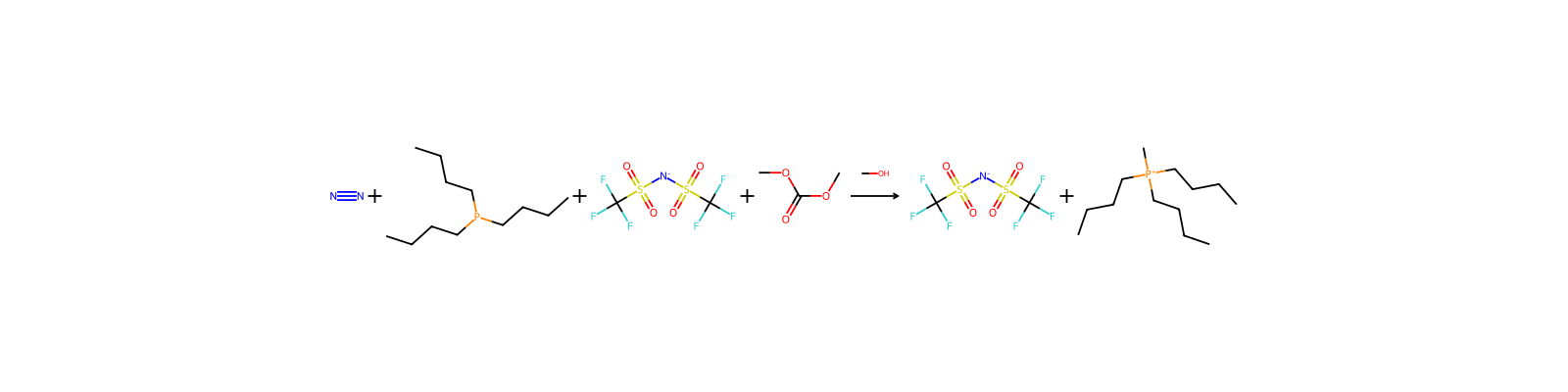
PreparationTributylmethylphosphonium Bis(trifluoromethanesulfonyl)imide was prepared as follows: 500 g (2.48 mol) of tributylphosphine and 800 mL of dimethyl carbonate were placed in a pressure vessel (the air in the pressure vessel was replaced with nitrogen beforehand), and reacted at 145 °C and 1.4–1.5 MPa for 8 hours to obtain a light yellow to brown solution. After cooling, a white solid precipitated out. 418.69 g (1.49 mol) of bis(trifluoromethanesulfonyl)imide in 400 mL of methanol solution was slowly added while stirring at room temperature, generating a large amount of gas. Then, 1.00 g of lithium bis(trifluoromethanesulfonyl)imide was added every 10 minutes until no more white precipitate was formed. The solution was filtered, and the filtrate was distilled under reduced pressure to remove low-boiling-point substances. The solution was dried at 80 °C and under vacuum for 6 hours to obtain 727.94 g (yield of about 59% in the two-step reaction) of colorless to light yellow Tributylmethylphosphonium Bis(trifluoromethanesulfonyl)imide salt.
324575-10-2DTXSID00659835