HomeMCPWorkbenchSkills
HomeWorkbenchNotificationsMe
llms.txt · MCP GuidePrivacy Policy · Terms of Service · Supportv1.8.3
  1. Home
  2. /Compound

Meso-Tartaric acid

HCID 447315
New reaction
Print
Basic informationOverviewNames & identifiersPropertiesSafety & regulationChemistry & industryRelated reactionsCompound notes
Substructure searchFind similar structures

Basic information

CAS
133-37-9
Standard SMILES
O=C(O)[C@@H](O)[C@@H](O)C(=O)O
InChIKey
FEWJPZIEWOKRBE-XIXRPRMCSA-N
Molecular formula
C4H6O6
Average molar mass
150.09 g/mol
Monoisotopic mass
150.01643791

Overview

Meso-tartaric acid is a 2,3-dihydroxybutanedioic acid that has meso configuration. It is a conjugate acid of a meso-tartrate(1-).

Names & identifiers

Preferred name
Meso-Tartaric acid
IUPAC
(2R,3S)-2,3-dihydroxybutanedioic acid
English name
DL-Tartaric acid
Molecular formula
C4H6O6
Molecular weight
150.09

Names & synonyms

mesotartaric acidmeso-tartaric acid147-73-9erythraric acid(2R,3S)-2,3-dihydroxybutanedioic acidi-Tartaric acid(r,s)-tartaric acid(2R,3S)-tartaric acidm-tartaric acid(2R,3S)-2,3-dihydroxysuccinic acidTartaric acid, meso-(R*,S*)-2,3-Dihydroxybutanedioic acid
Show more names
TARTARIC ACIDRACEMIC ACIDdl-Tartaric acid anhydrousDL-TARTRATEDL-TartaricClopidogrel Impurity 45DL-Tartaric acid concentrateButanedioic acid, 2,3-dihydroxy-, (2R,3R)-rel-DL-Tartaric acid 133-37-9 pure 99% food additives Paratartaric acid kf-wang(at)kf-chem.comUvic acid
JQO211TF1ACHEBI:15673DTXSID60883336RefChem:156674GlyTouCan:G12655FYDTXCID501774085G12655FY205-696-1

Database identifiers

CAS
133-37-9、147-73-9、5990-63-6

Properties

Computed structural properties

XLogP
-1.9
Topological polar surface area
115 Ų
Hydrogen bond donors
4
Hydrogen bond acceptors
6
Rotatable bonds
3
Heavy atoms
10
Formal charge
0
Complexity
134

Experimental & physicochemical properties

Chemical ClassesOther Classes -> Organic Acids
SpringerMaterials PropertiesCrystal structure
FragrancesFragrance Ingredient (Tartaric acid (d-, l-, dl-, meso-)) -> IFRA transparency List
Physical DescriptionWhite solid; [ICSC] Colorless or white odorless solid; [JECFA] White odorless crystalline powder; [Acros Organics MSDS]
Collision Cross Section · 2 items

120.87 Ų [M-H]- [CCS Type: DT; Method: stepped-field]

118.4 Ų [M-H]-

Physicochemical properties

Melting point
199 °C · 199 °C(dec.)
Boiling point
191.59 °C · 191.59°C (rough estimate)
alpha
20 · [α]D20 -0.2~+0.2° (c=20, H2O)
Density
1.788 · 1.788
vapor pressure
0.1 hPa · <0.1 hPa (20 °C)

Safety & regulation

Safety information is for reference only and does not replace the supplier’s Safety Data Sheet (SDS), applicable regulations, or professional assessment.

GHS classification

GHS Classification · 6 items

This chemical does not meet GHS hazard criteria for 5.1% (26 of 506) of reports.

Danger

H315 (22.1%): Causes skin irritation [Warning Skin corrosion/irritation]

P261, P264, P264+P265, P271, P280, P302+P352, P304+P340, P305+P351+P338, P305+P354+P338, P317, P319, P321, P332+P317, P337+P317, P362+P364, P403+P233, P405, and P501 (click each P-code to see the statement)

Aggregated GHS information provided per 506 reports by companies from 13 notifications to the ECHA C&L Inventory. Each notification may be associated with multiple companies.

Warning

Hazard information

Regulatory Information · 2 items

Chemical: Butanedioic acid, 2,3-dihydroxy-, (R*,R*)-(.+-.)-

REACH registered substance: (±)-tartaric acid (EC: 205-105-7)

Other Safety InformationIMAP assessments - Butanedioic acid, 2,3-dihydroxy-, (R*,R*)-(.+-.)-: Human health tier I assessment
Hazards SummaryCauses burns; Inhalation of aerosol may cause pulmonary edema; [ICSC] An irritant; [Acros Organics MSDS]
Hazard Classes and Categories · 3 items

Skin Irrit. 2 (22.1%)

Skin Irrit. 2 (50%)

Skin Irrit. 2 (100%)

Toxicology

Adverse EffectsDermatotoxin - Skin burns.

Safety data

Chemistry & industry

Uses & manufacturing

UsesUsed as a synergist for antioxidants, acid, emulsifier, sequestrant, and flavoring agent; [JECFA]
Use Classification · 2 items

Fragrance Ingredients

Flavouring Agent -> FLAVOURING_AGENTFood Additives -> ACID; ANTIOXIDANT_SYNERGIST; EMULSIFIER; SEQUESTRANT; SYNERGIST -> JECFA Functional Classes

General Manufacturing InformationButanedioic acid, 2,3-dihydroxy-, (2R,3S)-rel-: ACTIVE
Applications · 2 items

Occurrenced-Tartaric acid occurs in many fruits or other parts of the plant, free or combined with potassium, calcium or magnesium. It is also reported found in raw, lean fish, white wine, red wine and port wine.

UsesDL-Tartaric acid is used as a synergist for antioxidants, emulsifier, sequestrant and flavoring agent. It is also added with citric acid to prepare effervescent salts, thereby enhancing the taste of oral medications. It is also utilized in pigments, processing aids, ink, toner and colorant products. It acts as a chelating agent in metal and farming industries. Further, it is used as lubricant and grease. It is mixed with sodium bicarbonate and used as a leavening agent in food preparation. In the pharmaceutical industry, it is utilized in the preparation of tartar emetic, which is used in cough syrup as an expectorant.

Preparation methods · 1 item

PreparationThe tartrates used in commerce are obtained as a by-product of wine manufacture and have the L(+) configuration. Produced from argols or wine lees, which are formed in the manufacture of wine by extracting the potassium acid tartrate, transforming this into the calcium salt and then acidifying with dilute sulfuric acid; also by oxidation of d-glucose with nitric acid. The dl-tartaric acid is obtained by boiling the d-tartaric acid with an aqueous solution of NaOH or by oxidation of fumaric acid. The l- and the meso-tartaric acid are also known, but are less important.

Related reactions

12 records
New reaction record
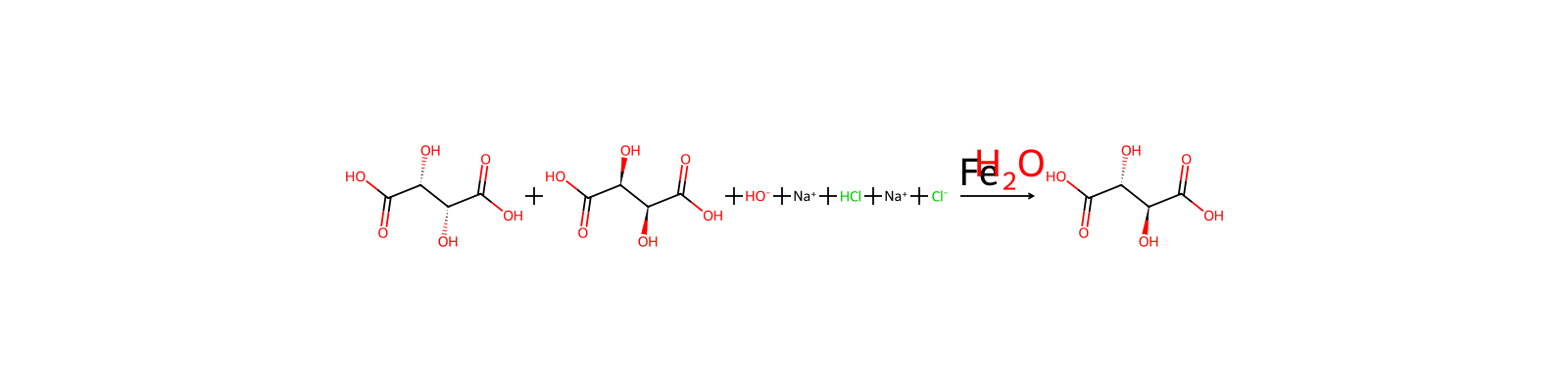
HRID 45757 reaction equation
HRID 45757As reactant
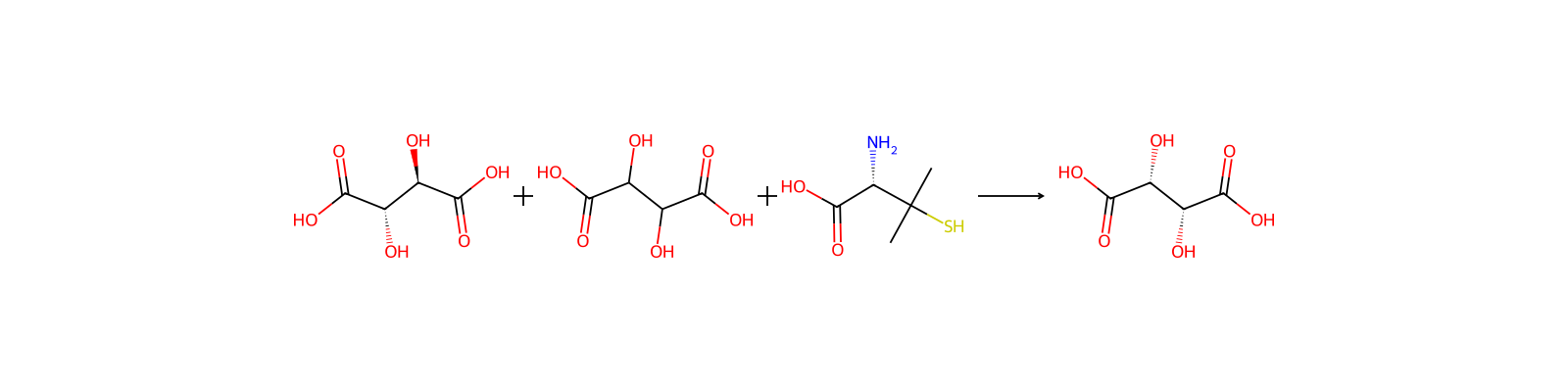
HRID 392005 reaction equation
HRID 392005As product
HRID 410126 reaction equation
HRID 410126As reactant
HRID 410127 reaction equation
HRID 410127As reactant
HRID 870248 reaction equation
HRID 870248As reactant
HRID 1402642 reaction equation
HRID 1402642As reactant
HRID 1402643 reaction equation
HRID 1402643As product
HRID 1470195 reaction equation
HRID 1470195As reactant
PreviousPage 1 of 2

Compound notes

On this pageBasic informationOverviewNames & identifiersPropertiesSafety & regulationChemistry & industryRelated reactionsCompound notes
PubChem CID
447315
DTXSID
DTXSID60883336
ChEMBL
CHEMBL225983
ChEBI
CHEBI:15673
UNII
JQO211TF1A
EC Number
205-105-7、205-696-1、629-249-9
Nikkaji
J134.706C
FEMA
3044 · 3044 | TARTARIC ACID (D-, L-, DL-, MESO-)
refractive index
1.586 · 1.5860 (estimate)
FLAVIS Number
8.018 · 08.018 | Tartaric acid
Flash point
210 °C · 210 °C - closed cup
storage temp.
30 °C · Store below +30°C.
solubility
2 O: · H2O: 0.1 g/mL, clear
pka
3.03 · 3.03, 4.37(at 25℃)
form
powder to crystal
color
White to Almost white
Odor
100 % · at 100.00 %. very mild caramellic
PH
3.19 · 3.19(1 mM solution);2.58(10 mM solution);2.03(100 mM solution);
Odor Type
odorless
biological source
synthetic
Water Solubility
soluble
Merck
14 · 14,9069
JECFA Number
621 · 621
BRN
1725148 · 1725148
Dielectric constant
35.9 · 35.9(-10℃)
Stability
Stable. Incompatible with bases, oxidizing agents, reducing agents, silver.
Major Application
flavors and fragrances
Cosmetics Ingredients Functions
BUFFERINGFRAGRANCE
InChI
1S/C4H6O6/c5-1(3(7)8)2(6)4(9)10/h1-2,5-6H,(H,7,8)(H,9,10)/t1-,2-/m0/s1
InChIKey
FEWJPZIEWOKRBE-UHFFFAOYSA-N
SMILES
O[C@@H]([C@H](O)C(O)=O)C(O)=O
LogP
-1.43 · -1.43
CAS DataBase Reference
133 · 133-37-9(CAS DataBase Reference)
FDA UNII
4 J4Z8788N8 · 4J4Z8788N8
NIST Chemistry Reference
Tartaric acid(133-37-9)
EPA Substance Registry System
2 · Butanedioic acid, 2,3-dihydroxy-, (2R,3R)-rel- (133-37-9)
UNSPSC Code
41116105 · 41116105
NACRES
21 · NB.21
Symbol(GHS)
5 · GHS05
Signal word
Danger
Hazard statements
318 · H318
Precautionary statements
280 · P280-P305+P351+P338+P310
PPE
95 · dust mask type N95 (US), Eyeshields, Gloves
Hazard Codes
Xi
Risk Statements
36 · 36/37/38-41
Safety Statements
26 · 26-37/39-36
WGK Germany
3 · 3
Autoignition Temperature
425 °C · 425 °C
TSCA
TSCA listed
HS Code
2918120000 · 2918120000
Storage Class
11 · 11 - Combustible Solids
Hazard Classifications
1 · Eye Dam. 1
REACH Registrations
Active
PPE
dust mask type N95 (US), Eyeshields, Gloves
wgk
3
tsca
TSCA listed
hs_code
2918120000
risk_code
36/37/38-41
Signal word
Danger
Symbol(GHS)
GHS05
hazard_code
Xi
safety_code
26-37/39-36
Storage Class
11 - Combustible Solids
Hazard statements
H318
REACH Registrations
Active
Hazard Classifications
Eye Dam. 1
Autoignition Temperature
425 °C
Precautionary statements
P280-P305+P351+P338+P310

Upstream & downstream products

Upstream raw materials

CALCIUM TARTRATETungstic acidMaleic acidMaleic anhydrideHydrogen peroxideSodium pyruvate(+/-)-trans-Epoxysuccinic acidD(-)-Tartaric acidcis-Epoxysuccinic acidtrans-2,4-Pentadienoic acidDihydroxyfumaric acidMesotartaric acidSorbic acid

Downstream products

L(+)-Diethyl L-tartratePotassium tartrateDisodium tartrate dihydrateL-Antimony potassium tartrateAmmonium L-tartratePyruvic acidKitasamycin tartratePotassium sodium tartrate(2S,3S)(-)-Dihydroxybutane-1,4-dioic acid diethyl esterPotassium Bitartrate4-Hydroxy-D-(-)-2-phenylglycine
Additional notes · 1 item

DefinitionChEBI: DL-Tartaric acid is a tetraric acid that is butanedioic acid substituted by hydroxy groups at positions 2 and 3. It has a role as a human xenobiotic metabolite and a plant metabolite. It is a conjugate acid of a 3-carboxy-2,3-dihydroxypropanoate.