
HRID 465157As reactant
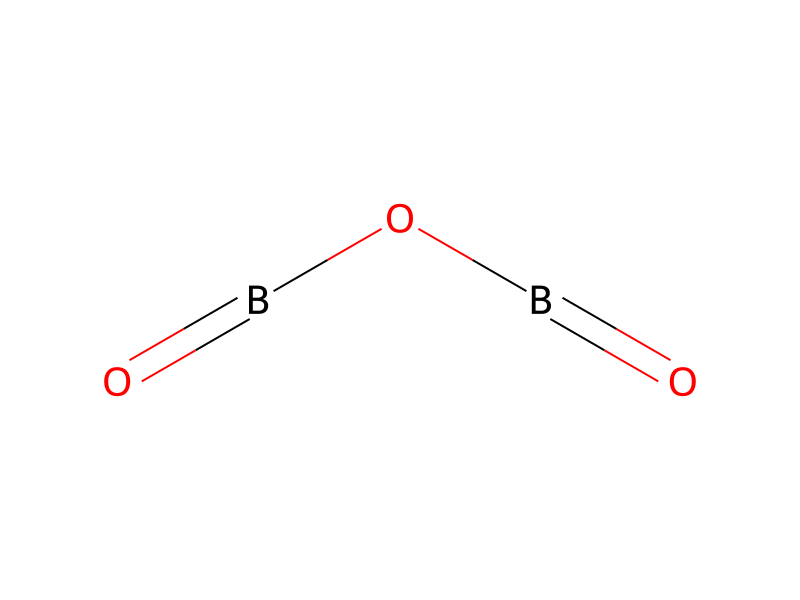
1303-86-2O=BOB=OJKWMSGQKBLHBQQ-UHFFFAOYSA-NDiboron trioxide is a boron oxide with formula B2O3.
1303-86-2DTXSID7034387CHEBI:30163Safety information is for reference only and does not replace the supplier’s Safety Data Sheet (SDS), applicable regulations, or professional assessment.
DescriptionBoron oxide is a noncombustible, colorless,semitransparent lumps or hard, white, odorless crystals,with slightly bitter taste. Molecular weight=69.64; Boilingpoint=about 1860℃; Freezing/Melting point=about450℃. Hazard Identification (based on NFPA-704 MRating System): Health 2, Flammability 0, Reactivity 0.Moderately soluble in water; solubility=(moderate) 3%;slow reaction.
UsesA saturated solution of H3BO3 contains about 2% of the compound at 0 C, increasing to about 39% at 100 C. The compound also is soluble in alcohol. In preparations, solutions of boric acid are nonirritating and slightly astringent with antiseptic properties. Although no longer used as a preservative for meats, boric acid finds extensive use in mouthwashes, nasal sprays, and eye-hygiene formulations. Boric acid (sometimes with borax) is used as a fire-retardant. A commercial preparation of this type (Minalith) consists of diammonium phosphate, ammonium sulfate, sodium tetraborate, and boric acid. The tanning industry uses boric acid in the deliming of skins where calcium borates, soluble in H2O, are formed. As sold commercially, boric acid is B3O3·3H2O, prepared by adding HCl or H2SO4 to a solution of borax.
UsesBoron oxide was used as the intermediate glass layer at a bonding temperature of 450°C. In preparation of fluxes; component of enamels and glass; catalyst in organic reaction. In metallurgy; in analysis of silicates to determine SiO2 and alkalies; in blowpipe analysis.
General DescriptionColorless, semi-transparent glassy lumps or hard white odorless crystals. Mp 450°C; bp: 1860°C. Density: 2.46 g cm-3. Moderately soluble in water. Used as an insecticide; as the starting material for the synthesis of other boron compounds; as a fluxing agent in enamels and glasses; and in mixture with 2-6% boron nitride, as a bonding agent in the hot isostatic pressing of boron nitride ceramics.
PreparationBoric oxide is produced by treating borax with sulfuric acid in a fusion furnace. At temperatures above 750°C, the molten boric acid layer separates out from sodium sulfate. It then is decanted, cooled, and obtained in 96-97% purity. Boric acid above 99% purity may be obtained by fusing granular material. Boric oxide may be prepared by heating boric acid. 2B(OH)3 → B2O3 + 3H2O





DefinitionChEBI: Diboron trioxide is a boron oxide with formula B2O3.