
uspto-grants-1998_03 · 10.6084/m9.figshare.5104873.v1 · US05728848
查看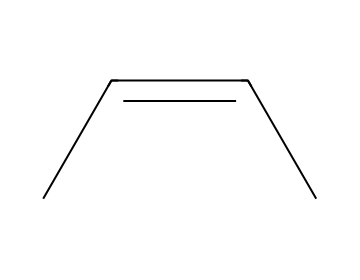
IDENTITY
COMPUTED
PROPERTIES
log Kow = 1.85 (mixture of 70% cis- and 30% trans-2-Butene)
log Kow = 2.33
2.33
Slightly aromatic odor
0.616 g/cu cm at 25 °C
Density (at the boiling point of the liquid): 0.6 kg/l
0.616 @25 °C
0.00782 mPa
Colorless gas
Flammable gas
Colorless gas
Very soluble in ethanol and ether. Soluble in benzene. /cis- and trans-2-Butene/
In water, 658 mg/L at 25 °C
Insoluble in water
Soluble in most organic solvents
Soluble in benzene; very soluble in alcohol, ether
Solubility in water, mg/l at 25 °C: 658 (very slightly soluble)
-11.99 °C (10.42 °F) - closed cup
Flammable gas
3.73 °C at 760 mm Hg /cis-2-Butene/
3.72 °C
3.7 °C
3.7 °C @760 [mm Hg]
When heated to decomposition it emits acrid smoke and irritating vapors.
When heated to decomposition it emits acrid smoke and fumes.
-139.3 °C /cis-2-Butene/
-138.89 °C
-138.7 °C
-138.9 °C
1.9 (Air = 1)
Relative vapor density (air = 1): 1.9
1600 mm Hg at 25 °C /cis-2-Butene/
Vapor pressure: 1410 mm Hg at 21 °C
Vapor pressure = 1360 mm Hg at 20 °C
1,600 mm Hg at 25 °C
Vapor pressure, kPa at 21 °C: 181
1600 [mm Hg] @25 °C
GHS
Danger
H220: Extremely flammable gas [Danger Flammable gases]
P203, P210, P222, P280, P377, P381, and P403 (click each P-code to see the statement)
Danger
HAZARDS
Chemical: 2-Butene
Chemical: 2-Butene, (Z)-
2-Butene, (2Z)- is listed on the EPA's Chemical Data Reporting (CDR) system. Manufacturers and importers of 2-Butene, (2Z)- are required to report information about their production and use of this chemical to the EPA under the Toxic Substances Control Act (TSCA). (40 eCFR Part 711)
Status: Active Update: 10-07-2020 https://echa.europa.eu/registration-dossier/-/registered-dossier/13346
2-Butene: HSNO Approval: HSR005566 Approved with controls
cis-2-Butene: HSNO Approval: HSR005567 Approved with controls
IMAP assessments - 2-Butene: Human health tier I assessment
IMAP assessments - 2-Butene, (Z)-: Human health tier I assessment
Flammable Gas
Excerpt from ERG Guide 115 [Gases - Flammable (Including Refrigerated Liquids)]:;EXTREMELY FLAMMABLE. Will be easily ignited by heat, sparks or flames. Will form explosive mixtures with air. Vapors from liquefied gas are initially heavier than air and spread along ground. CAUTION: Hydrogen (UN1049), Deuterium (UN1957), Hydrogen, refrigerated liquid (UN1966), Methane (UN1971) and Hydrogen and Methane mixture, compressed (UN2034) are lighter than air and will rise. Hydrogen and Deuterium fires are difficult to detect since they burn with an invisible flame. Use an alternate method of detection (thermal camera, broom handle, etc.) Vapors may travel to source of ignition and flash back. Cylinders exposed to fire may vent and release flammable gas through pressure relief devices. Containers may explode when heated. Ruptured cylinders may rocket. CAUTION: When LNG - Liquefied natural gas (UN1972) is released on or near water, product may vaporize explosively. (ERG, 2024)
Extremely flammable. Gas/air mixtures are explosive.
Flammable gas.
Dangerous fire and explosion risk.
Excerpt from ERG Guide 115 [Gases - Flammable (Including Refrigerated Liquids)]:;Vapors may cause dizziness or asphyxiation without warning, especially when in closed or confined areas. Some may be irritating if inhaled at high concentrations. Contact with gas, liquefied gas or cryogenic liquids may cause burns, severe injury and/or frostbite. Fire may produce irritating and/or toxic gases. (ERG, 2024)
Hydrocarbons, Aliphatic Unsaturated
H220; H280
UN Hazard Class: 2.1
Highly Flammable
The unsaturated aliphatic hydrocarbons, such as 2-BUTENE, are generally much more reactive than the alkanes. Strong oxidizers may react vigorously with them. Reducing agents can react exothermically to release gaseous hydrogen. In the presence of various catalysts (such as acids) or initiators, compounds in this class can undergo very exothermic addition polymerization reactions. Aluminum borohydride reacts with alkenes and in the presence of oxygen, combustion is initiated even in the absence of moisture.
Lower flammable limit: 1.7% by volume; Upper flammable limit: 9.0% by volume
SAFETY
Excerpt from ERG Guide 115 [Gases - Flammable (Including Refrigerated Liquids)]:;DO NOT EXTINGUISH A LEAKING GAS FIRE UNLESS LEAK CAN BE STOPPED. CAUTION: Hydrogen (UN1049), Deuterium (UN1957), Hydrogen, refrigerated liquid (UN1966) and Hydrogen and Methane mixture, compressed (UN2034) will burn with an invisible flame. Use an alternate method of detection (thermal camera, broom handle, etc.).;SMALL FIRE: Dry chemical or CO2.;LARGE FIRE: Water spray or fog. If it can be done safely, move undamaged containers away from the area around the fire. CAUTION: For LNG - Liquefied natural gas (UN1972) pool fires, DO NOT USE water. Use dry chemical or high-expansion foam.;FIRE INVOLVING TANKS: Fight fire from maximum distance or use unmanned master stream devices or monitor nozzles. Cool containers with flooding quantities of water until well after fire is out. Do not direct water at source of leak or safety devices; icing may occur. Withdraw immediately in case of rising sound from venting safety devices or discoloration of tank. ALWAYS stay away from tanks in direct contact with flames. For massive fire, use unmanned master stream devices or monitor nozzles; if this is impossible, withdraw from area and let fire burn. (ERG, 2024)
Shut off supply; if not possible and no risk to surroundings, let the fire burn itself out. In other cases extinguish with water spray, dry powder, alcohol-resistant foam. In case of fire: keep cylinder cool by spraying with water. Combat fire from a sheltered position.
Fresh air, rest. Artificial respiration may be needed. Refer for medical attention.
ON FROSTBITE: rinse with plenty of water, do NOT remove clothes. Refer for medical attention .
First rinse with plenty of water for several minutes (remove contact lenses if easily possible), then refer for medical attention.
Excerpt from ERG Guide 115 [Gases - Flammable (Including Refrigerated Liquids)]:;Refer to the "General First Aid" section. Specific First Aid: Clothing frozen to the skin should be thawed before being removed. In case of contact with liquefied gas, only medical personnel should attempt thawing frosted parts. In case of burns, immediately cool affected skin for as long as possible with cold water. Do not remove clothing if adhering to skin. (ERG, 2024)
Fireproof. Store outside or in a separate well-ventilated building. Ventilation along the floor.
Special hazards arising from the substance or mixture: Carbon oxides
Suitable extinguishing media: Use water spray, alcohol-resistant foam, dry chemical or carbon dioxide. Advice for firefighters: Wear self-contained breathing apparatus for firefighting if necessary. Further information: Use water spray to cool unopened containers.
Very dangerous fire hazard when exposed to heat or flame ... To fight fire, stop flow of gas.
Suitable extinguishing media: Use water spray, alcohol-resistant foam, dry chemical or carbon dioxide.
Advice for firefighters: Wear self-contained breathing apparatus for firefighting if necessary.
Keep container tightly closed in a dry and well-ventilated place. Contents under pressure. Storage class (TRGS 510): Gases
Keep container tightly closed in a dry and well-ventilated place. Contents under pressure. Storage class (TRGS 510): Gases
ACCIDENTAL RELEASE MEASURES: Personal precautions, protective equipment and emergency procedures: Avoid breathing vapors, mist or gas. Ensure adequate ventilation. Remove all sources of ignition. Evacuate personnel to safe areas. Beware of vapors accumulating to form explosive concentrations. Vapors can accumulate in low areas. Environmental precautions: Prevent further leakage or spillage if safe to do so. Do not let product enter drains. Methods and materials for containment and cleaning up: Clean up promptly by sweeping or vacuum.
ACCIDENTAL RELEASE MEASURES: Personal precautions, protective equipment and emergency procedures: Avoid breathing vapors, mist or gas. Ensure adequate ventilation. Remove all sources of ignition. Evacuate personnel to safe areas. Beware of vapors accumulating to form explosive concentrations. Vapors can accumulate in low areas. Environmental precautions: Prevent further leakage or spillage if safe to do so. Do not let product enter drains. Methods and materials for containment and cleaning up: Clean up promptly by sweeping or vacuum.
Excerpt from ERG Guide 115 [Gases - Flammable (Including Refrigerated Liquids)]:;ELIMINATE all ignition sources (no smoking, flares, sparks or flames) from immediate area. All equipment used when handling the product must be grounded. Do not touch or walk through spilled material. Stop leak if you can do it without risk. If possible, turn leaking containers so that gas escapes rather than liquid. Use water spray to reduce vapors or divert vapor cloud drift. Avoid allowing water runoff to contact spilled material. Do not direct water at spill or source of leak. CAUTION: For LNG - Liquefied natural gas (UN1972), DO NOT apply water, regular or alcohol-resistant foam directly on spill. Use a high-expansion foam if available to reduce vapors. Prevent spreading of vapors through sewers, ventilation systems and confined areas. Isolate area until gas has dispersed. CAUTION: When in contact with refrigerated/cryogenic liquids, many materials become brittle and are likely to break without warning. (ERG, 2024)
SRP: Recycle any unused portion of the material for its approved use or return it to the manufacturer or supplier. Ultimate disposal of the chemical must consider: the material's impact on air quality; potential migration in air, soil or water; effects on animal, aquatic and plant life; and conformance with environmental and public health regulations. If it is possible or reasonable use an alternative chemical product with less inherent propensity for occupational harm/injury/toxicity or environmental contamination.
Product: Burn in a chemical incinerator equipped with an afterburner and scrubber but exert extra care in igniting as this material is highly flammable. Offer surplus and non-recyclable solutions to a licensed disposal company. Contact a licensed professional waste disposal service to dispose of this material. Contaminated packaging: Dispose of as unused product.
SRP: Recycle any unused portion of the material for its approved use or return it to the manufacturer or supplier. Ultimate disposal of the chemical must consider: the material's impact on air quality; potential migration in air, soil or water; effects on animal, aquatic and plant life; and conformance with environmental and public health regulations. If it is possible or reasonable use an alternative chemical product with less inherent propensity for occupational harm/injury/toxicity or environmental contamination.
Product: Burn in a chemical incinerator equipped with an afterburner and scrubber but exert extra care in igniting as this material is highly flammable. Offer surplus and non-recyclable solutions to a licensed disposal company. Contact a licensed professional waste disposal service to dispose of this material. Contaminated packaging: Dispose of as unused product.
Evacuate danger area! Consult an expert! Personal protection: self-contained breathing apparatus. Remove all ignition sources. Shut off cylinder if possible. Ventilation. Isolate the area until the gas has dispersed. NEVER direct water jet on liquid.
Gloves must be inspected prior to use. Use proper glove removal technique (without touching glove's outer surface) to avoid skin contact with this product. Dispose of contaminated gloves after use in accordance with applicable laws and good laboratory practices. Wash and dry hands.
Avoid inhalation of vapor or mist. Use explosion-proof equipment. Keep away from sources of ignition - No smoking. Take measures to prevent the build up of electrostatic charge.
ACCIDENTAL RELEASE MEASURES: Personal precautions, protective equipment and emergency procedures: Avoid breathing vapors, mist or gas. Ensure adequate ventilation. Remove all sources of ignition. Evacuate personnel to safe areas. Beware of vapors accumulating to form explosive concentrations. Vapors can accumulate in low areas. Environmental precautions: Prevent further leakage or spillage if safe to do so. Do not let product enter drains.
Handle in accordance with good industrial hygiene and safety practice. Wash hands before breaks and at the end of workday.
SRP: The scientific literature for the use of contact lenses by industrial workers is inconsistent. The benefits or detrimental effects of wearing contact lenses depend not only upon the substance, but also on factors including the form of the substance, characteristics and duration of the exposure, the uses of other eye protection equipment, and the hygiene of the lenses. However, there may be individual substances whose irritating or corrosive properties are such that the wearing of contact lenses would be harmful to the eye. In those specific cases, contact lenses should not be worn. In any event, the usual eye protection equipment should be worn even when contact lenses are in place.
ACCIDENTAL RELEASE MEASURES: Personal precautions, protective equipment and emergency procedures: Avoid breathing vapors, mist or gas. Ensure adequate ventilation. Remove all sources of ignition. Evacuate personnel to safe areas. Beware of vapors accumulating to form explosive concentrations. Vapors can accumulate in low areas. Environmental precautions: Prevent further leakage or spillage if safe to do so. Do not let product enter drains.
TOXICITY
2-Butene has been detected in exhaled air. In the majority of subjects, concentrations of the cis- form were greater than those for the trans- isomer(1). Of 18 personal air samples from attendants at a high volume gasoline service station in PA, 1983, 2-butene was detected but not quantified in 17 samples and measured in one sample at a concentration of 0.1 ppm(2). Workers in the petroleum field are likely to be exposed to 2-butene by inhalation of gasoline fumes during the production, transport or dispensing of motor fuels; personal air samples taken for workers in the petroleum industry indicated that 14 of 56 outside operators, 48 of 49 transport drivers and 48 of 49 service attendants were exposed to 2-butene(3).
2-Butene has been detected in exhaled air. In the majority of subjects, concentrations of the cis form were greater than those for the trans isomer.
TERRESTRIAL FATE: Based on a classification scheme(1), an estimated Koc value of 40(SRC), determined from a log Kow of 1.85(2) and a regression-derived equation(3), indicates that 2-butene is expected to have very high mobility in soil(SRC). Volatilization of 2-butene from moist soil surfaces is expected to be an important fate process(SRC) given an estimated Henry's Law constant of 1.54X10⁻¹ atm-cu m/mole(SRC), using a fragment constant estimation method(4). 2-Butene is expected to volatilize from dry soil surfaces(SRC) based upon a vapor pressure of 1600 mm Hg at 25 °C(5). Biodegradation data in soil were not available(SRC, 2018). However, based on pure culture studies resulting in oxidation of cis- and trans-2-butene and subsequent accumulation of the metabolite(6), primary biodegradation may be an important environmental fate process under certain conditions in soil(SRC).
AQUATIC FATE: Based on a classification scheme(1), an estimated Koc value of 40(SRC), determined from a log Kow of 1.85(2) and a regression-derived equation(3), indicates that 2-butene is not expected to adsorb to suspended solids and sediment(SRC). Volatilization from water surfaces is expected(4) based upon an estimated Henry's Law constant of 1.54X10⁻¹ atm-cu m/mole(SRC), developed using a fragment constant estimation method(5). Using this Henry's Law constant and an estimation method(4), volatilization half-lives for a model river and model lake are 2 hours and 3 days, respectively(SRC). According to a classification scheme(6), an estimated BCF of 8(SRC), from its log Kow(2) and a regression-derived equation(3), suggests the potential for bioconcentration in aquatic organisms is low(SRC). Biodegradation data in water were not available(SRC, 2018). However, based on pure culture studies resulting in oxidation of cis- and trans-2-butene and subsequent accumulation of the metabolite(7), primary biodegradation may be an important environmental fate process under certain conditions in water(SRC).
ATMOSPHERIC FATE: According to a model of gas/particle partitioning of semivolatile organic compounds in the atmosphere(1), 2-butene, which has a vapor pressure of 1600 mm Hg at 25 °C(2), is expected to exist solely as a gas in the ambient atmosphere. Gas-phase 2-butene is degraded in the atmosphere by reaction with photochemically-produced hydroxyl radicals(SRC); the half-life for this reaction in air is estimated to be 6.4 hours(SRC), calculated from its rate constant of 6.00X10⁻¹¹ cu cm/molecule-sec at 25 °C(3). The rate constant for the vapor-phase reaction of 2-butene with ozone has been measured in the range of 5.98X10⁻¹⁷ to 4.32X10⁻¹⁶ cu cm/molecule-sec at 25 °C(4). This corresponds to an atmospheric half-life of about 0.64 to 4.6 hours at an atmospheric concentration of 7X10+11 ozone molecules per cu cm(4). The rate constant for the gas-phase nighttime reaction of 2-butene with nitrate radicals has been measured in the range of 1.89X10⁻¹³ to 2.11X10⁻¹³ cu cm/molecule-sec at 25 °C(5). This corresponds to an atmospheric half-life of about 0.5 hours at an atmospheric concentration of 2X10+9 nitrate radicals per cu cm(5). 2-Butene does not contain chromophores that absorb at wavelengths >290 nm(6) and, therefore, is not expected to be susceptible to direct photolysis by sunlight(SRC).
TERRESTRIAL FATE: Based on a classification scheme(1), an estimated Koc value of 100(SRC), determined from a log Kow of 2.33(2) and a regression-derived equation(3), indicates that cis-2-butene is expected to have high mobility in soil(SRC). Volatilization of cis-2-butene from moist soil surfaces is expected to be an important fate process(SRC) given a Henry's Law constant of 0.231 atm-cu m/mole(4). cis-2-butene is expected to volatilize from dry soil surfaces(SRC) based upon a vapor pressure of 1600 mm Hg at 25 °C(5). Biodegradation data in soil were not available(SRC, 2018). However, based on pure culture studies resulting in oxidation of cis-2-butene and subsequent accumulation of the metabolite(6), primary biodegradation may be an important environmental fate process under certain conditions in soil(SRC).
AQUATIC FATE: Based on a classification scheme(1), an estimated Koc value of 100(SRC), determined from a log Kow of 2.33(2) and a regression-derived equation(3), indicates that cis-2-butene is not expected to adsorb to suspended solids and sediment(SRC). Volatilization from water surfaces is expected(4) based upon a Henry's Law constant of 0.231 atm-cu m/mole(5). Using this Henry's Law constant and an estimation method(4), volatilization half-lives for a model river and model lake are 2 hours and 3 days, respectively(SRC). According to a classification scheme(6), an estimated BCF of 16(SRC), from its log Kow(2) and a regression-derived equation(3), suggests the potential for bioconcentration in aquatic organisms is low(SRC). Biodegradation data in water were not available(SRC, 2018). However, based on pure culture studies resulting in oxidation of cis-2-butene and subsequent accumulation of the metabolite(7), primary biodegradation may be an important environmental fate process under certain conditions in water(SRC).
ATMOSPHERIC FATE: According to a model of gas/particle partitioning of semivolatile organic compounds in the atmosphere(1), cis-2-butene, which has a vapor pressure of 1600 mm Hg at 25 °C(2), is expected to exist solely as a gas in the ambient atmosphere. Gas-phase cis-2-butene is degraded in the atmosphere by reaction with photochemically-produced hydroxyl radicals, ozone molecules, and nitrate radicals(SRC). The half-life for the reaction with hydroxyl radicals is estimated to be 7 hours(SRC) calculated from its rate constant of 5.6X10⁻¹¹ cu cm/molecule-sec at 25 °C(3). The half-life for the reaction with ozone molecules is estimated to be 2 hours(SRC) calculated from its rate constant of 1.3X10⁻¹⁶ cu cm/molecule-sec at 25 °C(4). The half-life for the nighttime reaction with nitrate radicals is estimated to be 0.5 hours(SRC) calculated from its rate constant of 1.89X10⁻¹³ cu cm/molecule-sec at 25 °C(5). cis-2-Butene does not contain chromophores that absorb at wavelengths >290 nm(6) and, therefore, is not expected to be susceptible to direct photolysis by sunlight(SRC).
Exposure mainly occurs via inhalation.
IDENTIFICATION AND USE: 2-Butene is a colorless gas. It is used as a solvent and a cross-linking agent. It is also used to polymerize gasoline, and for butadiene synthesis, as well as the synthesis of derivatives. HUMAN STUDIES: 2-Butene is an asphyxiant gas. Rapid evaporation of liquid 2-butene may cause frostbite. it may cause effects on the CNS. Exposure may result in unconsciousness. ANIMAL STUDIES: Rats were exposed for 4 hr to 2-butene at a nominal concentration of 10,000 ppm (22,948 mg/cu m). No clinical signs were seen and normal growth occurred over the 14 d observation period. 2-Butene is a cardiac sensitizer in dogs. In developmental studies in rats, there were no effects on mating behavior, fertility and gestation indices, the number of implantation sites and corpora lutea per dam, numbers of pups delivered, viability of pups at and after birth and the pup sex ratio when compared to the control group. There were no treatment-related effects on the development of pups. Male and female rats were exposed to 2-butene at target concentrations of 2500 or 5000 ppm (5737 or 11,474 mg/cu m) for two weeks prior to breeding, during breeding (1 week) and until day 19 of gestation (39-46 days of exposure). No significant systemic toxicity occurred in either sex, or in pregnant female rats. 2-Butene is a CNS depressant. About 13 to 13.5% (300 or 400 mg/L) causes deep CNS depression, and in mice about 19% (120 to 420 mg/L) is fatal. It is a mild mucous membrane irritant. A chromosome aberration study was conducted with 2-butene in rat lymphocytes in vito. No significant increases were seen in the frequency of chromosome aberrations either in the presence or absence of a metabolic activation. 2-Butene was not mutagenic to S. typhimurium TA98, TA100, TA1535, TA 1537 and E.coli WP2uvrA, with or without metabolic activation.
IDENTIFICATION AND USE: cis-2-Butene is a colorless gas. It is used in solvents, as a cross-linking agent, in polymerization of gasoline, in butadiene synthesis, and in synthesis of C4 and C5 derivatives. HUMAN STUDIES: cis-2-Butene is a simple asphyxiant. Rapid evaporation of liquid 2-butene (in its cis or trans form, or as a mixture of both) may cause frostbite. The substance may cause effects on the central nervous system. Exposure may result in unconsciousness. ANIMAL STUDIES: There are no data available.
Intake: 11.5 mg/m cu: EHE max (maximum estimated human exposure) = 5 ppm or 11.5 mg/m cu equivalent to the peak concentration at working place(1). <0.23 mg/m cu TWA (time-weighted average) at working place or EHE mean <0.1ppm, (calculated)(1).
Dizziness. Unconsciousness. Suffocation.
ON CONTACT WITH LIQUID: FROSTBITE.
See Skin.
2-Butene was listed as a compound present in both gasoline and the exhaust from motor vehicles(1). The estimated annual emissions of 2-butene from gasoline powered vehicles in the UK in 1983 was 5.58 kilo tons(1). The average concentration of 2-butene in the exhaust of 67 Australian gasoline vehicles was 1.1% w/w of the total non methane hydrocarbons(2). 2-Butene was identified as a stack emission from a waste incinerator(3).
2-Butene was identified, not quantified, in automobile emissions in Canada(1) and 4-stroke lawn mowers(2). The emission rate of 2-butene from typical automobiles was reported as 27-37 mg per liter of gasoline(3). The emission rate of 2-butene from ferries with diesel engines was reported as 0.1-0.3 mg/kWh(4). Car exhaust in London, England contained 2-butene at an avg concentration of 648 and 822 ppb(5). 2-Butene was detected at concentrations of 1.12-5.7 ug/cu m in the effluent of a Swedish cat-cracking refinery(6).
cis-2-Butene was identified, not quantified, in automobile emissions in Canada(1) and 4-stroke lawn mowers(2). The emission rate of cis-2-butene from typical automobiles was reported as 27 mg per liter of gasoline(3). The emission rate of cis-2-butene from ferries with diesel engines was reported as 0.2 and 0.1 mg/kWh(4). Car exhaust in London, England contained cis-2-butene at an avg concentration of 648 ppb(5). cis-2-Butene was identified, not quantified, in exhaust from a moped and lawnmower(6). cis-2-Butene was detected at concentrations of 1.12-5.7 ug/cu m in the effluent of a Swedish cat-cracking refinery(7).
The Koc of 2-butene is estimated as 40(SRC), using a log Kow of 1.85(1) and a regression-derived equation(2). According to a classification scheme(3), this estimated Koc value suggests that 2-butene is expected to have very high mobility in soil.
The Koc of cis-2-butene is estimated as 100(SRC), using a log Kow of 2.33(1) and a regression-derived equation(2). According to a classification scheme(3), this estimated Koc value suggests that cis-2-butene is expected to have high mobility in soil.
2-Butene is an anthropogenic compound and it is not known to exist in nature(1).
cis-2-Butene is an anthropogenic compound and is not known to occur naturally(1).
URBAN/SUBURBAN: 2-Butene was detected, but not quantified, in the air of Elizabeth and Pine Barrens, NJ, 1979(1). The concentration of 2-butene taken from the top of an 82 story building at noon in New York City, 1977, ranged from 5.0-6.7 ug/cu m(2). The average concentration of 2-butene and isobutene, measured in 780 samples from Houston, TX, Summer 1977, was 4 ppb(3). The concentration of 2-butene in downtown Houston obtained during two separate day-long sampling expeditions in July of 1973 ranged from not detected to 0.012 ppm and from not detected to 0.02 ppm in three sampling expeditions in Pasadena, TX(4). The concentration of 2-butene in two rooftop samples taken in Riverside, CA, 1965-66 was 10.5 and 2.0 ppb, respectively(5). 2-Butene was qualitatively identified in roadway air samples(6). 2-Butene, as a mixture with 1,3-butadiene, was determined in the air of Jones State Forest, TX, in 1978(7).
URBAN/SUBURBAN: The estimated annual mean concentration of 2-butene in London, England is 3 ug/cu m(1). The observed background level of 2-butene in Sidney, Australia, was 5.1 ug/cu m(1). The mean concentration of 2-butene in urban, rural, and polluted rural locations in NW England, 1983, was 27.6, <2.1 and 5.6 ppb, respectively(2). The average concentration of 2-butene in Sidney, Australia, 1979-1980, was 2.1 ppb(3).
URBAN/SUBURBAN: 2-Butene was reported in urban air in Porto Alegre, Brazil in 1996 at a mean concentration of 2.3 and 3.2 mg/cu m(1). 2-Butene was detected in 1993 at an avg concentration of 0.75 ug/cu m (not detected-3.0 ug/cu m) in Los Angeles, CA(2). 2-Butene was detected in 53% of the air samples obtained in Atlanta, GA at concentrations of 0.1-0.15 ppb(3). Mean concentrations of 3-13.9 ppb 2-butene were reported for various sites around Vienna, Austria(4).
RURAL/REMOTE: 2-Butene was detected in the atmosphere of the Borden Forest, Canada in 1993 at concentrations of 0.02-0.1 ppb during daytime hours and 0.01-0.09 ppb during nighttime hours(1). 2-Butene was detected in Egbert, Canada at a concentration of 0.166-0.038 ppb(2). 2-Butene (trans) was detected in the Kejimkujik National Park, Nova Scotia (not detected-0.05 ppb), Lac la Flamme, Canada (not detected-0.03 ppb), Egbert, Canada (not detected-0.02 ppb) and Saturna Island, Canada (not detected-0.03 ppb)(3). 2-Butene was qualitatively detected in the Eggegebirge Forest, West Germany, 1988(4).
SOURCE DOMINATED: 2-Butene was reported at average concentrations of 0.334-0.408 ppb along roadsides and at 0.149-0.159 ppb at airports in Atlanta, GA(1). The concentration of 2-butene at an unspecified street in London, England was reported as 7.1-9 ppb(2). 2-Butene was reported in the Caldecott Tunnel, CA at mean concentration of 6.6-11.2 mg/l in August of 1994 when low oxygenated fuels (0.3%) were being employed in the San Francisco area(3). 2-Butene was reported in the Caldecott Tunnel, CA at a mean concentration of 13.6-15 mg/l in October of 1994 when high oxygenated fuels (2%) were being employed in the San Francisco area(3). At 16 locations during the summer, monsoon, and winter season 2004 in the Thane Belapur Industrial Area in Mumbai, 2-butene was identified but not quantified, as a volatile component in source air samples collected in the vicinity of processing units and storage plants of industrial units in the sampling area(4).
URBAN/SUBURBAN: cis-2-Butene was reported in urban air in Porto Alegre, Brazil in 1996 at a mean concentration of 2.3 mg/cu m(1). cis-2-Butene was reported in 1993 at an average concentration of 0.75 ug/cu m (0.0-3.0 ug/cu m) in Los Angeles, CA(2). cis-2-Butene was detected in 51% of the air samples obtained in Atlanta, GA at concentrations of 0.1-0.15 ppb(3). Mean concentrations of 3-4 ppb cis-2-butene were reported for various sites around Vienna, Austria(4). cis-2-Butene was detected at estimated concentrations ranging from 0.0-1.6 ppbv (average = 0.4 ppbv) in air samples colleted over a 1-hour period in Taipei, Twain on January 29, 1997(5).
/SIGNS AND SYMPTOMS/ Rapid evaporation of the 2-butene (in its cis or trans form, or a mixture of both) may cause frostbite. The substance may cause effects on the CNS. Exposure may result in unconsciousness.
/SIGNS AND SYMPTOMS/ A simple asphyxiant.
/SIGNS AND SYMPTOMS/ Rapid evaporation of the 2-butene (in its cis or trans form, or as a mixture of both) may cause frostbite. The substance may cause effects on the central nervous system. Exposure may result in unconsciousness.
2-Butene's production and use in the production of gasolines, butadiene and other chemicals(1) may result in its release to the environment through various waste streams(SRC). 2-Butene is an isomeric mixture of trans-and cis-2-butene recovered from refining gases or produced by petroleum cracking(2). 2-Butene occurs in coal gas and has been detected in diesel exhaust(2). 2-Butene has been identified as a constituent of tobacco smoke(3).
cis-2-Butene's production and use as a solvent, cross-linking agent, in the polymerization of gasoline, in butadiene synthesis, and in the synthesis of C4 and C5 derivatives(1) may result in its release to the environment through various waste streams(SRC). cis-2-Butene occurs in coal gas(2). cis-2-Butene is found in gasoline at 0.09-0.35 vol%, in evaporate from gasoline fuel tank at 4.20 vol%, and evaporate from carburetor at 0.2-0.3 vol%(3). cis-2-Butene has been identified as a constituent of tobacco smoke(4).
REGULATORY
Chemical: 2-Butene
Chemical: 2-Butene, (Z)-
2-Butene, (2Z)- is listed on the EPA's Chemical Data Reporting (CDR) system. Manufacturers and importers of 2-Butene, (2Z)- are required to report information about their production and use of this chemical to the EPA under the Toxic Substances Control Act (TSCA). (40 eCFR Part 711)
Status: Active Update: 10-07-2020 https://echa.europa.eu/registration-dossier/-/registered-dossier/13346
2-Butene: HSNO Approval: HSR005566 Approved with controls
cis-2-Butene: HSNO Approval: HSR005567 Approved with controls
2-Butene
1
10000
Flammable chemical that can be released at a facility.
2-Butene-cis
1
PHARMACOLOGY
In rat liver cytosol meso-2,3-dibromobutane was converted, almost exclusively, into trans-2-butene while racemic-2,3-dibromobutane gave rise to cis-2-butene.
2-Butene has been detected in exhaled air. In the majority of subjects, concentrations of the cis form were greater than those for the trans isomer.
2-Butene has been detected in exhaled air. In the majority of subjects, concentrations of the cis form were greater than those for the trans isomer.
USES
INT FOR BUTADIENE, HEPTENES, SEC-BUTYL ALC, BUTYLENE OXIDE; PRODN OF HIGH-DENSITY POLYETHYLENE & POLYMER GASOLINES
For cis-2-butene (USEPA/OPP Pesticide Code: 606666) there are 0 labels match. /SRP: Not registered for current use in the U.S., but approved pesticide uses may change periodically and so federal, state and local authorities must be consulted for currently approved uses./
Solvent, cross-linking agent, polymerization of gasoline, butadiene synthesis; synthesis of C4 and C5 derivatives.
CHEM INT FOR GASOLINE ALKYLATE & POLYGAS (BUTYLENES MIXT)
REFINERY FUEL (MIXT OF BUTYLENES)
For more Uses (Complete) data for cis-2-Butene (6 total), please visit the HSDB record page.
2023: 25,000,000 - <40,000,000 lb;2022: 10,000,000 - <25,000,000 lb;2021: 10,000,000 - <50,000,000 lb;2020: 10,000,000 - <50,000,000 lb
(1984) 3.56X10+11 g /1-Butene and 2-Butene mixed/
Non-confidential 2016 Chemical Data Reporting (CDR) information on the production and use of chemicals manufactured or imported into the United States. Chemical: 2-Butene:;Table: National Aggregate Production Volume (pounds) [Table#675]
(1982) 3X10+11 G (EST; IN MIXT OF BUTYLENES)
Non-confidential 2016 Chemical Data Reporting (CDR) information on the production and use of chemicals manufactured or imported into the United States. Chemical: cis-2-Butene:;Table: National Aggregate Production Volume (pounds) [Table#5520]
Not Known or Reasonably Ascertainable;Intermediate;Fuel
Intermediate;Fuel
There are two important sources for the commercial production of butylenes: catalytic or thermal cracking, and steam cracking. In these two processes, butylenes are always produced as by-products. /Butylenes/
1-Butene and isobutylene cannot be economically separated into pure components by conventional distillation because they are close boiling isomers. 2-Butene can be separated from the other two isomers by simple distillation. There are four types of separation methods available: (1) selective removal of isobutylene by polymerization and separation of 1-butene; (2) use of addition reactions with alcohol, acids, or water to selectively produce pure isobutylene and 1-butene; (3) selective extraction of isobutylene with a liquid solvent, usually an acid; and (4) physical separation of isobutylene from 1-butene by absorbents.
Disproportionation or the metathesis reaction offers an opportunity to convert surplus olefins to other desirable olefins. Phillips Petroleum and Institut Francais du Petrole have pioneered this technology for the dimerization of light olefins. The original metathesis reaction of Phillips Petroleum was intended to convert propylene to 2-butene and ethylene. The reverse reaction that converts 2-butene in the presence of excess ethylene to propylene has also been demonstrated. In this process, ethylene is first dimerized to 2-butene followed by metathesis to yield propylene. Since this is a two-stage process, 2-butene can be produced from the first stage, if needed. In the dimerization step, about 95% purity of 2-butene is achieved at 90% ethylene conversion.
... /A/ process has emerged that consists of catalytically hydroisomerizing 1-butene to 2-butenes. In this process, trace quantities of butadienes are also hydrogenated to yield feedstocks rich in isobutylene which can then be easily separated from 2-butenes by simple distillation. /2-Butenes/
For more Methods of Manufacturing (Complete) data for 2-Butene (6 total), please visit the HSDB record page.
There are two important sources for the commercial production of butylenes: catalytic or thermal cracking, and steam cracking. In these two processes, butylenes are always produced as by-products. /Butylenes/
Grades: Technical 95%, CP 99%, Research 99.8%
Wholesale and Retail Trade;Petroleum Refineries;Petrochemical Manufacturing
2-Butene: ACTIVE
2-Butene, (2Z)-: ACTIVE
Butylenes are C4H8 mono-olefin isomers: 1-butene, cis-2-butene, trans-2-butene, and isobutylene (2-methylpropene). These isomers are usually coproduced as a mixture and are commonly referred to as the C4 fraction. These C4 fractions are usually obtained as by-products from petroleum refinery and petrochemical complexes that crack petroleum fractions and natural gas liquids. Since the C4 fractions almost always contain butanes, it is also known as the B-B stream. The linear isomers are referred to as butenes.
Butenes are unsaturated olefinic hydrocarbons, C4H8, Mr 56.1080, existing in four isomers: 1) 1-butene; 2) cis-2-butene; 3) trans-2-butene; and 4) 2-methylpropene (isobutene). In everyday use, the IUPAC nomenclature is less common than the use of older designations. Especially the branched-chain isomer 4 is commonly referred to as "isobutene" or "isobutylene" instead of the IUPAC name "2-methylpropene". The three linear chain isomers 1, 2, and 3 are usually referred to as "n-butenes" and often occur as mixtures during chemical processing. The old name "butylenes" is still in use for butenes.
2-Butene, C4H8, can occur in trans or cis conformation; the former is the more stable form.
ALIASES
REACTIONS
uspto-grants-1998_03 · 10.6084/m9.figshare.5104873.v1 · US05728848
查看
uspto-grants-2010_06 · 10.6084/m9.figshare.5104873.v1 · US07745573B2
查看
uspto-grants-1999_01 · 10.6084/m9.figshare.5104873.v1 · US05864046
查看
uspto-grants-2000_10 · 10.6084/m9.figshare.5104873.v1 · US06130338
查看
uspto-grants-2000_10 · 10.6084/m9.figshare.5104873.v1 · US06130338
查看
uspto-grants-2000_10 · 10.6084/m9.figshare.5104873.v1 · US06130338
查看
uspto-grants-2000_10 · 10.6084/m9.figshare.5104873.v1 · US06130338
查看
uspto-grants-2014_06 · 10.6084/m9.figshare.5104873.v1 · US08759480B2
查看