HRID 384283As reactant
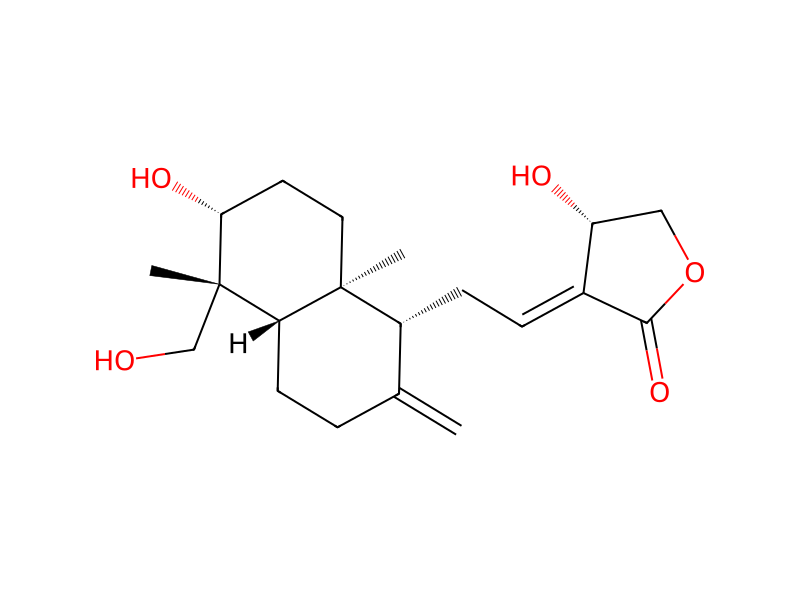
5508-58-7C=C1CC[C@@H]2[C@](C)(CO)[C@H](O)CC[C@@]2(C)[C@@H]1C/C=C1/C(=O)OC[C@H]1OBOJKULTULYSRAS-OTESTREVSA-NAndrographolide is a labdane diterpenoid isolated from the leaves and roots of Andrographis paniculata that exhibits anti-HIV, anti-inflammatory and antineoplastic properties. It has a role as a metabolite, an anti-inflammatory drug, an antineoplastic agent and an anti-HIV agent. It is a primary alcohol, a secondary alcohol, a labdane diterpenoid, a carbobicyclic compound and a gamma-lactone.
Safety information is for reference only and does not replace the supplier’s Safety Data Sheet (SDS), applicable regulations, or professional assessment.
Warning
H315 (100%): Causes skin irritation [Warning Skin corrosion/irritation]
P261, P264, P264+P265, P271, P280, P302+P352, P304+P340, P305+P351+P338, P319, P321, P332+P317, P337+P317, P362+P364, P403+P233, P405, and P501 (click each P-code to see the statement)
Aggregated GHS information provided per 31 reports by companies from 2 notifications to the ECHA C&L Inventory. Each notification may be associated with multiple companies.
2(3H)-Furanone, 3-2-(1R,4aS,5R,6R,8aS)-decahydro-6-hydroxy-5-(hydroxymethyl)-5,8a-dimethyl-2-methylene-1-naphthalenylethylidenedihydro-4-hydroxy-, (3E,4S)-: Does not have an individual approval but may be used as a component in a product covered by a group standard. It is not approved for use as a chemical in its own right.
HMPL-004 acts on multiple cellular targets in the inflammatory signal transduction pathways resulting in suppressed inflammation cytokine expression including TNF-α, IL-1β and IL-6. HMPL-004 was demonstrated to inhibit TNF-α and IL-1β production in cell-based assays. HMPL-004 is also able to inhibit NF-kB activation. NF-kB is a family of transcriptional factors that regulate a wide spectrum of genes critically involved in host defence and inflammation. The mechanism of action of HMPL-004 was further supported in laboratory IBD animal models. Treatment of IBD rats with HMPL-004 caused a significant drop in plasma cytokine concentrations, including TNF-α and IL-1β.
Substances that reduce or suppress INFLAMMATION.
Anti-inflammatory agents that are non-steroidal in nature. In addition to anti-inflammatory actions, they have analgesic, antipyretic, and platelet-inhibitory actions. They act by blocking the synthesis of prostaglandins by inhibiting cyclooxygenase, which converts arachidonic acid to cyclic endoperoxides, precursors of prostaglandins. Inhibition of prostaglandin synthesis accounts for their analgesic, antipyretic, and platelet-inhibitory actions; other mechanisms may contribute to their anti-inflammatory effects.
Substances that are destructive to protozoans.
Agents used in the prophylaxis or therapy of VIRUS DISEASES. Some of the ways they may act include preventing viral replication by inhibiting viral DNA polymerase; binding to specific cell-surface receptors and inhibiting viral penetration or uncoating; inhibiting viral protein synthesis; or blocking late stages of virus assembly.
Drugs or agents which antagonize or impair any mechanism leading to blood platelet aggregation, whether during the phases of activation and shape change or following the dense-granule release reaction and stimulation of the prostaglandin-thromboxane system.
5508-58-7DTXSID3045980CHEMBL186141CHEBI:65408DescriptionAndrographolide is the bitter principle, a colorless and neutral crystalline substance. It is the major labdane diterpenoid isolated from Andrographis paniculate. It exhibits antiviral, anti-inflammatory, and anticancer activities. The underlying mechanism is the inhibition of the mitogen-activated protein kinase/extracellular signal-regulated kinase (MAPK/ERK) signaling (specifically p38 MAPK/ERK1/2) pathway and downstream transcription factors such as nuclear factor kappa B (NF-κB) and nuclear factor of activated T cells (NFAT). Andrographolide is also confirmed with chemopreventive effects against and the inhibitory effects on cancer cell growth in breast, colon, epidermoid, gastric, liver, leukemia, myeloma, peripheral blood lymphocytes, and prostate cancers. Andrographolide has been used for liver complaints and fever, and as an anti-inflammatory and immunostimulant. Andrographolide exerts anti-growth and pro-apoptotic effects on human rheumatoid arthritis fibroblast- like synoviocytes, the main cellular constituent of pannus, that combined with a massive infiltration of lymphocytes and macrophages, invades and destroys the local articular structure. Thereby, andrographolide is proposed to be used in Rheumatoid Arthritis and other autoimmune diseases.
DescriptionAndrographolide is a diterpene lactone compound extracted from Andrographis. paniculata (Burm. F) Nees. Andrographis paniculata is also known as lanhelian, yijianxi, zhanshecao, kucao, kudancao, etc. Since this product originates in India, it is also known as Indian grass. This product is dry ground part of Jupiteraceae plant Andrographis paniculata (conus) may originate in South Asia. It is commonly cultivated in China such as in Fujian, Guangdong, Hainan, Guangxi, and Yunnan and also in Australia and was also introduced in Jiangsu and Shaanxi.Andrographis paniculata is commonly used in traditional Chinese medicine. Its ability of relieving “snake venom, and internal injuries cough” was recorded in “Lingnan herbal medicine records.” “Quanzhou Materia Medica” described it as “heat-clearing and detoxifying, anti-inflammatory, detumescence and inhibition throat inflammation, dysentery and high fever.”The above ground part of Andrographis paniculata contains andrographolide, neo-andrographolide, 14-deoxygenated andrographolide, etc., and the root contains mainly flavonoids.
OccurrenceAndrographis is found growing wild in India and Sri Lanka and is cultivated in many other parts of the world.
HistoryIn 1911, Gorter firstly isolated a crystalline substance from Andrographis paniculata, identified it as a diterpene lactone compound, and named it andrographolide .Andrographolide structure is complex and difficult to artificially synthesize, so it is often extracted from the plant.Andrographolide water solubility is poor and its bioavailability is low; its pharmacological effects are extensive but weak, so the preparation requirements are strict. Therefore, from the 1970s, drugs and organic chemical researchers have done a lot of work in the modification and transformation of andrographolide, mainly concentrated in the α, β-unsaturated lactone double bond Michael addition, redox, selective esterification of hydroxyl groups, oxidation and substitution reactions, intramolecular cyclization, replacement of lactone rings, etc. They had obtained a number of new derivatives. In the research of pharmacological effects, the main study of the andrographolide derivatives focuses on antitumor, antivirus, and other biological activities and has made some progress .
UsesAndrographolide is a labdane diterpenoid. Andrographolide is the main bioactive component isolated from the medicinal plant Andrographis paniculata. It has a broad range of therapeutic applications including anti-inflammatory and anti-platelet aggregation activities and potential antineoplastic properties. Andrographolide showed significant antihepatotoxic action in P. berghei K173- induced hepatic damage in M. natalensis. Andrographolide inhibits tumor necrosis factor-α (TNF-α)-induced intercellular adhesion mol.-1 (ICAM-1) expression and adhesion of HL-60 cells onto human umbilical vein endothelial cells (HUVEC), which are associated with inflammatory diseases. These findings suggest that Andrographolide may have potential as a cardiovascular-protective agent.
General DescriptionAndrographolide, a bioactive diterpene lactone, is the main constituent of Andrographis paniculata, a plant used in traditional medicines. It is known to have different biological activities such as anti-inflammatory, anti-malarial, anti-cancer and hepatoprotective activity. It also shows potent anti-viral effect against dengue virus.
DefinitionChEBI: Andrographolide is a labdane diterpenoid isolated from the leaves and roots of Andrographis paniculata that exhibits anti-HIV, anti-inflammatory and antineoplastic properties. It has a role as a metabolite, an anti-inflammatory drug, an anti-HIV agent and an antineoplastic agent. It is a gamma-lactone, a primary alcohol, a secondary alcohol, a labdane diterpenoid and a carbobicyclic compound.