
uspto-grants-2009_07 · 10.6084/m9.figshare.5104873.v1 · US07560560B2
查看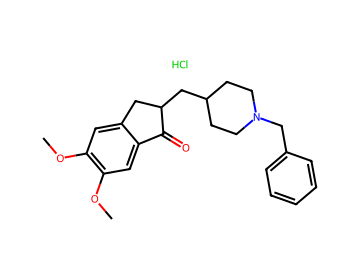
IDENTITY
COMPUTED
PROPERTIES
196.6 Ų [M+H]+ [CCS Type: TW; Method: calibrated with polyalanine and drug standards]
GHS
Danger
H300 (17.9%): Fatal if swallowed [Danger Acute toxicity, oral];H301 (76.2%): Toxic if swallowed [Danger Acute toxicity, oral];H319 (79.8%): Causes serious eye irritation [Warning Serious eye damage/eye irritation]
P264, P264+P265, P270, P280, P301+P316, P305+P351+P338, P321, P330, P337+P317, P405, and P501 (click each P-code to see the statement)
Aggregated GHS information provided per 84 reports by companies from 15 notifications to the ECHA C&L Inventory. Each notification may be associated with multiple companies.;Information may vary between notifications depending on impurities, additives, and other factors. The percentage value in parenthesis indicates the notified classification ratio from companies that provide hazard codes. Only hazard codes with percentage values above 10% are shown. For more detailed information, please visit ECHA C&L website.
HAZARDS
Acute Tox. 2 (17.9%);Acute Tox. 3 (76.2%);Eye Irrit. 2 (79.8%)
TOXICITY
If the compound has been ingested, rapid gastric lavage should be performed using 5% sodium bicarbonate. For skin contact, the skin should be washed with soap and water. If the compound has entered the eyes, they should be washed with large quantities of isotonic saline or water. In serious cases, atropine and/or pralidoxime should be administered. Anti-cholinergic drugs work to counteract the effects of excess acetylcholine and reactivate AChE. Atropine can be used as an antidote in conjunction with pralidoxime or other pyridinium oximes (such as trimedoxime or obidoxime), though the use of '-oximes' has been found to be of no benefit, or possibly harmful, in at least two meta-analyses. Atropine is a muscarinic antagonist, and thus blocks the action of acetylcholine peripherally.
Acute exposure to cholinesterase inhibitors can cause a cholinergic crisis characterized by severe nausea/vomiting, salivation, sweating, bradycardia, hypotension, collapse, and convulsions. Increasing muscle weakness is a possibility and may result in death if respiratory muscles are involved. Accumulation of ACh at motor nerves causes overstimulation of nicotinic expression at the neuromuscular junction. When this occurs symptoms such as muscle weakness, fatigue, muscle cramps, fasciculation, and paralysis can be seen. When there is an accumulation of ACh at autonomic ganglia this causes overstimulation of nicotinic expression in the sympathetic system. Symptoms associated with this are hypertension, and hypoglycemia. Overstimulation of nicotinic acetylcholine receptors in the central nervous system, due to accumulation of ACh, results in anxiety, headache, convulsions, ataxia, depression of respiration and circulation, tremor, general weakness, and potentially coma. When there is expression of muscarinic overstimulation due to excess acetylcholine at muscarinic acetylcholine receptors symptoms of visual disturbances, tightness in chest, wheezing due to bronchoconstriction, increased bronchial secretions, increased salivation, lacrimation, sweating, peristalsis, and urination can occur. Certain reproductive effects in fertility, growth, and development for males and females have been linked specifically to organophosphate pesticide exposure. Most of the research on reproductive effects has been conducted on farmers working with pesticides and insecticdes in rural areas. In females menstrual cycle disturbances, longer pregnancies, spontaneous abortions, stillbirths, and some developmental effects in offspring have been linked to organophosphate pesticide exposure. Prenatal exposure has been linked to impaired fetal growth and development. Neurotoxic effects have also been linked to poisoning with OP pesticides causing four neurotoxic effects in humans: cholinergi
Donepezil is well absorbed with a relative oral bioavailability of 100% and reaches peak plasma concentrations in 3 to 4 hours.
Donepezil is a cholinesterase or acetylcholinesterase (AChE) inhibitor. A cholinesterase inhibitor (or 'anticholinesterase') suppresses the action of acetylcholinesterase. Because of its essential function, chemicals that interfere with the action of acetylcholinesterase are potent neurotoxins, causing excessive salivation and eye-watering in low doses, followed by muscle spasms and ultimately death. Nerve gases and many substances used in insecticides have been shown to act by binding a serine in the active site of acetylcholine esterase, inhibiting the enzyme completely. Acetylcholine esterase breaks down the neurotransmitter acetylcholine, which is released at nerve and muscle junctions, in order to allow the muscle or organ to relax. The result of acetylcholine esterase inhibition is that acetylcholine builds up and continues to act so that any nerve impulses are continually transmitted and muscle contractions do not stop. Among the most common acetylcholinesterase inhibitors are phosphorus-based compounds, which are designed to bind to the active site of the enzyme. The structural requirements are a phosphorus atom bearing two lipophilic groups, a leaving group (such as a halide or thiocyanate), and a terminal oxygen.
Symptoms of overdose include severe nausea, vomiting, salivation, sweating, bradycardia, hypotension, respiratory depression, collapse and convulsions. Increasing muscle weakness is a possibility and may result in death if respiratory muscles are involved.
No indication of carcinogenicity to humans (not listed by IARC).
Drug Induced Liver Injury Rank (DILIrank 2.0)
Donepezil hydrochloride
vLess-DILI-concern
3
Adverse reactions
DOI:10.1016/j.drudis.2016.02.015
PHARMACOLOGY
Donepezil is metabolized by CYP 450 isoenzymes 2D6 and 3A4 in the liver and also undergoes glucuronidation. The main metabolite, 6-O-desmethyl donepezil, has been reported to inhibit AChE to the same extent as donepezil in vitro. Route of Elimination: Donepezil is both excreted in the urine intact and extensively metabolized to four major metabolites, two of which are known to be active, and a number of minor metabolites, not all of which have been identified. Half Life: 70 hours
DONEPEZIL HYDROCHLORIDE
Cholinesterase Inhibitors [MoA]; Cholinesterase Inhibitor [EPC]
Drugs that inhibit cholinesterases. The neurotransmitter ACETYLCHOLINE is rapidly hydrolyzed, and thereby inactivated, by cholinesterases. When cholinesterases are inhibited, the action of endogenously released acetylcholine at cholinergic synapses is potentiated. Cholinesterase inhibitors are widely used clinically for their potentiation of cholinergic inputs to the gastrointestinal tract and urinary bladder, the eye, and skeletal muscles; they are also used for their effects on the heart and the central nervous system.
Drugs used to specifically facilitate learning or memory, particularly to prevent the cognitive deficits associated with dementias. These drugs act by a variety of mechanisms.
USES
For the palliative treatment of mild to moderate dementia of the Alzheimer's type.
ALIASES
REACTIONS
uspto-grants-2009_07 · 10.6084/m9.figshare.5104873.v1 · US07560560B2
查看
uspto-grants-2009_07 · 10.6084/m9.figshare.5104873.v1 · US07560560B2
查看
uspto-grants-2007_03 · 10.6084/m9.figshare.5104873.v1 · US07186842B2
查看
uspto-grants-2003_11 · 10.6084/m9.figshare.5104873.v1 · US06649765B1
查看
uspto-grants-2015_03 · 10.6084/m9.figshare.5104873.v1 · US08987458B2
查看
uspto-grants-2005_10 · 10.6084/m9.figshare.5104873.v1 · US06953856B2
查看
uspto-grants-2009_01 · 10.6084/m9.figshare.5104873.v1 · US07479563B2
查看
uspto-grants-2009_01 · 10.6084/m9.figshare.5104873.v1 · US07479563B2
查看