
uspto-grants-1978_05 · 10.6084/m9.figshare.5104873.v1 · US04089865
查看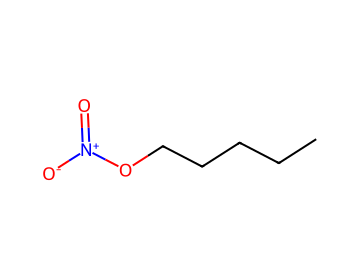
IDENTITY
COMPUTED
PROPERTIES
Sickening sweet odor
1 at 68 °F (USCG, 1999)
0.99
0.99 @25 °C
Slightly yellow liquid
Liquid
In water, 360 mg/L at 25 °C
In water, 0.3%
120 °F (USCG, 1999)
118 °F (48 °C) - open cup
125 °F (open cup)
292 to 314 °F at 760 mmHg (USCG, 1999)
150 °C (unstable)
BP: 145 °C
145 °C @760 [mm Hg]
When heated to decomposition it emits toxic fumes of /nitrogen oxides/.
-190 °F (USCG, 1999)
-123 °C
5.07 [mmHg]
5.07 mm Hg at 25 °C
Henry's Law constant = 1.66X10⁻³ atm-cu m/mol at 25 °C
Amyl nitrate appears as a clear colorless liquid with an ether-like odor. Flash point 118 °F. About the same density as water and insoluble in water. Vapors heavier than air. Produces toxic oxides of nitrogen during combustion. Used as an additive for diesel fuels.
Clear colorless liquid with an ether-like odor; [CAMEO]
900;901;902;905;903
1220
GHS
Warning
H226 (100%): Flammable liquid and vapor [Warning Flammable liquids];H315 (100%): Causes skin irritation [Warning Skin corrosion/irritation];H319 (100%): Causes serious eye irritation [Warning Serious eye damage/eye irritation]
P210, P233, P240, P241, P242, P243, P264, P264+P265, P280, P302+P352, P303+P361+P353, P305+P351+P338, P321, P332+P317, P337+P317, P362+P364, P370+P378, P403+P235, and P501 (click each P-code to see the statement)
The GHS information provided by 1 company from 1 notification to the ECHA C&L Inventory.
HAZARDS
Amyl Nitrate: HSNO Approval: HSR001085 Approved with controls
The New Jersey Worker and Community Right to Know Act requires public and private employers to provide information about hazardous substances at their workplaces. (N.J.S.A. 34:5A-1 et. seq.)
Flammable Liquid
Special Hazards of Combustion Products: Toxic oxides of nitrogen may form in a fire.;Behavior in Fire: Overheated material may detonate. (USCG, 1999)
· HIGHLY FLAMMABLE: Will be easily ignited by heat, sparks or flames.;· Vapors may form explosive mixtures with air.;· Vapors may travel to source of ignition and flash back.;· Most vapors are heavier than air. They will spread along the ground and collect in low or confined areas (sewers, basements, tanks, etc.).;· Vapor explosion hazard indoors, outdoors or in sewers.;· Those substances designated with a (P) may polymerize explosively when heated or involved in a fire.;· Runoff to sewer may create fire or explosion hazard.;· Containers may explode when heated.;· Many liquids will float on water.;· Substance may be transported hot.;· For hybrid vehicles, GUIDE 147 (lithium ion or sodium ion batteries) or GUIDE 138 (sodium batteries) should also be consulted.;· If molten aluminum is involved, refer to GUIDE 169.
A flammable liquid.
Inhalation or ingestion may cause headache, methemoglobin, and nausea. Liquid and vapor irritate eyes. Contact with skin may cause slight irritation. (USCG, 1999)
CAUTION: Petroleum crude oil (UN1267) may contain TOXIC hydrogen sulphide gas.;· Inhalation or contact with material may irritate or burn skin and eyes.;· Fire may produce irritating, corrosive and/or toxic gases.;· Vapors may cause dizziness or asphyxiation, especially when in closed or confined areas.;· Runoff from fire control or dilution water may cause environmental contamination.
Causes convulsions, acute pulmonary edema, and renal tubular changes in inhalation lethal-concentration studies of guinea pigs; Causes convulsions and cyanosis in inhalation lethal-concentration studies of rabbits; [RTECS] A strong oxidizing agent; [CAMEO] May cause mild skin irritation; An eye irritant; May induce methemoglobinemia; [CHRIS] See Butyl nitrate. See Amyl nitrite.
1112 128
Nitro, Nitroso, Nitrate, and Nitrite Compounds, Organic
Highly Flammable;Strong Oxidizing Agent
AMYL NITRATE is an oxidizing reagent. When exposed to heat or flame it may decompose to form nitrogen oxides. Accelerates the burning of combustible materials. Can produce a violent reaction with reducing materials [Sax, 9th ed., p. 228].
/GUIDE 140 OXIDIZERS/ Fire or Explosion: These substances will accelerate burning when involved in a fire. Some may decompose explosively when heated or involved in a fire. May explode from heat or contamination. Some will react explosively with hydrocarbons (fuels). May ignite combustibles (wood, paper, oil, clothing, etc.). Containers may explode when heated. Runoff may create fire or explosion hazard.
/GUIDE 140 OXIDIZERS/ Health: Inhalation, ingestion or contact (skin, eyes) with vapors or substance may cause severe injury, burns or death. Fire may produce irritating, corrosive and/or toxic gases. Runoff from fire control or dilution water may cause pollution.
/GUIDE 140 OXIDIZERS/ Public Safety: CALL Emergency Response Telephone Number on Shipping Paper first. If Shipping Paper not available or no answer, refer to appropriate telephone number listed on the inside back cover. As an immediate precautionary measure, isolate spill or leak area in all directions for at least 50 meters (150 feet) for liquids and at least 25 meters (75 feet) for solids. Keep unauthorized personnel away. Stay upwind, uphill and/or upstream. Ventilate closed spaces before entering.
/GUIDE 140 OXIDIZERS/ Protective Clothing: Wear positive pressure self-contained breathing apparatus (SCBA). Wear chemical protective clothing that is specifically recommended by the manufacturer. It may provide little or no thermal protection. Structural firefighters' protective clothing will only provide limited protection.
For more DOT Emergency Guidelines (Complete) data for n-Amyl nitrate (8 total), please visit the HSDB record page.
Amyl nitrate
UN1112
Class 3 Flammable and combustible liquid (49 eCFR § 173.120)
PG III: the degree of danger presented by the material is minor;For more information about the packing group assignment, please visit 49 eCFR § 173
SAFETY
Excerpt from ERG Guide 128 [Flammable Liquids (Water-Immiscible)]:;CAUTION: The majority of these products have a very low flash point. Use of water spray when fighting fire may be inefficient. CAUTION: For mixtures containing alcohol or polar solvent, alcohol-resistant foam may be more effective.;SMALL FIRE: Dry chemical, CO2, water spray or regular foam. If regular foam is ineffective or unavailable, use alcohol-resistant foam.;LARGE FIRE: Water spray, fog or regular foam. If regular foam is ineffective or unavailable, use alcohol-resistant foam. Avoid aiming straight or solid streams directly onto the product. If it can be done safely, move undamaged containers away from the area around the fire.;FIRE INVOLVING TANKS, RAIL TANK CARS OR HIGHWAY TANKS: Fight fire from maximum distance or use unmanned master stream devices or monitor nozzles. Cool containers with flooding quantities of water until well after fire is out. For petroleum crude oil, do not spray water directly into a breached tank car. This can lead to a dangerous boil over. Withdraw immediately in case of rising sound from venting safety devices or discoloration of tank. ALWAYS stay away from tanks in direct contact with flames. For massive fire, use unmanned master stream devices or monitor nozzles; if this is impossible, withdraw from area and let fire burn. (ERG, 2024)
· CALL 911. Then call emergency response telephone number on shipping paper. If shipping paper not available or no answer, refer to appropriate telephone number listed on the inside back cover.;· Keep unauthorized personnel away.;· Stay upwind, uphill and/or upstream.;· Ventilate closed spaces before entering, but only if properly trained and equipped.
· ELIMINATE all ignition sources (no smoking, flares, sparks or flames) from immediate area.;· All equipment used when handling the product must be grounded.;· Do not touch or walk through spilled material.;· Stop leak if you can do it without risk.;· Prevent entry into waterways, sewers, basements or confined areas.;· A vapor-suppressing foam may be used to reduce vapors.;· Absorb or cover with dry earth, sand or other non-combustible material and transfer to containers.;· Use clean, non-sparking tools to collect absorbed material.;Large Spill;· Dike far ahead of liquid spill for later disposal.;· Water spray may reduce vapor, but may not prevent ignition in closed spaces.
INHALATION: move to fresh air; support respiration; get medical attention.;INGESTION: induce vomiting; get medical attention.;EYES: irrigate thoroughly with water.;SKIN: wash with soap and water. (USCG, 1999)
General First Aid:;· Call 911 or emergency medical service.;· Ensure that medical personnel are aware of the material(s) involved, take precautions to protect themselves and avoid contamination.;· Move victim to fresh air if it can be done safely.;· Administer oxygen if breathing is difficult.;· If victim is not breathing:;-- DO NOT perform mouth-to-mouth resuscitation; the victim may have ingested or inhaled the substance.;-- If equipped and pulse detected, wash face and mouth, then give artificial respiration using a proper respiratory medical device (bag-valve mask, pocket mask equipped with a one-way valve or other device).;-- If no pulse detected or no respiratory medical device available, provide continuous compressions. Conduct a pulse check every two minutes or monitor for any signs of spontaneous respirations.;· Remove and isolate contaminated clothing and shoes.;· For minor skin contact, avoid spreading material on unaffected skin.;· In case of contact with substance, remove immediately by flushing skin or eyes with running water for at least 20 minutes.;· For severe burns, immediate medical attention is required.;· Effects of exposure (inhalation, ingestion, or skin contact) to substance may be delayed.;· Keep victim calm and warm.;· Keep victim under observation.;· For further assistance, contact your local Poison Control Center.;· Note: Basic Life Support (BLS) and Advanced Life Support (ALS) should be done by trained professionals.;Specific First Aid:;· Wash skin with soap and water.
Vapors are heavier than air and will collect in low areas. Vapors may travel long distances to ignition sources and flashback. Vapors in confined areas may explode when exposed to fire. Storage containers and parts of containers may rocket great distances, in many directions.
· Wear positive pressure self-contained breathing apparatus (SCBA).;· Structural firefighters' protective clothing provides thermal protection but only limited chemical protection.
Use dry chemical, carbon dioxide, or alcohol foam extinguishers. ... If material or contaminated runoff enters waterways, notify downstream users of potentially contaminated waters. Notify local health and fire officials and pollution control agencies. From a secure, explosion-proof location, use water spray to cool exposed containers. If cooling streams are ineffective (venting sound increases in volume and pitch, tank discolors, or shows any signs of deforming), withdraw immediately to a secure position. ... The only respirators recommended for firefighting are self-contained breathing apparatuses that have full face-pieces and are operated in a pressure-demand or other positive-pressure mode.
Use water spray, dry chemical, foam, or carbon dioxide. Use water spray to keep fire-exposed containers cool.
If material on fire or involved in fire: Do not extinguish fire unless flow can be stopped. Use water in flooding quantities as fog. Solid streams of water may be ineffective. Cool all affected containers with flooding quantities of water. Apply water from as far a distance as possible. Use foam, dry chemical, or carbon dioxide.
Store in a flammable liquid storage area or approved cabinet away from ignition sources and corrosive and reactive materials. Prior to working with this chemical you should be trained on its proper handling and storage. Store in tightly closed containers in a cool, well-ventilated area away from heat, sparks, flames, and other combustible materials, such as wood, paper, or oil. Outside or detached storage is preferred. Before entering confined space where amyl nitrate may be present, check to make sure that an explosive concentration does not exist. Metal containers involving the transfer of this chemical should be grounded and bonded. Where possible, automatically pump liquid from drums or other storage containers to process containers. Drums must be equipped with self-closing valves, pressure vacuum bungs, and flame arresters. Use only nonsparking tools and equipment, especially when opening and closing containers of this chemical. Sources of ignition, such as smoking and open flames, are prohibited where this chemical is used, handled, or stored in a manner that could create a potential fire or explosion hazard.
Store in a cool, dry, well-ventilated location. Outside or detached storage is preferred. Inside storage should be in a standard flammable liquids storage warehouse, room, or cabinet.
Evacuate persons not wearing protective equipment from area of spill or leak until cleanup is complete. Remove all ignition sources. Ventilate site of spill or leak. Use water spray to reduce vapors. Absorb liquids in vermiculite, dry sand, earth, or a similar material and deposit in sealed containers. Keep amyl nitrate out of a confined space, such as a sewer, because of the potential for an explosion, unless the sewer is designed to prevent the buildup of explosive concentrations. It may be necessary to contain and dispose of this chemical as a hazardous waste. If material or contaminated runoff enters waterways, notify downstream users of potentially contaminated waters.
Emergency response personal protective equipment: Wear full protective clothing and positive pressure self-contained breathing apparatus. Spill or leak procedures: Stop or control the leak, if this can be done without undue risk. Use water spray to cool and disperse vapors and protect personnel.
Excerpt from ERG Guide 128 [Flammable Liquids (Water-Immiscible)]:;ELIMINATE all ignition sources (no smoking, flares, sparks or flames) from immediate area. All equipment used when handling the product must be grounded. Do not touch or walk through spilled material. Stop leak if you can do it without risk. Prevent entry into waterways, sewers, basements or confined areas. A vapor-suppressing foam may be used to reduce vapors. Absorb or cover with dry earth, sand or other non-combustible material and transfer to containers. Use clean, non-sparking tools to collect absorbed material.;LARGE SPILL: Dike far ahead of liquid spill for later disposal. Water spray may reduce vapor, but may not prevent ignition in closed spaces. (ERG, 2024)
SRP: Recycle any unused portion of the material for its approved use or return it to the manufacturer or supplier. Ultimate disposal of the chemical must consider: the material's impact on air quality; potential migration in air, soil or water; effects on animal, aquatic and plant life; and conformance with environmental and public health regulations. If it is possible or reasonable use an alternative chemical product with less inherent propensity for occupational harm/injury/toxicity or environmental contamination.
SRP: Wastewater from contaminant suppression, cleaning of protective clothing/equipment, or contaminated sites should be contained and evaluated for subject chemical or decomposition product concentrations. Concentrations shall be lower than applicable environmental discharge or disposal criteria. Alternatively, pretreatment and/or discharge to a permitted wastewater treatment facility is acceptable only after review by the governing authority and assurance that "pass through" violations will not occur. Due consideration shall be given to remediation worker exposure (inhalation, dermal and ingestion) as well as fate during treatment, transfer and disposal. If it is not practicable to manage the chemical in this fashion, it must be evaluated in accordance with EPA 40 CFR Part 261, specifically Subpart B, in order to determine the appropriate local, state and federal requirements for disposal.
Incineration with scrubber to remove nitrogen oxides in effluent gases.
If material not on fire and not involved in fire: Keep sparks, flames, and other sources of ignition away. Keep material out of water sources and sewers. Build dikes to contain flow as necessary. Use water spray to knock-down vapors.
Personnel protection: Avoid breathing vapors. Keep upwind. ... Do not handle broken packages unless wearing appropriate personal protective equipment. Wash away any material which may have contacted the body with copious amounts of water or soap and water.
SRP: Contaminated protective clothing should be segregated in a manner such that there is no direct personal contact by personnel who handle, dispose, or clean the clothing. The completeness of the cleaning procedures should be considered before the decontaminated protective clothing is returned for reuse by the workers. Contaminated clothing should not be taken home at the end of shift, but should remain at employee's place of work for cleaning.
Employees should wash immediately with soap when skin is wet or contaminated. Provide emergency showers and eyewash.
Excerpt from ERG Guide 128 [Flammable Liquids (Water-Immiscible)]:;IMMEDIATE PRECAUTIONARY MEASURE: Isolate spill or leak area for at least 50 meters (150 feet) in all directions.;LARGE SPILL: Consider initial downwind evacuation for at least 300 meters (1000 feet).;FIRE: If tank, rail tank car or highway tank is involved in a fire, ISOLATE for 800 meters (1/2 mile) in all directions; also, consider initial evacuation for 800 meters (1/2 mile) in all directions. (ERG, 2024)
Immediate precautionary measure;· Isolate spill or leak area for at least 50 meters (150 feet) in all directions.;Large Spill;· Consider initial downwind evacuation for at least 300 meters (1000 feet).;Fire;· If tank, rail tank car or highway tank is involved in a fire, ISOLATE for 800 meters (1/2 mile) in all directions; also, consider initial evacuation for 800 meters (1/2 mile) in all directions.
TOXICITY
TERRESTRIAL FATE: Based on a classification scheme(1), an estimated Koc value of 130(SRC), determined from a structure estimation method(2), indicates that n-amyl nitrate is expected to have high mobility in soil(SRC). Volatilization of n-amyl nitrate from moist soil surfaces is expected to be an important fate process(SRC) given a Henry's Law constant of 1.66X10⁻³ atm-cu m/mole(3). n-Amyl nitrate is expected to volatilize from dry soil surfaces(SRC) based upon a vapor pressure of 5.07 mm Hg at 25 °C(3). Biodegradation data in soil were not available(SRC, 2018).
AQUATIC FATE: Based on a classification scheme(1), an estimated Koc value of 130(SRC), determined from a structure estimation method(2), indicates that n-amyl nitrate is not expected to adsorb to suspended solids and sediment(SRC). Volatilization from water surfaces is expected(3) based upon a Henry's Law constant of 1.66X10⁻³ atm-cu m/mole(4). Using this Henry's Law constant and an estimation method(3), volatilization half-lives for a model river and model lake are 4 hrs and 5 days, respectively(SRC). According to a classification scheme(5), an estimated BCF of 29(SRC), from an estimated log Kow of 2.72(2) and a regression-derived equation(2), suggests the potential for bioconcentration in aquatic organisms is low(SRC). Biodegradation data in water were not available(SRC, 2018).
ATMOSPHERIC FATE: According to a model of gas/particle partitioning of semivolatile organic compounds in the atmosphere(1), n-amyl nitrate, which has a vapor pressure of 5.07 mm Hg at 25 °C(2), is expected to exist solely as a vapor in the ambient atmosphere. Vapor-phase n-amyl nitrate is degraded in the atmosphere by reaction with photochemically-produced hydroxyl radicals(SRC); the half-life for this reaction in air is estimated to be 5 days(SRC), calculated from its rate constant of 3.0X10⁻¹² cu cm/molecule-sec at 25 °C(3). n-Amyl nitrate does not contain chromophores that absorb at wavelengths >290 nm(4) and, therefore, is not expected to be susceptible to direct photolysis by sunlight(SRC).
n-Amyl nitrate has been identified in pork flavor volatiles(1).
Methemoglobinemia - The presence of increased methemoglobin in the blood; the compound is classified as secondary toxic effect
IDENTIFICATION AND USE: Amyl nitrate is a slightly yellow liquid. It is used in the military, has been used to increase the cetane number of diesel fuels, and is also a component of Otto fuel II. HUMAN STUDIES: Persons exposed in the laboratory during an inhalation study in animals developed nausea and headache. Patients presented with methemoglobinemia following oral ingestion of amyl nitrate. One patient had a methemoglobin fraction of 90.6%. ANIMAL STUDIES: Cats, guinea pigs, rabbits, rats, and mice were exposed to measured concentrations of amyl nitrates in air. The order of decreasing susceptibility is mouse > rat and rabbit > guinea pig > cat. However, except for the cat, which survived all exposures including the highest, 3730 ppm for 7 hr, the differential susceptibility among species was small. All species survived exposures of 600 ppm for 10 days at 7 hr/day or 262 ppm for 20 days at 7 hr/day. High lethal levels of amyl nitrate produced signs and symptoms which were characterized by tremors, ataxia, alterations in respiration, lethargy, cyanosis, convulsions, coma, and deaths.
Using a structure estimation method based on molecular connectivity indices(1), the Koc of n-amyl nitrate can be estimated to be 130(SRC). According to a classification scheme(2), this estimated Koc value suggests that n-amyl nitrate is expected to have high mobility in soil(SRC).
RURAL/REMOTE: n-Amyl nitrate was present at an average concentration of 4 ptt in samples from a rural site in Egbert, located northwest of Toronto, Ontario, Canada, collected from March 26 - April 27, 1990. A relative formation rate in April of 0.25X10+3/sec was calculated(1). The total butyl and pentyl nitrate concentration ranged from 0.8 to 37 parts/trillion volume in atmospheric samples collected in the North Pacific during April-June 1986(2).
/SIGNS AND SYMPTOMS/ Persons exposed in the laboratory during /an inhalation study in animals/ developed nausea and headache.
/CASE REPORTS/ OBJECTIVES: To assess the impact of the Parklife annual music festival on the local hospital, North Manchester General. METHODS: Data was obtained retrospectively by analysis of emergency department records during the weekend of Parklife 2015. RESULTS: 32 patients were identified, 56% reported taking drugs. 34% were admitted for overnight observation. 4 patients presented with methemoglobinemia following oral ingestion of amyl nitrate. One patient had a methemoglobin fraction of 90.6%, which is amongst the most extreme recorded in literature. CONCLUSION: Music festivals can impose a burden on local health services. Organizers should operate an efficient surveillance system in order to prevent the sale and use of recreational drugs, providing adequate on-site health services and working in collaboration with local emergency services.
/CASE REPORTS/ We wish to report two cases of methemoglobinemia secondary to amyl nitrate use. A 55-year-old male presented with saturations in the mid 80s despite FiO2 of 1.0 and GCS /Glascow Coma Scale/ 10 and a 22-year-old female who presented with fluctuating GCS and a slate grey colour. Both were found to have high levels of methemoglobinemia on ABG /arterial blood gas/, were treated with methylene blue and made excellent recoveries. These cases illustrate the risk of methemoglobinemia secondary to amyl nitrate. Appropriate and prompt management can lead to very good outcomes.
n-Amyl nitrate's production and use in specific fuel formulations and former use as a diesel fuel additive(1) will result in its direct release to the environment(SRC). Organic nitrates, such as pentyl nitrate, are produced from the atmospheric oxidation of alkanes in the presence of high amounts of nitrogen oxide [NO](2).
An estimated BCF of 29 was calculated in fish for n-amyl nitrate(SRC), using an estimated log Kow of 2.72(1) and a regression-derived equation(1). According to a classification scheme(2), this BCF suggests the potential for bioconcentration in aquatic organisms is low(SRC).
The Henry's Law constant for n-amyl nitrate is 1.6X10⁻³ atm-cu m/mole(1). This Henry's Law constant indicates that n-amyl nitrate is expected to volatilize from water surfaces(2). Based on this Henry's Law constant, the volatilization half-life from a model river (1 m deep, flowing 1 m/sec, wind velocity of 3 m/sec)(2) is estimated as 4 hours(SRC). The volatilization half-life from a model lake (1 m deep, flowing 0.05 m/sec, wind velocity of 0.5 m/sec)(2) is estimated as 5 days(SRC). n-Amyl nitrate is expected to volatilize from dry soil surfaces(SRC) based upon a vapor pressure of 5.07 mm Hg(1).
/OTHER TOXICITY INFORMATION/ ... Cats, guinea pigs, rabbits, rats, and mice /were exposed/ to measured concentrations of amyl nitrates in air. ... The order of decreasing susceptibility is mouse > rat and rabbit > guinea pig > cat. However, except for the cat, which survived all exposures including the highest, 3730 ppm for 7 hr, the differential susceptibility among species was small. All species survived exposures of 600 ppm for 10 days at 7 hr/day or 262 ppm for 20 days at 7 hr/day. High lethal levels of amyl nitrate produced signs and symptoms which were characterized by tremors, ataxia, alterations in respiration, lethargy, cyanosis, convulsions, coma, and deaths. All exposures except 262 ppm produced signs in cats and guinea pigs, and some alterations in respiration were observed in rabbits and mice at the lowest concentration, 262 ppm. A cat exposed at 599 ppm developed methemoglobin levels up to 59.5% after the seventh exposure. Cats exposed at concentrations ranging from 1700 to 3700 ppm of amyl nitrates showed Heinz body formation. Animals that died during exposure had diffuse degenerative changes in the liver, kidneys, and brain and hyperemia and edema of the lungs. Those sacrificed at varying intervals after exposures had normal findings on pathological examination.
The rate constant for the vapor-phase reaction of n-amyl nitrate with photochemically-produced hydroxyl radicals is 3.0X10⁻¹² cu cm/molecule-sec at 25 °C(1). This corresponds to an atmospheric half-life of about 5 days at an atmospheric concentration of 5X10+5 hydroxyl radicals per cu cm(1). n-Amyl nitrate is expected to undergo hydrolysis in the environment due to the presence of functional groups that hydrolyze under environmental conditions(2). n-Amyl nitrate does not contain chromophores that absorb at wavelengths >290 nm(2) and, therefore, is not expected to be susceptible to direct photolysis by sunlight(SRC).
REGULATORY
Amyl Nitrate: HSNO Approval: HSR001085 Approved with controls
The New Jersey Worker and Community Right to Know Act requires public and private employers to provide information about hazardous substances at their workplaces. (N.J.S.A. 34:5A-1 et. seq.)
USES
Used as an additive in diesel fuels; [CAMEO]
It is used in the military, has been used to increase the cetane number of diesel fuels, and is also a component of Otto fuel II.
ALIASES
REACTIONS
uspto-grants-1978_05 · 10.6084/m9.figshare.5104873.v1 · US04089865
查看
uspto-grants-1977_08 · 10.6084/m9.figshare.5104873.v1 · US04045439
查看
uspto-grants-2015_05 · 10.6084/m9.figshare.5104873.v1 · US09029411B2
查看
Training data from https://doi.org/10.1039/C8SC04228D (3/10) · 10.1039/C8SC04228D
查看
Test data from https://doi.org/10.1039/C8SC04228D · 10.1039/C8SC04228D
查看
uspto-grants-1978_06 · 10.6084/m9.figshare.5104873.v1 · US04096267
查看
uspto-grants-1977_01 · 10.6084/m9.figshare.5104873.v1 · US04001421
查看
uspto-grants-1979_12 · 10.6084/m9.figshare.5104873.v1 · US04177285
查看