
uspto-grants-1997_07 · 10.6084/m9.figshare.5104873.v1 · US05648323
查看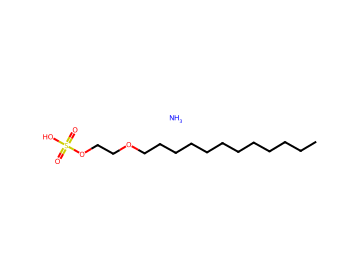
IDENTITY
COMPUTED
PROPERTIES
Light yellow viscous liquid; [MSDSonline]
GHS
This chemical does not meet GHS hazard criteria for 12.6% (59 of 469) of reports.
Danger
H315 (87.4%): Causes skin irritation [Warning Skin corrosion/irritation];H318 (12.4%): Causes serious eye damage [Danger Serious eye damage/eye irritation];H319 (75.1%): Causes serious eye irritation [Warning Serious eye damage/eye irritation]
P264, P264+P265, P280, P302+P352, P305+P351+P338, P305+P354+P338, P317, P321, P332+P317, P337+P317, and P362+P364 (click each P-code to see the statement)
Aggregated GHS information provided per 469 reports by companies from 6 notifications to the ECHA C&L Inventory. Each notification may be associated with multiple companies.;Reported as not meeting GHS hazard criteria per 59 of 469 reports by companies.;There are 5 notifications provided by 410 of 469 reports by companies with hazard statement code(s).;Information may vary between notifications depending on impurities, additives, and other factors. The percentage value in parenthesis indicates the notified classification ratio from companies that provide hazard codes. Only hazard codes with percentage values above 10% are shown. For more detailed information, please visit ECHA C&L website.
HAZARDS
Chemical: Poly(oxy-1,2-ethanediyl), .alpha.-sulfo-.omega.-(dodecyloxy)-, ammonium salt (1:1)
Poly(oxy-1,2-ethanediyl), .alpha.-sulfo-.omega.-(dodecyloxy)-, ammonium salt (1:1) is listed on the EPA's Chemical Data Reporting (CDR) system. Manufacturers and importers of Poly(oxy-1,2-ethanediyl), .alpha.-sulfo-.omega.-(dodecyloxy)-, ammonium salt (1:1) are required to report information about their production and use of this chemical to the EPA under the Toxic Substances Control Act (TSCA). (40 eCFR Part 711)
XU - indicates a substance exempt from reporting under the Chemical Data Reporting Rule, (40 CFR 711).
Poly(oxyethylene) lauryl ether ammonium sulfate: Does not have an individual approval but may be used under an appropriate group standard
IMAP assessments - Sodium and ammonium laureth sulfate: Human health tier II assessment
An eye irritant; [MSDSonline]
Chemical: Ammonium Laureth Sulfate ; Green circle - The chemical has been verified to be of low concern based on experimental and modeled data.
Skin Irrit. 2 (87.4%);Eye Dam. 1 (12.4%);Eye Irrit. 2 (75.1%)
Not Classified
Acute toxicity - category 4;Eye irritation - category 2A;Skin irritation - category 2
TOXICITY
Ammonium laureth sulfate itself only causes mild irritation. However, it may react to produce nitrosamines, which are believed to be carcinogenic. (L1888, L1890)
Oral (A2880) ; inhalation (A2880) ; dermal (L1889)
Safe in the present practices of use and concentration. Ingredient, concentration, and use information are available in documents discoverable at https://cir-reports.cir-safety.org
While ammonium laureth sulfate itself is not toxic, it is a nitrosating agent. Nitrosating agents may decompose and/or react to cause nitrosamine contamination. Nitrosamines are produced from secondary amines and amides in the presence of nitrite ions and are believed to be carcinogenic. Once in the body, nitrosamines are activated by cytochrome P-450 enzymes. They are then believed to induce their carcinogenic effects by forming DNA adducts at the N- and O-atoms. (L1889, L1890, A2878, A2879, A2880)
Ammonium laureth sulfate can cause mild irritation. (L1888)
Not listed by IARC. Certain nitrosamines are classified by IARC as either probably or possibly carcinogenic to humans (Groups 2A and 2B, respectively). (L135)
REGULATORY
Chemical: Poly(oxy-1,2-ethanediyl), .alpha.-sulfo-.omega.-(dodecyloxy)-, ammonium salt (1:1)
Poly(oxy-1,2-ethanediyl), .alpha.-sulfo-.omega.-(dodecyloxy)-, ammonium salt (1:1) is listed on the EPA's Chemical Data Reporting (CDR) system. Manufacturers and importers of Poly(oxy-1,2-ethanediyl), .alpha.-sulfo-.omega.-(dodecyloxy)-, ammonium salt (1:1) are required to report information about their production and use of this chemical to the EPA under the Toxic Substances Control Act (TSCA). (40 eCFR Part 711)
XU - indicates a substance exempt from reporting under the Chemical Data Reporting Rule, (40 CFR 711).
Poly(oxyethylene) lauryl ether ammonium sulfate: Does not have an individual approval but may be used under an appropriate group standard
PHARMACOLOGY
Nitrosamines can enter the body via ingestion, inhalation, or dermal contact. Once in the body, nitrosamines are metabolized by cytochrome P-450 enzymes, which essentially activates them into carcinogens. (A2878, A2879)
USES
CIR ingredient: Ammonium Laureth Sulfate
Used as a foaming and cleansing agent in shampoos and cleaners; [MSDSonline]
Ammonium laureth sulfate is a surfactant often found in shampoos. (L1888)
2022: 11,000 lb;2021: 50,600 lb;2020: 22,000 lb
Information on 205 consumer products that contain Ammonium laureth sulfate in the following categories is provided:;• Auto Products;• Commercial / Institutional;• Inside the Home;• Personal Care;• Pet Care
EPA Safer Chemical Functional Use Classes -> Surfactants
Safer Chemical Classes -> Green circle - The chemical has been verified to be of low concern
Cosmetics -> Foaming; Surfactant; Cleansing
Poly(oxy-1,2-ethanediyl), .alpha.-sulfo-.omega.-(dodecyloxy)-, ammonium salt (1:1): ACTIVE
ALIASES
REACTIONS

