2-Phosphonobutane-1,2,4-tricarboxylic acid
HCID 61973
Completing data — refresh the page later to see the latest
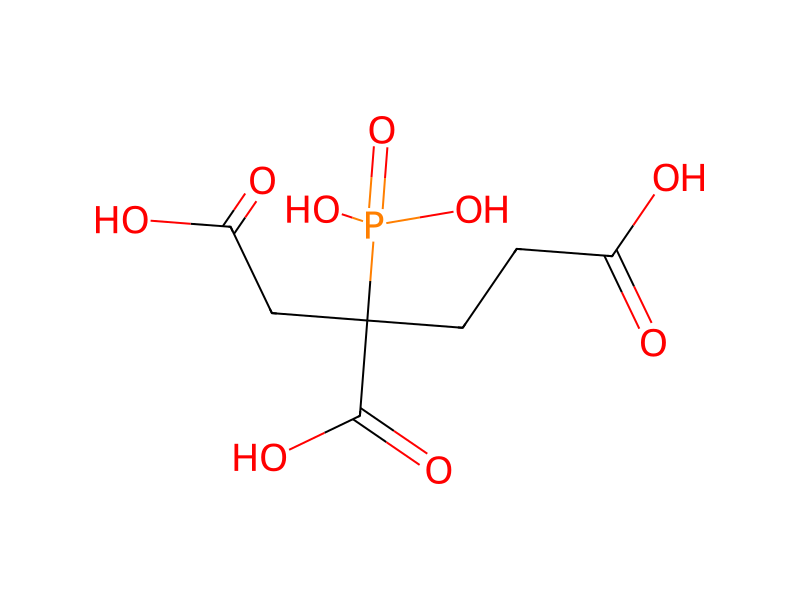
Basic information
- CAS
37971-36-1- Standard SMILES
O=C(O)CCC(CC(=O)O)(C(=O)O)P(=O)(O)O- InChIKey
SZHQPBJEOCHCKM-UHFFFAOYSA-N- Molecular formula
- C7H11O9P
- Average molar mass
- 270.13 g/mol
- Monoisotopic mass
- 270.01406892
Overview
dental plaque crystal growth inhibitor; RN given for parent cpd; structure given in first source
Names & identifiers
- Preferred name
- 2-Phosphonobutane-1,2,4-tricarboxylic acid
- IUPAC
- 2-phosphonobutane-1,2,4-tricarboxylic acid
- English name
- 2-Phosphonobutane-1,2,4-tricarboxylic acid
- Molecular formula
- C7H11O9P
- Molecular weight
- 270.13
Names & synonyms
2-PHOSPHONOBUTANE-1,2,4-TRICARBOXYLIC ACID37971-36-12-Phosphono-1,2,4-butanetricarboxylic acid1,2,4-Butanetricarboxylic acid, 2-phosphono-phosphonobutanetricarboxylic acidBAYHIBIT AMPBTAPBTC tricarboxylic acid306P37319LDTXSID4027999RefChem:478251DTXCID807999
Show more names
PBTCAPBTC 47~53%2-Phosphonobutane-1scale inhibitor PBTCAReverse Osmosis Antiscalant2-Phosphonobutane-1,2,4-TricarboxyL2-Phosphonobutan-1,2,4-tricarbonsure2-phosphono-1,2,4-butanetricarboxylic
253-733-5PBTC2-Phosophonobutane-1,2,4-tricarboxylic acid2-Phosphonobutane-1,2,4-tricarbonic acidMFCD019407533-Carboxy-3-phosphonohexanedioic AcidC7H11O9PEINECS 253-733-5
Database identifiers
- CAS
37971-36-1
Properties
Computed structural propertiesFilling in
- XLogP
- -2.8
- Topological polar surface area
- 169 Ų
- Hydrogen bond donors
- 5
- Hydrogen bond acceptors
- 9
- Rotatable bonds
- 7
- Heavy atoms
- 17
- Formal charge
- 0
- Complexity
- 383
Experimental & physicochemical properties
Chemical ClassesOther Classes -> Organophosphates, Other
Physical Description
Liquid
Produced as a solid; Available as aqeous solution; [eChemPortal: SIDSUNEP] Dark straw-colored liquid; [MSDSonline]
Physicochemical properties
- Melting point
- -15 °C · -15 °C
- Boiling point
- 545.2 · 545.2±60.0 °C(Predicted)
- Density
- 1.25 · 1.25 (50% aq.)
- vapor pressure
- 0 Pa · 0Pa at 25℃
- refractive index
- 1.579 · 1.579
- solubility
- Completely miscible in water
- form
- clear liquid
- pka
- 1.14 · 1.14±0.10(Predicted)
- color
- Colorless to Light yellow
- Water Solubility
Safety & regulation
Safety information is for reference only and does not replace the supplier’s Safety Data Sheet (SDS), applicable regulations, or professional assessment.
GHS classification
GHS Classification
This chemical does not meet GHS hazard criteria for 2.7% (7 of 261) of reports.
Danger
H290 (46.4%): May be corrosive to metals [Warning Corrosive to Metals]
P234, P260, P264, P264+P265, P280, P301+P330+P331, P302+P361+P354, P304+P340, P305+P351+P338, P305+P354+P338, P316, P321, P337+P317, P363, P390, P405, P406, and P501 (click each P-code to see the statement)
Aggregated GHS information provided per 261 reports by companies from 17 notifications to the ECHA C&L Inventory. Each notification may be associated with multiple companies.
Hazard information
Regulatory Information
Chemical: 1,2,4-Butanetricarboxylic acid, 2-phosphono-
1,2,4-Butanetricarboxylic acid, 2-phosphono- is listed on the EPA's Chemical Data Reporting (CDR) system. Manufacturers and importers of 1,2,4-Butanetricarboxylic acid, 2-phosphono- are required to report information about their production and use of this chemical to the EPA under the Toxic Substances Control Act (TSCA). (40 eCFR Part 711)
REACH registered substance: 2-phosphonobutane-1,2,4-tricarboxylic acid (EC: 253-733-5)
1,2,4-Butanetricarboxylic acid, 2-phosphono-: Does not have an individual approval but may be used under an appropriate group standard
Hazards SummaryCorrosive to skin and eyes; [eChemPortal: ERMA] An eye irritant; [MSDSonline] The commercial product is a solution that is not irritating to the skin or eyes. [AIHA]
Hazard Classes and CategoriesMet. Corr. 1 (46.4%)
Toxicology
Adverse Effects
Chemistry & industry
Uses & manufacturing
Uses
Used as additive to cooling water (anti-scaling agent) and to industrial cleaning/bleaching agents (food processing and textile industries); [eChemPortal: SIDSUNEP]
Textiles (Fiber & Fabric Manufacturing) [Category: Industry]
U.S. Production2023: 1,000,000 - <2,500,000 lb
Consumer UsesAnti-adhesive/cohesive
Industry UsesAnti-scaling agent
Household ProductsInformation on 9 consumer products that contain Phosphonobutanetricarboxylic Acid in the following categories is provided:
General Manufacturing Information
Services
1,2,4-Butanetricarboxylic acid, 2-phosphono-: ACTIVE
Applications
Description2-Phosphonobutane-1,2,4-tricarboxylic acid(PBTC) is the latest generation of internationally popular phosphine carboxylic acid, and it is one of the most widely used and best-performing products in the compounding of high-efficiency scale and corrosion inhibitors. It is especially suitable for water quality conditions of high temperature, high hardness, high alkalinity, high pH, and high concentration ratio, and has good scale inhibition performance for calcium carbonate scale and calcium phosphate scale.
UsesPBTC is the most widely used in the compounding of high-efficiency scale and corrosion inhibitors, is one of the products with the best performance, and is also an excellent stabilizer for zinc salts. It is widely used in the corrosion and scale inhibition of circulating cooling water system and oilfield water injection system, especially suitable for compounding with zinc salt and copolymer. It can be used as a chelating agent and metal cleaning agent in the washing industry.
Related reactions
0 records
No related reactions yet