HomeMCPWorkbenchSkills
HomeWorkbenchNotificationsMe
llms.txt · MCP GuidePrivacy Policy · Terms of Service · Supportv1.8.3
  1. Home
  2. /Compound

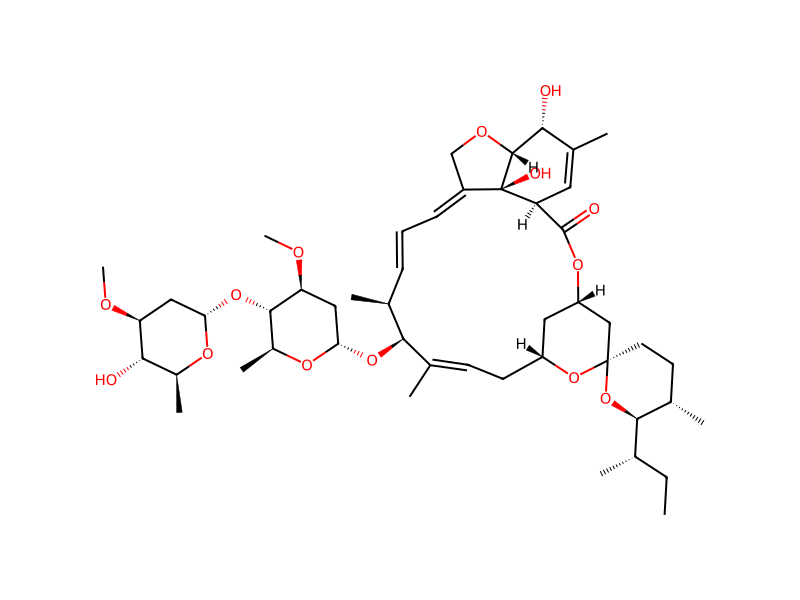
Ivermectin B1a

HCID 6321424
New reaction
Print

Completing data — refresh the page later to see the latest
Basic informationOverviewNames & identifiersPropertiesSafety & regulationChemistry & industryRelated reactionsCompound notes
Substructure searchFind similar structures

Basic information

CAS
70161-11-4
Standard SMILES
CC[C@H](C)[C@H]1O[C@]2(CC[C@@H]1C)C[C@@H]1C[C@@H](C/C=C(\C)[C@@H](O[C@H]3C[C@H](OC)[C@@H](O[C@H]4C[C@H](OC)[C@@H](O)[C@H](C)O4)[C@H](C)O3)[C@@H](C)/C=C/C=C3\CO[C@@H]4[C@H](O)C(C)=C[C@@H](C(=O)O1)[C@]34O)O2
InChIKey
AZSNMRSAGSSBNP-XPNPUAGNSA-N
Molecular formula
C48H74O14
Average molar mass
875.1 g/mol
Monoisotopic mass
874.50785703

Overview

LSM-5397 is a milbemycin.

Names & identifiers

Preferred name
Ivermectin B1a
IUPAC
(1R,4S,5'S,6R,6'R,8R,10E,12S,13S,14E,16E,20R,21R,24S)-6'-[(2S)-butan-2-yl]-21,24-dihydroxy-12-[(2R,4S,5S,6S)-5-[(2S,4S,5S,6S)-5-hydroxy-4-methoxy-6-methyloxan-2-yl]oxy-4-methoxy-6-methyloxan-2-yl]oxy-5',11,13,22-tetramethylspiro[3,7,19-trioxatetracyclo[15.6.1.14,8.020,24]pentacosa-10,14,16,22-tetraene-6,2'-oxane]-2-one
English name
Ivermectin
Molecular formula
C48H74O14
Molecular weight
875.099

Names & synonyms

Ivermectin B1aDihydroavermectin B1a71827-03-722,23-Dihydroavermectin B1aavermectin H2B1aDTXSID8023181H2B1a5-O-demethyl-22,23-dihydroavermectin A1a91Y2202OUWDTXCID303181CHEBI:63941Avermectin A1a, 5-O-demethyl-22,23-dihydro-
Show more names
Component B1aIvermectin component bDihydroaverMectin B1a, IverMectin, 22,23-DihydroaverMectin B1a
(1R,4S,5'S,6R,6'R,8R,10E,12S,13S,14E,16E,20R,21R,24S)-6'-[(2S)-butan-2-yl]-21,24-dihydroxy-12-[(2R,4S,5S,6S)-5-[(2S,4S,5S,6S)-5-hydroxy-4-methoxy-6-methyloxan-2-yl]oxy-4-methoxy-6-methyloxan-2-yl]oxy-5',11,13,22-tetramethylspiro[3,7,19-trioxatetracyclo[15.6.1.14,8.020,24]pentacosa-10,14,16,22-tetraene-6,2'-oxane]-2-one(1R,4S,5'S,6R,6'R,8R,10E,12S,13S,14E,16E,20R,21R,24S)-6'-((2S)-butan-2-yl)-21,24-dihydroxy-12-((2R,4S,5S,6S)-5-((2S,4S,5S,6S)-5-hydroxy-4-methoxy-6-methyloxan-2-yl)oxy-4-methoxy-6-methyloxan-2-yl)oxy-5',11,13,22-tetramethylspiro(3,7,19-trioxatetracyclo(15.6.1.14,8.020,24)pentacosa-10,14,16,22-tetraene-6,2'-oxane)-2-oneRefChem:1087879(1'R,2R,4'S,5S,6R,8'R,10'E,12'S,13'S,14'E,16'E,20'R,21'R,24'S)-6-((2S)-butan-2-yl)-21',24'-dihydroxy-12'-(((2R,4S,5S,6S)-5-(((2S,4S,5S,6S)-5-hydroxy-4-methoxy-6-methyloxan-2-yl)oxy)-4-methoxy-6-methyloxan-2-yl)oxy)-5,11',13',22'-tetramethyl-3',7',19'-trioxaspiro(oxane-2,6'-tetracyclo(15.6.1.14,8.020,24)pentacosane)-10',14',16',22'-tetraen-2'-one276-046-2615-075-0(2aE,4E,5'S,6S,6'R,7S,8E,11R,13R,15S,17aR,20R,20aR,20bS)-6'-((2S)-butan-2-yl)-20,20b-dihydroxy-5',6,8,19-tetramethyl-17-oxo-3',4',5',6,6',10,11,14,15,17,17a,20,20a,20b-tetradecahydro-2H,7H-spiro(11,15-methanofuro(4,3,2-pq)(2,6)benzodioxacyclooctadecine-13,2'-pyran)-7-yl 2,6-dideoxy-4-O-(2,6-dideoxy-3-O-methyl-alpha-L-arabino-hexopyranosyl)-3-O-methyl-alpha-L-arabino-hexopyranosideIvermectin Component B1a

Properties

Computed structural propertiesFilling in

XLogP
4.1
Topological polar surface area
170 Ų
Hydrogen bond donors
3
Hydrogen bond acceptors
14
Rotatable bonds
8
Heavy atoms
62
Formal charge
0
Complexity
1,680

Experimental & physicochemical properties

PesticidesPesticide
Collision Cross Section292.7 Ų [M+Na]+ [CCS Type: TW; Method: calibrated with polyalanine and drug standards]

Physicochemical properties

Symbol(GHS)
8 · GHS08,GHS09,GHS06
Signal word
Danger
Hazard statements
400 · H400-H312-H361-H300-H373
Precautionary statements
201 · P201-P202-P281-P308+P313-P405-P501-P273-P391-P501-P264-P270-P301+P310-P321-P330-P405-P501-P280-P302+P352-P312-P322-P363-P501-P260-P314-P501
RIDADR
2588 · 2588
HazardClass
6.1 · 6.1(a)
PackingGroup
II

Safety & regulation

Safety information is for reference only and does not replace the supplier’s Safety Data Sheet (SDS), applicable regulations, or professional assessment.

GHS classification

GHS Classification · 4 items

Danger

H300 (100%): Fatal if swallowed [Danger Acute toxicity, oral]

P203, P260, P264, P270, P273, P280, P301+P316, P302+P352, P317, P318, P319, P321, P330, P362+P364, P391, P405, and P501 (click each P-code to see the statement)

Aggregated GHS information provided per 27 reports by companies from 2 notifications to the ECHA C&L Inventory. Each notification may be associated with multiple companies.

Hazard information

Regulatory InformationAvermectin A1a, 5-O-demethyl-22,23-dihydro-: Does not have an individual approval but may be used as a component in a product covered by a group standard. It is not approved for use as a chemical in its own right.
Hazard Classes and CategoriesAcute Tox. 2 (100%)

Toxicology

Health EffectsAvermectins are neurotoxic and have reproductive and developmental effects. (L1826)
Exposure RoutesIvermectin is moderately well absorbed. Improved absorption with high fat meal.
Toxicity Summary · 1 item

Ivermectin binds selectively and with high affinity to glutamate-gated chloride ion channels in invertebrate muscle and nerve cells of the microfilaria. This binding causes an increase in the permeability of the cell membrane to chloride ions and results in hyperpolarization of the cell, leading to paralysis and death of the parasite. Ivermectin also is believed to act as an agonist of the neurotransmitter gamma-aminobutyric acid (GABA), thereby disrupting GABA-mediated central nervous system (CNS) neurosynaptic transmission. Ivermectin may also impair normal intrauterine development of O. volvulus microfilariae and may inhibit their release from the uteri of gravid female worms. It has low solubility in water and extensive non-specific binding. It opens GABA-insensitive chloride channels, reducing membrane resistance and increasing conductance inward. (T10)

Chemistry & industry

Pharmacology

Metabolism/Metabolites · 1 item

Primarily hepatic. Ivermectin and/or its metabolites are excreted almost exclusively in the feces over an estimated 12 days, with less than 1 % of the administered dose excreted in the urine. Route of Elimination: Ivermectin is metabolized in the liver, and ivermectin and/or its metabolites are excreted almost exclusively in the feces over an estimated 12 days, with less than 1% of the administered dose excreted in the urine. Half Life: 16 hours (also reported at 22-28 hours)

Uses & manufacturing

Uses · 1 item

For the treatment of intestinal (i.e., nondisseminated) strongyloidiasis due to the nematode parasite <i>Strongyloides stercoralis</i>. Also for the treatment of onchocerciasis (river blindness) due to the nematode parasite <i>Onchocerca volvulus</i>. Can be used to treat scabies caused by <i>Sarcoptes scabiei</i>. Active ingredient in some commercial ant bait traps. (L829)

Applications · 1 item

UsesIvermectin B1a (dihydroavermectin B1a) is the major component (>80%) of the commercial anthelmintic, ivermectin. Members of the avermectin/milbemycin anthelmintic class exert their anthelmintic effects by binding to glutamate-gated chloride channels expressed on nematode neurones and pharyngeal muscle cells. The avermectins and milbemycins are also potent insecticides. The individual 25-sec-butyl (B1a) and 25-iso-propyl (B1b) components of ivermectin have received little separate study.

Additional notes

DefinitionChEBI: LSM-5397 is a milbemycin.

Related reactions

1 records
New reaction record
HRID 1648803 reaction equation
HRID 1648803As product

Compound notes

On this pageBasic informationOverviewNames & identifiersPropertiesSafety & regulationChemistry & industryRelated reactionsCompound notes

Database identifiers

CAS
70161-11-4、71827-03-7
PubChem CID
6321424
DTXSID
DTXSID8023181
ChEMBL
CHEMBL263291、CHEMBL5488101
ChEBI
CHEBI:94551
UNII
91Y2202OUW
EC Number
276-046-2、615-075-0
Nikkaji
J3.421.993A
Signs and Symptoms · 1 item

Avermectins cause irritation of skin and eyes, central nervous system depression (incoordination, tremors, lethargy, excitation, pupil dilation, coma), vomiting, convulsions and/or tremors, and respiratory failure at high doses. (L1826) Adverse effects include muscle or joint pain, dizziness, fever, headache, skin rash, fast heartbeat.

Carcinogen ClassificationNot listed by IARC.
Toxicity DataLD<sub>50</sub> = 29.5 mg/kg (Mouse, oral); LD<sub>50</sub> = 10 mg/kg (Rat, oral)

Safety data

ridadr
2588
Signal word
Danger
Symbol(GHS)
GHS08,GHS09,GHS06
hazard_class
6.1(a)
packing_group
II
Hazard statements
H400-H312-H361-H300-H373
Precautionary statements
P201-P202-P281-P308+P313-P405-P501-P273-P391-P501-P264-P270-P301+P310-P321-P330-P405-P501-P280-P302+P352-P312-P322-P363-P501-P260-P314-P501