
uspto-grants-1993_09 · 10.6084/m9.figshare.5104873.v1 · US05248810
查看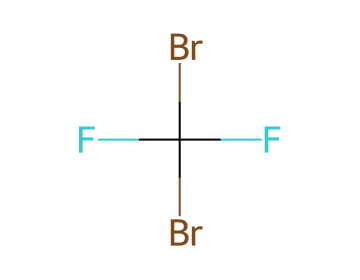
IDENTITY
COMPUTED
PROPERTIES
1.99
Characteristic odor
2.29 at 59 °F (NIOSH, 2024) - Denser than water; will sink
2.3063 g/cu cm @ 15 °C
Density (gas): 8.7 kg/m³
2.29 at 59 °
(59 °F): 2.29
Colorless heavy liq
COLORLESS GAS
Colorless, heavy liquid or gas (above 76 degrees F).
Insoluble (NIOSH, 2024)
Sol in ether, acetone, benzene, and water.
Sol in methanol; insol in water
Solubility in water: none
Insoluble
76 °F at 760 mmHg (NIOSH, 2024)
25 °C @ 760 mm Hg
22.8 °C
76 °F
76 °F
WHEN HEATED TO DECOMPOSITION, IT EMITS VERY TOXIC FUMES OF /HYDROGEN BROMIDE AND HYDROGEN FLUORIDE./
-231 °F (NIOSH, 2024)
-110.1 °C
-101.1 °C
-231 °F
-231 °F
7.2 (AIR= 1)
Relative vapor density (air = 1): 7.2
620 mmHg (NIOSH, 2024)
820.0 [mmHg]
820 mm Hg @ 25 °C
Vapor pressure, kPa at 20 °C: 83
620 mmHg
620 mmHg
3.976X10⁻² N/m @ -110 °C
Index of refraction: 1.399 @ 12 °C
GHS
Warning
H420 (100%): Harms public health and the environment by destroying ozone in the upper atmosphere [Warning Hazardous to the ozone layer]
P502</a, and a href="https://pubchem.ncbi.nlm.nih.gov/ghs/#P502">P502 (click each P-code to see the statement)
Aggregated GHS information provided per 39 reports by companies from 2 notifications to the ECHA C&L Inventory.;Information may vary between notifications depending on impurities, additives, and other factors. The percentage value in parenthesis indicates the notified classification ratio from companies that provide hazard codes. Only hazard codes with percentage values above 10% are shown. For more detailed information, please visit ECHA C&L website.
HAZARDS
Chemical: Methane, dibromodifluoro-
Dibromodifluoromethane: Does not have an individual approval but may be used under an appropriate group standard
The New Jersey Worker and Community Right to Know Act requires public and private employers to provide information about hazardous substances at their workplaces. (N.J.S.A. 34:5A-1 et. seq.)
Evaluation - Chemicals that are unlikely to require further regulation to manage risks to human health
Class 9
Excerpt from ERG Guide 171 [Substances (Low to Moderate Hazard)]:;Some may burn but none ignite readily. Containers may explode when heated. Some may be transported hot. For UN3508, Capacitor, asymmetric, be aware of possible short circuiting as this product is transported in a charged state. Polymeric beads, expandable (UN2211) may evolve flammable vapours. (ERG, 2024)
· Some may burn but none ignite readily.;· Containers may explode when heated.;· Some may be transported hot.;· For UN3508, Capacitor, asymmetric, be aware of possible short circuiting as this product is transported in a charged state.;· Polymeric beads, expandable (UN2211) may evolve flammable vapours.
Not combustible. Gives off irritating or toxic fumes (or gases) in a fire.
NONFLAMMABLE.
Excerpt from ERG Guide 171 [Substances (Low to Moderate Hazard)]:;Inhalation of material may be harmful. Contact may cause burns to skin and eyes. Inhalation of Asbestos dust may have a damaging effect on the lungs. Fire may produce irritating, corrosive and/or toxic gases. Some liquids produce vapors that may cause dizziness or asphyxiation. Runoff from fire control or dilution water may cause environmental contamination. (ERG, 2024)
· Inhalation of material may be harmful.;· Contact may cause burns to skin and eyes.;· Inhalation of Asbestos dust may have a damaging effect on the lungs.;· Fire may produce irritating, corrosive and/or toxic gases.;· Some liquids produce vapors that may cause dizziness or asphyxiation.;· Runoff from fire control or dilution water may cause environmental contamination.
Pulmonary damage is noted in animals after a single exposure of 4000 ppm. Decomposition may yield hydrogen bromide and hydrogen fluoride; TLV Basis = irritation of upper respiratory tract, liver damage, and CNS impairment; [ACGIH] See CHLOROFLUOROCARBONS.
1941 171
1941 171
Fluorinated Organic Compounds
UN Hazard Class: 9; UN Pack Group: III
DIBROMODIFLUOROMETHANE is incompatible with the following: Chemically-active metals such as sodium, potassium, calcium, powdered aluminum, zinc & magnesium (NIOSH, 2024).
Decomposes on contact with hot surfaces or flames. This produces toxic and corrosive gases including hydrogen bromide and hydrogen fluoride. Reacts with alkali metals, powdered aluminium, magnesium and zinc.
SAFETY
Excerpt from ERG Guide 171 [Substances (Low to Moderate Hazard)]:;CAUTION: Fire involving Safety devices (UN3268) and Fire suppressant dispersing devices (UN3559) may have a delayed activation and a risk of hazardous projectiles. Extinguish the fire at a safe distance.;SMALL FIRE: Dry chemical, CO2, water spray or regular foam.;LARGE FIRE: Water spray, fog or regular foam. Do not scatter spilled material with high-pressure water streams. If it can be done safely, move undamaged containers away from the area around the fire. Dike runoff from fire control for later disposal.;FIRE INVOLVING TANKS: Cool containers with flooding quantities of water until well after fire is out. Withdraw immediately in case of rising sound from venting safety devices or discoloration of tank. ALWAYS stay away from tanks in direct contact with flames. (ERG, 2024)
In case of fire in the surroundings, use appropriate extinguishing media.
Fresh air, rest. Half-upright position. Artificial respiration may be needed. Refer for medical attention.
Rinse and then wash skin with water and soap.
First rinse with plenty of water for several minutes (remove contact lenses if easily possible), then refer for medical attention.
· CALL 911. Then call emergency response telephone number on shipping paper. If shipping paper not available or no answer, refer to appropriate telephone number listed on the inside back cover.;· Keep unauthorized personnel away.;· Stay upwind, uphill and/or upstream.
· Do not touch or walk through spilled material.;· Stop leak if you can do it without risk.;· Prevent dust cloud.;· For Asbestos, avoid inhalation of dust. Cover spill with plastic sheet or tarp to minimize spreading. Do not clean up or dispose of, except under supervision of a specialist.;Small Dry Spill;· With clean shovel, place material into clean, dry container and cover loosely; move containers from spill area.;Small Spill;· Pick up with sand or other non-combustible absorbent material and place into containers for later disposal.;Large Spill;· Dike far ahead of liquid spill for later disposal.;· Cover powder spill with plastic sheet or tarp to minimize spreading.;· Prevent entry into waterways, sewers, basements or confined areas.
Excerpt from NIOSH Pocket Guide for Difluorodibromomethane:;Eye: IRRIGATE IMMEDIATELY - If this chemical contacts the eyes, immediately wash (irrigate) the eyes with large amounts of water, occasionally lifting the lower and upper lids. Get medical attention immediately.;Skin: WATER FLUSH IMMEDIATELY - If this chemical contacts the skin, immediately flush the contaminated skin with water. If this chemical penetrates the clothing, immediately remove the clothing and flush the skin with water. Get medical attention promptly.;Breathing: RESPIRATORY SUPPORT - If a person breathes large amounts of this chemical, move the exposed person to fresh air at once. If breathing has stopped, perform artificial respiration. Keep the affected person warm and at rest. Get medical attention as soon as possible.;Swallow: MEDICAL ATTENTION IMMEDIATELY - If this chemical has been swallowed, get medical attention immediately. (NIOSH, 2024)
General First Aid:;· Call 911 or emergency medical service.;· Ensure that medical personnel are aware of the material(s) involved, take precautions to protect themselves and avoid contamination.;· Move victim to fresh air if it can be done safely.;· Administer oxygen if breathing is difficult.;· If victim is not breathing:;-- DO NOT perform mouth-to-mouth resuscitation; the victim may have ingested or inhaled the substance.;-- If equipped and pulse detected, wash face and mouth, then give artificial respiration using a proper respiratory medical device (bag-valve mask, pocket mask equipped with a one-way valve or other device).;-- If no pulse detected or no respiratory medical device available, provide continuous compressions. Conduct a pulse check every two minutes or monitor for any signs of spontaneous respirations.;· Remove and isolate contaminated clothing and shoes.;· For minor skin contact, avoid spreading material on unaffected skin.;· In case of contact with substance, remove immediately by flushing skin or eyes with running water for at least 20 minutes.;· For severe burns, immediate medical attention is required.;· Effects of exposure (inhalation, ingestion, or skin contact) to substance may be delayed.;· Keep victim calm and warm.;· Keep victim under observation.;· For further assistance, contact your local Poison Control Center.;· Note: Basic Life Support (BLS) and Advanced Life Support (ALS) should be done by trained professionals.
(General first aid procedures);Eye: Irrigate immediately - If this chemical contacts the eyes, immediately wash (irrigate) the eyes with large amounts of water, occasionally lifting the lower and upper lids. Get medical attention immediately.;Skin: Water flush immediately - If this chemical contacts the skin, immediately flush the contaminated skin with water. If this chemical penetrates the clothing, immediately remove the clothing and flush the skin with water. Get medical attention promptly.;Breathing: Respiratory support;Swallow: Medical attention immediately - If this chemical has been swallowed, get medical attention immediately.
See Chemical Dangers.
· Wear positive pressure self-contained breathing apparatus (SCBA).;· Structural firefighters' protective clothing provides thermal protection but only limited chemical protection.
IN GENERAL, MATERIALS WHICH ARE TOXIC AS STORED OR WHICH CAN DECOMP INTO TOXIC COMPONENTS ... SHOULD BE STORED IN A COOL, WELL-VENTILATED PLACE, OUT OF DIRECT RAYS OF THE SUN, AWAY FROM AREAS OF HIGH FIRE HAZARD, & SHOULD BE PERIODICALLY INSPECTED ... INCOMPATIBLE MATERIALS SHOULD BE ISOLATED FROM EACH OTHER.
Excerpt from ERG Guide 171 [Substances (Low to Moderate Hazard)]:;Do not touch or walk through spilled material. Stop leak if you can do it without risk. Prevent dust cloud. For Asbestos, avoid inhalation of dust. Cover spill with plastic sheet or tarp to minimize spreading. Do not clean up or dispose of, except under supervision of a specialist.;SMALL DRY SPILL: With clean shovel, place material into clean, dry container and cover loosely; move containers from spill area.;SMALL SPILL: Pick up with sand or other non-combustible absorbent material and place into containers for later disposal.;LARGE SPILL: Dike far ahead of liquid spill for later disposal. Cover powder spill with plastic sheet or tarp to minimize spreading. Prevent entry into waterways, sewers, basements or confined areas. (ERG, 2024)
SRP: At the time of review, criteria for land treatment or burial (sanitary landfill) disposal practices are subject to significant revision. Prior to implementing land disposal of waste residue (including waste sludge), consult with environmental regulatory agencies for guidance on acceptable disposal practices.
Ventilation. Do NOT let this chemical enter the environment.
SUFFICIENT EXHAUST & GENERAL VENTILATION SHOULD BE PROVIDED ... EXCESS SKIN CONTACT WITH LIQ FLUOROCARBONS SHOULD BE MINIMIZED TO PREVENT DEFATTING OF SKIN & POSSIBLE SKIN ABSORPTION. /FLUOROCARBONS/
If this chemical gets into the eyes, irrigate immediately. If this chemical contacts the skin, flush with water immediately. ... Remove nonimpervious clothing promptly if wet or contaminated.
FILLING AREAS SHOULD BE MONITORED TO ENSURE THAT THE AMBIENT CONCN OF FLUOROCARBONS DOES NOT EXCEED 1000 PPM ... INHALATION OF FLUOROCARBON VAPORS SHOULD BE AVOIDED ... /FLUOROCARBONS/
APPEARANCE OF TOXIC DECOMP PRODUCTS SERVES AS WARNING OF OCCURRENCE OF THERMAL DECOMP & DETECTION OF SHARP ACRID ODOR WARNS OF PRESENCE ... HALIDE LAMPS OR ELECTRONIC LEAK DETECTORS MAY ALSO BE USED. ADEQUATE VENTILATION ALSO AVOIDS PROBLEM OF TOXIC DECOMPOSITION PRODUCTS. /FLUOROCARBONS/
For more Preventive Measures (Complete) data for DIBROMODIFLUOROMETHANE (7 total), please visit the HSDB record page.
Excerpt from ERG Guide 171 [Substances (Low to Moderate Hazard)]:;IMMEDIATE PRECAUTIONARY MEASURE: Isolate spill or leak area in all directions for at least 50 meters (150 feet) for liquids and at least 25 meters (75 feet) for solids.;SPILL: Increase the immediate precautionary measure distance, in the downwind direction, as necessary.;FIRE: If tank, rail tank car or highway tank is involved in a fire, ISOLATE for 800 meters (1/2 mile) in all directions; also, consider initial evacuation for 800 meters (1/2 mile) in all directions. (ERG, 2024)
Immediate precautionary measure;· Isolate spill or leak area in all directions for at least 50 meters (150 feet) for liquids and at least 25 meters (75 feet) for solids.;Spill;· For highlighted materials: see Table 1 - Initial Isolation and Protective Action Distances.;· For non-highlighted materials: increase the immediate precautionary measure distance, in the downwind direction, as necessary.;Fire;· If tank, rail tank car or highway tank is involved in a fire, ISOLATE for 800 meters (1/2 mile) in all directions; also, consider initial evacuation for 800 meters (1/2 mile) in all directions.
TOXICITY
IF INHALATION OCCURS, EPINEPHRINE OR OTHER SYMPATHOMIMETIC AMINES & ADRENERGIC ACTIVATORS SHOULD NOT BE ADMIN SINCE THEY WILL FURTHER SENSITIZE HEART TO DEVELOPMENT OF ARRHYTHMIAS. /FLUOROCARBONS/
respiratory system, central nervous system, liver
TERRESTRIAL FATE: Based on a classification scheme(1), an estimated Koc value of 49(SRC), determined from a structure estimation method(2), indicates that dibromodifluoromethane is expected to have very high mobility in soil(SRC). Volatilization of dibromodifluoromethane from moist soil surfaces is expected to be an important fate process(SRC) given an estimated Henry's Law constant of 0.03 atm-cu m/mole(SRC), using a fragment constant estimation method(3). Volatilization of dibromodifluoromethane from dry soil surfaces is expected to occur rapidly(SRC) based upon a vapor pressure of 820 mm Hg(4). Based upon the highly halogenated structure of dibromodifluoromethane, biodegradation is expected to be slow(5).
AQUATIC FATE: Based on a classification scheme(1), an estimated Koc value of 49(SRC), determined from a structure estimation method(2), indicates that dibromodifluoromethane is not expected to adsorb to suspended solids and sediment in water(SRC). Volatilization from water surfaces is expected(3) based upon an estimated Henry's Law constant of 0.03 atm-cu m/mole(SRC), developed using a fragment constant estimation method(4). Using this Henry's Law constant and an estimation method(3), volatilization half-lives for a model river and model lake are 1.5 hrs and 5.7 days, respectively(SRC). According to a classification scheme(5), an estimated BCF of 6.9(SRC), from an estimated log Kow(6) and a regression-derived equation(7), suggests the potential for bioconcentration in aquatic organisms is low. Based upon the highly halogenated structure of dibromodifluoromethane, biodegradation is expected to be slow(8).
ATMOSPHERIC FATE: According to a model of gas/particle partitioning of semivolatile organic compounds in the atmosphere(1), dibromodifluoromethane, which has a vapor pressure of 820 mm Hg at 25 °C(2), is expected to exist solely in the vapor-phase in the ambient atmosphere. Vapor-phase dibromodifluoromethane is slowly degraded in the atmosphere by reaction with photochemically-produced hydroxyl radicals(SRC); the half-life for this reaction in air is estimated to be greater than 44 years(3), based on its rate constant of <5.0X10⁻¹⁶ cu cm/molecule-sec at 25 °C(4). Dibromodifluoromethane absorbs very little UV radiation above 290 nm and is not expected to photolyze at an environmentally important rate in the ambient atmosphere(5). Based on dibromodifluoromethane's long residence time in the atmosphere, it will diffuse gradually into the upper limits of the troposphere, and eventually into the stratosphere above the ozone layer where it will contribute to ozone depletion(6).
Neurotoxin - Acute solvent syndrome;Occupational hepatotoxin - Secondary hepatotoxins: the potential for toxic effect in the occupational setting is based on cases of poisoning by human ingestion or animal experimentation.;Toxic Pneumonitis - Inflammation of the lungs induced by inhalation of metal fumes or toxic gases and vapors.
The substance can be absorbed into the body by inhalation.
inhalation, ingestion, skin and/or eye contact
Cough. Sore throat. Laboured breathing. Shortness of breath. Confusion. Drowsiness. Unconsciousness.
In Animals: irritation respiratory system; central nervous system symptoms; liver damage
Avoid release to the environment because of its impact on the ozone layer.
Consider the points of attack /skin, respiratory system/ in preplacement and periodic physical examinations.
Using a structure estimation method based on molecular connectivity indices(1), the Koc for dibromodifluoromethane can be estimated to be about 49(SRC). According to a classification scheme(2), this estimated Koc value suggests that dibromodifluoromethane is expected to have very high mobility in soil.
Dibromodifluoromethane (CBr2F2, CAS # 75-61-6) was evaluated for behavioral changes associated with acute inhalation toxicity in 4 male cats individually exposed in an airtight Plexiglas cages to slowly increasing atmospheric concentrations (in air) approaching 3 vol%. Evaporated from a thermostated vessel, CBr2F2 was mixed immediately with the main air supply (gas density of 1.90 gm/cm3), the ambient atmospheric content controlled by floating-body gauges and monitored by gas densitometer at the exhaust end of the experimental chamber. Treatment in 2 cats each of 99.4 and 96.4 vol% samples was associated with clinical signs of increasing gravity with increasing atmospheric concentrations, including enlarged pupils and blinking eyelids, arched back, head shaking, raised fur, tremor, slight to extreme restlessness, static gait, optisthotonus, gasping, salivation, prostration and marked ataxia, tonic convulsions, and clonic convulsions. The symptoms, their time to onset and the associated atmospheric levels of CBr2F2 were largely consistent between individual cats and samples, with behavioral changes and narcosis first noted at approximately 0.5% v/v (10 minutes) and convulsions at 2.2-2.7 v/v (44-57 minutes). The time to near recovery, generally defined by the authors by the cat's return to its feet, ranged from 2.5 to 10 minutes after termination of the exposures, although ataxia persisted (duration unspecified) in all animals.
URBAN/SUBURBAN: Numerous air samples taken from four separate landfills located in New Jersey contained detectable levels of dibromodifluoromethane(1). At one landfill, dibromodifluoromethane was detected 85% of the time while at the other three landfills it was detected 65% of the time (concentrations not specified)(1). A study of the types and levels of brominated compounds released into the atmosphere by chemical manufacturers in the state of Arkansas revealed detectable levels of dibromodifluoromethane over a two year period(2). Many of the chemicals studied were detected off plant property suggesting transport into neighboring environments was occurring(2).
EARLY ... HUMAN EXPERIENCE INDICATED THAT HIGH VAPOR CONCN (EG, 20%) MAY CAUSE CONFUSION, PULMONARY IRRITATION, TREMORS & RARELY COMA, BUT THAT THESE EFFECTS WERE GENERALLY TRANSIENT & WITHOUT LATE SEQUELAE. ... CAUSE OF DEATH /FROM ABUSE OF FLUOROCARBONS/ IS IN CONSIDERABLE DOUBT. FREEZING OF AIRWAY SOFT TISSUES CAN PROBABLY BE ELIMINATED AS A CAUSE OF DEATH EXCEPT IN CASES WHERE THE PRODUCT WAS SPRAYED DIRECTLY INTO THE MOUTH FROM ITS CONTAINER OR FROM A BALLOON CONTAINING SOME LIQUID. LARYNGEAL SPASM OR EDEMA, OXYGEN DISPLACEMENT, OR SENSITIZATION OF MYOCARDIUM TO ENDOGENOUS CATECHOLAMINES WITH SUBSEQUENT VENTRICULAR FIBRILLATION APPEAR TO BE REASONABLE POSSIBILITIES. /FLUOROCARBONS/
A SPECIAL CLASS OF CHEMICALS SUBJECT TO ABUSE BY INHALATION ARE THE FLUOROHYDROCARBONS ... THE "SNIFFING" OF SUCH AEROSOL SPRAYS IS HAZARDOUS PRACTICE. ... 110 "SUDDEN SNIFFING DEATHS" /HAVE BEEN IDENTIFIED/ ... IN EACH CASE THE VICTIM SPRAYED THE AEROSOL INTO A PLASTIC BAG, INHALED THE CONTENTS, BECAME EXCITED, RAN 90 M OR SO, COLLAPSED, & DIED. NECROPSY FINDINGS WERE LARGELY NEGATIVE ... ALTHOUGH AMOUNT OF PROPELLANT ABSORBED INTO BLOOD FROM USE OF HAIRSPRAY, COSMETIC, HOUSEHOLD, & MEDICATED AEROSOLS MUST VARY WITH CIRCUMSTANCES, PHYSICIAN IS ADVISED TO COUNSEL ... PATIENT ON POTENTIAL DANGERS, PARTICULARLY FROM THEIR USE IN POORLY VENTILATED CONFINED AREAS. IT IS POSSIBLE THAT PATIENTS WITH CARDIAC OR RESPIRATORY DISORDERS MAY PROVE ESPECIALLY SUSCEPTIBLE. /FLUOROHYDROCARBONS/
Fluorocarbons containing bromine ... are more toxic than the corresponding chloro compounds. /Fluorocarbons/
MANUFACTURING PROCESSES USE HYDROFLUORIC ACID FROM FLUOROSPAR IN PRODUCTION OF ALL FLUOROCARBONS. SOME PROCESSES USE CARBON TETRACHLORIDE FROM CARBON DISULFIDE, OR AS CO-PRODUCT OF PERCHLOROETHYLENE & CHLORINATION OF PROPYLENE, OR CHLOROFORM FROM CHLORINATION OF METHANOL. THE MAJOR HAZARDS RELATE PRIMARILY TO THE INADVERTENT RELEASE OF HYDROFLUORIC ACID OR CARBON TETRACHLORIDE, RATHER THAN TO THE MANUFACTURED FLUOROCARBONS. /FLUOROCARBONS/
FLUOROCARBON VAPORS ARE FOUR TO FIVE TIMES HEAVIER THAN AIR. THUS HIGH CONCN TEND TO ACCUMULATE IN LOW-LYING AREAS, RESULTING IN HAZARD OF INHALATION OF CONCENTRATED VAPORS, WHICH MAY BE FATAL. ... THE HIGHEST EXPOSURE IN THE PLANT OCCURS WITH VENTING OF GASES FROM RETURNABLE CYLINDERS. /FLUOROCARBONS/
REGULATORY
Chemical: Methane, dibromodifluoro-
Dibromodifluoromethane: Does not have an individual approval but may be used under an appropriate group standard
The New Jersey Worker and Community Right to Know Act requires public and private employers to provide information about hazardous substances at their workplaces. (N.J.S.A. 34:5A-1 et. seq.)
PHARMACOLOGY
Cardiac arrhythmia, possibly aggravated by elevated levels of catecholamines due to stress ... is suggested as the cause of these adverse responses, which may lead to death. /Fluorocarbons/
... MAIN FACTOR AFFECTING FATE OF FLUOROCARBONS IS BODY FAT, WHERE THEY ARE CONCENTRATED & SLOWLY RELEASED INTO BLOOD @ CONCN THAT SHOULD NOT CAUSE ANY RISK OF CARDIAC SENSITIZATION. /FLUOROCARBONS/
THERE IS A SIGNIFICANT ACCUMULATION OF PROPELLANTS IN BRAIN, LIVER & LUNG COMPARED TO BLOOD LEVELS, SIGNIFYING PROPELLANT TISSUE DISTRIBUTION SIMILAR TO THAT OF CHLOROFORM. /FLUOROCARBONS/
USES
Has been used in fire extinguishers and as a chemical intermediate; [ACGIH]
See CHLOROFLUOROCARBONS
FIRE-EXTINGUISHING AGENT
Synthesis of dyes, pharmaceuticals, quarternary ammonium cmpd
POLYMER INTERMEDIATE
This and other Freons are used occasionally to trace the plume of major power plants
(1977) PROBABLY GREATER THAN 2.27X10+6 G
Vapor phase bromination of difluoromethane
Grades: Pure (95.0% minimum)
Methane, dibromodifluoro-: ACTIVE
MECHANICAL VAPOR COMPRESSION SYSTEMS USE FLUOROCARBONS FOR REFRIGERATION & AIR CONDITIONING & ACCOUNT FOR ... MAJORITY OF REFRIGERATION CAPABILITY IN US. ... FLUOROCARBONS ARE USED AS REFRIGERANTS IN HOME APPLIANCES, MOBILE AIR CONDITIONING UNITS, RETAIL FOOD REFRIGERATION SYSTEMS & ... CHILLERS. /FLUOROCARBONS/
THE BROMINE-CONTAINING FLUOROCARBONS OPERATE BY CHEMICAL INTERRUPTION OF THE COMBUSTION CHAIN, AND ARE USED IN TOTAL FLOODING SYSTEMS FOR COMPUTER ROOMS AND TELEPHONE FACILITIES, AS WELL AS AIRCRAFT AND PORTABLE FIRE EXTINGUISHERS, INCLUDING USE ON THE AIR FORCE P-13 RAPID INTERVENTION CRASH TRUCKS. HALON EMERGES FROM THE FIRE EXTINGUISHER NOZZLE AS A MIXTURE OF 85 PERCENT LIQUID AND 15 PERCENT VAPOR AND IS DISCHARGED OVER LONG DISTANCES. IT COMPLETELY VAPORIZES UPON CONTACT WITH FIRE. /BROMINATED FLUOROCARBONS/
ALIASES
REACTIONS
uspto-grants-1993_09 · 10.6084/m9.figshare.5104873.v1 · US05248810
查看
uspto-grants-1993_09 · 10.6084/m9.figshare.5104873.v1 · US05248810
查看
uspto-grants-2013_09 · 10.6084/m9.figshare.5104873.v1 · US08530485B2
查看
uspto-grants-2013_09 · 10.6084/m9.figshare.5104873.v1 · US08541425B2
查看
Training data from https://doi.org/10.1039/C8SC04228D (2/10) · 10.1039/C8SC04228D
查看
Training data from https://doi.org/10.1039/C8SC04228D (2/10) · 10.1039/C8SC04228D
查看
Training data from https://doi.org/10.1039/C8SC04228D (2/10) · 10.1039/C8SC04228D
查看
Training data from https://doi.org/10.1039/C8SC04228D (2/10) · 10.1039/C8SC04228D
查看