
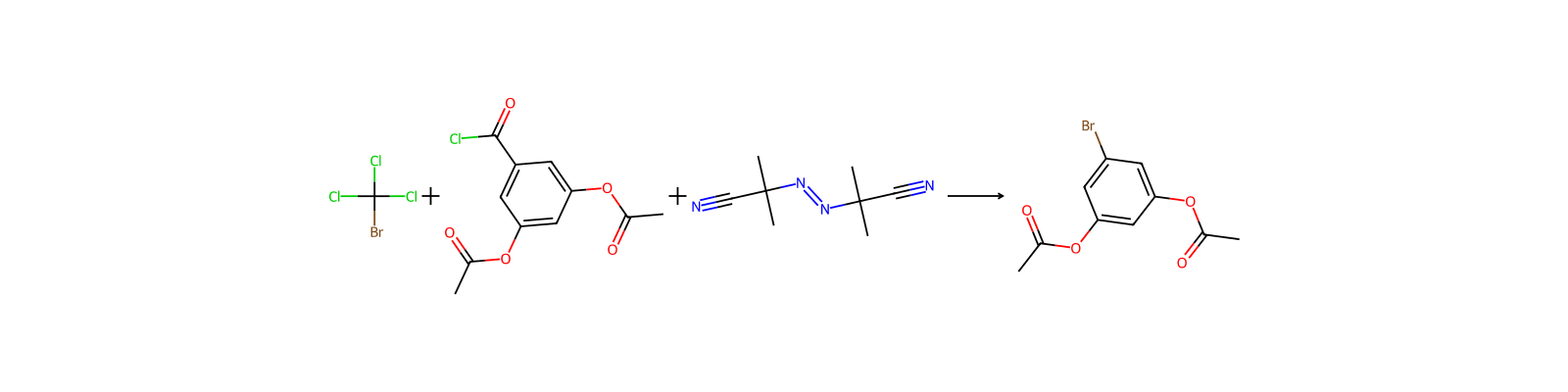
HRID 63200As reactant

75-62-7ClC(Cl)(Cl)BrXNNQFQFUQLJSQT-UHFFFAOYSA-NA potent liver poison. In rats, bromotrichloromethane produces about three times the degree of liver microsomal lipid peroxidation as does carbon tetrachloride.
75-62-7DTXSID7023930CHEMBL1608022.012 @ 25 °C
2.012 @25 °C
INSOL IN WATER; SOL IN ALL PROP IN ALCOHOL & ETHER
MISCIBLE WITH MANY ORG LIQUIDS
Very soluble in ether and ethanol
105 °C
104.2 °C @760 [mm Hg]
Safety information is for reference only and does not replace the supplier’s Safety Data Sheet (SDS), applicable regulations, or professional assessment.
Warning
H302 (79.5%): Harmful if swallowed [Warning Acute toxicity, oral]
P261, P264, P264+P265, P270, P271, P280, P301+P317, P302+P352, P304+P340, P305+P351+P338, P317, P319, P321, P330, P332+P317, P337+P317, P362+P364, P403+P233, P405, and P501 (click each P-code to see the statement)
Aggregated GHS information provided per 190 reports by companies from 8 notifications to the ECHA C&L Inventory. Each notification may be associated with multiple companies.
Chemical: Methane, bromotrichloro-
REACH registered substance: Bromotrichloromethane (EC: 200-886-0)
Bromotrichloromethane: Does not have an individual approval but may be used under an appropriate group standard
AFTER ORAL ADMIN OF BROMOTRICHLOROMETHANE TO RATS, FORMATION OF RADICAL CBRCL2 AND CCL3 BY LIVER METABOLISM MAY OCCUR.
UTILIZING THE SPIN-TRAPPING AGENT PHENYL-TERT-BUTYL NITRONE, A FREE RADICAL, CCL3, WAS DETECTED WHICH IS PRODUCED FROM CARBON TETRACHLORIDE OR BROMOTRICHLOROMETHANE DURING ENZYMIC OXIDATION OF NADPH BY RAT LIVER MICROSOMES.
THE FREE CHLOROFORM RADICAL, BISALLYL RADICAL, & BROMODICHLOROMETHANE RADICAL WERE DETECTED IN RAT LIVERS POISONED WITH BROMOTRICHLOROMETHANE.
Used in organic synthesis and as a flame retardant; [HSDB]
ORGANIC SYNTHESIS
FLAME RETARDANT
Addition /to isoprene/ is induced using bromotrichloromethane in a 3:1 mol ratio to isoprene by x-irradiation at 60 Gy/min. The main reaction yields a mixture of ca 75% 1,4 and 25% 4,1 addition product



39.0 [mmHg]
39 mm Hg at 25 °C
39 [mm Hg] @25 °C
SRP: At the time of review, criteria for land treatment or burial (sanitary landfill) disposal practices are subject to significant revision. Prior to implementing land disposal of waste residue (including waste sludge), consult with environmental regulatory agencies for guidance on acceptable disposal practices.
0.71 [mg/m3]
7.9 [mg/m3]
47 [mg/m3]
HEPATOCYTES FROM LIVERS OF RATS FED A SEMISYNTHETIC VITAMIN E-SUPPLEMENTED DIET WERE SLIGHTLY MORE PROTECTED FROM PEROXIDATION AND CELLULAR DAMAGE INDUCED BY BROMOTRICHLOROMETHANE TREATMENT THAN WERE HEPATOCYTES FROM RATS FED A VITAMIN E-DEFICIENT DIET.
WHEN INCUBATED FOR 15 MIN IN AIR WITH RAT LIVER MICROSOMES FROM PHENOBARBITAL-TREATED RATS, A NADPH-GENERATING SYSTEM, AND GSH (5 MILLIMOLAR), BROMOTRICHLOROMETHANE WAS CONVERTED TO DIGLUTATHIONYL DITHIOCARBONATE.
WHEN ISOLATED RAT HEPATOCYTES WERE INCUBATED WITH 2 MILLIMOLAR BROMOTRICHLOROMETHANE, INCR IN THE NUMBER OF CELLS TAKING UP TRYPAN BLUE, RELEASING LACTATE DEHYDROGENASE OR FORMING MALONDIALDEHYDE WAS OFFSET BY ADDING 1X10⁻⁴ MOLAR 2-HYDROXYESTRADIOL OR (+)-CYANIDANOL-3.
PROTECTIVE EFFECTS OF CADMIUM ACETATE IN TRICHLOROBROMOMETHANE POISONING.
For more Interactions (Complete) data for BROMOTRICHLOROMETHANE (6 total), please visit the HSDB record page.
TERRESTRIAL FATE: Based on a classification scheme(1), an estimated Koc value of 567(SRC), determined from an estimated log Kow(2,SRC) and a regression-derived equation(3), indicates that bromotrichloromethane is expected to have low mobility in soil(SRC). Volatilization of bromotrichloromethane from moist soil surfaces is expected (SRC) given an estimated Henry's Law constant of 3.7X10⁻⁴ atm-cu m/mole(SRC), using a fragment constant estimation method(4). The potential for volatilization of bromotrichloromethane from dry soil surfaces may exist(SRC) based on a measured vapor pressure of 39 mm Hg(5). Based upon the highly halogenated structure of bromotrichloromethane, biodegradation in soil is expected to be slow(6,SRC).
AQUATIC FATE: Based on a classification scheme(1), an estimated Koc value of 567(SRC), determined from an estimated log Kow of 2.5(2,SRC) and a regression-derived equation(3), indicates that bromotrichloromethane is expected to adsorb to suspended solids and sediment in water(SRC). Volatilization from water surfaces is expected(3) based upon an estimated Henry's Law constant of 3.7X10⁻⁴ atm-cu m/mole(SRC), developed using a fragment constant estimation method(4). Using this Henry's Law constant and an estimation method(3), volatilization half-lives for a model river and model lake are 3.7 hrs and 6.6 days, respectively(SRC). According to a classification scheme(5), an estimated BCF of 49(SRC), from an estimated log Kow(2) and a regression-derived equation(6), suggests the potential for bioconcentration in aquatic organisms is moderate. Based upon the highly halogenated structure of bromotrichloromethane, biodegradation in water is expected to be slow(7).
ATMOSPHERIC FATE: According to a model of gas/particle partitioning of semivolatile organic compounds in the atmosphere(1), bromotrichloromethane, which has a measured vapor pressure of 39 mm Hg at 25 °C(2), is expected to exist solely as a vapor in the ambient atmosphere. Based on bromotrichloromethane's structural similarity to bromotrifluoromethane, it is expected to slowly degrade in the atmosphere by reaction with photochemically-produced hydroxyl radicals(SRC); the half-life for bromotrichloromethane's reaction in air is estimated to be greater than 44 years(3), based on bromotrifluoromethane's rate constant of <5.0X10⁻¹⁶ cu cm/molecule-sec at 25 °C(3). Photolysis may occur based on bromotrichloromethane's structural similarity to other halogenated methane compounds but not at an environmentally important rate(4).
The Koc of bromotrichloromethane is estimated as approximately 567(SRC), using an estimated log Kow of 2.5(1,SRC) and a regression-derived equation(2). According to a classification scheme(3), this estimated Koc value suggests that bromotrichloromethane is expected to have low mobility in soil(SRC).
An estimated BCF value of 49 was calculated for bromotrichloromethane(SRC), using an estimated log Kow of 2.5(1,SRC) and a regression-derived equation(2). According to a classification scheme(3), this BCF value suggests that bioconcentration in aquatic organisms is moderate(SRC).