
Training data from https://doi.org/10.1039/C8SC04228D (8/10) · 10.1039/C8SC04228D
查看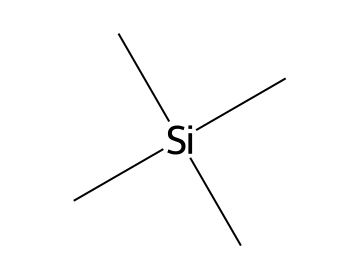
IDENTITY
COMPUTED
PROPERTIES
log Kow = 3.24
0.641 g/cu cm at 25 °C
0.648 @25 °C
Volatile liquid or gas
Insoluble in cold concentrated sulfuric acid; soluble in most organic solvents
Very soluble in ethanol and ether
In water, 19.6 mg/L at 25 °C
-27 dec C (closed cup)
26.6 °C
When heated to decomposition it emits acrid smoke and irritating fumes.
-99.06 °C
-99 °C
718.0 [mmHg]
718 mm Hg at 25 °C
Index of refraction = 1.3587 at 20 °C/D
5785.1 cal/mol
Tetramethylsilane appears as a colorless, mildly acidic volatile liquid. A serious fire hazard. Mildly toxic by ingestion. Emits acrid smoke and fumes when heated to high temperatures. Less dense than water and insoluble in water, but soluble in most organic solvents. Used as an aviation fuel and as an internal standard for nmr analytical instruments.
Liquid
Liquid; bp = 26.6 deg C; [Merck Index] Colorless odorless liquid; [Air Products MSDS]
GHS
Danger
H224 (99.2%): Extremely flammable liquid and vapor [Danger Flammable liquids];H302 (17.3%): Harmful if swallowed [Warning Acute toxicity, oral];H411 (23.6%): Toxic to aquatic life with long lasting effects [Hazardous to the aquatic environment, long-term hazard]
P210, P233, P240, P241, P242, P243, P264, P270, P273, P280, P301+P317, P303+P361+P353, P330, P370+P378, P391, P403+P235, and P501 (click each P-code to see the statement)
Aggregated GHS information provided per 127 reports by companies from 7 notifications to the ECHA C&L Inventory. Each notification may be associated with multiple companies.;Information may vary between notifications depending on impurities, additives, and other factors. The percentage value in parenthesis indicates the notified classification ratio from companies that provide hazard codes. Only hazard codes with percentage values above 10% are shown. For more detailed information, please visit ECHA C&L website.
HAZARDS
Chemical: Silane, tetramethyl-
Silane, tetramethyl- is listed on the EPA's Chemical Data Reporting (CDR) system. Manufacturers and importers of Silane, tetramethyl- are required to report information about their production and use of this chemical to the EPA under the Toxic Substances Control Act (TSCA). (40 eCFR Part 711)
Status: Active Update: 13-10-2022 https://echa.europa.eu/registration-dossier/-/registered-dossier/14468
Tetramethylsilane: HSNO Approval: HSR005569 Approved with controls
The New Jersey Worker and Community Right to Know Act requires public and private employers to provide information about hazardous substances at their workplaces. (N.J.S.A. 34:5A-1 et. seq.)
Flammable Liquid
Excerpt from ERG Guide 130 [Flammable Liquids (Water-Immiscible / Noxious)]:;HIGHLY FLAMMABLE: Will be easily ignited by heat, sparks or flames. Vapors may form explosive mixtures with air. Vapors may travel to source of ignition and flash back. Most vapors are heavier than air. They will spread along the ground and collect in low or confined areas (sewers, basements, tanks, etc.). Vapor explosion hazard indoors, outdoors or in sewers. Those substances designated with a (P) may polymerize explosively when heated or involved in a fire. Runoff to sewer may create fire or explosion hazard. Containers may explode when heated. Many liquids will float on water. (ERG, 2024)
· HIGHLY FLAMMABLE: Will be easily ignited by heat, sparks or flames.;· Vapors may form explosive mixtures with air.;· Vapors may travel to source of ignition and flash back.;· Most vapors are heavier than air. They will spread along the ground and collect in low or confined areas (sewers, basements, tanks, etc.).;· Vapor explosion hazard indoors, outdoors or in sewers.;· Those substances designated with a (P) may polymerize explosively when heated or involved in a fire.;· Runoff to sewer may create fire or explosion hazard.;· Containers may explode when heated.;· Many liquids will float on water.
A very dangerous fire hazard when exposed to heat or flame. Spontaneously flammable in air.
Tetramethylsilicane is spontaneously flammable in air. /Tetramethylsilicane/
Excerpt from ERG Guide 130 [Flammable Liquids (Water-Immiscible / Noxious)]:;May cause toxic effects if inhaled or absorbed through skin. Inhalation or contact with material may irritate or burn skin and eyes. Fire will produce irritating, corrosive and/or toxic gases. Vapors may cause dizziness or asphyxiation, especially when in closed or confined areas. Runoff from fire control or dilution water may cause environmental contamination. (ERG, 2024)
· May cause toxic effects if inhaled or absorbed through skin.;· Inhalation or contact with material may irritate or burn skin and eyes.;· Fire will produce irritating, corrosive and/or toxic gases.;· Vapors may cause dizziness or asphyxiation, especially when in closed or confined areas.;· Runoff from fire control or dilution water may cause environmental contamination.
Pyrophoric; No adverse effects observed in combined subchronic/reproductive/developmental inhalation study of rats at concentrations up to 5,000 ppm/6 hours/day; [HSDB] A mild irritant; Inhalation of vapor may cause nose, throat, and lung irritation and pose an asphyxiation hazard; Harmful by ingestion; [Air Products MSDS] See Diethylsilane.
2749 130
Hydrocarbons, Aliphatic Saturated
Highly Flammable
Although TETRAMETHYLSILANE is not strictly a hydrocarbon, its properties and reactivity are very similar to saturated aliphatic hydrocarbons. It is highly flammable, insoluble in water, and chemically inert in most situations.
Tetramethylsilane
UN2749
Class 3 Flammable and combustible liquid (49 eCFR § 173.120)
PG I: the degree of danger presented by the material is great;For more information about the packing group assignment, please visit 49 eCFR § 173
Highly flammable. It is insoluble in water.
SAFETY
Excerpt from ERG Guide 130 [Flammable Liquids (Water-Immiscible / Noxious)]:;CAUTION: The majority of these products have a very low flash point. Use of water spray when fighting fire may be inefficient.;SMALL FIRE: Dry chemical, CO2, water spray or regular foam. If regular foam is ineffective or unavailable, use alcohol-resistant foam.;LARGE FIRE: Water spray, fog or regular foam. If regular foam is ineffective or unavailable, use alcohol-resistant foam. Avoid aiming straight or solid streams directly onto the product. If it can be done safely, move undamaged containers away from the area around the fire.;FIRE INVOLVING TANKS, RAIL TANK CARS OR HIGHWAY TANKS: Fight fire from maximum distance or use unmanned master stream devices or monitor nozzles. Cool containers with flooding quantities of water until well after fire is out. Withdraw immediately in case of rising sound from venting safety devices or discoloration of tank. ALWAYS stay away from tanks in direct contact with flames. For massive fire, use unmanned master stream devices or monitor nozzles; if this is impossible, withdraw from area and let fire burn. (ERG, 2024)
· CALL 911. Then call emergency response telephone number on shipping paper. If shipping paper not available or no answer, refer to appropriate telephone number listed on the inside back cover.;· Keep unauthorized personnel away.;· Stay upwind, uphill and/or upstream.;· Ventilate closed spaces before entering, but only if properly trained and equipped.
· ELIMINATE all ignition sources (no smoking, flares, sparks or flames) from immediate area.;· All equipment used when handling the product must be grounded.;· Do not touch or walk through spilled material.;· Stop leak if you can do it without risk.;· Prevent entry into waterways, sewers, basements or confined areas.;· A vapor-suppressing foam may be used to reduce vapors.;· Absorb or cover with dry earth, sand or other non-combustible material and transfer to containers.;· Use clean, non-sparking tools to collect absorbed material.;Large Spill;· Dike far ahead of liquid spill for later disposal.;· Water spray may reduce vapor, but may not prevent ignition in closed spaces.
Excerpt from ERG Guide 130 [Flammable Liquids (Water-Immiscible / Noxious)]:;Refer to the "General First Aid" section. Specific First Aid: Wash skin with soap and water. In case of burns, immediately cool affected skin for as long as possible with cold water. Do not remove clothing if adhering to skin. (ERG, 2024)
General First Aid:;· Call 911 or emergency medical service.;· Ensure that medical personnel are aware of the material(s) involved, take precautions to protect themselves and avoid contamination.;· Move victim to fresh air if it can be done safely.;· Administer oxygen if breathing is difficult.;· If victim is not breathing:;-- DO NOT perform mouth-to-mouth resuscitation; the victim may have ingested or inhaled the substance.;-- If equipped and pulse detected, wash face and mouth, then give artificial respiration using a proper respiratory medical device (bag-valve mask, pocket mask equipped with a one-way valve or other device).;-- If no pulse detected or no respiratory medical device available, provide continuous compressions. Conduct a pulse check every two minutes or monitor for any signs of spontaneous respirations.;· Remove and isolate contaminated clothing and shoes.;· For minor skin contact, avoid spreading material on unaffected skin.;· In case of contact with substance, remove immediately by flushing skin or eyes with running water for at least 20 minutes.;· For severe burns, immediate medical attention is required.;· Effects of exposure (inhalation, ingestion, or skin contact) to substance may be delayed.;· Keep victim calm and warm.;· Keep victim under observation.;· For further assistance, contact your local Poison Control Center.;· Note: Basic Life Support (BLS) and Advanced Life Support (ALS) should be done by trained professionals.;Specific First Aid:;· Wash skin with soap and water.
· Wear positive pressure self-contained breathing apparatus (SCBA).;· Structural firefighters' protective clothing provides thermal protection but only limited chemical protection.
If material on fire or involved in fire: Do not extinguish fire unless flow can be stopped. Use water in flooding quantities as fog. Solid streams of water may spread fire. Cool all affected containers with flooding quantities of water. Apply water from as far a distance as possible. Use foam, dry chemical, or carbon dioxide.
Wear positive pressure self-contained breathing apparatus when fighting fires involving this material.
Suitable extinguishing media: For small (incipient) fires, use media such as "alcohol" foam, dry chemical, or carbon dioxide. For large fires, apply water from as far as possible. Use very large quantities (flooding) of water applied as a mist or spray; solid streams of water may be ineffective. Cool all affected containers with flooding quantities of water. ... Use water spray to cool unopened containers.
Special protective equipment for fire-fighters: Wear self contained breathing apparatus for fire fighting if necessary.
Store in cool place. Keep container tightly closed in a dry and well-ventilated place. Containers which are opened must be carefully resealed and kept upright to prevent leakage. Recommended storage temperature: 2 - 8 °C Over time, pressure may increase causing containers to burst. Handle and open container with care.
SRP: Wastewater from contaminant suppression, cleaning of protective clothing/equipment, or contaminated sites should be contained and evaluated for subject chemical or decomposition product concentrations. Concentrations shall be lower than applicable environmental discharge or disposal criteria. Alternatively, pretreatment and/or discharge to a permitted wastewater treatment facility is acceptable only after review by the governing authority and assurance that "pass through" violations will not occur. Due consideration shall be given to remediation worker exposure (inhalation, dermal and ingestion) as well as fate during treatment, transfer and disposal. If it is not practicable to manage the chemical in this fashion, it must be evaluated in accordance with EPA 40 CFR Part 261, specifically Subpart B, in order to determine the appropriate local, state and federal requirements for disposal.
Methods for cleaning up: Contain spillage, and then collect with non-combustible absorbent material, (e.g. sand, earth, diatomaceous earth, vermiculite) and place in container for disposal according to local / national regulations. Personal precautions: Avoid breathing vapors, mist or gas. Ensure adequate ventilation. Remove all sources of ignition. Evacuate personnel to safe areas. Beware of vapors accumulating to form explosive concentrations. Vapors can accumulate in low areas.
Environmental precautions: Prevent further leakage or spillage if safe to do so. Do not let product enter drains.
Excerpt from ERG Guide 130 [Flammable Liquids (Water-Immiscible / Noxious)]:;ELIMINATE all ignition sources (no smoking, flares, sparks or flames) from immediate area. All equipment used when handling the product must be grounded. Do not touch or walk through spilled material. Stop leak if you can do it without risk. Prevent entry into waterways, sewers, basements or confined areas. A vapor-suppressing foam may be used to reduce vapors. Absorb or cover with dry earth, sand or other non-combustible material and transfer to containers. Use clean, non-sparking tools to collect absorbed material.;LARGE SPILL: Dike far ahead of liquid spill for later disposal. Water spray may reduce vapor, but may not prevent ignition in closed spaces. (ERG, 2024)
Burn in a chemical incinerator equipped with an afterburner and scrubber but exert extra care in igniting as this material is highly flammable. Observe all federal, state, and local environmental regulations. Contact a licensed professional waste disposal service to dispose of this material.
SRP: The most favorable course of action is to use an alternative chemical product with less inherent propensity for occupational harm/injury/toxicity or environmental contamination. Recycle any unused portion of the material for its approved use or return it to the manufacturer or supplier. Ultimate disposal of the chemical must consider: the material's impact on air quality; potential migration in soil or water; effects on animal and plant life; and conformance with environmental and public health regulations.
SRP: The scientific literature for the use of contact lenses by industrial workers is inconsistent. The benefits or detrimental effects of wearing contact lenses depend not only upon the substance, but also on factors including the form of the substance, characteristics and duration of the exposure, the uses of other eye protection equipment, and the hygiene of the lenses. However, there may be individual substances whose irritating or corrosive properties are such that the wearing of contact lenses would be harmful to the eye. In those specific cases, contact lenses should not be worn. In any event, the usual eye protection equipment should be worn even when contact lenses are in place.
SRP: Contaminated protective clothing should be segregated in a manner that results in no direct personal contact by personnel who handle, dispose of, or clean the clothing. Quality assurance procedures to confirm the efficacy of the cleaning procedures should be implemented prior to the decontaminated protective clothing being returned for reuse by the workers. Contaminated clothing (including shoes/socks) should not be taken home at end of shift, but should remain at employee's place of work for cleaning.
If material not on fire and not involved in fire: Keep sparks, flames, and other sources of ignition away. Keep material out of water sources and sewers. Build dikes to contain flow as necessary. Attempt to stop leak if without undue personnel hazard. Use water spray to knock-down vapors.
Avoid breathing vapors. Keep upwind. Avoid bodily contact with the material. Do not handle broken packages unless wearing appropriate personal protective equipment. Wash away any material which may have contacted the body with copious amounts of water or soap and water.
For more Preventive Measures (Complete) data for Tetramethylsilane (7 total), please visit the HSDB record page.
Excerpt from ERG Guide 130 [Flammable Liquids (Water-Immiscible / Noxious)]:;IMMEDIATE PRECAUTIONARY MEASURE: Isolate spill or leak area for at least 50 meters (150 feet) in all directions.;LARGE SPILL: Consider initial downwind evacuation for at least 300 meters (1000 feet).;FIRE: If tank, rail tank car or highway tank is involved in a fire, ISOLATE for 800 meters (1/2 mile) in all directions; also, consider initial evacuation for 800 meters (1/2 mile) in all directions. (ERG, 2024)
Immediate precautionary measure;· Isolate spill or leak area for at least 50 meters (150 feet) in all directions.;Large Spill;· Consider initial downwind evacuation for at least 300 meters (1000 feet).;Fire;· If tank, rail tank car or highway tank is involved in a fire, ISOLATE for 800 meters (1/2 mile) in all directions; also, consider initial evacuation for 800 meters (1/2 mile) in all directions.
100 [ppm]
130 [ppm]
270 [ppm]
TOXICITY
Samples collected and analyzed during the period from July to December 1980 detected tetramethylsilane on 4 of 12 subjects' exhaled breath in Bayonne and Elizabeth, New Jersey (nine subjects) and Research Triangle Park, North Carolina (3 subjects). The subjects were workers in the chemical and oil industries as well as a sewage treatment plant worker(1).
TERRESTRIAL FATE: Based on a classification scheme(1), an estimated Koc value of 44(SRC), determined from a structure estimation method(2), indicates that tetramethylsilane is expected to have very high mobility in soil(SRC). Volatilization of tetramethylsilane from moist soil surfaces is expected to be an important fate process(SRC) given an estimated Henry's Law constant of 4.25 atm-cu m/mole(SRC), based upon its vapor pressure, 718 mm Hg(3), and water solubility, 19.6 mg/L(4). Tetramethylsilane is expected to volatilize from dry soil surfaces(SRC) based upon its vapor pressure(3). Biodegradation data were not available(SRC, 2009).
AQUATIC FATE: Based on a classification scheme(1), an estimated Koc value of 44(SRC), determined from a structure estimation method(2), indicates that tetramethylsilane is not expected to adsorb to suspended solids and sediment(SRC). Volatilization from water surfaces is expected(3) based upon an estimated Henry's Law constant of 4.25 atm-cu m/mole(SRC), derived from its vapor pressure, 718 mm Hg(4), and water solubility, 19.6 mg/L(5). Using this Henry's Law constant and an estimation method(3), volatilization half-lives for a model river and model lake are 2.7 hours and 3.7 days, respectively(SRC). According to a classification scheme(6), an estimated BCF of 64(SRC), from a log Kow of 3.24(7) and a regression-derived equation(8), suggests the potential for bioconcentration in aquatic organisms is moderate(SRC). Biodegradation data were not available(SRC, 2009).
ATMOSPHERIC FATE: According to a model of gas/particle partitioning of semivolatile organic compounds in the atmosphere(1), tetramethylsilane, which has a vapor pressure of 718 mm Hg at 25 °C(2), is expected to exist solely as a vapor in the ambient atmosphere. Vapor-phase tetramethylsilane is degraded in the atmosphere by reaction with photochemically-produced hydroxyl radicals(SRC); the half-life for this reaction in air is estimated to be 16 days(SRC), calculated from its rate constant of 1.00X10⁻¹² cu cm/molecule-sec at 25 °C(3). Tetramethylsilane does not contain chromophores that absorb at wavelengths >290 nm(4) and therefore is not expected to be susceptible to direct photolysis by sunlight(SRC).
Other Poison - Simple Asphyxiant
Using a structure estimation method based on molecular connectivity indices(1), the Koc of tetramethylsilane can be estimated to be 44(SRC). According to a classification scheme(2), this estimated Koc value suggests that tetramethylsilane is expected to have very high mobility in soil.
Tetramethylsilane's production and use in chemical deposition of films of silicon carbide, as a 1H NMR primary reference standard(1), and as an additive to aviation fuel(2) may result in its release to the environment through various waste streams(SRC).
An estimated BCF of 64 was calculated for tetramethylsilane(SRC), using a log Kow of 3.24(1) and a regression-derived equation(2). According to a classification scheme(3), this BCF suggests the potential for bioconcentration in aquatic organisms is moderate(SRC), provided the compound is not metabolized by the organism(SRC).
The Henry's Law constant for tetramethylsilane is estimated as 4.25 atm-cu m/mole(SRC) derived from its vapor pressure, 718 mm Hg(1), and water solubility, 19.6 mg/L(2). This Henry's Law constant indicates that tetramethylsilane is expected to volatilize rapidly from water surfaces(3). Based on this Henry's Law constant, the volatilization half-life from a model river (1 m deep, flowing 1 m/sec, wind velocity of 3 m/sec)(3) is estimated as 2.7 hours(SRC). The volatilization half-life from a model lake (1 m deep, flowing 0.05 m/sec, wind velocity of 0.5 m/sec)(3) is estimated as 3.7 days(SRC). The estimated Henry's Law constant for tetramethylsilane indicates that volatilization from moist soil surfaces is likely(SRC). The potential for volatilization of tetramethylsilane from dry soil surfaces may exist(SRC) based upon a vapor pressure of 718 mm Hg(1).
/LABORATORY ANIMALS: Subchronic or Prechronic Exposure/ The potential toxicity of tetramethylsilane ... was evaluated in a combined repeated exposure toxicity study with a reproductive/ developmental toxicity screening test. The study design utilized an enhanced version of the protocol in accordance with the OECD and EPA test guidelines Nos. 422 and 870.3650, respectively. Developmental neurotoxicity endpoints including Functional Observational Battery (FOB) and Motor Activity were performed on male and female rats. The test substance was administered six hours a day, seven days a wk by inhalation to 10 rats/sex/group at 0, 200, 1000, and 5000 ppm. All animals survived to the scheduled necropsy. There were no clinical signs or effects on body weights and food consumption among the groups. No treatment-related changes were observed in any FOB or motor activity parameters. There were no alterations in hematology, serum chemistry, organ weights, organ to body weight ratios or macroscopic examination of organs/tissues among the groups. Histopathologic examination of tissues and organs for control and high exposure animals demonstrated no significant microscopic findings. No effects were observed in any of the reproductive parameters evaluated. One female in 200 ppm group was found non-gravid but the remaining females produced litters that were similar in all respects to control litters. Based on the results of this study, the NOAEL for tetramethylsilane in rats via inhalation route was considered to be 5000 ppm.
The rate constant for the vapor-phase reaction of tetramethylsilane with photochemically-produced hydroxyl radicals is 1.00X10⁻¹² cu cm/molecule-sec at 25 °C(1). This corresponds to an atmospheric half-life of about 16 days at an atmospheric concentration of 5X10+5 hydroxyl radicals per cu cm(SRC). The rate constants for the vapor-phase reaction of tetramethylsilane with ozone and nitrate are <0.7X10⁻²⁰ and <0.8X10⁻¹⁶ cu cm/molecule-sec at 25 °C, respectively(1). Tetramethylsilane is not expected to undergo hydrolysis in the environment due to the lack of functional groups that hydrolyze under environmental conditions(2). Tetramethylsilane does not contain chromophores that absorb at wavelengths >290 nm(2) and therefore is not expected to be susceptible to direct photolysis by sunlight(SRC).
NIOSH (NOES Survey 1981-1983) has statistically estimated that 1,822 workers (272 of these were female) were potentially exposed to tetramethylsilane in the US(1). Occupational exposure to tetramethylsilane may occur through inhalation and dermal contact with this compound at workplaces where it is produced or used. The general population is not likely to be exposed to tetramethylsilane as it is predominately used in a research and manufacturing setting(SRC).
DRINKING WATER: Samples collected and analyzed during the period from July to December 1980 detected tetramethylsilane in 1 of 1 drinking water sample; the sample was collected from a home of workers in the chemical and oil industries or a sewage treatment plant worker in Bayonne or Elizabeth, New Jersey or in Research Triangle Park, North Carolina(1).
Tetramethylsilane's production and use as a chemical deposition agent for films of silicon carbide, an 1H NMR primary reference standard, and an additive to aviation fuel may result in its release to the environment through various waste streams. If released to air, a vapor pressure of 718 mm Hg at 25 °C indicates tetramethylsilane will exist solely as a vapor in the atmosphere. Vapor-phase tetramethylsilane will be degraded in the atmosphere by reaction with photochemically-produced hydroxyl radicals; the half-life for this reaction in air is estimated to be 16 days. Tetramethylsilane does not contain chromophores that absorb at wavelengths >290 nm and therefore is not expected to be susceptible to direct photolysis by sunlight. If released to soil, tetramethylsilane is expected to have very high mobility based upon an estimated Koc of 44. Volatilization from moist soil surfaces is expected to be an important fate process based upon an estimated Henry's Law constant of 4.25 atm-cu m/mole. Tetramethylsilane may volatilize from dry soil surfaces based upon its vapor pressure. Biodegradation data were not available. If released into water, tetramethylsilane is not expected to adsorb to suspended solids and sediment based upon the estimated Koc. Volatilization from water surfaces is expected to be an important fate process based upon this compound's estimated Henry's Law constant. Estimated volatilization half-lives for a model river and model lake are 2.7 hours and 3.7 days, respectively. An estimated BCF of 64 suggests bioconcentration in aquatic organisms is moderate. Hydrolysis is not expected to be an important environmental fate process since this compound lacks functional groups that hydrolyze under environmental conditions. Occupational exposure to tetramethylsilane may occur through inhalation and dermal contact with this compound at workplaces where it is produced or used. The general population is not likely to be exposed to tetramethylsilane as it is predom
REGULATORY
Chemical: Silane, tetramethyl-
Silane, tetramethyl- is listed on the EPA's Chemical Data Reporting (CDR) system. Manufacturers and importers of Silane, tetramethyl- are required to report information about their production and use of this chemical to the EPA under the Toxic Substances Control Act (TSCA). (40 eCFR Part 711)
Status: Active Update: 13-10-2022 https://echa.europa.eu/registration-dossier/-/registered-dossier/14468
Tetramethylsilane: HSNO Approval: HSR005569 Approved with controls
The New Jersey Worker and Community Right to Know Act requires public and private employers to provide information about hazardous substances at their workplaces. (N.J.S.A. 34:5A-1 et. seq.)
Tetramethylsilane
1
10000
Flammable chemical that can be released at a facility.
USES
Used as NMR reference standard, in semiconductor chemical vapor deposition, and for silylation of samples for GC analysis; [Merck Index] Used as an aviation fuel; [CAMEO] Used in semiconductor processing; [Air Products MSDS]
Semiconductor Manufacturing [Category: Industry]
In aviation fuel
Used in chemical deposition of films of silicon carbide; 1H NMR primary reference standard
2023: 1,000,000 - <2,500,000 lb;2022: 1,000,000 - <2,500,000 lb;2021: 1,000,000 - <2,500,000 lb;2020: 1,000,000 - <2,500,000 lb
Silane, tetramethyl- is listed as a High Production Volume (HPV) chemical (65FR81686). Chemicals listed as HPV were produced in or imported into the U.S. in >1 million pounds in 1990 and/or 1994. The HPV list is based on the 1990 Inventory Update Rule. (IUR) (40 CFR part 710 subpart B; 51FR21438).
Production volumes for non-confidential chemicals reported under the Inventory Update Rule. [Table#7428]
Production volume for non-confidential chemicals reported under the 2006 Inventory Update Rule. Chemical: Silane, tetramethyl-. Aggreated National Production Volume: 1 to < 10 million lbs.
Plating agent;Intermediate
By Grignard reaction of silicon tetrachloride and methylmagnesium chloride.
All Other Basic Organic Chemical Manufacturing;All Other Chemical Product and Preparation Manufacturing;Electrical Equipment, Appliance, and Component Manufacturing;All Other Basic Inorganic Chemical Manufacturing
Silane, tetramethyl-: ACTIVE
ALIASES
REACTIONS


