Cobalt oxide
HCID 6432046
基本情報
- CAS
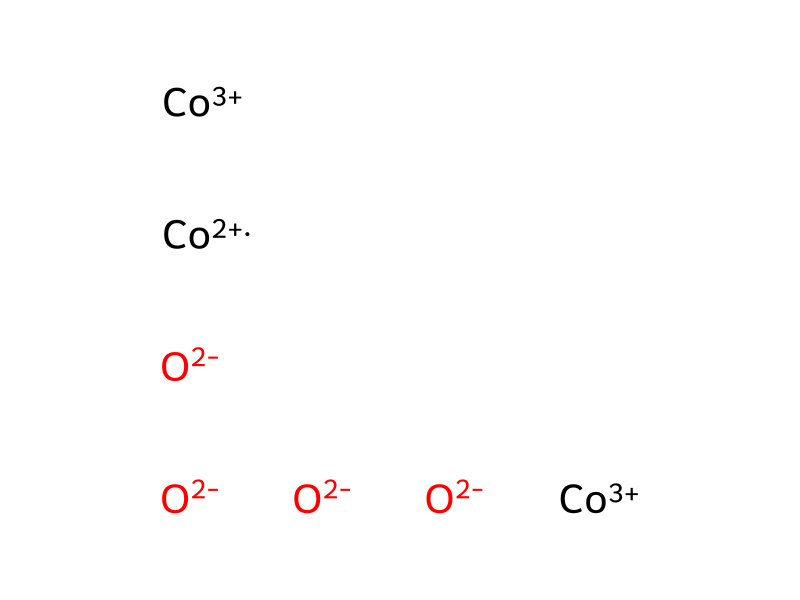
11104-61-3- 標準SMILES
[Co+2].[Co+3].[Co+3].[O-2].[O-2].[O-2].[O-2]- InChIKey
UBEWDCMIDFGDOO-UHFFFAOYSA-N- 分子式
- Co3O4
- 平均分子量
- 240.797 g/mol
- 単同位体質量
- 240.77924
概要
Cobalt(II, III) oxide is a mixed valence oxide of cobalt. It is a black antiferromagnetic solid. Cobalt is a metallic element with the atomic number 27. It is found naturally in rocks, soil, water, plants, and animals. In small amounts cobalt is an essential element for life, as it is part of vitamin B12. However, excess exposure is known to exhibit toxic effects. (L29, L30)
名称と識別子
- 優先名称
- Cobalt oxide
- IUPAC
- cobalt(2+);bis(cobalt(3+));tetrakis(oxygen(2-))
- 英語名
- Cobalt oxide
- 分子式
- CoO
- 分子量
- 0
名称と別名
Cobalt tetraoxideUSK772NS5611104-61-3234-334-5Co(3)O(4)Cobalt oxideCobaltum OxydatumDTXSID801014561RefChem:58007Tricobalt tetraoxideCobaltic-cobaltous oxidecobalt(2+);cobalt(3+);oxygen(2-)
名称をさらに表示
cobalt(2+),oxygen(2-)cobalt(2+),oxygen(2 oxygen(2-)
Cobalt oxide blackoxocobalt; oxo(oxocobaltiooxy)cobaltEINECS 215-157-2Cobalt oxide (II,III)Cobalt (II, III) oxideUNII-USK772NS56COBALT OXIDE [MART.]SCHEMBL5054762
データベース識別子
- CAS
11104-61-3、1308-06-1- PubChem CID
- 6432046
- UNII
- USK772NS56
- EC Number
- 215-157-2、234-334-5
物性
構造計算による物性
- 極性表面積
- 4 Ų
- 水素結合供与体数
- 0
- 水素結合受容体数
- 4
- 回転可能結合数
- 0
- 重原子数
- 7
- 形式電荷
- 0
- 複雑度
- 0
実験および物理化学的性質
SpringerMaterials Propertiesdielectric constant
Food Contact SubstancesFCS -> FDA Inventory of Food Contact Substances Listed in 21 CFR
Physical DescriptionLarge Crystals; Dry Powder
物理化学的性質
- EPAの化学物質情報
- Cobalt oxide (11104-61-3)
安全と法規制
安全情報は参考情報です。供給元の安全データシート(SDS)、適用法令、専門家による評価に代わるものではありません。
GHS分類
GHS Classification
This chemical does not meet GHS hazard criteria for 100% (7 of 7) of all reports.
Not Classified
Aggregated GHS information provided per 7 reports by companies from 1 notifications to the ECHA C&L Inventory.
Danger
H301: Toxic if swallowed [Danger Acute toxicity, oral]
P203, P233, P260, P261, P264, P270, P271, P272, P280, P284, P301+P316, P302+P352, P304+P340, P316, P318, P319, P320, P321, P330, P333+P317, P342+P316, P362+P364, P403, P403+P233, P405, and P501 (click each P-code to see the statement)
危険有害性情報
Regulatory Information
Chemical: Cobalt oxide
Cobalt oxide is listed on the EPA's Chemical Data Reporting (CDR) system. Manufacturers and importers of Cobalt oxide are required to report information about their production and use of this chemical to the EPA under the Toxic Substances Control Act (TSCA). (40 eCFR Part 711)
Other Safety InformationIMAP assessments - Cobalt oxide: Human health tier II assessment
Hazard Classes and Categories
Not Classified
Specific target organ toxicity (repeated exposure) - category 1
安全と保護具
Minimum Risk LevelChronic Inhalation: 0.0001 mg/m3 (L134)
Intermediate Oral: 0.01 mg/kg/day (L134)
Protective Action Criteria (PAC)
0.082 [mg/m3]
6.7 [mg/m3]
40 [mg/m3]
毒性情報
化学と産業
薬理情報
Metabolism/Metabolites
Cobalt is absorbed though the lungs, gastrointestinal tract, and skin. Since it is a component of the vitamin B12 (cyanocobalamin), it is distributed to most tissues of the body. It is transported in the blood, often bound to albumin, with the highest levels being found in the liver and kidney. Cobalt is excreted mainly in the urine and faeces. (L29)
用途と製造
UsesNo data.
U.S. Production2023: 468,662 lb
Consumer UsesOther
Industry UsesOther
General Manufacturing Information
Petroleum Refineries
Cobalt oxide: ACTIVE
関連反応
6 件