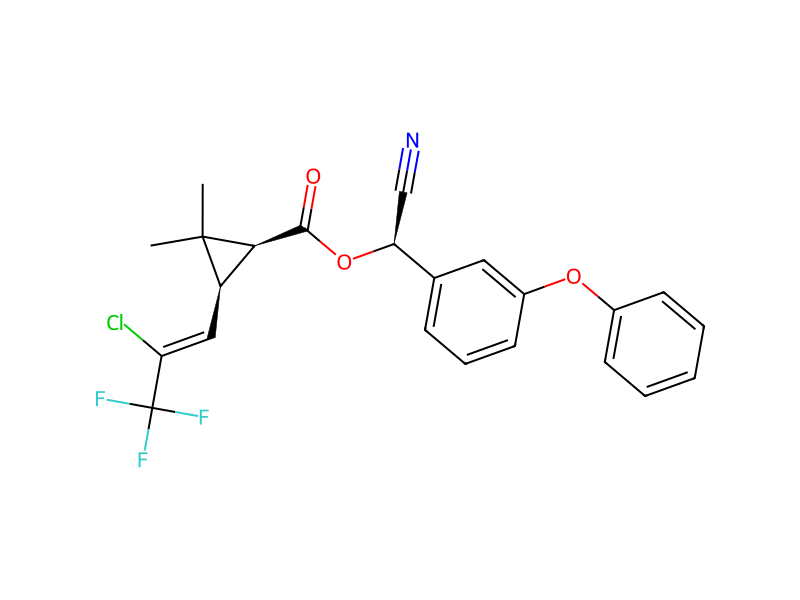
alpha-Cyan-3-phenoxybenzyl-3-(2-chlor-3,3,3-trifluorprop-1-enyl)-2,2-dimethylcyclopropan-carboxylat, 1:1 Gemisch der(Z)-(1R,3R), S-ester und(Z)-(1S,3S), R-ester
lambda-Cyhalothrin
HCID 6440557
Daten werden ergänzt – lade die Seite später neu, um den aktuellen Stand zu sehen
Grundinformationen
- CAS
76703-65-6- Standard-SMILES
CC1(C)[C@H](/C=C(\Cl)C(F)(F)F)[C@@H]1C(=O)O[C@@H](C#N)c1cccc(Oc2ccccc2)c1- InChIKey
ZXQYGBMAQZUVMI-GCMPRSNUSA-N- Summenformel
- C23H19ClF3NO3
- Durchschnittliche Molmasse
- 449,8 g/mol
Überblick
(1S)-cis-(alphaR)-cyhalothrin is a cyclopropanecarboxylate ester.
Namen und Bezeichner
- Bevorzugter Name
- lambda-Cyhalothrin
- IUPAC
- trans-[(R)-cyano-(3-phenoxyphenyl)methyl] (1S,3S)-3-[(Z)-2-chloro-3,3,3-trifluoroprop-1-enyl]-2,2-dimethylcyclopropane-1-carboxylate
- Lokaler Name
- alpha-Cyan-3-phenoxybenzyl-3-(2-chlor-3,3,3-trifluorprop-1-enyl)-2,2-dimethylcyclopropan-carboxylat, 1:1 Gemisch der(Z)-(1R,3R), S-ester und(Z)-(1S,3S), R-ester
- Englischer Name
- λ-Cyhalothrin
- Summenformel
- C23H19ClF3NO3
- Molmasse
- 449.85
Namen und Synonyme
lambda-CyhalothrinKarate91465-08-6IconWarriorOXYFLYZ44TGV333KLambda cyhalothrinDTXSID7032559Cyclopropanecarboxylic acid, 3-((1Z)-2-chloro-3,3,3-trifluoro-1-propenyl)-2,2-dimethyl-, (R)-cyano(3-phenoxyphenyl)methyl ester, (1S,3S)-rel-DTXCID00196593lambdacyhalothrin
Weitere Namen anzeigen
λ-CyhalothrinLambda CyhalothrineL-CYHALOTHRINL-Cyhalothrin,100 μL/mL in MeOHcyano-3-phenoxybenzyl-3-(2-chloro-3,3,3-trifluoropropenyl)-2,2-dimethyl cyclopropanecarboxylatePP321Matado
RefChem:5935CHEBI:39325415-130-776703-65-6lambda-Cyhalothrin [ISO]Cyhalothrin K(1S)-cis-(alphaR)-cyhalothrinlambda-Cyhalothrin, (-)-
Datenbank-Bezeichner
Eigenschaften
Berechnete StruktureigenschaftenWird ergänzt
- XLogP
- 6,1
- Polarare Oberfläche (TPSA)
- 59,3 Ų
- H-Brücken-Donoren
- 0
- H-Brücken-Akzeptoren
- 7
- Frei drehbare Bindungen
- 7
- Schwere Atome
- 31
- Formalladung
- 0
- Komplexität
- 736
Experimentelle und physikochemische Eigenschaften
Pesticides
Insecticides
Active substance -> EU Pesticides database: Approved
Pesticide
LogP7.0
DensityRelative density (water = 1): 1.3
SolubilitySolubility in water: none
Endocrine DisruptorsPotential endocrine disrupting compound
Decomposition275 °C
Melting Point49.2 °C
Vapor PressureVapor pressure, Pa at 20 °C:
Physical DescriptionCOLOURLESS-TO-BEIGE SOLID (TECHNICAL GRADE).
Collision Cross Section
190.4 Ų [M+Na]+ [CCS Type: DT; Buffer gas: N2; Ionization: ESI+; Dataset: TOXCAST; Source Identifier: DTXSID7032559]
Sicherheit und Regulatorisches
Sicherheitsangaben dienen nur zur Orientierung und ersetzen weder das Sicherheitsdatenblatt (SDB) des Lieferanten noch geltende Vorschriften oder eine fachliche Bewertung.
GHS-Klassifizierung
GHS Classification
Danger
H301: Toxic if swallowed [Danger Acute toxicity, oral]
P260, P264, P270, P271, P273, P280, P284, P301+P316, P302+P352, P304+P340, P316, P317, P320, P321, P330, P362+P364, P391, P403+P233, P405, and P501 (click each P-code to see the statement)
Danger
H301+H311 (10.8%): Toxic if swallowed or in contact with skin [Danger Acute toxicity, oral; acute toxicity, dermal]
P260, P262, P264, P264+P265, P270, P271, P273, P280, P284, P301+P316, P302+P352, P304+P340, P305+P351+P338, P308+P316, P316, P317, P320, P321, P330, P337+P317, P361+P364, P362+P364, P391, P403+P233, P405, and P501 (click each P-code to see the statement)
Gefahrenhinweise
Regulatory Information
Regulation (EC) No 178/2002 (amended)
Lambda cyhalothrin is listed in the dataset of EPA Human Health Benchmarks for Pesticides under the Safe Drinking Water Act (40 eCFR 141)
00/80/EC, 2010/77/EU, Reg. (EU) 2015/1885, Reg. (EU) 2016/146, Reg. (EU) 2018/155, Reg. (EU) 2023/114, Reg. (EU) 2024/324, Reg. (EU) 2026/1421, Reg. (EU) No 2019/724, Reg. (EU) No 540/2011
REACH registered substance: A mixture of: α-cyano-3-phenoxybenzyl (Z)-(1R,3R)-[(S)-3-(2-chloro-3,3,3-trifluoro-prop-1-enyl)]-2,2-dimethylcyclopropanecarboxylate; α-cyano-3-phenoxybenzyl (Z)-(1S,3S)-[(R)-3-(2-chloro-3,3,3-trifluoro-prop-1-enyl)]-2,2-dimethylcyclopropanecarboxylate (EC: 415-130-7)
Lambda-cyhalothrin: HSNO Approval: HSR003295 Approved with controls
Other Safety InformationIMAP assessments - Cyclopropanecarboxylic acid, 3-(2-chloro-3,3,3-trifluoro-1-propenyl)-2,2-dimethyl-, cyano(3-phenoxyphenyl)methyl ester,[1.alpha.(S*),3.alpha.(Z)]-(.+-.)-: Human health tier I assessment
Fire HazardsLiquid formulations containing organic solvents may be flammable. Gives off irritating or toxic fumes (or gases) in a fire. Risk of fire and explosion if formulations contain flammable/explosive solvents.
Chemie und Industrie
Pharmakologische Informationen
Metabolism/Metabolites
Cyhalothrin has been shown to be well absorbed after oral administration, extensively metabolized, and eliminated as polar conjugates in urine. The main route of metabolism is, as anticipated, via hydrolysis of the ester linkage. The cyclopropane-carboxylic acid moiety is subsequently excreted via the urine as the glucuronide conjugate. The 3-phenoxybenzyl moiety is further metabolized by loss of the nitrile group, oxidation of the aldehyde form to a carboxylic acid, aromatic hydroxylation at the 4' position, and formation of the 4- O-sulfate conjugate of 3-(4-hydroxyphenoxy)benzoic acid. (L871)
MeSH Pharmacological Classification
Chemicals that kill or inhibit the growth of fungi in agricultural applications, on wood, plastics, or other materials, in swimming pools, etc.
Pesticides designed to control insects that are harmful to man. The insects may be directly harmful, as those acting as disease vectors, or indirectly harmful, as destroyers of crops, food products, or textile fabrics.
Verwendung und Herstellung
UsesPyrethroids are used as insecticides. (L857)
Household ProductsInformation on 73 consumer products that contain lambda-Cyhalothrin in the following categories is provided:
Anwendungen
VerwendenInsecticide; pyrethrin analog
Vor- und nachgelagerte Produkte
Vorgelagerte Rohstoffe
Zugehörige Reaktionen
0
Noch keine zugehörigen Reaktionen