
uspto-grants-2014_09 · 10.6084/m9.figshare.5104873.v1 · US08846955B2
查看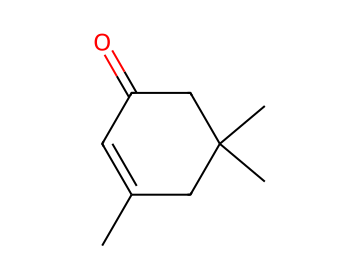
IDENTITY
COMPUTED
PROPERTIES
log Kow = 1.70
1.70
1.67
Peppermint-like odor
Camphor-like
0.921 at 77 °F (USCG, 1999) - Less dense than water; will float
0.9255 @ 20 °C
Bulk density: 7.7 lb/gal @ 20 °C
Relative density (water = 1): 0.92
0.919-0.927
0.92
2.62 cP @ 20 °C
Water-white liquid
Colorless to white-liquid.
Clear liquid
0.1 to 1 mg/mL at 64 °F (NTP, 1992)
Soluble in ether, acetone, alcohol
Has high solvent power for vinyl resins, cellulose esters, ether, and many substances soluble with difficulty in other solvents.
In water, 12,000 mg/l @ 25 °C.
12 mg/mL at 25 °C
Solubility in water, g/100ml at 25 °C: 1.2
184 °F (NTP, 1992)
84 °C
184 °F (84 °C) CLOSED CUP
84 °C c.c.
184 °F
184 °F
419.4 °F at 760 mmHg (NTP, 1992)
215.32 °C
213.00 to 215.00 °C. @ 760.00 mm Hg
215 °C
213-215 °C
419.4 °F
18 °F (NTP, 1992)
-8.1 °C
-8.1 °C
-8 °C
17 °F
-8.1 °C
4.77 (NTP, 1992) - Heavier than air; will sink (Relative to Air)
4.77 (Air= 1)
Relative vapor density (air = 1): 4.8
4.77
Odor Threshold Low: 0.19 [ppm];Odor Threshold High: 0.53 [ppm];Detection odor threshold from AIHA (mean = 0.19 ppm)
Odor detection in air= 2.00 ppm. Purity not specified.
Odor recognition in air= 5.40 ppm. Purity not specified.
1 mg/cu m (odor low); 50 mg/cu m (odor high)
0.2 mmHg at 68 °F ; 1 mmHg at 100 °F (NTP, 1992)
0.43 [mmHg]
0.438 mm Hg @ 25 °C
Vapor pressure, Pa at 20 °C: 40
0.3 mmHg
0.75 [mm Hg] @33.1 °C
GHS
Warning
H302: Harmful if swallowed [Warning Acute toxicity, oral];H312: Harmful in contact with skin [Warning Acute toxicity, dermal];H319: Causes serious eye irritation [Warning Serious eye damage/eye irritation];H335: May cause respiratory irritation [Warning Specific target organ toxicity, single exposure; Respiratory tract irritation];H351: Suspected of causing cancer [Warning Carcinogenicity]
P203, P261, P264, P264+P265, P270, P271, P280, P301+P317, P302+P352, P304+P340, P305+P351+P338, P317, P318, P319, P321, P330, P337+P317, P362+P364, P403+P233, P405, and P501 (click each P-code to see the statement)
This chemical does not meet GHS hazard criteria for < 0.1% (1 of 2220) of reports.
HAZARDS
Chemical: 2-Cyclohexen-1-one, 3,5,5-trimethyl-
Hazard Traits - Carcinogenicity; Dermatotoxicity; Developmental Toxicity; Hepatotoxicity and Digestive System Toxicity; Neurotoxicity; Respiratory Toxicity;Authoritative List - CA TACs; CWA 303(c); CWA 303(d); IARC Carcinogens - 2B; OEHHA RELs;Report - regardless of intended function of ingredient in the product
Regulation (EC) No 1831/2003 (amended)
2-Cyclohexen-1-one, 3,5,5-trimethyl- is listed on the EPA's Chemical Data Reporting (CDR) system. Manufacturers and importers of 2-Cyclohexen-1-one, 3,5,5-trimethyl- are required to report information about their production and use of this chemical to the EPA under the Toxic Substances Control Act (TSCA). (40 eCFR Part 711)
Status: Active Update: 09-03-2023 https://echa.europa.eu/registration-dossier/-/registered-dossier/31888;Status: Active Update: 24-02-2023 https://echa.europa.eu/registration-dossier/-/registered-dossier/14527
2-Cyclohexen-1-one, 3,5,5-trimethyl-: HSNO Approval: HSR001178 Approved with controls
IMAP assessments - 2-Cyclohexen-1-one, 3,5,5-trimethyl-: Human health tier II assessment;IMAP assessments - 2-Cyclohexen-1-one, 3,5,5-trimethyl-: Environment tier I assessment
Combustible Liquid
Combustible. (USCG, 1999)
Combustible. Above 84 °C explosive vapour/air mixtures may be formed.
Flammable & explosive when exposed to heat or flame.
LIQUID: Irritating to skin and eyes. Harmful if swallowed. (USCG, 1999)
Isophorone is a clear liquid that smells like peppermint. It can be dissolved in water and evaporates somewhat faster than water. It is an industrial chemical used as a solvent in some printing inks, paints, lacquers, and adhesives. It is also used as an intermediate in the production of certain chemicals. Although isophorone is an industrial chemical, it also occurs naturally in cranberries.
Isophorone is a widely used solvent and chemical intermediate. The acute (short-term) effects of isophorone in humans from inhalation exposure include eye, nose, and throat irritation. Chronic (long- term) exposure to isophorone in humans can cause dizziness, fatigue, and depression. Animal studies indicate that long-term inhalation of high concentrations of isophorone causes central nervous system effects. Limited evidence in animal studies suggests that isophorone may cause birth defects such as fetal malformations and growth retardation from inhalation exposure to isophorone during pregnancy. No information is available on the reproductive, developmental, or carcinogenic effects of isophorone in humans. EPA has classified isophorone as a Group C, possible human carcinogen.
Liquid causes first degree burns on short exposure. [CHRIS] Isophorone is a skin irritant. [Quick CPC]
1993 128(combustible liquid, n.o.s.)
Isophorone is listed as an indirect food additive for use only as a component of adhesives.
Ketones;Hydrocarbons, Aliphatic Unsaturated
Symbol: Xn; R: 21/22-36/37-40; S: (2)-13-23-36/37/39-46
USEPA; Ambient Water Quality Criteria Doc: Isophorone (1980) EPA 440/5-80-056
USEPA; Health and Environmental Effects Profile for Isophorone (1986) ECAO-CIN-P162
DHHS/ATSDR; Toxicological Profile for Isophorone (1989) ATSDR/TP-89/15
DHHS/NTP; Toxicology & Carcinogenesis Studies of Isophorone in F344/N Rats and B6C3F1 Mice (Gavage Studies) Technical Report Series No. 291 (1986) NIH Publication No. 86-2547
SAFETY
Excerpt from ERG Guide 128 [Flammable Liquids (Water-Immiscible)]:;CAUTION: The majority of these products have a very low flash point. Use of water spray when fighting fire may be inefficient. CAUTION: For mixtures containing alcohol or polar solvent, alcohol-resistant foam may be more effective.;SMALL FIRE: Dry chemical, CO2, water spray or regular foam. If regular foam is ineffective or unavailable, use alcohol-resistant foam.;LARGE FIRE: Water spray, fog or regular foam. If regular foam is ineffective or unavailable, use alcohol-resistant foam. Avoid aiming straight or solid streams directly onto the product. If it can be done safely, move undamaged containers away from the area around the fire.;FIRE INVOLVING TANKS, RAIL TANK CARS OR HIGHWAY TANKS: Fight fire from maximum distance or use unmanned master stream devices or monitor nozzles. Cool containers with flooding quantities of water until well after fire is out. For petroleum crude oil, do not spray water directly into a breached tank car. This can lead to a dangerous boil over. Withdraw immediately in case of rising sound from venting safety devices or discoloration of tank. ALWAYS stay away from tanks in direct contact with flames. For massive fire, use unmanned master stream devices or monitor nozzles; if this is impossible, withdraw from area and let fire burn. (ERG, 2024)
Use water spray, powder, foam, carbon dioxide.
Fresh air, rest. Artificial respiration may be needed. Refer for medical attention.
Remove contaminated clothes. Rinse and then wash skin with water and soap.
First rinse with plenty of water for several minutes (remove contact lenses if easily possible), then refer for medical attention.
Rinse mouth. Give a slurry of activated charcoal in water to drink. Do NOT induce vomiting.
EYES: First check the victim for contact lenses and remove if present. Flush victim's eyes with water or normal saline solution for 20 to 30 minutes while simultaneously calling a hospital or poison control center. Do not put any ointments, oils, or medication in the victim's eyes without specific instructions from a physician. IMMEDIATELY transport the victim after flushing eyes to a hospital even if no symptoms (such as redness or irritation) develop.;SKIN: IMMEDIATELY flood affected skin with water while removing and isolating all contaminated clothing. Gently wash all affected skin areas thoroughly with soap and water. If symptoms such as redness or irritation develop, IMMEDIATELY call a physician and be prepared to transport the victim to a hospital for treatment.;INHALATION: IMMEDIATELY leave the contaminated area; take deep breaths of fresh air. If symptoms (such as wheezing, coughing, shortness of breath, or burning in the mouth, throat, or chest) develop, call a physician and be prepared to transport the victim to a hospital. Provide proper respiratory protection to rescuers entering an unknown atmosphere. Whenever possible, Self-Contained Breathing Apparatus (SCBA) should be used; if not available, use a level of protection greater than or equal to that advised under Protective Clothing.;INGESTION: DO NOT INDUCE VOMITING. If the victim is conscious and not convulsing, give 1 or 2 glasses of water to dilute the chemical and IMMEDIATELY call a hospital or poison control center. Be prepared to transport the victim to a hospital if advised by a physician. If the victim is convulsing or unconscious, do not give anything by mouth, ensure that the victim's airway is open and lay the victim on his/her side with the head lower than the body. DO NOT INDUCE VOMITING. IMMEDIATELY transport the victim to a hospital. (NTP, 1992)
(General first aid procedures);Eye: Irrigate immediately - If this chemical contacts the eyes, immediately wash (irrigate) the eyes with large amounts of water, occasionally lifting the lower and upper lids. Get medical attention immediately.;Skin: Soap wash promptly - If this chemical contacts the skin, promptly wash the contaminated skin with soap and water. If this chemical penetrates the clothing, promptly remove the clothing and wash the skin with soap and water. Get medical attention promptly.;Breathing: Respiratory support;Swallow: Medical attention immediately - If this chemical has been swallowed, get medical attention immediately.
Separated from strong oxidants, strong bases and amines.
27.0 [ppm]
2.0 [ppm]
Do not extinguish fire unless flow can be stopped. Use water in flooding quantities as fog. Solid streams of water may be ineffective. Cool all affected containers with flooding quantities of water. Apply water from as far a distance as possible. Use "alcohol" foam, dry chemical or carbon dioxide.
If material on fire or involved in fire: Do not extinguish fire unless flow can be stopped or safely confined. Use water in flooding quantities as fog. Solid streams of water may be ineffective. Cool all affected containers with flooding quantities of water. Apply water from as far a distance as possible. Use "alcohol" foam, dry chemical or carbon dioxide.
Use water spray to keep fire exposed containers cool. Use flooding quantities of water as fog or spray, dry chemical, foam, or carbon dioxide.
store in a cool, dry, well-ventilated location. Outside or detached storage is preferred. Separate from oxidizing materials.
If leak or spill has not ignited, use water spray to disperse vapors & to protect men attempting to stop leak.
Environmental considerations: Land spill: Dig a pit, pond, lagoon, holding area to contain liquid or solid material. /SRP: If time permits, pits, ponds, lagoons, soak holes, or holding areas should be sealed with an impermeable flexible membrane liner./ Dike surfact flow using soil, sand bags, foamed polyurethane, or foamed concrete. Absorb bulk liquid with fly ash, cement powder, or comercial sorbents.
Environmental considerations: Water spill: Use natural barriers or oil spill control booms to limit spill travel. Remove trapped material with suction hoses.
Environmental considerations: Air spill: Apply water spray or mist ot knock kown vapors.
Excerpt from ERG Guide 128 [Flammable Liquids (Water-Immiscible)]:;ELIMINATE all ignition sources (no smoking, flares, sparks or flames) from immediate area. All equipment used when handling the product must be grounded. Do not touch or walk through spilled material. Stop leak if you can do it without risk. Prevent entry into waterways, sewers, basements or confined areas. A vapor-suppressing foam may be used to reduce vapors. Absorb or cover with dry earth, sand or other non-combustible material and transfer to containers. Use clean, non-sparking tools to collect absorbed material.;LARGE SPILL: Dike far ahead of liquid spill for later disposal. Water spray may reduce vapor, but may not prevent ignition in closed spaces. (ERG, 2024)
SRP: At the time of review, criteria for land treatment or burial (sanitary landfill) disposal practices are subject to significant revision. Prior to implementing land disposal of waste residue (including waste sludge), consult with environmental regulatory agencies for guidance on acceptable disposal practices.
The following wastewater treatment technologies have been investigated for Isophorone. Concentration process: Biological treatment.
The following wastewater treatment technologies have been investigated for Isophorone. Concentration process: Solvent extraction.
The following wastewater treatment technologies have been investigated for Isophorone. Concentration process: Activated carbon.
Spray into incinerator or burn in paper packaging. Additional flammable solvent may be added.
Personal protection: filter respirator for organic gases and vapours adapted to the airborne concentration of the substance. Collect leaking and spilled liquid in sealable containers as far as possible. Absorb remaining liquid in sand or inert absorbent. Then store and dispose of according to local regulations.
Irrigate eyes with water. Wash skin with abundant quantities of water.
SRP: The scientific literature for the use of contact lenses in industry is conflicting. The benefit or detrimental effects of wearing contact lenses depend not only upon the substance, but also on factors including the form of the substance, characteristics and duration of the exposure, the uses of other eye protection equipment, and the hygiene of the lenses. However, there may be individual substances whose irritating or corrosive properties are such that the wearing of contact lenses would be harmful to the eye. In those specific cases, contact lenses should not be worn. In any event, the usual eye protection equipment should be worn even when contact lenses are in place.
SRP: Contaminated protective clothing should be segregated in such a manner so that there is no direct personal contact by personnel who handle, dispose, or clean the clothing. Quality assurance to ascertain the completeness of the cleaning procedures should be implemented before the decontaminated protective clothing is returned for reuse by the workers. Contaminated clothing should not be taken home at end of shift, but should remain at employee's place of work for cleaning.
Personnel protection: Avoid breathing vapors. Keep upwind. ... Do not handle broken packages unless wearing appropriate personal protective equipment. Wash away any material which may have contacted the body with copious amounts of water or soap and water.
For more Preventive Measures (Complete) data for ISOPHORONE (7 total), please visit the HSDB record page.
TOXICITY
CDC-ATSDR Toxicological Profile
Reproductive
Joint toxic action of isophorone with 26 industrial liquid chemicals was examined based on acute LD50 data from oral intubations of female albino rats. ... LD50s were determined for each of the cmpds. Based on the assumption of simple similar action, isophorone exhibited >additive toxicity in combination with 9 cmpds & <additive toxicity in combination with 17 cmpds. The significance of the interactions was determined by modifying the interactive ratios (predicted/observed LC50) so that the distribution approximated normality. Significant interaction was then defined as those ratios which were beyond 1.96 standard deviations from the mean ratio. By this criterion none of the mixtures containing isophorone deviated significantly from the assumption of simple similar action. In a subsequent study, equal volume mixtures of isophorone & propylene oxide showed markedly <additive toxicity, but equitoxic mixtures showed slightly >additive toxicity. An equitoxic mixture was defined as a mixture of chemicals in volumes directly proportional to their respective rat oral LD50 values, so that each component contributed the same degree of toxicity to the mixture.
... /It was/ reported that inhalation of isophorone for 4 hr by mice increased the threshold for onset of seizures produced by iv admin of pentrazole ... .
Dermal (Skin), Hepatic (Liver), Neurological (Nervous System), Ocular (Eyes), Respiratory (From the Nose to the Lungs)
Urinary
Eyes, skin, respiratory system, central nervous system, liver, kidneys
LC50 Cyprinodon variegatus (sheepshead minnow) 166,000-295,000 ug/l/96 hr. /Conditions of bioassay not specified/
EC50 Selenastrum capricornutum (alga) 122,000 ug/l/96 hr, Toxic Effect: cell number reduced. /Conditions of bioassay not specified/
EC50 Selenastrum capricornutum (alga) 126,000 ug/l/96 hr, Toxic Effect: Chlorophyll a synthesis inhibited. /Conditions of bioassay not specified/
EC50 Skeletonema costatum (alga) 105,000 ug/l/96 hr, Toxic Effect: cell number reduced. /Conditions of bioassay not specified/
For more Ecotoxicity Values (Complete) data for ISOPHORONE (9 total), please visit the HSDB record page.
TERRESTRIAL FATE: Based on a classification scheme(1), an estimated Koc value of 200(SRC), determined from a log Kow of 1.70(2), indicates that isophorone is expected to have moderate mobility in soil(SRC). Volatilization of isophorone from moist soil surfaces is expected to be an important fate process(SRC) given an estimated Henry's Law constant of 6.6X10⁻⁶ atm-cu m/mole(SRC), derived from its vapor pressure, 0.438 mm Hg(3), and water solubility, 12,000 mg/l(4). Isophorone is not expected to volatilize from dry soil surfaces(SRC) based upon its vapor pressure(3). Biodegradation is not expected to be an important environmental fate process in soil based upon a 3% theoretical BOD in 2 weeks using an activated sludge inoculum and the Japanese MITI test(5).
AQUATIC FATE: Based on a classification scheme(1), an estimated Koc value of 200(SRC), determined from a log Kow of 1.70(2), indicates that isophorone is not expected to adsorb strongly to suspended solids and sediment(SRC). Volatilization from water surfaces is expected(3) based upon an estimated Henry's Law constant of 6.6X10⁻⁶ atm-cu m/mole(SRC), derived from its vapor pressure, 0.438 mm Hg(4), and water solubility, 12,000 mg/l(5). Using this Henry's Law constant and an estimation method(3), volatilization half-lives for a model river and model lake are 7 and 52 days, respectively(SRC). According to a classification scheme(6), a BCF of 7(2), suggests the potential for bioconcentration in aquatic organisms is low(SRC). Biodegradation is not expected to be an important environmental fate process in water based upon a 3% theoretical BOD in 2 weeks using an activated sludge inoculum and the Japanese MITI test(7).
ATMOSPHERIC FATE: According to a model of gas/particle partitioning of semivolatile organic compounds in the atmosphere(1), isophorone, which has a vapor pressure of 0.438 mm Hg at 25 °C(2), is expected to exist solely as a vapor in the ambient atmosphere. Vapor-phase isophorone is degraded in the atmosphere by reaction with photochemically-produced hydroxyl radicals(SRC); the half-life for this reaction in air is estimated to be 5 hrs(SRC), calculated from its rate constant of 8.1X10⁻¹¹ cu cm/molecule-sec at 25 °C(SRC) that was derived using a structure estimation method(3).
Isophorone was detected in apricots (Prunus armeniaca) and plums (Prunus salicina, Lindl.) at 17, 4, an 11 mg/kg in 3 of 3 apricots and at 1 mg/kg in 1 of 2 plums(1).
Neurotoxin - Acute solvent syndrome;Dermatotoxin - Skin burns.;IARC Carcinogen - Class 3: Chemicals are not classifiable by the International Agency for Research on Cancer.;ACGIH Carcinogen - Confirmed Animal.
The substance can be absorbed into the body by inhalation, through the skin and by ingestion.
inhalation, ingestion, skin and/or eye contact
IDENTIFICATION: Isophorone is a colorless liquid with a peppermint like odor. It is soluble in water and miscible with most organic solvents. HUMAN EXPOSURE: The odor of isophorone can be detected at low concentrations. Eye, nose and throat irritation has been observed along with nausea, headache, dizziness, faintness and inebriation. Dermal and inhalation exposure may occur along with oral exposure from drinking water. ANIMAL STUDIES: Distribution studies in rats using (14)C isophorone showed that 93% of orally administered radioactivity appeared mainly in the urine and expired air within 24 hr. The tissues retaining the highest concentration after this period were the liver, kidney and preputial glands. The metabolites from oral administration of isophorone identified in rabbit urine resulted from the oxidation of the 3-methyl group, reduction of the keto group and hydrogenation of the double bond of the cyclohexene ring, and were eliminated as such or as glucuronide derivatives in the case of the alcohols. In animal studies, data indicate that isophorone is rapidly absorbed through the skin. Acute effects from dermal exposure in rats and rabbits ranged from mild erythema to scabs. Conjunctivitis and corneal damage have been reported following direct application to the eye or exposure to high concentrations of isophorone. In acute and short-term oral studies on rodents at high doses degenerative effects were seen in the liver and CNS depression and some deaths. In a 90 day oral study in beagle dogs (with limited numbers) no effects were seen at doses up to 150 mg/kg body weight per day. Isophorone does not induce gene mutations in bacteria, chromosomal aberrations in vitro, DNA repair in primary rat hepatocytes, or bone marrow micronuclei in mice. Positive effects were observed only in the absence of an exogenous metabolic system in L5178YTK +/- mouse mutagenesis assays as well as in a sister chromatid exchange assay. Isophorone induced morphological transformatio
Burning sensation. Sore throat. Cough. Dizziness. Headache. Nausea. Shortness of breath.
Redness. Pain. Blurred vision.
Abdominal pain. Further see Inhalation.
irritation eyes, nose, throat; headache, nausea, dizziness, lassitude (weakness, exhaustion), malaise (vague feeling of discomfort), narcosis; dermatitis; In Animals: kidney, liver damage
The following link will take the user to the National Toxicology Program (NTP) Test Agent Search Results page, which tabulates all of the "Standard Toxicology & Carcinogenesis Studies", "Developmental Studies", and "Genetic Toxicity Studies" performed with this chemical. Clicking on the "Testing Status" link will take the user to the status (i.e., in review, in progress, in preparation, on test, completed, etc.) and results of all the studies that the NTP has done on this chemical. [http://ntp-apps.niehs.nih.gov/ntp_tox/index.cfm?fuseaction=ntpsearch.searchresults&searchterm=78-59-1]
REGULATORY
Chemical: 2-Cyclohexen-1-one, 3,5,5-trimethyl-
Hazard Traits - Carcinogenicity; Dermatotoxicity; Developmental Toxicity; Hepatotoxicity and Digestive System Toxicity; Neurotoxicity; Respiratory Toxicity;Authoritative List - CA TACs; CWA 303(c); CWA 303(d); IARC Carcinogens - 2B; OEHHA RELs;Report - regardless of intended function of ingredient in the product
Regulation (EC) No 1831/2003 (amended)
2-Cyclohexen-1-one, 3,5,5-trimethyl- is listed on the EPA's Chemical Data Reporting (CDR) system. Manufacturers and importers of 2-Cyclohexen-1-one, 3,5,5-trimethyl- are required to report information about their production and use of this chemical to the EPA under the Toxic Substances Control Act (TSCA). (40 eCFR Part 711)
Status: Active Update: 09-03-2023 https://echa.europa.eu/registration-dossier/-/registered-dossier/31888;Status: Active Update: 24-02-2023 https://echa.europa.eu/registration-dossier/-/registered-dossier/14527
2-Cyclohexen-1-one, 3,5,5-trimethyl-: HSNO Approval: HSR001178 Approved with controls
Isophorone is listed as an indirect food additive for use only as a component of adhesives.
Pursuant to section 8(d) of TSCA, EPA promulgated a model Health and Safety Data Reporting Rule. The section 8(d) model rule requires manufacturers, importers, and processors of listed chemical substances and mixtures to submit to EPA copies and lists of unpublished health and safety studies. Isophorone is included on this list.
Section 8(a) of TSCA requires manufacturers of this chemical substance to report preliminary assessment information concerned with production, exposure, and use to EPA as cited in the preamble in 51 FR 41329.
Isophorone is exempted from the requirement of a tolerance when used as a solvent or cosolvent in accordance with good agricultural practice as inert (or occasionally active) ingredents in pesticide formulations applied to growing crops only.
This action promulgates standards of performance for equipment leaks of Volatile Organic Compounds (VOC) in the Synthetic Organic Chemical Manufacturing Industry (SOCMI). The intended effect of these standards is to require all newly constructed, modified, and reconstructed SOCMI process units to use the best demonstrated system of continuous emission reduction for equipment leaks of VOC, considering costs, non air quality health and environmental impact and energy requirements. Isophorone is produced, as an intermediate or a final product, by process units covered under this subpart.
Listed as a hazardous air pollutant (HAP) generally known or suspected to cause serious health problems. The Clean Air Act, as amended in 1990, directs EPA to set standards requiring major sources to sharply reduce routine emissions of toxic pollutants. EPA is required to establish and phase in specific performance based standards for all air emission sources that emit one or more of the listed pollutants. Isophorone is included on this list.
Persons in charge of vessels or facilities are required to notify the National Response Center (NRC) immediately, when there is a release of this designated hazardous substance, in an amount equal to or greater than its reportable quantity of 5000 lb or 2270 kg. The toll free number of the NRC is (800) 424-8802; In the Washington D.C. metropolitan area (202) 426-2675. The rule for determining when notification is required is stated in 40 CFR 302.4 (section IV. D.3.b).
Toxic pollutant designated pursuant to section 307(a)(1) of the Federal Water Pollution Control Act and is subject to effluent limitations.
(FL) FLORIDA 37 ug/L
(ME) MAINE 370 ug/l
(MN) MINNESOTA 100 ug/l
(NH) NEW HAMPSHIRE 100 ug/l
EPA 100 ug/l
PHARMACOLOGY
... ISOPHORONE IS METABOLIZED IN RABBITS INTO 5,5-DIMETHYLCYCLOHEX-1-EN-3-ONE-1-CARBOXYLIC ACID, WHICH IS EXCRETED IN URINE AS ESTER GLUCURONIDE.
AFTER ORAL ADMIN OF 1 G/KG ALPHA-ISOPHORONE, RABBIT & RAT URINE CONTAINED ALPHA-ISOPHORONE, ISOPHOROL, CIS-3,5,5-TRIMETHYLCYCLOHEXANOL, TRANS-3,5,5-TRIMETHYLCYCLOHEXANOL, DIHYDROISOPHORONE, 5,5-DIMETHYLCYCLOHEX-1-EN-3-ONE-1-CARBOXYLIC ACID, & DIHYDROISOPHORONE GLUCURONIDE.
The allylic methyl group of isophorone was oxidized to a carboxylic acid group when industrial isophorone was administered orally to rabbits. The product was detected in urine and no other products were identified.
Rabbits & rats treated orally with isophorone excreted unchanged isophorone in the expired air & in the urine. The urine also contained 3-carboxy-5,5-dimethyl-2-cyclohexene-1-one & glucuronic conjugates of 3,3,5-trimethyl-2-cyclohexene-1-ol (isophorol), 3,5,5,-trimethylcyclohexanone (dihydroisophorone), & cis- & trans-3,5,5-trimethylcyclohexanols. Rat urine contained more dihydroisophorone & less isophorol than did rabbit urine. ... /It was/ proposed that metab of isophorone involves methyloxidation to 3-carboxy-5,5-dimethyl-2-cyclohexene-1-one, reduction of the ketone group to isophorol, reduction of the ring double bond to dihydroisophorone, & dismutation of dihydroisophorone to cis- & trans-3,5,5-trimethylcyclohexanols.
The demonstrated toxicity of isophorone by oral, inhalation, and dermal exposures indicates that it is capable of passage across epithelial membranes.
Rabbits and rats treated orally with isophorone excreted unchanged isophorone in the expired air and in the urine.
Preliminary results of a pharmacokinetic study indicate that rats treated orally with 14C-isophorone excreted 93% of the radiolabel in the urine, expired air & feces in 24 hr. The majority was found in the urine indicating that isophorone was well absorbed. The wide distribution of isophorone in the organs of rats & a rabbit 1-5 hr after dosing by gavage with 4000 mg/kg indicates rapid GI absorption. In two rabbits given a gavage dose of 1000 mg/kg isophorone, a blood level of isophorone of 102 ug/L was found within 10 min. The level increased to 141 ug/L in 30 min & declined to < or = 0.05 ug/L in 21 hr. The results indicate rapid absorption & elimination. The detection of unchanged isophorone & its metabolites in the urine & the observations of systemic toxicity & carcinogenicity in animals exposed orally to isophorone provide qualitative evidence that isophorone is absorbed after oral exposure.
In rats exposed to 400 ppm isophorone for 4 hr & sacrificed immediately after exposure or 1.5 or 3 hr after exposure, levels of isophorone were highest in all tissues examined (brain, lungs, heart, stomach, liver, spleen, pancreas, kidney, adrenals, testicles, & ovaries) immediately after exposure. Levels ranged from 1.5-74 ug/g tissue wet weight. The levels declined rapidly in males but declined very little in females by 3 hr after exposure.
Radiolabel was widely distributed in male rats 24 hr after an oral dose of 14C-isophorone in corn oil, with highest levels in the liver, kidney, preputial gland, testes, brain, & lungs. Isophorone was widely distributed to the tissues of rats & a rabbit following treatment with isophorone at a gavage dose of 4000 mg/kg. The rats died within 1-5 hr & the rabbit died within an hr after dosing at which times the tissues were sampled for analysis. in rats, tissue levels of isophorone in ug/g tissue wet weight were as follows: stomach-6213, pancreas-2388, adrenals-1513, spleen-1038, liver-613, brain-378, lung-383, heart-387, kidney-465, testes-275, & ovaries-471. In the rabbit, tissue levels were as follows: stomach-5395, adrenals-1145, ovaries-3000, spleen-545, liver-515, kidney-295, heart-260, & lungs-50.
Cytoplasm;Extracellular
USES
Isophorone is used mainly as a solvent for concentrated vinyl chloride/acetate-based coating systems for metal cans, other metal paints, nitrocellulose finishes, and printing inks for plastics. Isophorone is an intermediate in the synthesis of 3,5-xylenol, 3,3,5-trimethylcyclohexanol, and plant growth retardants.
Used as a solvent for coatings, especially vinyl resins applied by roller; also used as a chemical intermediate and a solvent for other materials; [ACGIH]
Painting (Solvents) [Category: Paint]
For Isophorone (USEPA/OPP Pesticide Code: 047401) there are 0 labels match. /SRP: Not registered for current use in the U.S., but approved pesticide uses may change periodically and so federal, state and local authorities must be consulted for currently approved uses./
SOLVENT FOR LACQUERS & PLASTICS
SOLVENT FOR MANY OILS, FATS, GUMS, RESINS, NITROCELLULOSE, & VINYL-RESIN COPOLYMERS
It usually contains 1-3% of the isomeric beta-isophorone (3,5,5-trimethyl-3-cyclohexen-1-one).
COMMERCIAL ISOPHORONE USUALLY CONTAINS SOME UNCONJUGATED ISOMER (UP TO 5%) AND SMALL AMOUNTS (<1%) OF XYLITONE
Beta-isophorone 2-4%, mesitylene (1,3,5-trimethylbenzene) trace, mesityl oxide (2-methyl-2 pentene-4-one) trace, phorone (2,6-dimethyl-2, 5-heptadiene-4-one) trace, isoxylitones trace, water trace.
(1984) 9.81X10+8 g
(1986) 7.44X10+5 lb
2023: 10,000,000 - <50,000,000 lb;2022: 10,000,000 - <50,000,000 lb;2021: 10,000,000 - <50,000,000 lb;2020: 10,000,000 - <50,000,000 lb
(1972) GREATER THAN 4.54X10+5 G
(1976) GREATER THAN 2.27X10+6 G
Worldwide production capacity for isophorone currently stands at ca. 50,000 tons annually.
Not Known or Reasonably Ascertainable;Solvent
Other;Solvent;Adhesion/cohesion promoter;Intermediate;Stabilizing agent;Not Known or Reasonably Ascertainable
Isophorone
2-Cyclohexen-1-one, 3,5,5-trimethyl-; Isoacetophorone; 3,5,5-Trimethyl-2-cyclohexen-1-one
IFRA_STD_154.pdf
49
IFRA 51st Amendment - Guidance for the use of IFRA Standards
Prohibition: This material should not be used as a fragrance ingredient_Restriction: This material should be used only in the limited quantity as stated in the Standard
ACETONE ... IS PASSED OVER CALCIUM OXIDE, HYDROXIDE OR CARBIDE OR THEIR MIXT AT 350 °C AND ATMOSPHERIC PRESSURE, OR IT IS HEATED @ 200-250 °C UNDER PRESSURE. ISOPHORONE IS SEPARATED FROM RESULTANT PRODUCTS BY DISTILLATION.
Produced by the condensation of acetone in the liquid phase at ca. 200 °C and 3.6 Mpa in the presence of an aqueous potassium hydroxide solution (ca. 1%). The process steps condensation, separation of unreacted acetone, and hydrolysis of byproducts can be carried out in a single reactor. Reaction in the gas phase at 350 °C over calcium-aluminum oxide has also been reported.
Review of preparation and purification: G.S. Salvapati, M. Janardanarao, J. Sci. Ind. Res. 42, 261-267 (1983).
Purity: 98.0% by wt., min.
Flavouring Agent -> FLAVOURING_AGENT -> JECFA Functional Classes
Flavoring Agents -> JECFA Flavorings Index
Flavouring Agent -> FLAVOURING_AGENT -> JECFA Functional Classes
Flavouring Agent -> FLAVOURING_AGENT -> JECFA Functional Classes
Flavouring Agent -> FLAVOURING_AGENT -> JECFA Functional Classes
Printing Ink Manufacturing;All Other Chemical Product and Preparation Manufacturing;Not Known or Reasonably Ascertainable;Adhesive Manufacturing;Paint and Coating Manufacturing;Plastics Material and Resin Manufacturing;Pesticide, Fertilizer, and Other Agricultural Chemical Manufacturing
2-Cyclohexen-1-one, 3,5,5-trimethyl-: ACTIVE
It is the most powerful solvent for nitrocellulose and "Vinylite" resins.
ALIASES
REACTIONS
uspto-grants-2014_09 · 10.6084/m9.figshare.5104873.v1 · US08846955B2
查看
uspto-grants-2014_09 · 10.6084/m9.figshare.5104873.v1 · US08846955B2
查看
Training data from https://doi.org/10.1039/C8SC04228D (2/10) · 10.1039/C8SC04228D
查看
uspto-grants-1981_03 · 10.6084/m9.figshare.5104873.v1 · US04257985
查看
uspto-grants-1981_03 · 10.6084/m9.figshare.5104873.v1 · US04257985
查看
Training data from https://doi.org/10.1039/C8SC04228D (6/10) · 10.1039/C8SC04228D
查看
Training data from https://doi.org/10.1039/C8SC04228D (8/10) · 10.1039/C8SC04228D
查看
Training data from https://doi.org/10.1039/C8SC04228D (8/10) · 10.1039/C8SC04228D
查看