HomeMCPSkillsWorkbenchOpenChem
HomeWorkbenchNotificationsMe
llms.txt · skill.md · MCP GuidePrivacy Policy · Terms of Service · Supportv1.8.5
  1. Home
  2. /Compound

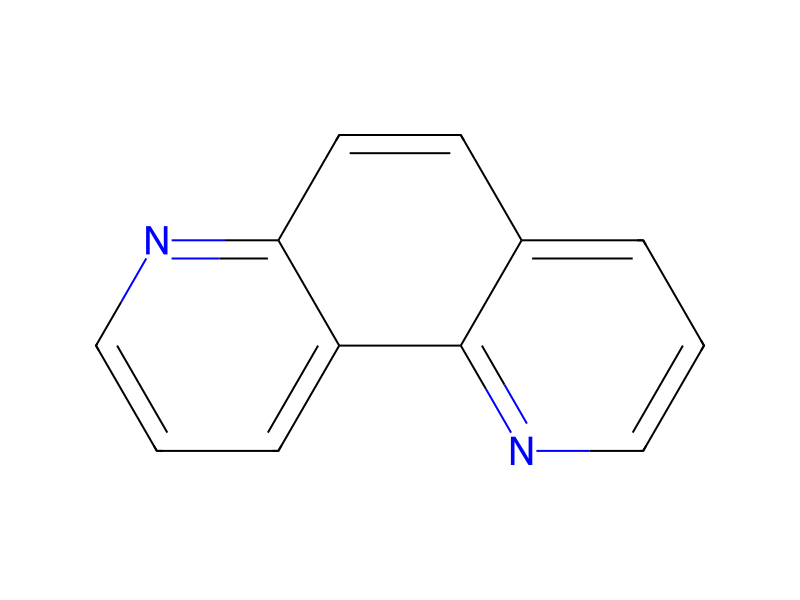
1,7-Phenanthroline

HCID 67473
New reaction
Print
Basic informationOverviewNames & identifiersPropertiesSafety & regulationChemistry & industryRelated reactionsCompound notes
Substructure searchFind similar structures

Basic information

CAS
12678-01-2
Standard SMILES
c1cnc2c(c1)ccc1ncccc12
InChIKey
OZKOMUDCMCEDTM-UHFFFAOYSA-N
Molecular formula
C12H8N2
Average molar mass
180.2 g/mol
Monoisotopic mass
180.06874826

Overview

1,7-phenanthroline is a phenanthroline.

Names & identifiers

Preferred name
1,7-Phenanthroline
IUPAC
1,7-phenanthroline
English name
1,7-PHENANTHROLINE
Molecular formula
C12H8N2
Molecular weight
180.21

Names & synonyms

1,7-Phenanthroline230-46-65Y778HQU2SDTXSID50870492NSC-35679CHEBI:36418RefChem:73719DTXCID70818210MFCD00004971MLS000738106NSC3567912678-01-2
Show more names
PHENANTHROLINENSC 35679AKOS 900614,10-Phenanthroline1,7-Phenanthroline 99%Pyrido[2,3-f]quinolinePyrido[2,3-f]quinoline1
SMR000393870pyridino[2,3-f]quinolineM-PHENANTHROLINEPhenanthrolines1,5-DIAZAPHENANTHRENEm-Phenanthrolin[1,7]phenanthrolineOpera_ID_785

Database identifiers

CAS
12678-01-2、230-46-6
PubChem CID
67473
DTXSID
DTXSID50870492
ChEMBL
CHEMBL1529707
ChEBI
CHEBI:36418
UNII
5Y778HQU2S
EC Number
625-267-6
Nikkaji
J151.373G

Properties

Computed structural properties

XLogP
2.5
Topological polar surface area
25.8 Ų
Hydrogen bond donors
0
Hydrogen bond acceptors
2
Rotatable bonds
0
Heavy atoms
14
Formal charge
0
Complexity
204

Experimental & physicochemical properties

PolymersOther Classes -> Polycyclic Aromatic Hydrocarbons
SpringerMaterials PropertiesAngular frequency
LogP1.93
Solubility>27 [ug/mL] (The mean of the results at pH 7.4)
Vapor Pressure0.0000326 [mmHg]
Physical DescriptionTan crystalline powder; [MSDSonline]

Physicochemical properties

Melting point
79 · 79-81 °C (lit.)
Boiling point
303.03 °C · 303.03°C (rough estimate)
Density
1.1836 · 1.1836 (rough estimate)
refractive index
1.52 · 1.5200 (estimate)
RTECS
8290000 · SF8290000
storage temp.
Sealed in dry,Room Temperature
pka
1 · pK1:4.30(+1) (25°C)
form
Crystalline Powder
color
White to beige
Water Solubility
It is soluble in water, ethanol, ether and benzene.
Sensitive
Moisture Sensitive
InChI
1S/C12H8N2/c1-3-9-5-6-11-10(4-2-7-13-11)12(9)14-8-1/h1-8H
InChIKey
OZKOMUDCMCEDTM-UHFFFAOYSA-N
SMILES
c1cnc2c(c1)ccc3ncccc23
CAS DataBase Reference
230 · 230-46-6(CAS DataBase Reference)
EWG's Food Scores
1 · 1
FDA UNII
5 Y778HQU2S · 5Y778HQU2S
UNSPSC Code
12352100 · 12352100
NACRES
22 · NA.22
Symbol(GHS)
5 · GHS05,GHS06,GHS09
Signal word
Danger
Hazard statements
301 · H301-H318-H410
Precautionary statements
273 · P273-P280-P301+P310+P330-P305+P351+P338+P310
PPE
95 · dust mask type N95 (US), Eyeshields, Faceshields, Gloves
Hazard Codes
Xn,N,T
Risk Statements
22 · 22-41-50/53-25
Safety Statements
26 · 26-36/39-61-60-45-39
RIDADR
2811 · UN 2811 6.1/PG 3
WGK Germany
3 · 3
HazardClass
6.1 · 6.1
PackingGroup
III
HS Code
2933990099 · 2933990099
Storage Class
6.1 C · 6.1C - Combustible acute toxic Cat.3toxic compounds or compounds which causing chronic effects
Hazard Classifications
3 OralAquatic · Acute Tox. 3 OralAquatic Acute 1Aquatic Chronic 1Eye Dam. 1

Safety & regulation

Safety information is for reference only and does not replace the supplier’s Safety Data Sheet (SDS), applicable regulations, or professional assessment.

GHS classification

GHS Classification · 4 items

Danger

H301 (90.9%): Toxic if swallowed [Danger Acute toxicity, oral]

P264, P264+P265, P270, P273, P280, P301+P316, P305+P354+P338, P317, P321, P330, P391, P405, and P501 (click each P-code to see the statement)

Aggregated GHS information provided per 44 reports by companies from 4 notifications to the ECHA C&L Inventory. Each notification may be associated with multiple companies.

Hazard information

Hazards SummaryToxic by ingestion; An irritant; [MSDSonline] See POLYCYCLIC AROMATIC HYDROCARBONS.
Hazard Classes and CategoriesAcute Tox. 3 (90.9%)

Safety data

PPE
dust mask type N95 (US), Eyeshields, Faceshields, Gloves
wgk
3
ridadr
UN 2811 6.1/PG 3
hs_code
2933990099
risk_code
22-41-50/53-25
Signal word
Danger
Symbol(GHS)
GHS05,GHS06,GHS09
hazard_code
Xn,N,T
safety_code
26-36/39-61-60-45-39
hazard_class
6.1
Storage Class
6.1C - Combustible acute toxic Cat.3toxic compounds or compounds which causing chronic effects
packing_group
III
Hazard statements
H301-H318-H410
Hazard Classifications
Acute Tox. 3 OralAquatic Acute 1Aquatic Chronic 1Eye Dam. 1
Precautionary statements
P273-P280-P301+P310+P330-P305+P351+P338+P310

Chemistry & industry

Applications · 2 items

Uses1,7-Phenanthroline acts as an inhibitor of germination and growth of plants. it can be used to produce [1,7]phenanthroline-8-carbonitrile with hydrocyanic acid; potassium salt at temperature. It is also used as an intermediate and chemical research.

General Description1,7-Phenanthroline has inhibitory effect on germination and growth of plants. 1,7-Phenanthroline is an aza-analog of phenanthrene, was found to be mutagenic in the Ames test using Salmonella typhimurium TA100 in the presence of a rat liver S9 fraction. Supramolecular assemblies of 1,2,4,5-benzenetetracarboxylic acid with 1,7-phenanthroline (aza donor molecule) were investigated.

Upstream & downstream products

Upstream raw materials

3-Nitroaniline5-Aminoquinolinem-PhenylenediamineHydrochloric acid7-Nitro-quinolineGlycerol

Additional notes

DefinitionChEBI: 1,7-phenanthroline is a phenanthroline.

Related reactions

6 records
New reaction record
HRID 165082As reactant
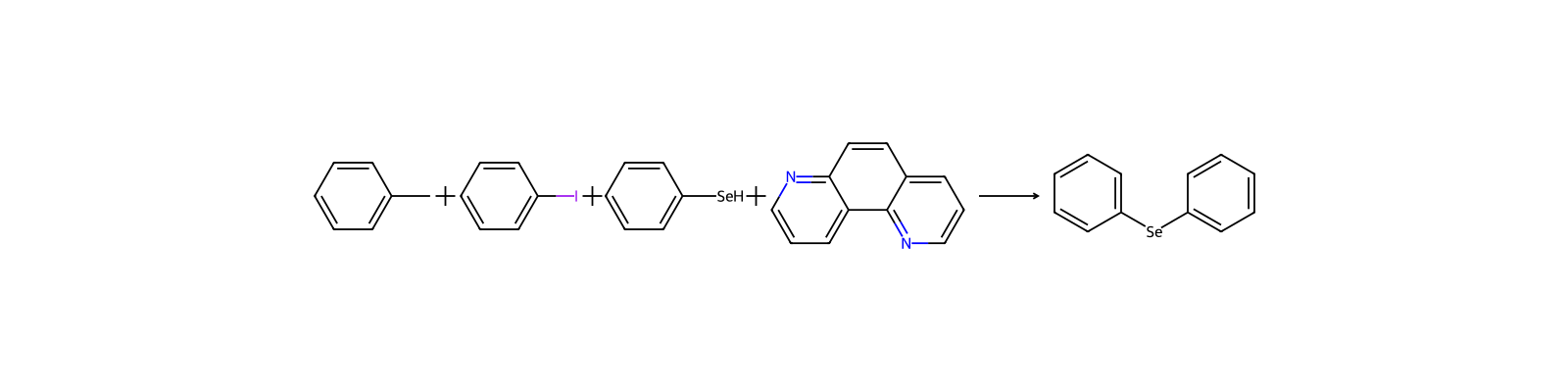
HRID 281140As reactant
HRID 671805As reactant
HRID 824174As reactant
HRID 960892As reactant
HRID 1541828As reactant

Compound notes

On this pageBasic informationOverviewNames & identifiersPropertiesSafety & regulationChemistry & industryRelated reactionsCompound notes