
HRID 8526As reactant
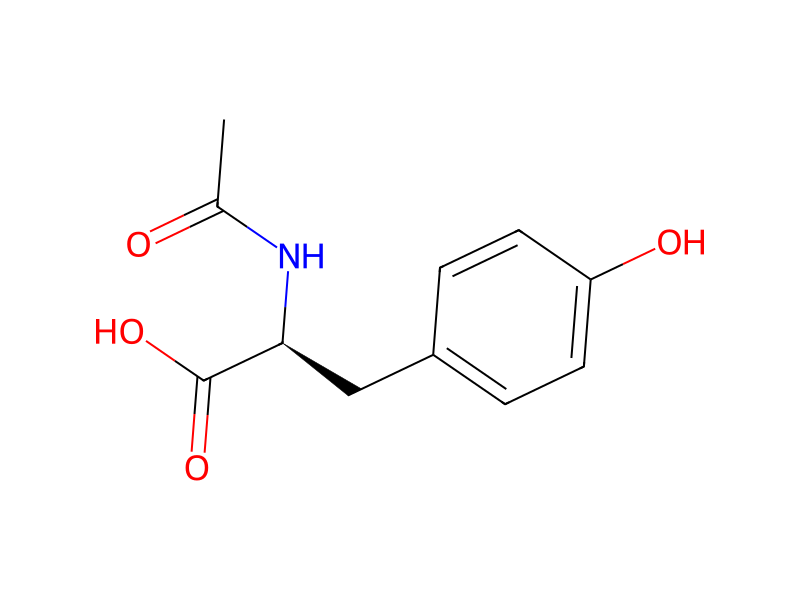
537-55-3CC(=O)N[C@@H](Cc1ccc(O)cc1)C(=O)OCAHKINHBCWCHCF-JTQLQIEISA-NN-acetyl-L-tyrosine is an N-acetyltyrosine in which the chiral centre has L configuration. It has a role as a biomarker, an EC 2.1.1.4 (acetylserotonin O-methyltransferase) inhibitor and a human urinary metabolite. It is a N-acetyltyrosine and a N-acyl-L-tyrosine. It is a conjugate acid of a N-acetyl-L-tyrosinate.
537-55-3DTXSID7046045CHEMBL65543Cosmetic ingredients (Acetyl Tyrosine) -> CIR (Cosmetic Ingredient Review)
Tanning
149-152
149 - 152 °C
Safety information is for reference only and does not replace the supplier’s Safety Data Sheet (SDS), applicable regulations, or professional assessment.
This chemical does not meet GHS hazard criteria for 15.5% (61 of 394) of reports.
Danger
H318 (84.3%): Causes serious eye damage [Danger Serious eye damage/eye irritation]
P264+P265, P280, P305+P354+P338, and P317 (click each P-code to see the statement)
Aggregated GHS information provided per 394 reports by companies from 4 notifications to the ECHA C&L Inventory.
Chemical: L-Tyrosine, N-acetyl-
L-Tyrosine, N-acetyl-: Does not have an individual approval but may be used under an appropriate group standard
The panel concluded that the 115 amino acid alkyl amides listed below are safe in the present practices of use and concentration in cosmetics, when formulated to be non-irritating...Acetyl Tyrosine
Safe for use in cosmetics, with qualifications
N-acetyltyrosine is eliminated in the urine. The extent of urinary elimination versus utilization in the tissues appears to be related to the rapidity of infusion. When infused slowly in standard doses as in the clinical setting, about 35% is excreted unchanged in the urine. When larger doses are infused rapidly, much higher amounts are excreted reaching values up to 56%. In rat studies it was found that of the drug eliminated in the urine about 74% is present as unchanged N-acetyltyrosine and 23% is present as tyrosine.
UsesN-Acetyl-L-tyrosine is involved in catecholamine production. It can be used as a cell culture media component in the commercial biomanufacture of therapeutic recombinant proteins and monoclonal antibodies.


CHEBI:21563DefinitionChEBI: N-acetyl-L-tyrosine is an N-acetyltyrosine in which the chiral centre has L configuration. It has a role as an EC 2.1.1.4 (acetylserotonin O-methyltransferase) inhibitor, a biomarker and a human urinary metabolite. It is a N-acyl-L-tyrosine and a N-acetyltyrosine. It is a conjugate acid of a N-acetyl-L-tyrosinate.