
uspto-grants-1988_02 · 10.6084/m9.figshare.5104873.v1 · US04725600
查看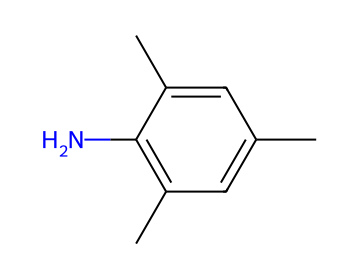
IDENTITY
COMPUTED
PROPERTIES
0.9633 (EPA, 1998) - Less dense than water; will float
0.96 kg/l
0.96 @25 °C
Liquid
Insoluble in water
450 to 451 °F at 760 mmHg (EPA, 1998)
232-234 °C
232 °C @760 [mm Hg]
When heated to decomposition it emits toxic fumes of nitroxides.
23 °F (EPA, 1998)
-5 °C
-5 °C
0.06 [mmHg]
Aniline, 2,4,6-trimethyl- appears as a liquid. (EPA, 1998)
Liquid; [HSDB] Rose colored liquid; [MSDSonline]
pKa= 4.38
1230.9;1242.2;1261
1261;214.41
GHS
This chemical does not meet GHS hazard criteria for 36.9% (38 of 103) of reports.
Danger
H301 (10.7%): Toxic if swallowed [Danger Acute toxicity, oral];H302 (52.4%): Harmful if swallowed [Warning Acute toxicity, oral];H311 (12.6%): Toxic in contact with skin [Danger Acute toxicity, dermal];H312 (48.5%): Harmful in contact with skin [Warning Acute toxicity, dermal];H315 (57.3%): Causes skin irritation [Warning Skin corrosion/irritation];H319 (59.2%): Causes serious eye irritation [Warning Serious eye damage/eye irritation];H330 (51.5%): Fatal if inhaled [Danger Acute toxicity, inhalation];H335 (16.5%): May cause respiratory irritation [Warning Specific target organ toxicity, single exposure; Respiratory tract irritation];H373 (12.6%): May causes damage to organs through prolonged or repeated exposure [Warning Specific target organ toxicity, repeated exposure]
P260, P261, P262, P264, P264+P265, P270, P271, P280, P284, P301+P316, P301+P317, P302+P352, P304+P340, P305+P351+P338, P316, P317, P319, P320, P321, P330, P332+P317, P337+P317, P361+P364, P362+P364, P403+P233, P405, and P501 (click each P-code to see the statement)
Aggregated GHS information provided per 103 reports by companies from 17 notifications to the ECHA C&L Inventory. Each notification may be associated with multiple companies.;Reported as not meeting GHS hazard criteria per 38 of 103 reports by companies.;There are 15 notifications provided by 65 of 103 reports by companies with hazard statement code(s).;Information may vary between notifications depending on impurities, additives, and other factors. The percentage value in parenthesis indicates the notified classification ratio from companies that provide hazard codes. Only hazard codes with percentage values above 10% are shown. For more detailed information, please visit ECHA C&L website.
HAZARDS
Chemical: Benzenamine, 2,4,6-trimethyl-
Status: Active Update: 24-05-2018 https://echa.europa.eu/registration-dossier/-/registered-dossier/22322
2,4,6-Trimethylaniline: Does not have an individual approval but may be used under an appropriate group standard
The New Jersey Worker and Community Right to Know Act requires public and private employers to provide information about hazardous substances at their workplaces. (N.J.S.A. 34:5A-1 et. seq.)
Poison
When heated to decomposition, it emits toxic fumes of nitrogen oxides. Avoid decomposing heat. (EPA, 1998)
This material is moderately toxic orally. It is also considered highly toxic by unspecified routes. It is a skin and eye irritant. Suspect occupational carcinogen. (Non-Specific -- Aromatic Amines) The danger of acute poisoning is represented by methemoglobinemia leading to adverse effects on the red cells. A number of the amines may act as skin sensitizers. (EPA, 1998)
Irritating to skin; Severely irritating to eyes; Oral LD50 (rat) = 743 mg/kg; Causes liver injury in high-dose animal experiments; [HSDB] An irritant; Effects in high-dose animal studies include lacrimation, toxic hepatitis, and methemoglobinemia; [MSDSonline] See 2,4,5-Trimethylaniline.
Amines, Aromatic
ANILINE, 2,4,6-TRIMETHYL- neutralizes acids in exothermic reactions to form salts plus water. May be incompatible with isocyanates, halogenated organics, peroxides, phenols (acidic), epoxides, anhydrides, and acid halides. Flammable gaseous hydrogen may be generated in combination with strong reducing agents, such as hydrides.
No rapid reaction with air. No rapid reaction with water.
Releases of CERCLA hazardous substances are subject to the release reporting requirement of CERCLA section 103, codified at 40 CFR part 302, in addition to the requirements of 40 CFR part 355. Aniline, 2,4,6-trimethyl- is an extremely hazardous substance (EHS) subject to reporting requirements when stored in amounts in excess of its threshold planning quantity (TPQ) of 500 lbs.
Acute Tox. 3 (10.7%);Acute Tox. 4 (52.4%);Acute Tox. 3 (12.6%);Acute Tox. 4 (48.5%);Skin Irrit. 2 (57.3%);Eye Irrit. 2 (59.2%);Acute Tox. 1 (51.5%);STOT SE 3 (16.5%);STOT RE 2 (12.6%)
Acute toxicity (Oral) - Category 4;Acute toxicity (Inhalation: Vapours) - Category 1;Skin corrosion/irritation - Category 2;Serious eye damage/eye irritation - Category 2;Specific target organ toxicity - Repeated exposure - Category 2 (eye)
A skin and severe eye irritant.
Small amounts of aromatic amines - aniline ignite on contact, while larger amounts exploded dangerously, probably owing to rapid formation of diazonium perchlorates.
SAFETY
(Non-Specific -- Poisonous Liquid, n.o.s.) Keep unnecessary people away; isolate hazard area and deny entry. Stay upwind; keep out of low areas. Ventilate closed spaces before entering them. Wear positive pressure breathing apparatus and special protective clothing. If water pollution occurs, notify appropriate authorities.;(Non-Specific -- Poisonous Liquid, n.o.s.) Small fires: dry chemical, carbon dioxide, water spray or foam. Large fires: water spray, fog or foam. Move container from fire area if you can do so without risk. Fight fire from maximum distance. Dike fire control water for later disposal; do not scatter the material. (EPA, 1998)
Signs and Symptoms of Aniline, 2,4,6-Trimethyl- Exposure: Acute exposure to aniline, 2,4,6-trimethyl- may result in eye and skin irritation and cyanosis. Headache, nausea, dizziness, and weakness may also occur. Repeated exposure to aniline, 2,4,6- trimethyl- may cause a decrease in the peripheral vision and photosensitivity of the eye.;Emergency Life-Support Procedures: Acute exposure to aniline, 2,4,6-trimethyl- may require decontamination and life support for the victims. Emergency personnel should wear protective clothing appropriate to the type and degree of contamination. Air-purifying or supplied-air respiratory equipment should also be worn, as necessary. Rescue vehicles should carry supplies such as plastic sheeting and disposable plastic bags to assist in preventing spread of contamination.;Inhalation Exposure:;1. Move victims to fresh air. Emergency personnel should avoid self-exposure to aniline, 2,4,6-trimethyl-.;2. Evaluate vital signs including pulse and respiratory rate, and note any trauma. If no pulse is detected, provide CPR. If not breathing, provide artificial respiration. If breathing is labored, administer oxygen or other respiratory support.;3. Obtain authorization and/or further instructions from the local hospital for administration of an antidote or performance of other invasive procedures.;4. Transport to a health care facility.;Dermal/Eye Exposure:;1. Remove victims from exposure. Emergency personnel should avoid self-exposure to aniline, 2,4,6-trimethyl-.;2. Evaluate vital signs including pulse and respiratory rate, and note any trauma. If no pulse is detected, provide CPR. If not breathing, provide artificial respiration. If breathing is labored, administer oxygen or other respiratory support.;3. Remove and isolate contaminated clothing as soon as possible.;4. If eye exposure has occurred, eyes must be flushed with lukewarm water for at least 15 minutes.;5. Wash exposed skin areas thoroughly with water.;6. Obtain authorization and/or further instructions from the local hospital for administration of an antidote or performance of other invasive procedures.;7. Transport to a health care facility.;Ingestion Exposure:;1. Evaluate vital signs including pulse and respiratory rate, and note any trauma. If no pulse is detected, provide CPR. If not breathing, provide artificial respiration. If breathing is labored, administer oxygen or other respiratory support.;2. DO NOT induce vomiting or attempt to neutralize!;3. Obtain authorization and/or further instructions from the local hospital for administration of an antidote or performance of other invasive procedures.;4. Activated charcoal may be administered if victims are conscious and alert. Use 15 to 30 g (1/2 to 1 oz) for children, 50 to 100 g (1-3/4 to 3-1/2 oz) for adults, with 125 to 250 mL (1/2 to 1 cup) of water.
(Non-Specific -- Poisonous Liquid, n.o.s.) Do not touch spilled material; stop leak if you can do so without risk. Use water spray to reduce vapors.;Small spills: absorb with sand or other noncombustible absorbent material and place into containers for later disposal.;Large spills: dike far ahead of spill for later disposal. (EPA, 1998)
SRP: At the time of review, criteria for land treatment or burial (sanitary landfill) disposal practices are subject to significant revision. Prior to implementing land disposal of waste residue (including waste sludge), consult with environmental regulatory agencies for guidance on acceptable disposal practices.
SRP: The scientific literature for the use of contact lenses in industry is conflicting. The benefit or detrimental effects of wearing contact lenses depend not only upon the substance, but also on factors including the form of the substance, characteristics and duration of the exposure, the uses of other eye protection equipment, and the hygiene of the lenses. However, there may be individual substances whose irritating or corrosive properties are such that the wearing of contact lenses would be harmful to the eye. In those specific cases, contact lenses should not be worn. In any event, the usual eye protection equipment should be worn even when contact lenses are in place.
Excerpt from ERG Guide 153 [Substances - Toxic and/or Corrosive (Combustible)]:;IMMEDIATE PRECAUTIONARY MEASURE: Isolate spill or leak area in all directions for at least 50 meters (150 feet) for liquids and at least 25 meters (75 feet) for solids.;SPILL: Increase the immediate precautionary measure distance, in the downwind direction, as necessary.;FIRE: If tank, rail tank car or highway tank is involved in a fire, ISOLATE for 800 meters (1/2 mile) in all directions; also, consider initial evacuation for 800 meters (1/2 mile) in all directions. (ERG, 2024)
0.26 [mg/m3]
2.9 [mg/m3]
10 [mg/m3]
For emergency situations, wear a positive pressure, pressure-demand, full facepiece self-contained breathing apparatus (SCBA) or pressure- demand supplied air respirator with escape SCBA and a fully-encapsulating, chemical resistant suit. (EPA, 1998)
TOXICITY
TERRESTRIAL FATE: Based on a classification scheme(1), an estimated Koc value of 198(SRC), determined from a structure estimation method(2), indicates that 2,4,6-trimethylaniline is expected to have moderate mobility in soil(SRC). However, aromatic amines (including anilines) bind to humate found in soil in two phases(3). Initially, a rapid, reversible equilibrium is established, which may represent formation of imine linkages with the humate carbonyls(3). Subsequently, there is a slow reaction that is not readily reversed(3). Also, a pKa value of 4.38(4) suggests that 2,4,6-trimethylaniline will partially exist in the protonated form in moist soils and the protonated form of 2,4,6-trimethylaniline is expected to bind strongly to soil surfaces. Volatilization of 2,4,6-trimethylaniline from moist soil surfaces is expected to be an important fate process(SRC) given an estimated Henry's Law constant of 2.7X10⁻⁶ atm-cu m/mole(SRC), using a fragment constant estimation method(5). 2,4,6-Trimethylaniline is not expected to volatilize from dry soil surfaces(SRC) based upon an estimated vapor pressure of 0.067 mm Hg(SRC), determined from a fragment constant method(6).
AQUATIC FATE: Based on a classification scheme(1), an estimated Koc value of 198(SRC), determined from an estimation method(2), indicates that 2,4,6-trimethylaniline is expected to slightly adsorb to sediment and suspended solids in water(SRC). In a biodegradation study of 2,4,6-trimethylaniline in a mixed domestic/industrial treatment plant, 0-9% degraded at a concentration of 20 mg/l after 6 hours and 25 °C(3). Volatilization from water surfaces is expected(4) based upon an estimated Henry's Law constant of 2.7X10⁻⁶ atm-cu m/mole(SRC), developed using a fragment constant estimation method(5). Using this Henry's Law constant and an estimation method(4), volatilization half-lives for a model river and model lake are 11 and 120 days, respectively(SRC). However, volatilization from water surfaces may be attenuated by adsorption to humate material in the water column(6). However, aromatic amines (including anilines) bind to humate found in water in two phases(6). Initially, a rapid, reversible equilibrium is established, which may represent formation of imine linkages with the humate carbonyls(6). Subsequently, there is a slow reaction that is not readily reversed(6). A pKa of 4.38(7) suggests that 2,4,6-trimethylaniline will partially exist in the protonated form in the aqueous environments and the protonated form of 2,4,6-trimethylaniline is not expected to volatilize from water. According to a classification scheme(8), an estimated BCF of 25(SRC), from an estimated log Kow of 2.72(9) and a regression-derived equation(10), suggests the potential for bioconcentration in aquatic organisms is low.
ATMOSPHERIC FATE: According to a model of gas/particle partitioning of semivolatile organic compounds in the atmosphere(1), 2,4,6-trimethylaniline, which has an estimated vapor pressure of 0.067 mm Hg at 25 °C(2), is expected to exist solely as a vapor in the ambient atmosphere. Vapor-phase 2,4,6-trimethylaniline is degraded in the atmosphere by reaction with photochemically-produced hydroxyl radicals(SRC); the half-life for this reaction in air is estimated to be 6.7 hrs(SRC), calculated from its rate constant of 5.7X10⁻¹¹ cu cm/molecule-sec at 25 °C(SRC) determined using a structure estimation method(3).
Occupational hepatotoxin - Secondary hepatotoxins: the potential for toxic effect in the occupational setting is based on cases of poisoning by human ingestion or animal experimentation.;Methemoglobinemia - The presence of increased methemoglobin in the blood; the compound is classified as secondary toxic effect
Using a structure estimation method based on molecular connectivity indices(1), the Koc for 2,4,6-trimethylaniline can be estimated to be 198(SRC). According to a classification scheme(2), this estimated Koc value suggests that 2,4,6-trimethylaniline is expected to have moderate mobility in soil. However, primary amines(including anilines) bind to humate found in soil in two phases(3). Initially, a rapid, reversible equilibrium is established, which may represent formation of imine linkages with the humate carbonyls(3). Subsequently, there is a slow reaction that is not readily reversed(3).
...WORKERS WHO HAD BEEN ENGAGED FOR ELEVEN TO TWENTY YR IN MFR OF MESIDINE & ANILINE WERE REPORTED TO HAVE NARROWING OR PERIPHERAL VISUAL FIELDS, INCR IN SIZE OF BLIND SPOT, & DECR IN "PHOTOSENSITIVITY," FOR WHICH MESIDINE WAS THOUGHT TO BE RESPONSIBLE.
2,4,6-Trimethylaniline's production and use in the manufacture of dyes(1) may result in its release to the environment through various waste streams(SRC).
AEROBIC: In a pure culture study using Escherichia coli B, 2,4,6-trimethylaniline was not found to degrade after 7 days incubation at 37 °C in total darkness(1). 2,4,6-Trimethylaniline exhibited 0-9% depletion at 20 mg/l after 6 hrs @ 25 °C in a mixed domestic/industrial treatment plant(2).
2,4,6-Trimethylaniline
Group 3: Not classifiable as to its carcinogenicity to humans
Volume 27: (1982) Some Aromatic Amines, Anthraquinones and Nitroso Compounds, and Inorganic Fluorides Used in Drinking-water and Dental Preparations;Volume Sup 7: Overall Evaluations of Carcinogenicity: An Updating of IARC Monographs Volumes 1 to 42, 1987; 440 pages; ISBN 92-832-1411-0 (out of print)
1987
1987
An estimated BCF of 25 was calculated for 2,4,6-trimethylaniline(SRC), using an estimated log Kow of 2.72(1,SRC) and a regression-derived equation(2). According to a classification scheme(3), this BCF suggests the potential for bioconcentration in aquatic organisms is low.
The Henry's Law constant for 2,4,6-trimethylaniline is estimated as 2.7X10⁻⁶ atm-cu m/mole(SRC) using a fragment constant estimation method(1). This Henry's Law constant indicates that 2,4,6-trimethylaniline is expected to volatilize from water surfaces(2). Based on this Henry's Law constant, the volatilization half-life from a model river (1 m deep, flowing 1 m/sec, wind velocity of 3 m/sec)(2) is estimated as 11 days(SRC). The volatilization half-life from a model lake (1 m deep, flowing 0.05 m/sec, wind velocity of 0.5 m/sec)(2) is estimated as 120 days(SRC). However, aromatic amines (including anilines) bind to humate found in water in two phases(3). Initially, a rapid, reversible equilibrium is established, which may represent formation of imine linkages with the humate carbonyls(3). Subsequently, there is a slow reaction that is not readily reversed(3). A pKa of 4.38(4) suggests that 2,4,6-trimethylaniline will partially exist in the protonated form in the aqueous environments and the protonated form of 2,4,6-trimethylaniline is not expected to volatilize from water. 2,4,6-Trimethylaniline's Henry's Law constant(1) indicates that volatilization from moist soil surfaces may occur(SRC). 2,4,6-Trimethylaniline is not expected to volatilize from dry soil surfaces(SRC) based upon an estimated vapor pressure of 0.067 mm Hg(SRC), determined from a fragment constant method(5).
...PROVED PARTICULARLY TOXIC TO RETINA WHEN GIVEN TO RATS & RABBITS, PRODUCING MORPHOLOGIC CHANGES IN RETINA.
... IT HAS BEEN FOUND THAT 2,4,6-TRIMETHYLANILINE PRODUCES LIVER TUMORS IN RATS.
TESTED FOR LONG-TERM TOXICITY BY DIETARY ADMIN TO MALE CHARLES RIVER RATS & MALE & FEMALE HAM/1CR MICE. 2,4,6-TRIMETHYLANILINE LED TO TUMORS IN 1 OR MORE TISSUES IN ALL 3 ANIMAL MODELS & ALSO LED TO CIRRHOSIS OF LIVER IN RATS ONLY.
PITUITARY TUMOR WAS INDUCED IN FEMALE INBRED BUF RAT ON 18-MO DIET CONTAINING 1.1 MMOLE 2,4,6-TRIMETHYLANILINE/KG. IN 6TH TRANSFER, THIS TUMOR DEVELOPED INTO 2 LINES OF TRANSPLANTABLE TUMORS WITH DIFFERENT CHARACTERISTICS.
No data are available in humans. Inadequate evidence of carcinogenicity in animals. OVERALL EVALUATION: Group 3: The agent is not classifiable as to its carcinogenicity to humans.
The rate constant for the vapor-phase reaction of 2,4,6-trimethylaniline with photochemically-produced hydroxyl radicals has been estimated as 5.7X10⁻¹¹ cu cm/molecule-sec at 25 °C(SRC) using a structure estimation method(1). This corresponds to an atmospheric half-life of about 6.7 hrs at an atmospheric concentration of 5X10+5 hydroxyl radicals per cu cm(1). 2,4,6-Trimethylaniline is not expected to undergo hydrolysis in the environment due to the lack of hydrolyzable functional groups(2) nor to directly photolyze due to the lack of absorption in the environmental UV spectrum (>290 nm).
REGULATORY
Chemical: Benzenamine, 2,4,6-trimethyl-
Status: Active Update: 24-05-2018 https://echa.europa.eu/registration-dossier/-/registered-dossier/22322
2,4,6-Trimethylaniline: Does not have an individual approval but may be used under an appropriate group standard
The New Jersey Worker and Community Right to Know Act requires public and private employers to provide information about hazardous substances at their workplaces. (N.J.S.A. 34:5A-1 et. seq.)
Releases of CERCLA hazardous substances are subject to the release reporting requirement of CERCLA section 103, codified at 40 CFR part 302, in addition to the requirements of 40 CFR part 355. Aniline, 2,4,6-trimethyl- is an extremely hazardous substance (EHS) subject to reporting requirements when stored in amounts in excess of its threshold planning quantity (TPQ) of 500 lbs.
USES
Used in dyes; [HSDB]
Dyes
Produced by reduction of 1,3,5-trimethyl-2-nitrobenzene, which is obtained by nitration of mesitylene under special conditions.
Acid Blue 80, Acid Blue 129
Benzenamine, 2,4,6-trimethyl-: ACTIVE
ALIASES
REACTIONS
uspto-grants-1988_02 · 10.6084/m9.figshare.5104873.v1 · US04725600
查看
uspto-grants-2010_06 · 10.6084/m9.figshare.5104873.v1 · US07732365B2
查看
uspto-grants-2010_06 · 10.6084/m9.figshare.5104873.v1 · US07732643B2
查看
uspto-grants-2013_09 · 10.6084/m9.figshare.5104873.v1 · US08530655B2
查看
uspto-grants-2013_09 · 10.6084/m9.figshare.5104873.v1 · US08530655B2
查看
uspto-grants-2004_03 · 10.6084/m9.figshare.5104873.v1 · US06710006B2
查看
uspto-grants-1986_09 · 10.6084/m9.figshare.5104873.v1 · US04612376
查看
uspto-grants-1986_09 · 10.6084/m9.figshare.5104873.v1 · US04612376
查看