
uspto-grants-2005_02 · 10.6084/m9.figshare.5104873.v1 · US06858600B2
查看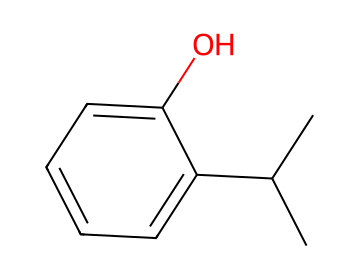
IDENTITY
COMPUTED
PROPERTIES
2.88
0.995 at 68 °F (USCG, 1999) - Less dense than water; will float
0.989-0.999
slightly soluble in water
miscible (in ethanol)
220 °F (USCG, 1999)
417.2 °F at 760 mmHg (USCG, 1999)
212.00 to 214.00 °C. @ 760.00 mm Hg
213-214 °C
62.6 °F (USCG, 1999)
15 - 16 °C
1.525-1.530
O-isopropyl phenol is a light-yellow liquid. Less dense than water and insoluble in water. Hence floats on water.
Light yellow liquid; mp = 17 deg C; [CAMEO] Melting point = 12-16 deg C; [Sigma-Aldrich MSDS]
Liquid
Colourless liquid, phenolic odour
Negative
-0.61
10.5
Agilent XCT
Electrospray ionization
ammonia (10nM)
1175.4;1178;1200;1175;1175;1183.3;1173
1198.9;1199.2;1200.2;1184;1203;1175;1198;1200;203.41
2111;2089
129.3 Ų [M-H]- [CCS Type: DT; Buffer gas: N2; Ionization: ESI-; Dataset: TOXCAST; Source Identifier: DTXSID2044391]
GHS
This chemical does not meet GHS hazard criteria for 0.3% (5 of 1618) of reports.
Danger
H302 (99.2%): Harmful if swallowed [Warning Acute toxicity, oral];H312 (84.2%): Harmful in contact with skin [Warning Acute toxicity, dermal];H314 (85.7%): Causes severe skin burns and eye damage [Danger Skin corrosion/irritation]
P260, P264, P270, P280, P301+P317, P301+P330+P331, P302+P352, P302+P361+P354, P304+P340, P305+P354+P338, P316, P317, P321, P330, P362+P364, P363, P405, and P501 (click each P-code to see the statement)
Aggregated GHS information provided per 1618 reports by companies from 15 notifications to the ECHA C&L Inventory. Each notification may be associated with multiple companies.;Reported as not meeting GHS hazard criteria per 5 of 1618 reports by companies.;There are 14 notifications provided by 1613 of 1618 reports by companies with hazard statement code(s).;Information may vary between notifications depending on impurities, additives, and other factors. The percentage value in parenthesis indicates the notified classification ratio from companies that provide hazard codes. Only hazard codes with percentage values above 10% are shown. For more detailed information, please visit ECHA C&L website.
HAZARDS
Chemical: Phenol, 2-(1-methylethyl)-
Commission Regulation (EC) No 1565/2000 (Repealed by Com. Implementing Reg. (EU) No 872/2012)
Status: Active Update: 28-08-2018 https://echa.europa.eu/registration-dossier/-/registered-dossier/21003
Phenol, 2-(1-methylethyl)-: Does not have an individual approval but may be used under an appropriate group standard
Evaluation - Propyl and butyl phenols
Corrosive
Special Hazards of Combustion Products: Irritating vapors and toxic gases, such as carbon dioxide and carbon monoxide, may be formed when involved in fire. (USCG, 1999)
Exposure can cause irritation of eyes, nose and throat. (USCG, 1999)
Causes sleep in intravenous lethal-dose studies of mice (LD50 = 100 mg/kg); [RTECS] A skin, eye, nose, and throat irritant; May cause second-degree skin burns after a few minutes contact; Vapor is moderately irritating; [CHRIS] Safe when used as a flavoring agent in food; [JECFA] Causes burns; Inhalation may cause corrosive injuries to upper respiratory tract; Harmful by ingestion; [Sigma-Aldrich MSDS]
Phenols and Cresols
Phenols, such as O-ISOPROPYL PHENOL, do not behave as organic alcohols, as one might guess from the presence of a hydroxyl (-OH) group in their structure. Instead, they react as weak organic acids. Phenols and cresols are much weaker as acids than common carboxylic acids (phenol has pKa = 9.88). These materials are incompatible with strong reducing substances such as hydrides, nitrides, alkali metals, and sulfides. Flammable gas (H2) is often generated, and the heat of the reaction may ignite the gas. Heat is also generated by the acid-base reaction between phenols and bases. Such heating may initiate polymerization of the organic compound. Phenols are sulfonated very readily (for example, by concentrated sulfuric acid at room temperature). The reactions generate heat. Phenols are also nitrated very rapidly, even by dilute nitric acid. Nitrated phenols often explode when heated. Special Hazards of Combustion Products: Irritating vapors and toxic gases, such as carbon dioxide and carbon monoxide, may be formed when involved in fire (USCG, 1999).
Insoluble in water.
Acute Tox. 4 (99.2%);Acute Tox. 4 (84.2%);Skin Corr. 1B (85.7%)
SAFETY
Fire Extinguishing Agents Not to Be Used: Water.;Fire Extinguishing Agents: Dry chemical, alcohol foam, or carbon dioxide. (USCG, 1999)
Get medical attention.;INHALATION: Remove to fresh air. If breathing has stopped, give artificial respiration. If breathing is difficult, give oxygen.;EYES: Flush with water for at least 15 min., lifting lids occasionally. Contact lenses should not be worn when working with this chemical.;SKIN: Remove contaminated clothing and shoes. Wash with soap and water. (USCG, 1999)
Excerpt from ERG Guide 153 [Substances - Toxic and/or Corrosive (Combustible)]:;ELIMINATE all ignition sources (no smoking, flares, sparks or flames) from immediate area. Do not touch damaged containers or spilled material unless wearing appropriate protective clothing. Stop leak if you can do it without risk. Prevent entry into waterways, sewers, basements or confined areas. Absorb or cover with dry earth, sand or other non-combustible material and transfer to containers. DO NOT GET WATER INSIDE CONTAINERS. (ERG, 2024)
Excerpt from ERG Guide 153 [Substances - Toxic and/or Corrosive (Combustible)]:;IMMEDIATE PRECAUTIONARY MEASURE: Isolate spill or leak area in all directions for at least 50 meters (150 feet) for liquids and at least 25 meters (75 feet) for solids.;SPILL: Increase the immediate precautionary measure distance, in the downwind direction, as necessary.;FIRE: If tank, rail tank car or highway tank is involved in a fire, ISOLATE for 800 meters (1/2 mile) in all directions; also, consider initial evacuation for 800 meters (1/2 mile) in all directions. (ERG, 2024)
Full impervious protective clothing, including boots and gloves. Where splashing is possible wear full face shield or chemical safety goggles. Use approved respirator to protect against vapors. (USCG, 1999)
TOXICITY
Dermatotoxin - Skin burns.
No indication of carcinogenicity to humans (not listed by IARC).
REGULATORY
Chemical: Phenol, 2-(1-methylethyl)-
Commission Regulation (EC) No 1565/2000 (Repealed by Com. Implementing Reg. (EU) No 872/2012)
Status: Active Update: 28-08-2018 https://echa.europa.eu/registration-dossier/-/registered-dossier/21003
Phenol, 2-(1-methylethyl)-: Does not have an individual approval but may be used under an appropriate group standard
PHARMACOLOGY
Membrane
USES
Used as a flavoring agent; [FDA]
Fragrance Ingredients
Flavouring Agent -> FLAVOURING_AGENT -> JECFA Functional Classes
Flavoring Agents -> JECFA Flavorings Index
Flavouring Agent -> FLAVOURING_AGENT -> JECFA Functional Classes
Flavouring Agent -> FLAVOURING_AGENT -> JECFA Functional Classes
Phenol, 2-(1-methylethyl)-: ACTIVE
Phenol, (1-methylethyl)-: INACTIVE
ALIASES
REACTIONS
uspto-grants-2005_02 · 10.6084/m9.figshare.5104873.v1 · US06858600B2
查看
uspto-grants-2008_09 · 10.6084/m9.figshare.5104873.v1 · US07423185B2
查看
uspto-grants-1995_05 · 10.6084/m9.figshare.5104873.v1 · US05414156
查看
uspto-grants-2016_09 · 10.6084/m9.figshare.5104873.v1 · US09440972B2
查看
uspto-grants-1982_08 · 10.6084/m9.figshare.5104873.v1 · US04346249
查看
Training data from https://doi.org/10.1039/C8SC04228D (9/10) · 10.1039/C8SC04228D
查看
Training data from https://doi.org/10.1039/C8SC04228D (9/10) · 10.1039/C8SC04228D
查看
Training data from https://doi.org/10.1039/C8SC04228D (6/10) · 10.1039/C8SC04228D
查看