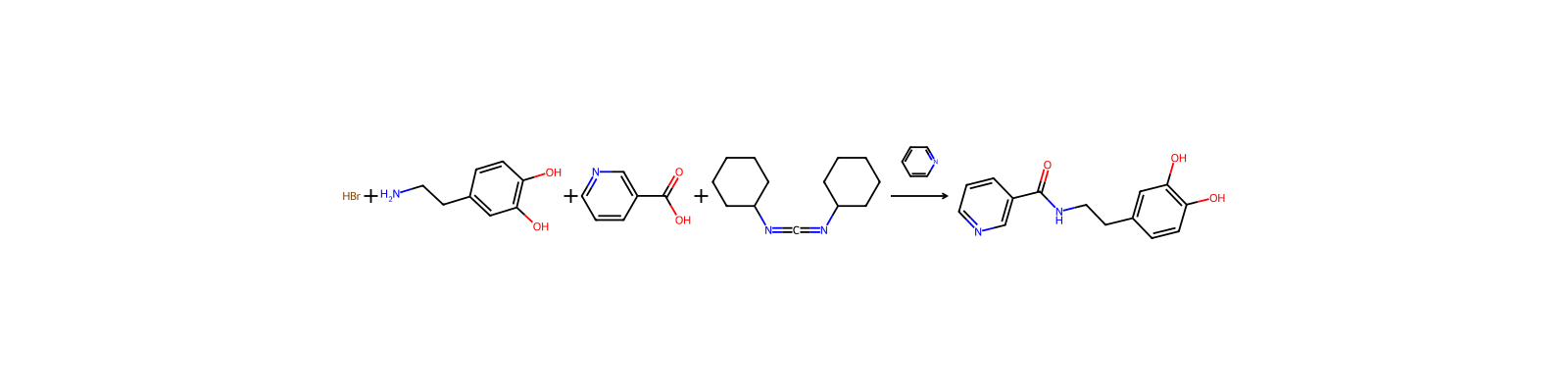
HRID 4572As reactant

645-31-8Br.NCCc1ccc(O)c(O)c1SGRSNYSOAPBTJP-UHFFFAOYSA-N645-31-8DTXSID20214748Safety information is for reference only and does not replace the supplier’s Safety Data Sheet (SDS), applicable regulations, or professional assessment.
This chemical does not meet GHS hazard criteria for 4.9% (2 of 41) of reports.
Warning
H315 (95.1%): Causes skin irritation [Warning Skin corrosion/irritation]
P261, P264, P264+P265, P271, P280, P302+P352, P304+P340, P305+P351+P338, P319, P321, P332+P317, P337+P317, P362+P364, P403+P233, P405, and P501 (click each P-code to see the statement)
Aggregated GHS information provided per 41 reports by companies from 3 notifications to the ECHA C&L Inventory. Each notification may be associated with multiple companies.
Uses3-Hydroxytyramine hydrobromide was used in the preparation of dopamine standards to measure the dopamine release and uptake in striatal brain slices from R6/1 HD model mice by fast-scan cyclic voltammetry. It was employed as internal standard in the determination of catecholamines in biological tissues by liquid chromatography.