HomeMCPSkillsWorkbenchOpenChem
HomeWorkbenchNotificationsMe
llms.txt · skill.md · MCP GuidePrivacy Policy · Terms of Service · Supportv1.8.5
  1. Home
  2. /Compound

Ubenimex

HCID 72172
New reaction
Print

Completing data — refresh the page later to see the latest
Basic informationOverviewNames & identifiersPropertiesSafety & regulationChemistry & industryRelated reactionsCompound notes
Substructure searchFind similar structures

Basic information

CAS
58970-76-6
Standard SMILES
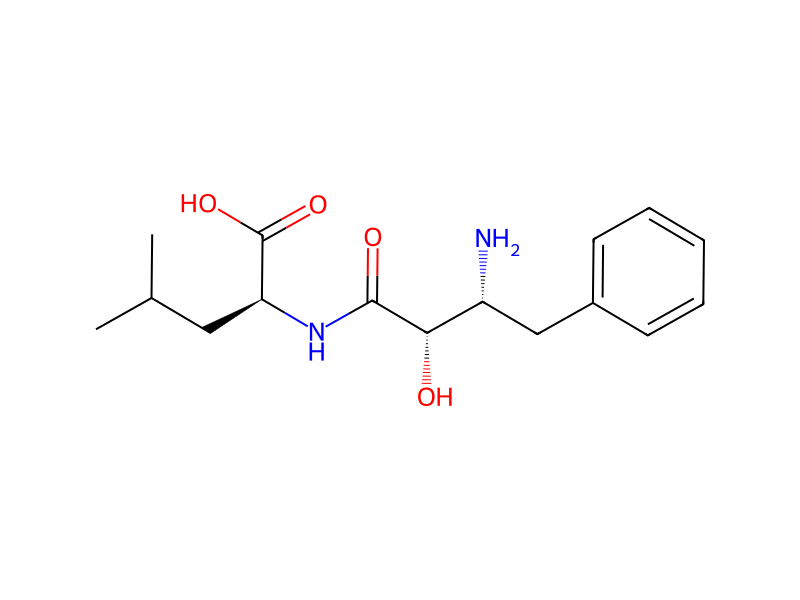
CC(C)C[C@H](NC(=O)[C@@H](O)[C@H](N)Cc1ccccc1)C(=O)O
InChIKey
VGGGPCQERPFHOB-RDBSUJKOSA-N
Molecular formula
C16H24N2O4
Average molar mass
308.37 g/mol
Monoisotopic mass
308.17360725

Overview

Ubenimex (also known as bestatin) is a competitive protease inhibitor. It is an inhibitor of aminopeptidase B, leukotriene A4 hydrolase, aminopeptidase N. It is being studied for use in the treatment of acute myelocytic leukemia.

Names & identifiers

Preferred name
Ubenimex
IUPAC
(2S)-2-[[(2S,3R)-3-amino-2-hydroxy-4-phenylbutanoyl]amino]-4-methylpentanoic acid
English name
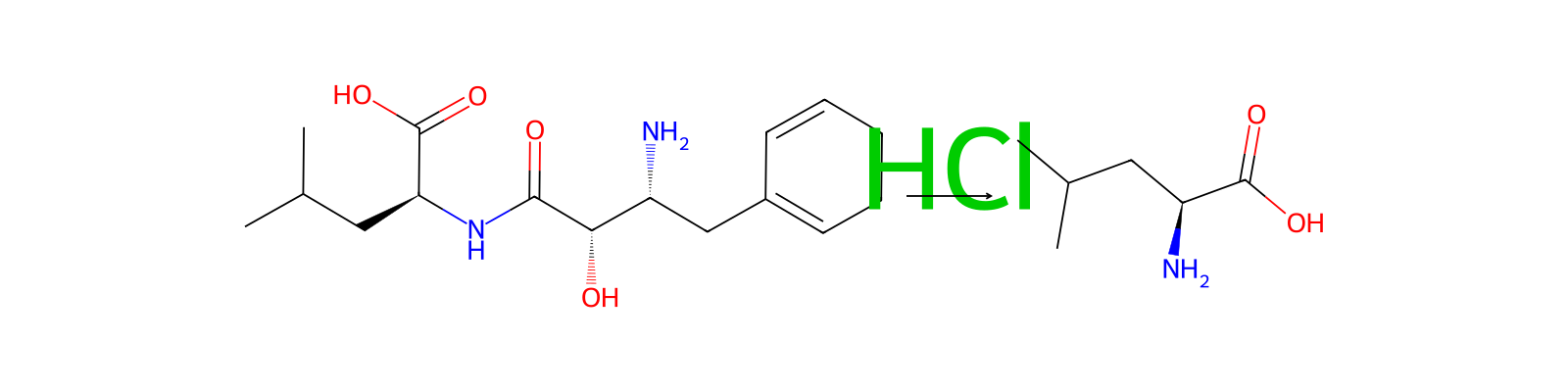
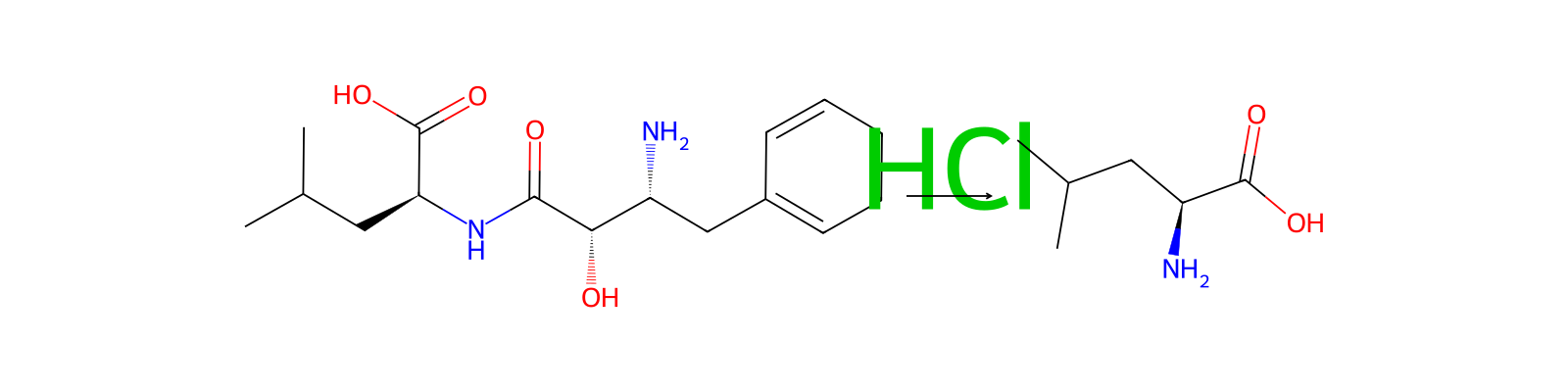
Bestatin hydrochloride
Molecular formula
C16H25ClN2O4
Molecular weight
344.83

Names & synonyms

BestatinUbenimex58970-76-6NK-421UbenimexumNK 421(3-Amino-2-hydroxy-4-phenylbutanoyl)-L-leucineI0J33N5627NSC-265489((2S,3R)-3-amino-2-hydroxy-4-phenylbutanoyl)-L-leucine(S-(R*,S*))-N-(3-Amino-2-hydroxy-4-phenylbutyroyl)-L-leucine(2S)-2-[[(2S,3R)-3-amino-2-hydroxy-4-phenylbutanoyl]amino]-4-methylpentanoic acid
Show more names
Bestatin.HCIBESTATIN HCLUbenimex HClUbenimex-d7 HClUbenimex hydrochlorideHYDROCHLORIDE,UbenimexBestatin HCl - Bio-X ?Wufenmei HydrochlorideBestatin hydrochlorideBestatin research grade
[(2s,3r)-3-amino-2-hydroxy-4-phenylbutanoyl]-l-leucineL-Leucine, N-(3-amino-2-hydroxy-1-oxo-4-phenylbutyl)-, (S-(R*,S*))-3-amino-2-hydroxy-4-phenylbutyryl-L-leucineNSC265489DTXSID4048430([2S,3R]-3-Amino-2-hydroxy-4-phenylbutanoyl)-L-leucine(2S)-2-(((2S,3R)-3-amino-2-hydroxy-4-phenylbutanoyl)amino)-4-methylpentanoic acidRefChem:900961

Properties

Computed structural propertiesFilling in

XLogP
-1
Topological polar surface area
113 Ų
Hydrogen bond donors
4
Hydrogen bond acceptors
5
Rotatable bonds
8
Heavy atoms
22
Formal charge
0
Complexity
367

Experimental & physicochemical properties

Drugs · 2 items

Pharmaceuticals -> Listed in ZINC15

Pharmaceuticals -> Antibiotics

Physicochemical properties

Melting point
216 · 216-218 °C
storage temp.
2 · 2-8°C
solubility
2 O: · H2O: 25 mg/mL, clear, colorless
form
White to off-white powder.
color
White
biological source
synthetic (organic)
Water Solubility
Soluble in water (4 mg/ml, warm), DMSO (>25 mg/ml), methanol, acetic acid, dimethyl formamide, and 100% ethanol.
BRN
4628066 · 4628066
Stability
2 years · Stable for 2 years from date of purchase as supplied. Solutions in DMSO, distilled water, or ethanol may be stored at -20° for up to 1 month.
InChI
1S/C16H24N2O4.ClH/c1-10(2)8-13(16(21)22)18-15(20)14(19)12(17)9-11-6-4-3-5-7-11;/h3-7,10,12-14,19H,8-9,17H2,1-2H3,(H,18,20)(H,21,22);1H/t12-,13+,14+;/m1./s1

Safety & regulation

Safety information is for reference only and does not replace the supplier’s Safety Data Sheet (SDS), applicable regulations, or professional assessment.

GHS classification

GHS Classification · 4 items

Warning

H315 (100%): Causes skin irritation [Warning Skin corrosion/irritation]

P261, P264, P264+P265, P271, P280, P302+P352, P304+P340, P305+P351+P338, P319, P321, P332+P317, P337+P317, P362+P364, P403+P233, P405, and P501 (click each P-code to see the statement)

Aggregated GHS information provided per 2 reports by companies from 2 notifications to the ECHA C&L Inventory. Each notification may be associated with multiple companies.

Hazard information

Hazard Classes and CategoriesSkin Irrit. 2 (100%)

Safety data

F
3-10
PPE
Eyeshields, Gloves, type N95 (US)
wgk
3
hs_code
29242995
risk_code
20/21/22-36/37/38
Signal word
Warning
Symbol(GHS)
GHS07
hazard_code
Xn
safety_code
22-24/25-36-26
Storage Class
11 - Combustible Solids
Hazard statements
H302-H315-H319-H335
Precautionary statements
P280-P305+P351+P338

Chemistry & industry

Pharmacology

MeSH Pharmacological Classification · 6 items

Substances that augment, stimulate, activate, potentiate, or modulate the immune response at either the cellular or humoral level. The classical agents (Freund's adjuvant, BCG, Corynebacterium parvum, et al.) contain bacterial antigens. Some are endogenous (e.g., histamine, interferon, transfer factor, tuftsin, interleukin-1). Their mode of action is either non-specific, resulting in increased immune responsiveness to a wide variety of antigens, or antigen-specific, i.e., affecting a restricted type of immune response to a narrow group of antigens. The therapeutic efficacy of many biological response modifiers is related to their antigen-specific immunoadjuvanticity.

Chemical substances, produced by microorganisms, inhibiting or preventing the proliferation of neoplasms.

Biologically active substances whose activities affect or play a role in the functioning of the immune system.

Compounds which inhibit or antagonize biosynthesis or actions of proteases (ENDOPEPTIDASES).

Agents used to treat AIDS and/or stop the spread of the HIV infection. These do not include drugs used to treat symptoms or opportunistic infections associated with AIDS.

Substances that inhibit the growth or reproduction of BACTERIA.

Applications · 6 items

DescriptionBestatin HCl (65391-42-6) inhibits leucine aminopeptidase and aminopeptidases B and N. Inhibits leukotriene A4 hydrolase. Displays immunostimulant activity via activation of macrophages and T lymphocytes. Displays antitumor activity.

UsesBestatin Hydrochloride is an inhibitor of aminopeptidases, LAP3, and leukotriene A4 hydrolase. It is the salt form of Bestatin (B319500).

Usescompetitive aminopeptidase B inhibitor

UsesBestatin is an inhibitor of amino peptidases and a potent, irreversible inhibitor of LTA4 hydrolase. It inhibits the amino peptidase activity of LTA4 hydrolase with a Ki value of 201 nM. It offers promise as a novel analgesic because it protects endogenous opioid peptides against degradation. It does not inhibit carboxypeptidases.

Related reactions

3 records
New reaction record
HRID 437009As reactant
HRID 972250As reactant
HRID 1448156As reactant

Compound notes

On this pageBasic informationOverviewNames & identifiersPropertiesSafety & regulationChemistry & industryRelated reactionsCompound notes

Database identifiers

CAS
58970-76-6、65391-42-6
PubChem CID
72172
DTXSID
DTXSID301369975
ChEMBL
CHEMBL29292
UNII
I0J33N5627
EC Number
261-529-2
Nikkaji
J12.831G
InChIKey
XGDFITZJGKUSDK-UDYGKFQRSA-N
SMILES
O=C(N[C@@H](CC(C)C)C(O)=O)[C@@H](O)[C@H](N)CC1=CC=CC=C1.Cl[H]
CAS DataBase Reference
65391 · 65391-42-6(CAS DataBase Reference)
FDA UNII
7 Y2JX7NQ · BY7Y2JX7NQ
UNSPSC Code
12352202 · 12352202
NACRES
77 · NA.77
Symbol(GHS)
7 · GHS07
Signal word
Warning
Hazard statements
302 · H302-H315-H319-H335
Precautionary statements
280 · P280-P305+P351+P338
PPE
95 · Eyeshields, Gloves, type N95 (US)
Hazard Codes
Xn
Risk Statements
20 · 20/21/22-36/37/38
Safety Statements
22 · 22-24/25-36-26
WGK Germany
3 · 3
F
3 · 3-10
HS Code
29242995 · 29242995
Storage Class
11 · 11 - Combustible Solids

UsesBestatin has been used as a protease inhibitor for the purification of his-tagged Tau protein.

General DescriptionChemical structure: amino acid derivatives

Preparation methods · 1 item

PreparationBacillus subtilis Zj016 fermentation broth was centrifuged at 4 ℃ and 10,000 r/min for 10 min. The supernatant was collected and clarified with 18% (NH4)2SO4. The supernatant was then concentrated by ultrafiltration using a 50,000 molecular weight ultrafiltration membrane. The concentrate was desalted using a 30,000 molecular weight ultrafiltration membrane and precipitated with 68% ethanol. The precipitate was then freeze-dried under vacuum to obtain BESTATIN HYDROCHLORIDE with an activity of 4.0 × 10⁵ U/g.

Additional notes

DefinitionChEBI: Bestatin (hydrochloride) is a peptide.