
uspto-grants-2013_09 · 10.6084/m9.figshare.5104873.v1 · US08536166B2
查看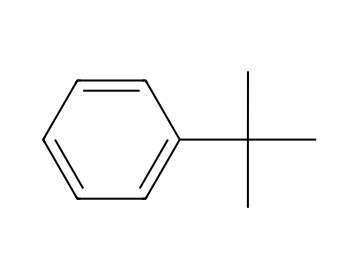
IDENTITY
COMPUTED
PROPERTIES
log Kow= 4.11
0.8669 @ 20 °C/4 °C
0.8665 @ 20°C
Liquid
Colorless liquid
Miscible with alc, ether, benzene
Insoluble in water; very soluble in ethanol and ethyl ether; miscible in acetone
Soluble in alcohol.
In water, 29.5 mg/l @ 25 °C.
140 °F (60 °C) OPEN CUP
169.1 °C
169.1 °C @760 [mm Hg]
When heated to decomposition it emits acrid smoke and fumes.
-57.8 °C
-57.8 °C
4.62 (Air= 1)
2.2 [mmHg]
Vapor pressure: 5.7 mm Hg @ 38.7 °C
2.20 mm Hg @ 25 °C
0.75 [mm Hg] @10 °C
Index of refraction: 1.49235 @ 20 °C/D
Liquid
Colorless liquid; [Hawley]
GHS
This chemical does not meet GHS hazard criteria for 0.4% (1 of 233) of reports.
Danger
H226 (91.8%): Flammable liquid and vapor [Warning Flammable liquids];H304 (44.6%): May be fatal if swallowed and enters airways [Danger Aspiration hazard];H315 (78.1%): Causes skin irritation [Warning Skin corrosion/irritation];H319 (14.6%): Causes serious eye irritation [Warning Serious eye damage/eye irritation];H411 (44.6%): Toxic to aquatic life with long lasting effects [Hazardous to the aquatic environment, long-term hazard]
P210, P233, P240, P241, P242, P243, P264, P264+P265, P273, P280, P301+P316, P302+P352, P303+P361+P353, P305+P351+P338, P321, P331, P332+P317, P337+P317, P362+P364, P370+P378, P391, P403+P235, P405, and P501 (click each P-code to see the statement)
Aggregated GHS information provided per 233 reports by companies from 12 notifications to the ECHA C&L Inventory. Each notification may be associated with multiple companies.;Reported as not meeting GHS hazard criteria per 1 of 233 reports by companies.;There are 11 notifications provided by 232 of 233 reports by companies with hazard statement code(s).;Information may vary between notifications depending on impurities, additives, and other factors. The percentage value in parenthesis indicates the notified classification ratio from companies that provide hazard codes. Only hazard codes with percentage values above 10% are shown. For more detailed information, please visit ECHA C&L website.
HAZARDS
Chemical: Benzene, (1,1-dimethylethyl)-
Hazard Traits - Nephrotoxicity and Other Toxicity to the Urinary System;Authoritative List - CA NLs;Report - if used as a fragrance or flavor ingredient
Benzene, (1,1-dimethylethyl)- is listed on the EPA's Chemical Data Reporting (CDR) system. Manufacturers and importers of Benzene, (1,1-dimethylethyl)- are required to report information about their production and use of this chemical to the EPA under the Toxic Substances Control Act (TSCA). (40 eCFR Part 711)
Status: Active Update: 06-07-2021 https://echa.europa.eu/registration-dossier/-/registered-dossier/27854;Status: Active Update: 03-01-2020 https://echa.europa.eu/registration-dossier/-/registered-dossier/27358
Benzene, (1,1-dimethylethyl)-: Does not have an individual approval but may be used under an appropriate group standard
The New Jersey Worker and Community Right to Know Act requires public and private employers to provide information about hazardous substances at their workplaces. (N.J.S.A. 34:5A-1 et. seq.)
Flammable liquid when exposed to heat or flame.
Effects in lethal dose studies include somnolence and tremor; [RTECS] An irritant; [MSDSonline]
Pursuant to section 8(d) of TSCA, EPA promulgated a model Health and Safety Data Reporting Rule. The section 8(d) model rule requires manufacturers, importers, and processors of listed chemical substances and mixtures to submit to EPA copies and lists of unpublished health and safety studies. t-Butylbenzene is included on this list.
Lower flammable limit: 0.7% at 212 °F (100 °C) by volume; Upper flammable limit: 5.7% at 212 °F (100 °C) by volume
2-Methyl-2-phenylpropane
Marine pollutant
2 - Materials that, under emergency conditions, can cause temporary incapacitation or residual injury.
2 - Materials that must be moderately heated or exposed to relatively high ambient temperatures before ignition can occur. Materials would not under normal conditions form hazardous atmospheres with air, but under high ambient temperatures or under moderate heating could release vapor in sufficient quantities to produce hazardous atmospheres with air.
0 - Materials that in themselves are normally stable, even under fire conditions.
THE TEMP RANGE FOR SMOOTH INTERACTION OF BROMOBENZENE, 1-BROMOBUTANE AND SODIUM IN ETHER TO GIVE BUTYLBENZENE IS CRITICAL. BELOW 15 °C REACTION IS DELAYED BUT LATER BECOMES VIGOROUS, AND ABOVE 30 °C THE REACTION BECOMES VIOLENT.
Flam. Liq. 3 (91.8%);Asp. Tox. 1 (44.6%);Skin Irrit. 2 (78.1%);Eye Irrit. 2 (14.6%);Aquatic Chronic 2 (44.6%)
Flammable liquids - Category 3;Acute toxicity (Inhalation: Vapours) - Category 3;Skin corrosion/irritation - Category 2;Specific target organ toxicity - Single exposure - Category 2 (nervous system)
Flammable agents - 3rd degree
(CA) CALIFORNIA 260 ug/l
(FL) FLORIDA 280 ug/l
(NH) NEW HAMPSHIRE 260 ug/L
No person may /transport,/ offer or accept a hazardous material for transportation in commerce unless that person is registered in conformance ... and the hazardous material is properly classed, described, packaged, marked, labeled, and in condition for shipment as required or authorized by ... /the hazardous materials regulations (49 CFR 171-177)./
The International Air Transport Association (IATA) Dangerous Goods Regulations are published by the IATA Dangerous Goods Board pursuant to IATA Resolutions 618 and 619 and constitute a manual of industry carrier regulations to be followed by all IATA Member airlines when transporting hazardous materials.
The International Maritime Dangerous Goods Code lays down basic principles for transporting hazardous chemicals. Detailed recommendations for individual substances and a number of recommendations for good practice are included in the classes dealing with such substances. A general index of technical names has also been compiled. This index should always be consulted when attempting to locate the appropriate procedures to be used when shipping any substance or article.
7000 [ppm]
SAFETY
To fight fire, use foam, carbon dioxide, dry chemical, water spray, fog, mist.
SRP: At the time of review, criteria for land treatment or burial (sanitary landfill) disposal practices are subject to significant revision. Prior to implementing land disposal of waste residue (including waste sludge), consult with environmental regulatory agencies for guidance on acceptable disposal practices.
7.5 [ppm]
83 [ppm]
500 [ppm]
TOXICITY
TERRESTRIAL FATE: Based on a classification scheme(1), an estimated Koc value of 1181(SRC), determined from a structure estimation method(2), indicates that t-butylbenzene is expected to have low mobility in soil(SRC). Volatilization of t-butylbenzene from moist soil surfaces is expected to be an important fate process(SRC) given an Henry's Law constant of 1.32X10⁻² atm-cu m/mole(3), derived from its vapor pressure, 2.20 mm Hg(4), and water solubility, 29.5 mg/l(5). The potential for volatilization of t-butylbenzene from dry soil surfaces may exist(SRC) based upon its vapor pressure(4). However, adsorption to soil is expected to attenuate volatilization(SRC). Biodegradation from soil may occur based on activated sludge study results(6-9).
AQUATIC FATE: Based on a classification scheme(1), an estimated Koc value of 1181(SRC), determined from a structure estimation method(11), indicates that t-butylbenzene is expected to adsorb to suspended solids and sediment(SRC). Volatilization from water surfaces is expected(3) based upon an estimated Henry's Law constant of 1.32X10⁻² atm-cu m/mole(4), derived from it's vapor pressure of 2.20 mm Hg(7) and water solubility of 29.5 mg/l(8). Using this Henry's Law constant and an estimation method(3), volatilization half-lives for a model river and model lake are 1 hr and 4 days, respectively(SRC). The volatilization half-life from a model pond is 30 days if adsorption is considered(9). According to a classification scheme(5), an estimated BCF of 291(SRC), from its log Kow of 4.11(2) and a regression-derived equation(6), suggests the potential for bioconcentration in aquatic organisms is high. Biodegradation from water may occur(10).
ATMOSPHERIC FATE: According to a model of gas/particle partitioning of semivolatile organic compounds in the atmosphere(1), t-butylbenzene, which has a vapor pressure of 2.20 mm Hg at 25 °C(2), is expected to exist solely as a vapor in the ambient atmosphere. Vapor-phase t-butylbenzene is degraded in the atmosphere by reaction with photochemically-produced hydroxyl radicals(SRC); the half-life for this reaction in air is estimated to be 3 days(SRC), calculated from its rate constant of 4.60X10⁻¹² cu cm/molecule-sec at 25 °C(3).
t-Butylbenzene was identified as one of the 420 volatile flavor components of Idaho Russet Burbank baked potatoes, at a relative concn of 0.16, the most abundant being "1"(1).
Neurotoxin - Acute solvent syndrome
t-Butylbenzene was detected, not quantified in the raw influent to a waste treatment system at a polyester finishing plant effluent(1). The compound was identified as a volatile from pre-aeration wastewater samples taken from a sewage treatment plant in Singapore(4). It was also identified as one of the 400 gas-phase hydrocarbon compounds in emissions from gasoline-powered motor vehicles in highway operation in the Allegheny Mountain Tunnel of the Pennsylvania Turnpike in 1979(2). t-Butylbenzene has been identified in effluent resulting from coal/refuse combustion(3).
Soil (Mediterranean red sandy clay) samples with different moisture contents (0.0, 0.8, 4.0, and 12%, wt/wt) were contaminated by vapors and/or liquid from a mixture containing 5 kerosene components (m-xylene, pseudo-cumene, t-butylbenzene (6.67% by vol), n-decane and n-dodecane). Vapor adsorption was found to be dependent on the vapor concn of each component and on the soil moisture content. Adsorption of t-butylbenzene on soil was 50 and 15 ug/g at 7 °C, 120 and 47 at 17 °C, 210 and 60 at 27 °C, and 330 and 100 ug/g at 34 °C for oven dried and air dried soil, respectively. The sorption coefficients of t-butylbenzene decr with incr temp but showed only a very slight variability between 20 and 34 °C, in air-dried soil. Volatilization from soil was high: 92.5% of t-butylbenzene was desorbed in less than 2 hr, and 99.7% in 16 hr.
Using a structure estimation method based on molecular connectivity indices(1), the Koc for t-butylbenzene can be estimated to be 1181(SRC). According to a classification scheme(2), this estimated Koc value suggests that t-butylbenzene is expected to have low mobility in soil.
Acute oral toxicity was evaluated in groups of 10 ChR-CD male rats administered a single dose of tert-butyl-benzene by oral gavage at dose levels of 3000, 3400 and 3800 mg/kg body weight. Mortality was observed in one rat at 3000 mg/kg, 2 rats at 3400 mg/kg and 9 rats at 3800 mg/kg body weight; the LD50 value was calculated to be 3503 mg/kg body weight. Clinical observations after dosing included rapid and labored respiration, salivation, prostration, lacrimation, stained nose and mouth, diarrhea, chromodacryorrhea, a stained and wet perineal area, weakness, alopecia on the abdomen, stained eyes, stained abdominal area, and lethargy. Animals at all dose levels exhibited weight loss after dosing. Gross necropsy was not reported.
Acute dermal toxicity was evaluated in 4 male and 4 female rats receiving single occluded, percutaneous doses of undiluted tertiary butyl benzene at a dose level of 2000 mg/kg of body weight. The test article was held in contact with the intact skin for a 24 hour period. Mortality was not observed witihn 14 days of treatment and the LD50 was estimated to be greater than 2000 mg/kg of body weight. Clinical observation revealed no signs of intoxiciation. Gross necropsy was not reported.
Acute inhalation toxicity was evaluated in groups of 5 male and 5 female Wistar strain rats exposed to tertiary butyl benzene at measured concentrations of 4.0, 4.4 and 4.6 mg/lof air. The test armosphere was generated by using a thermostated wick-type saturator. Mortality was observed within 14 days of treatment in 3 of the female rats at the 4.6 mg/l dose; the LC50 was estimated to be approximately 4.6 mg/l. Clinical observations included salivation, lachrymation, a high stepping gait, dyspnoea, fasiculations, tremors, endophthalamus, and convulsions. Gross necropsy evaluation revealed no pathological changes in the survivors but was not reported for those animals that died.
The frequency of chromosomal aberrations was evaluated in vitro by exposing rats liver (RL1) cells to 10, 20 and 40 ug/ml of tertiary butyl benzene. No increases in the frequency of chromatid gaps, chromatid breaks or total chromosome aberrations was observed at any dose level. Tertiary butyl benzene did not induce chromosome damage in this assay.
For more TSCA Test Submissions (Complete) data for T-BUTYLBENZENE (6 total), please visit the HSDB record page.
URBAN/SUBURBAN: t-Butylbenzene was detected using gas chromatographic analysis of Paris air during the fall of 1972(1). The ambient air of the Los Angeles, CA basin contained t-butylbenzene at concns ranging from 0.019 to 0.045 ppm v/v(2). t-Butylbenzene was detected in the ambient air of the Kanawha Valley, WV, Houston, TX and vicinity, and the Los Angeles, CA basin(3). It was detected in ambient air of Los Angeles, CA during 1966-1968 and in Azusa, CA in 1967(4).
SOURCE DOMINATED: t-Butylbenzene was identified not quantified in the air of six industrial cities of the USSR(1). t-Butylbenzene was detected at concns ranging from 0 to 39 ug/cu m in ambient air samples from six sites around Gatwick Airport, London, collected during August to November 1979(2).
t-Butylbenzene's production and use as a chemical intermediate and solvent(1) may result in its release to the environment through various waste streams(SRC). A composite gasoline sample obtained in Los Angeles, CA contained 0.12% t-butylbenzene by weight(2).
AEROBIC: t-Butylbenzene reached 0.3% of its theoretical BOD using an acclimated activated sludge inoculum and the 5-day BOD test at 20 °C(1). Theoretical BODs ranging from 0.6% to 39.8% were measured using the Warburg test(1,3-5). Alkylbenzenes are known to be oxidized by microorganisms(2). t-Butylbenzene was degraded using Moustorod Refinery wastewater inoculum, exhibiting 14, 100, and 100 % degradation in 7, 15, and 23 days, respectively; similar results were observed in non-aerated tests(6). t-Butylbenzene at a concn of 19-25 ppm was 10 and 30% removed after 20 and 80 days, respectively, in a grab sample study using water from the Ohio River, although volatilization could not be ruled out(7). Biological loss of t-butylbenzene was noted using artificial seawater acclimated with 100 ml gas oil at 20 °C for 3 days and then inoculated with North Sea coast water although the sample compound could not be resolved from 1,2,4-trimethylbenzene(8). t-Butylbenzene at a concn of 100 mg/l in an automated continuous respirometer study resulted in a growth rate of 1.21 1/day using an activated sludge inoculum following a lag of 4.40 days(9).
SOIL: t-Butylbenzene was detected at a maximum concn of 141 mg/kg in soil under a building which was recently demolished. Contamination was caused by leakages of solvents and paint raw materials over many years(1).
An estimated BCF of 291 was calculated for t-butylbenzene(SRC), using a log Kow of 4.11(1) and a regression-derived equation(2). According to a classification scheme(3), this BCF suggests the potential for bioconcentration in aquatic organisms is high.
The Henry's Law constant for t-butylbenzene is estimated as 1.32X10⁻² atm-cu m/mole(SRC), derived from its vapor pressure, 2.20 mm Hg(1), and water solubility, 29.5 mg/l(2). This Henry's Law constant indicates that t-butylbenzene is expected to volatilize rapidly from water surfaces(3). Based on this Henry's Law constant, the volatilization half-life from a model river (1 m deep, flowing 1 m/sec, wind velocity of 3 m/sec)(3) is estimated as 1 hr(SRC). The volatilization half-life from a model lake (1 m deep, flowing 0.05 m/sec, wind velocity of 0.5 m/sec)(3) is estimated as 5 days(SRC). The volatilization half-life from a model pond is 8 days if adsorption is considered(4). t-Butylbenzene's estimated Henry's Law constant(1,2) indicates that volatilization from moist soil surfaces may occur(SRC). The potential for volatilization of t-butylbenzene from dry soil surfaces may exist(SRC) based upon a vapor pressure of 2.20 mm Hg(1).
REGULATORY
Chemical: Benzene, (1,1-dimethylethyl)-
Hazard Traits - Nephrotoxicity and Other Toxicity to the Urinary System;Authoritative List - CA NLs;Report - if used as a fragrance or flavor ingredient
Benzene, (1,1-dimethylethyl)- is listed on the EPA's Chemical Data Reporting (CDR) system. Manufacturers and importers of Benzene, (1,1-dimethylethyl)- are required to report information about their production and use of this chemical to the EPA under the Toxic Substances Control Act (TSCA). (40 eCFR Part 711)
Status: Active Update: 06-07-2021 https://echa.europa.eu/registration-dossier/-/registered-dossier/27854;Status: Active Update: 03-01-2020 https://echa.europa.eu/registration-dossier/-/registered-dossier/27358
Benzene, (1,1-dimethylethyl)-: Does not have an individual approval but may be used under an appropriate group standard
The New Jersey Worker and Community Right to Know Act requires public and private employers to provide information about hazardous substances at their workplaces. (N.J.S.A. 34:5A-1 et. seq.)
Pursuant to section 8(d) of TSCA, EPA promulgated a model Health and Safety Data Reporting Rule. The section 8(d) model rule requires manufacturers, importers, and processors of listed chemical substances and mixtures to submit to EPA copies and lists of unpublished health and safety studies. t-Butylbenzene is included on this list.
(CA) CALIFORNIA 260 ug/l
(FL) FLORIDA 280 ug/l
(NH) NEW HAMPSHIRE 260 ug/L
PHARMACOLOGY
YIELDS 2,2-DIMETHYL-2-PHENYLETHANOL IN RABBIT. /FROM TABLE/
.../MONOBUTYLBENZENES/ ARE BELIEVED TO BE READILY METABOLIZED BY SIDE CHAIN HYDROXYLATION AND CONJUGATION FOR URINARY EXCRETION.
FROM CULTURES OF ACHROMOBACTER STRAINS A2 IN THE PRESENCE OF TERT-BUTYLBENZENE, A DIOL WAS ISOLATED AND IDENTIFIED AS 2,3-DIHYDRO-2,3-DIHYDROXY-TERT-BUTYLBENZENE. EVIDENCE FOR META CLEAVAGE OF THE AROMATIC RING AND FOR ACCUMULATION OF PIVALIC ACID IN THE CULTURES WAS ALSO OBTAINED.
USES
Used in organic synthesis; as polymerization solvent; as polymer linking agent; as solvent (e.g., production of hydrogen peroxide); [HSDB]
Organic synthesis, polymerization solvent, polymer linking agent
SOLVENT, EG, IN PRODN OF HYDROGEN PEROXIDE
(1979) 8.46X10+5 GRAMS (PRINCPL CUSTMS DISTS)
(1981) 4.80X10+7 GRAMS (PRINCPL CUSTMS DISTS)
2023: 75,000 - <500,000 lb;2022: 75,000 - <500,000 lb
(1979) PROBABLY GREATER THAN 2.27X10+6 GRAMS
(1981) PROBABLY GREATER THAN 2.27X10+6 GRAMS
Solvent
PREPD FROM BENZENE, ISOBUTYL CHLORIDE AND ALCL3; FROM ISOBUTYL ALCOHOL AND BENZENE BY TREATMENT WITH FUMING SULFURIC ACID ... .
... BY DECARBONYLATION OF BETA-PHENYLISOVALERALDEHYDE IN PRESENCE OF PD/C CATALYST.
PROBABLY BY REACTION OF BENZENE WITH ISOBUTYL OR T-BUTYL CHLORIDE IN THE PRESENCE OF ALUMINUM CHLORIDE
By the action of sodium on gamma-chloro-sec-butylbenzene.
For more Methods of Manufacturing (Complete) data for T-BUTYLBENZENE (6 total), please visit the HSDB record page.
Technical, pure, research
Information on 3 consumer products that contain tert-butylbenzene in the following categories is provided:;• Auto Products
Paint and Coating Manufacturing;Transportation Equipment Manufacturing
Benzene, (1,1-dimethylethyl)-: ACTIVE
ALIASES
REACTIONS
uspto-grants-2013_09 · 10.6084/m9.figshare.5104873.v1 · US08536166B2
查看
Training data from https://doi.org/10.1039/C8SC04228D (2/10) · 10.1039/C8SC04228D
查看
Training data from https://doi.org/10.1039/C8SC04228D (2/10) · 10.1039/C8SC04228D
查看
Training data from https://doi.org/10.1039/C8SC04228D (2/10) · 10.1039/C8SC04228D
查看
uspto-grants-2008_06 · 10.6084/m9.figshare.5104873.v1 · US07390904B2
查看
uspto-grants-2008_06 · 10.6084/m9.figshare.5104873.v1 · US07390904B2
查看
Training data from https://doi.org/10.1039/C8SC04228D (9/10) · 10.1039/C8SC04228D
查看
Training data from https://doi.org/10.1039/C8SC04228D (6/10) · 10.1039/C8SC04228D
查看