
HRID 568771As reactant
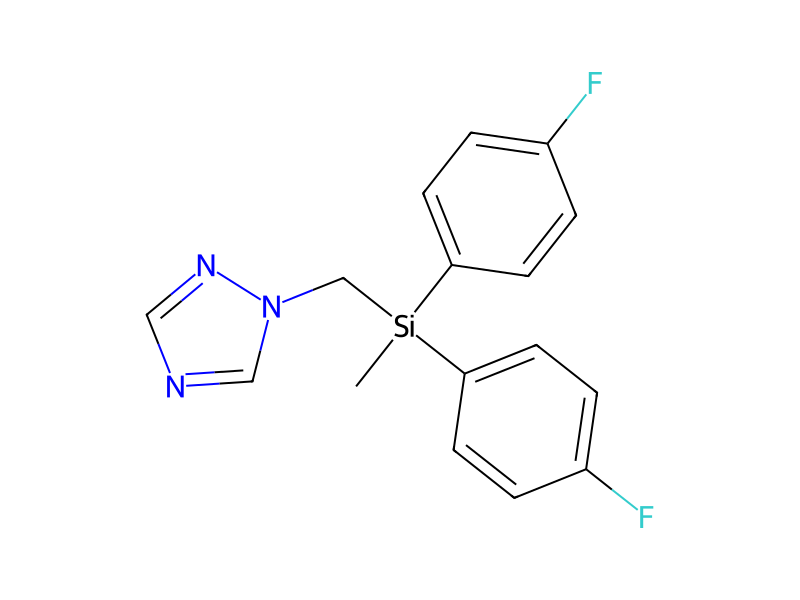
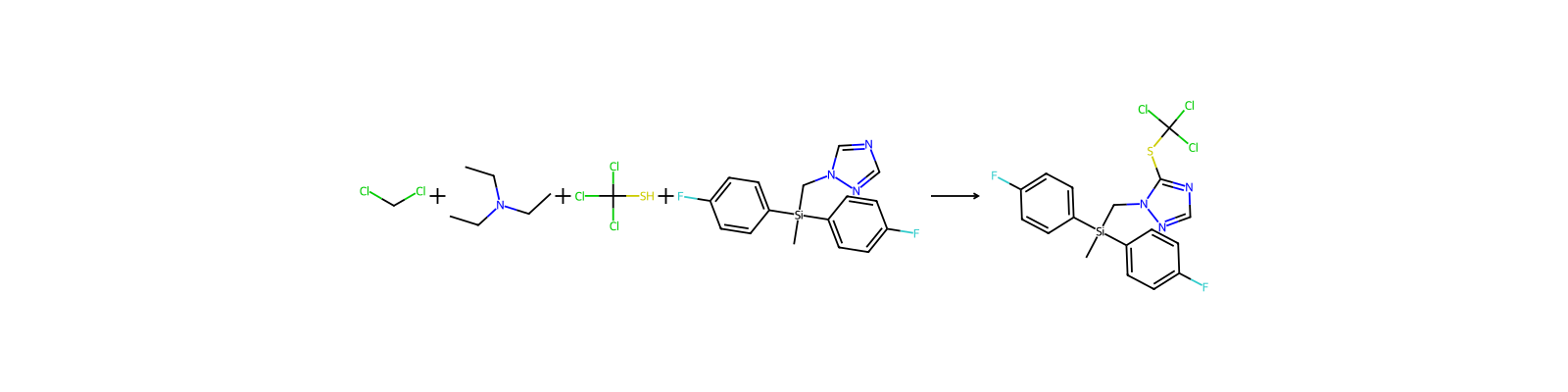
85509-19-9C[Si](Cn1cncn1)(c1ccc(F)cc1)c1ccc(F)cc1FQKUGOMFVDPBIZ-UHFFFAOYSA-NFlusilazole is an organosilicon compound that is dimethylsilane in which the hydrogens attached to the silicon are replaced by p-fluorophenyl groups and a hydrogen attached to one of the methyl groups is replaced by a 1H-1,2,4-triazol-1-yl group. It is a broad-sepctrum fungicide used to protect a variety of crops. It has a role as a xenobiotic, an EC 1.14.13.70 (sterol 14alpha-demethylase) inhibitor, an environmental contaminant and an antifungal agrochemical. It is an organosilicon compound, a member of triazoles, a member of monofluorobenzenes, a conazole fungicide and a triazole fungicide.
85509-19-9DTXSID3024235CHEMBL1900522CHEBI:81922Pesticide -> EPA IRIS
Fungicides
Active substance -> EU Pesticides database: Not approved
Fungicides
Pesticide (Flusilazole) -> USDA PDB
Positive
3.88
2.7
Agilent XCT
Electrospray ionization
formic acid (5.3nM)
Safety information is for reference only and does not replace the supplier’s Safety Data Sheet (SDS), applicable regulations, or professional assessment.
Danger
H302: Harmful if swallowed [Warning Acute toxicity, oral]
P203, P264, P270, P273, P280, P301+P317, P318, P330, P391, P405, and P501 (click each P-code to see the statement)
Danger
H302 (100%): Harmful if swallowed [Warning Acute toxicity, oral]
P203, P264, P270, P273, P280, P301+P317, P318, P330, P391, P405, and P501 (click each P-code to see the statement)
Hazard Traits - Reproductive Toxicity
Regulation (EC) No 396/2005 (amended)
Flusilazole is listed in the dataset of EPA Human Health Benchmarks for Pesticides under the Safe Drinking Water Act (40 eCFR 141)
06/133/EC, Reg. (EU) 2022/801, Reg. (EU) No 540/2011
Flusilazole: Does not have an individual approval but may be used as a component in a product covered by a group standard. It is not approved for use as a chemical in its own right.
Acute Tox. 4 (100%)
Carcinogenicity - category 2
Carc. 2
DescriptionFlusilazole is a curative and preventative fungicide used to control a range of fungal pathogens. It has a moderate aqueous solubility and a low volatility. It can be persistent in soils and water-sediment systems depending on local conditions. Risk of leaching to groundwater is low. There are concerns that flusilazole may be a reproduction / developmental toxin and an endocrine disrupter. Oral mammalian toxicity is moderate. For most species ecotoxicity is moderate.
UsesAgricultural fungicide.
UsesFlusilazole is a silicon-containing triazole fungicide. Flusilazole is used to control fungal infections on a variety of fruit and vegetable crops
UsesFlusilazole is a broad spectrum fungicide used to control fungal disease caused by pathogens of the Ascomycetes, Basidiomycetes and Deuteromycetes families. Flusilazole exhibits curative and preventative activities and is recommended for use in agriculture, horticulture and viticulture. Diseases controlled include eyespot, mildew, and rusts of cereals, cercospora and rust of sugar beets, leaf spots of oilseed rape, scab and mildew of pome and stone fruits, mildew and black rot of grapes and Sigatoka disease of bananas.



Flusilazole has a dose-related inhibition of serum testosterone and estradiol concentrations in rats. This inhibition of testosterone and estradiol biosynthesis may disrupt the hypothalamus–pituitary–testis axis, resulting in overstimulation of the testicular endocrine tissues and increase the risk of Leydig-cell tumours.
Symptoms include weight loss, weakness, lethargy, alopecia and diarrhoea. At higher dose, prostration, salivation, laboured breathing, convulsions, and loss of righting reflex would be expected. Flusilazole can also cause mild erythema at the site of application.
NuStar
Hepatic
7 x 10 ^-4 mg/kg-day
0.02
OPP
0.002
OPP
Flusilazole
0.02
600
Females 13-49 yrs
0.002
10
1.30e+02
1.60e+03
3.10e+01
4.00e+03
5.10e+00
2.00e-03
3.80e+02
4.90e+03
9.40e+01
4.00e+03
2.00e-03
Volatile
DefinitionChEBI: Flusilazole is an organosilicon compound that is dimethylsilane in which the hydrogens attached to the silicon are replaced by p-fluorophenyl groups and a hydrogen attached to one of the methyl groups is replaced by a 1H-1,2,4-triazol-1-yl group. It is a broad-sepctrum fungicide used to protect a variety of crops. It has a role as a xenobiotic, an environmental contaminant, an EC 1.14.13.70 (sterol 14alpha-demethylase) inhibitor and an antifungal agrochemical. It is a member of monofluorobenzenes, a member of triazoles, an organosilicon compound, a conazole fungicide and a triazole fungicide.