
uspto-grants-1993_09 · 10.6084/m9.figshare.5104873.v1 · US05248681
查看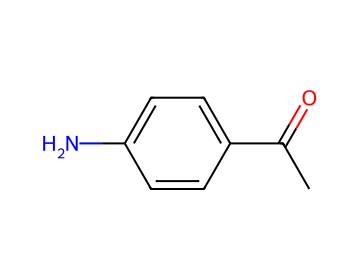
IDENTITY
COMPUTED
PROPERTIES
log Kow = 0.83
Pleasant, characteristic odor
Yellow monoclinic prisms from alcohol
Yellow needles
Soluble in hydrochloric acid
Very soluble in ether and ethanol
In water, 3.35X10+3 mg/L at 37 °C
294 °C; 195 °C at 15 mm Hg
106 °C
0.00989 [mmHg]
Yellow solid with a pleasant odor; [HSDB] Tan crystalline solid; [MSDSonline]
pKa = 2.76 (conjugate acid)
1440
2181
125.0 Ų [M-H]- [CCS Type: DT; Buffer gas: N2; Ionization: ESI-; Dataset: TOXCAST; Source Identifier: DTXSID6052669]
GHS
Warning
H302 (100%): Harmful if swallowed [Warning Acute toxicity, oral];H312 (67.1%): Harmful in contact with skin [Warning Acute toxicity, dermal];H315 (30.3%): Causes skin irritation [Warning Skin corrosion/irritation];H319 (30.3%): Causes serious eye irritation [Warning Serious eye damage/eye irritation];H332 (67.7%): Harmful if inhaled [Warning Acute toxicity, inhalation];H335 (29.7%): May cause respiratory irritation [Warning Specific target organ toxicity, single exposure; Respiratory tract irritation]
P261, P264, P264+P265, P270, P271, P280, P301+P317, P302+P352, P304+P340, P305+P351+P338, P317, P319, P321, P330, P332+P317, P337+P317, P362+P364, P403+P233, P405, and P501 (click each P-code to see the statement)
Aggregated GHS information provided per 155 reports by companies from 8 notifications to the ECHA C&L Inventory. Each notification may be associated with multiple companies.;Information may vary between notifications depending on impurities, additives, and other factors. The percentage value in parenthesis indicates the notified classification ratio from companies that provide hazard codes. Only hazard codes with percentage values above 10% are shown. For more detailed information, please visit ECHA C&L website.
HAZARDS
Chemical: Ethanone, 1-(4-aminophenyl)-
A strong inducer of methemoglobin in vivo; Emergency treatment: Aniline; [HSDB] Methemoglobinemia observed in oral lethal-dose study of dogs; [RTECS] An irritant; Toxic if swallowed; May be harmful by inhalation or skin absorption; [Aldrich MSDS] See Aniline.
Milman HA, Peterson C; Apparent Correlation Between Structure and Carcinogenicity of Phenylenediamines and Related Cmpds; Environ Health Perspectives 56: 261-73 (1984).
Acute Tox. 4 (100%);Acute Tox. 4 (67.1%);Skin Irrit. 2 (30.3%);Eye Irrit. 2A (30.3%);Acute Tox. 4 (67.7%);STOT SE 3 (29.7%)
SAFETY
SRP: The most favorable course of action is to use an alternative chemical product with less inherent propensity for occupational harm/injury/toxicity or environmental contamination. Recycle any unused portion of the material for its approved use or return it to the manufacturer or supplier. Ultimate disposal of the chemical must consider: the material's impact on air quality; potential migration in soil or water; effects on animal and plant life; and conformance with environmental and public health regulations.
The following wastewater treatment technologies have been investigated for acetophenone: concentration process: activated carbon. /Acetophenone/
The following wastewater treatment technologies have been investigated for acetophone: concentration process: resin adsorption. /Acetophenone/
TOXICITY
LD50; Species: Peromyscus maniculatus (Deer Mouse) wild, oral via capsule 1600 mg/kg
EC50; Species: Daphnia magna (Water flea) age 6-24 hr; Conditions: freshwater, static, 20 °C, pH > or =7.0; Concentration: 5000 ug/L for 48 hr (95% confidence interval: 2200-12000 ug/L); Effect: intoxication, immobilization /formulation/
TERRESTRIAL FATE: Based on a classification scheme(1), an estimated Koc value of 25(SRC), determined from a log Kow of 0.83(2) and a regression-derived equation(3), indicates that 4-acetylaniline is expected to have very high mobility in soil(SRC). However, aromatic amines are expected to bind strongly to humus or organic matter in soils due to the high reactivity of the aromatic amino group(4,5), suggesting that mobility may be much lower in some soils(SRC). Volatilization of 4-acetylaniline from moist soil surfaces is not expected to be an important fate process(SRC) given an estimated Henry's Law constant of 4.4X10⁻⁹ atm-cu m/mole(SRC), using a fragment constant estimation method(6). 4-Acetylaniline is not expected to volatilize from dry soil surfaces(SRC) based upon an estimated vapor pressure of 4.3X10⁻⁴ mm Hg at 25 °C(SRC), determined from a fragment constant method(7). Aerobic biodegradation data were not available(SRC, 2011). No biodegradation was observed when incubated in digester sludge under anaerobic conditions for 8 weeks(8).
AQUATIC FATE: Based on a classification scheme(1), an estimated Koc value of 25(SRC), determined from a log Kow of 0.83(2) and a regression-derived equation(3), indicates that 4-acetylaniline is not expected to adsorb to suspended solids and sediment(SRC). Volatilization from water surfaces is not expected(4) based upon an estimated Henry's Law constant of 4.4X10⁻⁹ atm-cu m/mole(SRC), developed using a fragment constant estimation method(5). According to a classification scheme(6), an estimated BCF of 3(SRC), from its log Kow(2) and a regression-derived equation(7), suggests the potential for bioconcentration in aquatic organisms is low(SRC). Aerobic biodegradation data were not available(SRC, 2011). No biodegradation was observed when incubated in digester sludge under anaerobic conditions for 8 weeks(8).
ATMOSPHERIC FATE: According to a model of gas/particle partitioning of semivolatile organic compounds in the atmosphere(1), 4-acetylaniline, which has an estimated vapor pressure of 4.3X10⁻⁴ mm Hg at 25 °C(SRC), determined from a fragment constant method(2), will exist in both the vapor and particulate phases in the ambient atmosphere. Vapor-phase 4-acetylaniline is degraded in the atmosphere by reaction with photochemically-produced hydroxyl radicals(SRC); the half-life for this reaction in air is estimated to be 3.6 hours(SRC), calculated from its estimated rate constant of 1.05X10⁻¹⁰ cu cm/molecule-sec at 25 °C(3). Particulate-phase 4-acetylaniline may be removed from the air by wet or dry deposition(SRC). 4-Acetylaniline (in alcohol solution) has UV absorption maximum at 316 nm(4) and therefore may be susceptible to direct photolysis by sunlight(SRC).
Methemoglobinemia - The presence of increased methemoglobin in the blood; the compound is classified as secondary toxic effect
4-Acetylaniline was detected in the effluent from a chemical manufacturing plant (sampling date in June 1973) in Newport, TN(1). The compound was detected not quantified in a raw sewage sample as part of an evaluation of the municipal sewage treatment systems in a treatment plant Harbin, China, May 2007(2).
The Koc of 4-acetylaniline is estimated as 25(SRC), using a log Kow of 0.83(1) and a regression-derived equation(2). According to a classification scheme(3), this estimated Koc value suggests that 4-acetylaniline is expected to have very high mobility in soil. However, aromatic amines are expected to bind strongly to humus or organic matter in soils due to the high reactivity of the aromatic amino group(4,5), suggesting that mobility may be much lower in some soils(SRC). The initial bonding reaction is followed by a slower and much less reversible reaction believed to represent the addition of the amine to quinoidal structures followed by oxidation of the product to give an amino-substituted quinone; these processes represent pathways by which aromatic amines may be converted to latent forms in the biosphere(6).
4-Acetylaniline's production and use as a laboratory reagent(1) may result in its release to the environment through various waste streams(SRC).
ANAEROBIC: In anaerobic biodegradation studies using a digester sludge inocula, 4-acetylaniline did not show any evidence of degradation after an 8-week incubation period(1).
An estimated BCF of 3 was calculated in fish for 4-acetylaniline(SRC), using a log Kow of 0.83(1) and a regression-derived equation(2). According to a classification scheme(3), this BCF suggests the potential for bioconcentration in aquatic organisms is low(SRC).
The Henry's Law constant for 4-acetylaniline is estimated as 4.4X10⁻⁹ atm-cu m/mole(SRC) using a fragment constant estimation method(1). This Henry's Law constant indicates that 4-acetylaniline is expected to be essentially nonvolatile from water and moist soil surfaces(2). 4-Acetylaniline is not expected to volatilize from dry soil surfaces(SRC) based upon an estimated vapor pressure of 4.3X10⁻⁴ mm Hg(SRC), determined from a fragment constant method(3).
/LABORATORY ANIMALS: Acute Exposure/ P-AMINOACETOPHENONE ... /WAS/ TESTED IN 0.02 MOLAR AQ SOLN @ PH 6.5 BY DROPPING FOR 10 MIN ON RABBIT CORNEAS FROM WHICH EPITHELIUM HAD BEEN REMOVED. NO SIGNIFICANT CORNEAL OPACITY RESULTED & RECOVERY WAS COMPLETE WITHIN 5 DAYS.
The rate constant for the vapor-phase reaction of 4-acetylaniline with photochemically produced hydroxyl radicals has been estimated to be 1.05X10⁻¹⁰ cu cm/molecule-sec at 25 °C(1) which corresponds to an atmospheric half-life of about 3.6 hrs at an atmospheric concentration of 5X10+5 hydroxyl radicals per cu cm(SRC). Aromatic amines and ketones are generally resistant to aqueous environmental hydrolysis(2); therefore, 4-acetylaniline is not expected to hydrolyze in water(SRC). As a class, aromatic amines react relatively rapidly in sunlit natural water via reaction with photochemically produced hydroxyl radicals and peroxy radicals(3); typical half-lives for hydroxyl radical and peroxy radical reaction are on the order of 19-30 sunlight hours(3); however, rate data specific to 4-acetylaniline were not located(SRC). 4-Acetylaniline (in alcohol solution) has UV absorption maximum at 316 nm(4) and therefore is may be susceptible to direct photolysis by sunlight(SRC).
Occupational exposure to 4-acetylaniline may occur through inhalation and dermal contact with this compound at workplaces where 4-acetylaniline is produced or used. (SRC)
REGULATORY
Chemical: Ethanone, 1-(4-aminophenyl)-
PHARMACOLOGY
P-AMINOACETOPHENONE IS KNOWN TO BE A POWERFUL METHEMOGLOBIN-FORMER IN VIVO.
USES
Used as intermediate for flavaniline (basic dye), acetohexamide, and an oral hypoglycemic drug; [HSDB]
Laboratory reagent
... for treating intoxication with cyanogenic toxic substances
CHEMICAL INTERMEDIATE FOR FLAVANILINE (BASIC DYE), ACETOHEXAMIDE, AND AN ORAL HYPOGLYCEMIC DRUG.
TRANSFER HYDROGENATION OF P-NITROACETOPHENONE WITH PALLADIUM CATALYST AND CYCLOHEXENE HYDROGEN DONOR
Ethanone, 1-(4-aminophenyl)-: ACTIVE
ALIASES
REACTIONS
uspto-grants-1993_09 · 10.6084/m9.figshare.5104873.v1 · US05248681
查看
uspto-grants-2006_08 · 10.6084/m9.figshare.5104873.v1 · US07094801B2
查看
uspto-grants-2006_08 · 10.6084/m9.figshare.5104873.v1 · US07094801B2
查看
uspto-grants-2010_06 · 10.6084/m9.figshare.5104873.v1 · US07741349B2
查看
uspto-grants-2005_02 · 10.6084/m9.figshare.5104873.v1 · US06849650B2
查看
uspto-grants-2005_02 · 10.6084/m9.figshare.5104873.v1 · US06855710B2
查看
uspto-grants-2008_09 · 10.6084/m9.figshare.5104873.v1 · US07419984B2
查看
uspto-grants-2013_09 · 10.6084/m9.figshare.5104873.v1 · US08541448B2
查看