HomeMCPWorkbenchSkills
HomeWorkbenchNotificationsMe
llms.txt · MCP GuidePrivacy Policy · Terms of Service · Supportv1.8.3
  1. Home
  2. /Compound

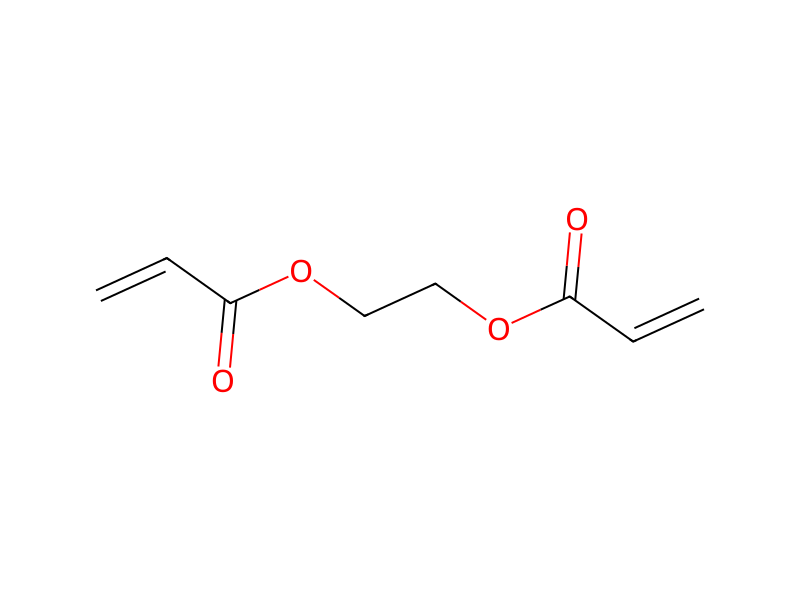
Ethylene glycol diacrylate

HCID 75282
New reaction
Print
Basic informationOverviewNames & identifiersPropertiesSafety & regulationChemistry & industryRelated reactionsCompound notes
Substructure searchFind similar structures

Basic information

CAS
2274-11-5
Standard SMILES
C=CC(=O)OCCOC(=O)C=C
InChIKey
KUDUQBURMYMBIJ-UHFFFAOYSA-N
Molecular formula
C8H10O4
Average molar mass
170.16 g/mol
Monoisotopic mass
170.0579088

Overview

Poly(ethylene glycol diacrylate) is a poly(ethylene glycol) compound terminated with acrylate groups.

Names & identifiers

Preferred name
Ethylene glycol diacrylate
IUPAC
2-prop-2-enoyloxyethyl prop-2-enoate
English name
Ethylene diacrylate
Molecular formula
C8H10O4
Molecular weight
170.16

Names & synonyms

Ethylene diacrylateEthylene glycol diacrylateEthylene acrylate2274-11-5Acrylic acid, ethylene esterEthyldiol acrilate1,2-Ethanediyl diacrylate2-Propenoic acid, 1,2-ethanediyl esterAcrylic acid, diester with ethylene glycolAcrylic acid, ethylene glycol diesterCCRIS 627Ethyldiol acrilate [Russian]
Show more names
EM 2240/5/74ethyldiolacrilate1,2-Diacrylyl ethaneEthylene glycol diacryla
EINECS 218-886-442Q902RIYEDTXSID90446152-Propenoic acid, 1,1'-(1,2-ethanediyl) esterNSC 24160BRN 1771527LIGHT ESTER EG-ANSC-24160

Database identifiers

CAS
2274-11-5、26570-48-9
PubChem CID
75282
DTXSID
DTXSID9044615
ChEMBL
CHEMBL3185327
ChEBI
CHEBI:53379
UNII
42Q902RIYE
EC Number
218-886-4
Nikkaji
J33.799D

Properties

Computed structural properties

XLogP
1.2
Topological polar surface area
52.6 Ų
Hydrogen bond donors
0
Hydrogen bond acceptors
4
Rotatable bonds
7
Heavy atoms
12
Formal charge
0
Complexity
173

Experimental & physicochemical properties

Density1.11 @25 °C
Food Contact SubstancesFCS -> FDA Inventory of Food Contact Substances Listed in 21 CFR

Physicochemical properties

Melting point
184 · 184-193℃
Boiling point
66 · 66-68 °C/2 mmHg (lit.)
Density
1.094 g/mL · 1.094 g/mL at 25 °C (lit.)
refractive index
20 · n 20/D 1.453 (lit.)
Flash point
101 °C · 101 °C - closed cup
storage temp.
2 · 2-8°C
form
Liquid
color
Clear colorless to light yellow
α-end
acrylate
Ω-end
acrylate
Major Application
environmentalpharmaceutical
InChI
1S/C8H10O4/c1-3-7(9)11-5-6-12-8(10)4-2/h3-4H,1-2,5-6H2
InChIKey
KUDUQBURMYMBIJ-UHFFFAOYSA-N
SMILES
C=CC(=O)OCCOC(=O)C=C
Indirect Additives used in Food Contact Substances
ETHYLENE DIACRYLATE
EWG's Food Scores
1 · 1
FDA UNII
42 Q902RIYE · 42Q902RIYE
EPA Substance Registry System
Ethylene glycol diacrylate (2274-11-5)
UNSPSC Code
77101502 · 77101502
NACRES
24 · NA.24
Symbol(GHS)
6 · GHS06,GHS09
Signal word
Danger
Hazard statements
301 · H301-H312+H332-H315-H319-H335-H411
Precautionary statements
273 · P273-P280-P301+P310+P330-P302+P352+P312-P304+P340+P312-P305+P351+P338
target organs
Respiratory system
Hazard Codes
Xn,N
Risk Statements
20 · 20/21/22-41-51/53-36/37/38
Safety Statements
26 · 26-36/37/39-61
RIDADR
2810 · UN 2810 6.1/PG 3
WGK Germany
3 · 3
RTECS
350000 · AT0350000
TSCA
TSCA listed
HazardClass
6.1 · 6.1(b)
PackingGroup
III
HS Code
2916190090 · 2916190090
Storage Class
6.1 C · 6.1C - Combustible acute toxic Cat.3toxic compounds or compounds which causing chronic effects
Hazard Classifications
3 OralAcute · Acute Tox. 3 OralAcute Tox. 4 DermalAcute Tox. 4 InhalationAquatic Chronic 2Eye Irrit. 2Skin Irrit. 2STOT SE 3

Safety & regulation

Safety information is for reference only and does not replace the supplier’s Safety Data Sheet (SDS), applicable regulations, or professional assessment.

GHS classification

GHS Classification · 5 items

This chemical does not meet GHS hazard criteria for 0.7% (5 of 697) of reports.

Danger

H301+H311 (63.3%): Toxic if swallowed or in contact with skin [Danger Acute toxicity, oral; acute toxicity, dermal]

P260, P261, P262, P264, P264+P265, P270, P271, P272, P273, P280, P284, P301+P316, P301+P317, P302+P352, P304+P340, P305+P351+P338, P305+P354+P338, P316, P317, P319, P320, P321, P330, P332+P317, P333+P317, P337+P317, P361+P364, P362+P364, P391, P403+P233, P405, and P501 (click each P-code to see the statement)

Aggregated GHS information provided per 697 reports by companies from 15 notifications to the ECHA C&L Inventory. Each notification may be associated with multiple companies.

Hazard information

Regulatory Information · 2 items

Chemical: 2-Propenoic acid, 1,2-ethanediyl ester

2-Propenoic acid, 1,2-ethanediyl ester: Does not have an individual approval but may be used as a component in a product covered by a group standard. It is not approved for use as a chemical in its own right.

Hazard Classes and CategoriesAcute Tox. 3 (72.3%)

Safety & protection

Protective Action Criteria (PAC) · 3 items

0.90 [mg/m3]

9.9 [mg/m3]

59 [mg/m3]

Safety data

wgk
3
tsca
TSCA listed
rtecs
AT0350000
ridadr
UN 2810 6.1/PG 3
hs_code
2916190090
risk_code
20/21/22-41-51/53-36/37/38
Signal word
Danger
Symbol(GHS)
GHS06,GHS09
hazard_code
Xn,N
safety_code
26-36/37/39-61
hazard_class
6.1(b)
Storage Class
6.1C - Combustible acute toxic Cat.3toxic compounds or compounds which causing chronic effects
packing_group
III
target organs
Respiratory system
Hazard statements
H301-H312+H332-H315-H319-H335-H411
Hazard Classifications
Acute Tox. 3 OralAcute Tox. 4 DermalAcute Tox. 4 InhalationAquatic Chronic 2Eye Irrit. 2Skin Irrit. 2STOT SE 3
Precautionary statements
P273-P280-P301+P310+P330-P302+P352+P312-P304+P340+P312-P305+P351+P338

Chemistry & industry

Uses & manufacturing

General Manufacturing Information2-Propenoic acid, 1,1'-(1,2-ethanediyl) ester: ACTIVE

Applications

Usesenvironmentalpharmaceutical

Upstream & downstream products

Upstream raw materials

2-(2-hydroxyethoxy)ethyl acrylateDiethylene glycol diacrylateEthylene oxideAcetyleneAcrylic acid

Additional notes

DefinitionChEBI: Poly(ethylene glycol diacrylate) is a poly(ethylene glycol) compound terminated with acrylate groups.

Related reactions

5 records
New reaction record
HRID 28073 reaction equation
HRID 28073As reactant
HRID 28074 reaction equation
HRID 28074As reactant
HRID 28075 reaction equation
HRID 28075As reactant
HRID 727422 reaction equation
HRID 727422As reactant
HRID 1447554 reaction equation
HRID 1447554As reactant

Compound notes

On this pageBasic informationOverviewNames & identifiersPropertiesSafety & regulationChemistry & industryRelated reactionsCompound notes