
uspto-grants-2010_06 · 10.6084/m9.figshare.5104873.v1 · US07732463B2
查看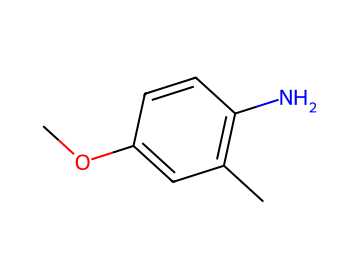
IDENTITY
COMPUTED
PROPERTIES
log Kow = 1.23
1.065 (NTP, 1992) - Denser than water; will sink
1.065 @ 25 °C
Crystals from ligroin
less than 1 mg/mL at 70.7 °F (NTP, 1992)
Very soluble in ethanol
greater than 230 °F (NTP, 1992)
Flash Point > 230 °F
478 to 480 °F at 760 mmHg (NTP, 1992)
248.5 °C
When heated to decomposition it emits toxic fumes of /nitrogen oxides/.
55 to 57 °F (NTP, 1992)
29.5 °C
0.02 [mmHg]
Index of refraction = 1.5647 @ 20 °C
Crystals or brick red liquid. (NTP, 1992)
Solid or brick-red liquid; [CAMEO] Colorless or brown liquid; mp = 13-14 deg C; [MSDSonline]
124.8 Ų [M+H]+ [CCS Type: DT; Buffer gas: N2; Ionization: APCI+; Dataset: TOXCAST; Source Identifier: DTXSID2020349];135.7 Ų [M+H]+ [CCS Type: DT; Buffer gas: N2; Ionization: ESI+; Dataset: TOXCAST; Source Identifier: DTXSID2020349]
GHS
Warning
H315 (89.6%): Causes skin irritation [Warning Skin corrosion/irritation];H319 (89.6%): Causes serious eye irritation [Warning Serious eye damage/eye irritation];H335 (87.5%): May cause respiratory irritation [Warning Specific target organ toxicity, single exposure; Respiratory tract irritation];H351 (10.4%): Suspected of causing cancer [Warning Carcinogenicity]
P203, P261, P264, P264+P265, P271, P280, P302+P352, P304+P340, P305+P351+P338, P318, P319, P321, P332+P317, P337+P317, P362+P364, P403+P233, P405, and P501 (click each P-code to see the statement)
Aggregated GHS information provided per 48 reports by companies from 8 notifications to the ECHA C&L Inventory. Each notification may be associated with multiple companies.;Information may vary between notifications depending on impurities, additives, and other factors. The percentage value in parenthesis indicates the notified classification ratio from companies that provide hazard codes. Only hazard codes with percentage values above 10% are shown. For more detailed information, please visit ECHA C&L website.
HAZARDS
Poison
This chemical is probably combustible. (NTP, 1992)
ACUTE/CHRONIC HAZARDS: This compound is a local irritant. When heated to decomposition it emits toxic fumes of NOx. This compound is an experimental animal carcinogen. (NTP, 1992)
An irritant; [CAMEO] An irritant; Can be absorbed through skin; Associated with tumors of urinary tract and liver in high-dose animal studies; [MSDSonline] See p-Cresidine.
Amines, Aromatic
M-CRESIDINE neutralizes acids in weakly exothermic reactions to form salts plus water. May be incompatible with isocyanates, halogenated organics, peroxides, phenols (acidic), epoxides, anhydrides, and acid halides. May generate hydrogen, a flammable gas, in combination with strong reducing agents such as hydrides. Reacts with oxidizing agents (NTP, 1992).
Sensitive to prolonged exposure to air and light. Insoluble in water.
Skin Irrit. 2 (89.6%);Eye Irrit. 2 (89.6%);STOT SE 3 (87.5%);Carc. 2 (10.4%)
SAFETY
Fires involving this compound should be controlled with a dry chemical carbon dioxide or Halon extinguisher. (NTP, 1992)
EYES: First check the victim for contact lenses and remove if present. Flush victim's eyes with water or normal saline solution for 20 to 30 minutes while simultaneously calling a hospital or poison control center. Do not put any ointments, oils, or medication in the victim's eyes without specific instructions from a physician. IMMEDIATELY transport the victim after flushing eyes to a hospital even if no symptoms (such as redness or irritation) develop.;SKIN: IMMEDIATELY flood affected skin with water while removing and isolating all contaminated clothing. Gently wash all affected skin areas thoroughly with soap and water. IMMEDIATELY call a hospital or poison control center even if no symptoms (such as redness or irritation) develop. IMMEDIATELY transport the victim to a hospital for treatment after washing the affected areas.;INHALATION: IMMEDIATELY leave the contaminated area; take deep breaths of fresh air. IMMEDIATELY call a physician and be prepared to transport the victim to a hospital even if no symptoms (such as wheezing, coughing, shortness of breath, or burning in the mouth, throat, or chest) develop. Provide proper respiratory protection to rescuers entering an unknown atmosphere. Whenever possible, Self-Contained Breathing Apparatus (SCBA) should be used; if not available, use a level of protection greater than or equal to that advised under Protective Clothing.;INGESTION: DO NOT INDUCE VOMITING. If the victim is conscious and not convulsing, give 1 or 2 glasses of water to dilute the chemical and IMMEDIATELY call a hospital or poison control center. Be prepared to transport the victim to a hospital if advised by a physician. If the victim is convulsing or unconscious, do not give anything by mouth, ensure that the victim's airway is open and lay the victim on his/her side with the head lower than the body. DO NOT INDUCE VOMITING. IMMEDIATELY transport the victim to a hospital.;OTHER: Since this chemical is a known or suspected carcinogen you should contact a physician for advice regarding the possible long term health effects and potential recommendation for medical monitoring. Recommendations from the physician will depend upon the specific compound, its chemical, physical and toxicity properties, the exposure level, length of exposure, and the route of exposure. (NTP, 1992)
You should protect this chemical from exposure to light. Keep the container tightly closed under an inert atmosphere, and store under refrigerated temperatures.
SMALL SPILLS AND LEAKAGE: If you spill this chemical, FIRST REMOVE ALL SOURCES OF IGNITION. Then, use absorbent paper to pick up all liquid spill material. Your contaminated clothing and absorbent paper should be sealed in a vapor-tight plastic bag for eventual disposal. Solvent wash all contaminated surfaces with 60-70% ethanol followed by washing with a soap and water solution. Do not reenter the contaminated area until the Safety Officer (or other responsible person) has verified that the area has been properly cleaned.;STORAGE PRECAUTIONS: You should protect this chemical from exposure to light. Keep the container tightly closed under an inert atmosphere, and store under refrigerated temperatures. (NTP, 1992)
SRP: At the time of review, criteria for land treatment or burial (sanitary landfill) disposal practices are subject to significant revision. Prior to implementing land disposal of waste residue (including waste sludge), consult with environmental regulatory agencies for guidance on acceptable disposal practices.
Excerpt from ERG Guide 153 [Substances - Toxic and/or Corrosive (Combustible)]:;IMMEDIATE PRECAUTIONARY MEASURE: Isolate spill or leak area in all directions for at least 50 meters (150 feet) for liquids and at least 25 meters (75 feet) for solids.;SPILL: Increase the immediate precautionary measure distance, in the downwind direction, as necessary.;FIRE: If tank, rail tank car or highway tank is involved in a fire, ISOLATE for 800 meters (1/2 mile) in all directions; also, consider initial evacuation for 800 meters (1/2 mile) in all directions. (ERG, 2024)
MINIMUM PROTECTIVE CLOTHING: If Tyvek-type disposable protective clothing is not worn during handling of this chemical, wear disposable Tyvek-type sleeves taped to your gloves.;RECOMMENDED RESPIRATOR: Where the neat test chemical is weighed and diluted, wear a NIOSH-approved half face respirator equipped with a combination filter cartridge, i.e. organic vapor/acid gas/HEPA (specific for organic vapors, HCl, acid gas, SO2 and a high efficiency particulate filter). (NTP, 1992)
TOXICITY
TERRESTRIAL FATE: Based on a classification scheme(1), an estimated Koc value of 110(SRC), determined from a log Kow of 1.23(2) and a regression-derived equation(3), indicates that m-cresidine is expected to have high mobility in soil(SRC). However, anilines (aromatic amines) are expected to bind strongly to humus or organic matter in soils due to the high reactivity of the aromatic amino group(4,5), suggesting that mobility may be much lower in some soils(SRC). Volatilization of m-cresidine from moist soil surfaces may be an important fate process(SRC) given an estimated Henry's Law constant of 1.2X10⁻⁷ atm-cu m/mole(SRC), using a fragment constant estimation method(6). m-Cresidine is not expected to volatilize from dry soil surfaces(SRC) based upon an estimated vapor pressure of 0.025 mm Hg(SRC), determined from a fragment constant method(7). Based on data for p-cresidine, a structural analog; m-cresidine is not expected to readily biodegrade in soil(SRC). For example, p-cresidine, present at 100 mg/l, reached 0.7% of its theoretical BOD in 2 weeks, using an activated sludge inoculum at 30 mg/l, and the Japanese MITI test(7).
AQUATIC FATE: Based on a classification scheme(1), an estimated Koc value of 110(SRC), determined from a log Kow of 1.23(2) and a regression-derived equation(3), indicates that m-cresidine is expected to adsorb slightly to suspended solids and sediment(SRC). Volatilization from water surfaces may occur (3) based upon an estimated Henry's Law constant of 1.2X10⁻⁷ atm-cu m/mole(SRC), developed using a fragment constant estimation method(4). Using this Henry's Law constant and an estimation method(3), volatilization half-lives for a model river and model lake are 15 and 169 days, respectively(SRC). According to a classification scheme(5), an estimated BCF of 2(SRC), from an estimated log Kow(2) and a regression-derived equation(6), suggests the potential for bioconcentration in aquatic organisms is low(SRC). Based on data for p-cresidine, a structural analog; m-cresidine is not expected to readily biodegrade in aqueous environments(SRC). For example, p-cresidine, present at 100 mg/l, reached 0.7% of its theoretical BOD in 2 weeks, using an activated sludge inoculum at 30 mg/l, and the Japanese MITI test(7).
ATMOSPHERIC FATE: According to a model of gas/particle partitioning of semivolatile organic compounds in the atmosphere(1), m-cresidine, which has an estimated vapor pressure of 0.025 mm Hg at 25 °C(SRC), determined from a fragment constant method(2), is expected to exist solely as a vapor in the ambient atmosphere(SRC). Vapor-phase m-cresidine is degraded in the atmosphere by reaction with photochemically-produced hydroxyl radicals(SRC); the half-life for this reaction in air is estimated to be 3.3 hours(SRC), calculated from its rate constant of 1.2X10⁻¹⁰ cu cm/molecule-sec at 25 °C(SRC) that was derived using a structure estimation method(3).
Occupational hepatotoxin - Secondary hepatotoxins: the potential for toxic effect in the occupational setting is based on cases of poisoning by human ingestion or animal experimentation.;Methemoglobinemia - The presence of increased methemoglobin in the blood; the compound is classified as secondary toxic effect
The following link will take the user to the National Toxicology Program (NTP) Test Agent Search Results page, which tabulates all of the "Standard Toxicology & Carcinogenesis Studies", "Developmental Studies", and "Genetic Toxicity Studies" performed with this chemical. Clicking on the "Testing Status" link will take the user to the status (i.e., in review, in progress, in preparation, on test, completed, etc.) and results of all the studies that the NTP has done on this chemical. [http://ntp-apps.niehs.nih.gov/ntp_tox/index.cfm?fuseaction=ntpsearch.searchresults&searchterm=102-50-1]
The Koc of m-cresidine is estimated as 110(SRC), using a log Kow of 1.23(1) and a regression-derived equation(2). According to a classification scheme(3), this estimated Koc value suggests that m-cresidine is expected to have high mobility in soil(SRC). However, anilines (aromatic amines) are expected to bind strongly to humus or organic matter in soils due to the high reactivity of the aromatic amino group(4,5), suggesting that mobility may be much lower in some soils(SRC).
m-Cresidine's former production and use as a dye intermediate(1) may have resulted in its release to the environment through various waste streams(SRC).
AEROBIC: Based on data for p-cresidine, a structural analog; m-cresidine is not expected to readily biodegrade in the environment(SRC). For example, p-cresidine, present at 100 mg/l, reached 0.7% of its theoretical BOD in 2 weeks, using an activated sludge inoculum at 30 mg/l, and the Japanese MITI test(1).
meta-Cresidine
Group 3: Not classifiable as to its carcinogenicity to humans
Volume 27: (1982) Some Aromatic Amines, Anthraquinones and Nitroso Compounds, and Inorganic Fluorides Used in Drinking-water and Dental Preparations;Volume Sup 7: Overall Evaluations of Carcinogenicity: An Updating of IARC Monographs Volumes 1 to 42, 1987; 440 pages; ISBN 92-832-1411-0 (out of print)
1987
1987
m-Cresidine
An estimated BCF of 2 was calculated for m-cresidine(SRC), using a log Kow of 1.23(1) and a regression-derived equation(2). According to a classification scheme(3), this BCF suggests the potential for bioconcentration in aquatic organisms is low(SRC).
The Henry's Law constant for m-cresidine is estimated as 1.2X10⁻⁷ atm-cu m/mole(SRC) using a fragment constant estimation method(1). This Henry's Law constant indicates that m-cresidine may volatilize from water surfaces(2). Based on this Henry's Law constant, the volatilization half-life from a model river (1 m deep, flowing 1 m/sec, wind velocity of 3 m/sec)(2) is estimated as 15 days(SRC). The volatilization half-life from a model lake (1 m deep, flowing 0.05 m/sec, wind velocity of 0.5 m/sec)(2) is estimated as 169 days(SRC). m-Cresidine's Henry's Law constant indicates that volatilization from moist soil surfaces may occur(SRC). m-Cresidine is not expected to volatilize from dry soil surfaces(SRC) based upon an estimated vapor pressure of 0.025 mm Hg(SRC), determined from a fragment constant method(3).
/LABORATORY ANIMALS: Subchronic or Prechronic Exposure/ In 7-wk subchronic studies, male and female Fischer 344 rats and B6C3F1 mice were given meta-cresidine in corn oil by intubation at doses of up to 300 mg/kg bw (rat) and up to 600 mg/kg bw (mouse) on 5 days a week. The male rats showed a dose-dependent depression in mean body weight gain of up to 27%; female mice showed depressions of up to 18%. The female rats and male mice showed less pronounced weight reductions. Chronic administration of 160 mg/kg bw/day led to hyperplastic and degenerative lesions of the urinary system in rats, and to dose-dependent nephrotoxicity (especially in males) in mice.
/LABORATORY ANIMALS: Chronic Exposure or Carcinogenicity/ Groups of 50 male and 50 female B6C3F1 mice, 6 weeks of age, were administered meta-cresidine (of indeterminate purity with at least three impurities detected by gas chromatography) by gavage in corn oil on 5 days/wk at two dosage schedules: 0.08 g/kg bw for 32 weeks; or 0.16 g/kg bw for 32 weeks, followed by 0.04 g/kg for 21 weeks and observation periods of 25 weeks for males and 41 weeks for females. The doses were selected on the basis of a range-finding study. A group consisting of 50 mice of each sex served as untreated controls; groups of 25 mice of each sex received the vehicle only. There were erratic depressions in mean body weight gain throughout the study in all treated males and females that received the high dose. Among male mice, there was a positive association between dosage and mortality (p<0.001): the median survival time for high-dose males was 26 weeks, and that for low-dose males was 52 weeks; these survival times were inadequate for an evaluation of carcinogenicity. There was a significantly higher mortality in high-dose females: by the end of the study, 80-84% of control females, 86% of low-dose females and 60% of the high-dose females were still alive. The incidences of hepatocellular adenomas plus carcinomas in female mice were 0/23 in vehicle controls, 1/50 (1 carcinoma) in low-dose mice and 5/45 (4 carcinomas) in high-dose mice, indicating a significant positive association (p=0.027) between dose and incidence.
/LABORATORY ANIMALS: Chronic Exposure or Carcinogenicity/ Groups of 50 male and 50 female Fischer 344 rats were administered... meta-cresidine by gavage in corn oil at dosages of 0.08 or 0.16 g/kg bw for 77 weeks and observed for an additional 32-33 weeks. The doses were selected on the basis of a range-finding study. A group consisting of 50 rats of each sex served as untreated controls, and groups of 25 animals of each sex as vehicle controls. There was a depression in mean body weight gain among high-dose male rats during the first 48 weeks, but thereafter their mean body weight gain was similar to that of controls. Mean body weight gains of low-dose males and of all treated females were similar to those of controls throughtout the study. Among males, there was a positive association between dosage and mortality: 64% of the untreated control males, 68% of the vehicle control males, 62% of the low-dose males and 48% of the high-dose males survived to the end of the study. Among females, there was a significantly greater mortality in the high-dose group: 52% of the vehicle controls, 72% of the untreated controls, 57% of the low-dose and 44% of the high-dose females survived to the end of the study. Among male rats, there was a dose related (p=0.014) increase in the incidence of transitional-cell carcinomas of the urinary bladder: vehicle controls, 0/25; low-dose rats, 0/45; high-dose rats, 5/44. Among male rats, there was a dose-related (p=0.014) increase in the incidence of transitional-cell carcinomas of the urinary bladder: vehicle controls, 0/25; low-dose rats, 0/45; high-dose rats, 5/44. Among females, transitional-cell carcinomas were found in 0/24 vehicle controls, 1/46 low-dose animals and 2/44 high-dose animals. Hyperplasia of the renal pelvis was found in 26/45 high-dose males and 29/45 high-dose females, but not in untreated or vehicle control or low-dose rats.
/GENOTOXICITY/ meta-Cresidine... was /not/ mutagenic in... Escherichia coli WP2uvrA or Salmonella typhimurium strains TA1537, TA1538, TA98 or TA100 when tested in the presence or absence of Aroclor-induced or uninduced hamster, rat or mouse liver microsomes.
/GENOTOXICITY/ In Vitro Cytogenetics: Positive (chromosome aberrations); Positive (sister chromatid exchanges). Salmonella: Positive /in TA100 strain with hamster liver S-9 in preincubation assay, 33-2000 ug/plate/
Classification of carcinogenicity: 1) evidence in humans: no adequate data; 2) evidence in animals: insufficient. Overall summary evaluation of carcinogenic risk to humans is Group 3: The agent is not classifiable as to its carcinogenicity to humans. /From table/
The rate constant for the vapor-phase reaction of m-cresidine with photochemically-produced hydroxyl radicals has been estimated as 1.2X10⁻¹⁰ cu cm/molecule-sec at 25 °C(SRC) using a structure estimation method(1). This corresponds to an atmospheric half-life of about 3.3 hours at an atmospheric concentration of 5X10+5 hydroxyl radicals per cu cm(1). m-Cresidine is not expected to undergo hydrolysis in the environment due to the lack of hydrolyzable functional groups(2) nor to directly photolyze due to the lack of absorption in the environmental UV spectrum (>290 nm)(SRC).
USES
Formerly used in the manufacture of dyes, inks, and pigments; [HSDB]
/Former use:/ Manufacture of dyes, inks and pigments.
Benzenamine, 4-methoxy-2-methyl-: ACTIVE
ALIASES
REACTIONS
uspto-grants-2010_06 · 10.6084/m9.figshare.5104873.v1 · US07732463B2
查看
uspto-grants-2008_09 · 10.6084/m9.figshare.5104873.v1 · US07427630B2
查看
uspto-grants-2008_09 · 10.6084/m9.figshare.5104873.v1 · US07427630B2
查看
uspto-grants-2014_09 · 10.6084/m9.figshare.5104873.v1 · US08822685B2
查看
uspto-grants-2014_09 · 10.6084/m9.figshare.5104873.v1 · US08835430B2
查看
Training data from https://doi.org/10.1039/C8SC04228D (6/10) · 10.1039/C8SC04228D
查看
uspto-grants-2009_07 · 10.6084/m9.figshare.5104873.v1 · US07557210B2
查看
uspto-grants-1997_01 · 10.6084/m9.figshare.5104873.v1 · US05594021
查看