
uspto-grants-1998_03 · 10.6084/m9.figshare.5104873.v1 · US05731315
查看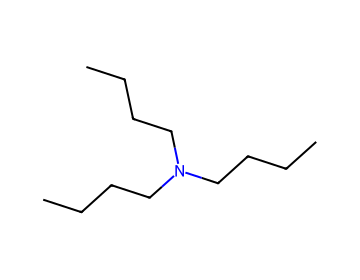
IDENTITY
COMPUTED
PROPERTIES
log Kow = 4.46
1.52
Odor of ammonia
0.7771 at 68 °F (NTP, 1992) - Less dense than water; will float
0.7782 at 20 °C/20 °C
Bulk density: 6.5 lb/gal
Relative density (water = 1): 0.78
0.78 @25 °C
1.35 cP at 25 °C; 0.73 cP at 60 °C
Pale yellow liquid
Slightly soluble (NTP, 1992)
In water, 142 mg/L at 25 °C
In water, 40 ppm at 18 °C
Sparingly soluble in water
Soluble in acetone; very soluble in ethanol, ethyl ether
Soublel in most org solvents
185 °F (NTP, 1992)
63 °C (145 °F) - closed cup
145 °F (63 °C)
187 °F (open cup)
63 °C c.c.
415 °F at 760 mmHg (NTP, 1992)
207 °C
216-217 °C
216.5 °C @760 [mm Hg]
When heated to decomp, emits toxic fumes of /nitrogen oxides/.
-94 °F (NTP, 1992)
-70 °C
-70 °C
6.38 (NTP, 1992) - Heavier than air; will sink (Relative to Air)
6.39 (Air = 1)
Relative vapor density (air = 1): 6.4
8 female and 8 male volunteers were exposed to the test substance (> 99.5% pure) in varying concentrations. An odor threshold of 0.07 +/- 0.03 ppm (approx. 0.54 mg/cu m) was identified in this study (lowest value: 0.01 ppm)
GHS
Danger
H302 (99.3%): Harmful if swallowed [Warning Acute toxicity, oral];H310 (79.8%): Fatal in contact with skin [Danger Acute toxicity, dermal];H311 (16.9%): Toxic in contact with skin [Danger Acute toxicity, dermal];H315 (85.6%): Causes skin irritation [Warning Skin corrosion/irritation];H319 (14.5%): Causes serious eye irritation [Warning Serious eye damage/eye irritation];H330 (84.2%): Fatal if inhaled [Danger Acute toxicity, inhalation];H412 (14.4%): Harmful to aquatic life with long lasting effects [Hazardous to the aquatic environment, long-term hazard]
P260, P262, P264, P264+P265, P270, P271, P273, P280, P284, P301+P317, P302+P352, P304+P340, P305+P351+P338, P316, P320, P321, P330, P332+P317, P337+P317, P361+P364, P362+P364, P403+P233, P405, and P501 (click each P-code to see the statement)
Aggregated GHS information provided per 3068 reports by companies from 17 notifications to the ECHA C&L Inventory. Each notification may be associated with multiple companies.;Information may vary between notifications depending on impurities, additives, and other factors. The percentage value in parenthesis indicates the notified classification ratio from companies that provide hazard codes. Only hazard codes with percentage values above 10% are shown. For more detailed information, please visit ECHA C&L website.
HAZARDS
Chemical: 1-Butanamine, N,N-dibutyl-
1-Butanamine, N,N-dibutyl- is listed on the EPA's Chemical Data Reporting (CDR) system. Manufacturers and importers of 1-Butanamine, N,N-dibutyl- are required to report information about their production and use of this chemical to the EPA under the Toxic Substances Control Act (TSCA). (40 eCFR Part 711)
Status: Cease Manufacture Update: 23-05-2018 https://echa.europa.eu/registration-dossier/-/registered-dossier/25009;Status: Active Update: 12-05-2022 https://echa.europa.eu/registration-dossier/-/registered-dossier/13327
1-Butanamine, N,N-dibutyl-: Does not have an individual approval but may be used under an appropriate group standard
The New Jersey Worker and Community Right to Know Act requires public and private employers to provide information about hazardous substances at their workplaces. (N.J.S.A. 34:5A-1 et. seq.)
Poison
Excerpt from ERG Guide 153 [Substances - Toxic and/or Corrosive (Combustible)]:;Combustible material: may burn but does not ignite readily. When heated, vapors may form explosive mixtures with air: indoors, outdoors and sewers explosion hazards. Those substances designated with a (P) may polymerize explosively when heated or involved in a fire. Corrosives in contact with metals may evolve flammable hydrogen gas. Containers may explode when heated. Runoff may pollute waterways. Substance may be transported in a molten form. (ERG, 2024)
· Combustible material: may burn but does not ignite readily.;· When heated, vapors may form explosive mixtures with air: indoors, outdoors and sewers explosion hazards.;· Those substances designated with a (P) may polymerize explosively when heated or involved in a fire.;· Corrosives in contact with metals may evolve flammable hydrogen gas.;· Containers may explode when heated.;· Runoff may pollute waterways.;· Substance may be transported in a molten form.
Combustible. Gives off irritating or toxic fumes (or gases) in a fire. Above 63 °C explosive vapour/air mixtures may be formed.
Flammable when exposed to heat, flame, or xidizers.
Excerpt from ERG Guide 153 [Substances - Toxic and/or Corrosive (Combustible)]:;TOXIC and/or CORROSIVE; inhalation, ingestion or skin contact with material may cause severe injury or death. Methyl bromoacetate (UN2643) is an eye irritant/lachrymator (causes flow of tears). Contact with molten substance may cause severe burns to skin and eyes. Avoid any skin contact. Fire may produce irritating, corrosive and/or toxic gases. Runoff from fire control or dilution water may be corrosive and/or toxic and cause environmental contamination. (ERG, 2024)
· TOXIC and/or CORROSIVE; inhalation, ingestion or skin contact with material may cause severe injury or death.;· Methyl bromoacetate (UN2643) is an eye irritant/lachrymator (causes flow of tears).;· Contact with molten substance may cause severe burns to skin and eyes.;· Avoid any skin contact.;· Fire may produce irritating, corrosive and/or toxic gases.;· Runoff from fire control or dilution water may be corrosive and/or toxic and cause environmental contamination.
A skin irritant; May cause skin sensitization; May cause CNS stimulation; [Merck Index] A skin and mild eye irritant; Can be absorbed through skin; [ICSC] A skin, eye, and respiratory tract irritant; External application to rabbit eyes scored 1 on a scale of 1-10 (10 being most severe) for degree of injury after 24 hours; Repeated inhalation exposures of rats to 120 ppm causes nasal irritation, restlessness, and tremors (no abnormalities in organs at autopsy); Emergency treatment: Irritants; [HSDB] Highly irritating to skin, eyes, and mucous membranes; [CAMEO] Not mutagenic in micronucleus assay of mice; Clinical signs that may be associated with neurotoxicity have been reported in various animal studies; [EPA] Causes convulsions, dyspnea, and coma in SC lethal-dose studies of rats; Causes changes in blood and enzyme activities in repeated dose oral study of rabbits; [RTECS] An irritant; Toxic by inhalation and in contact with skin; [Alfa Aesar MSDS] Search for (102-82-9[EC/RN Number]) AND (dermatitis OR allergic OR sensitizer OR sensitization): no results; [PubMed]
2542 153
Amines, Phosphines, and Pyridines
UN Hazard Class: 6.1; UN Pack Group: II
TRIBUTYLAMINE can react with oxidizing materials (NTP, 1992). Neutralizes acids in exothermic reactions to form salts plus water. May be incompatible with isocyanates, halogenated organics, peroxides, phenols (acidic), epoxides, anhydrides, and acid halides. Flammable gaseous hydrogen may be generated in combination with strong reducing agents, such as hydrides.
Decomposes on burning. This produces toxic gases including nitrogen oxides. The substance is a weak base. Reacts with oxidants and strong acids.
The vapour is heavier than air.
SAFETY
Excerpt from ERG Guide 153 [Substances - Toxic and/or Corrosive (Combustible)]:;SMALL FIRE: Dry chemical, CO2 or water spray.;LARGE FIRE: Dry chemical, CO2, alcohol-resistant foam or water spray. If it can be done safely, move undamaged containers away from the area around the fire. Dike runoff from fire control for later disposal.;FIRE INVOLVING TANKS, RAIL TANK CARS OR HIGHWAY TANKS: Fight fire from maximum distance or use unmanned master stream devices or monitor nozzles. Do not get water inside containers. Cool containers with flooding quantities of water until well after fire is out. Withdraw immediately in case of rising sound from venting safety devices or discoloration of tank. ALWAYS stay away from tanks in direct contact with flames. (ERG, 2024)
Use water spray, powder, foam, carbon dioxide.
Fresh air, rest.
Rinse skin with plenty of water or shower.
First rinse with plenty of water for several minutes (remove contact lenses if easily possible), then refer for medical attention.
Rinse mouth.
· CALL 911. Then call emergency response telephone number on shipping paper. If shipping paper not available or no answer, refer to appropriate telephone number listed on the inside back cover.;· Keep unauthorized personnel away.;· Stay upwind, uphill and/or upstream.;· Ventilate closed spaces before entering, but only if properly trained and equipped.
· ELIMINATE all ignition sources (no smoking, flares, sparks or flames) from immediate area.;· Do not touch damaged containers or spilled material unless wearing appropriate protective clothing.;· Stop leak if you can do it without risk.;· Prevent entry into waterways, sewers, basements or confined areas.;· Absorb or cover with dry earth, sand or other non-combustible material and transfer to containers.;· DO NOT GET WATER INSIDE CONTAINERS.
EYES: First check the victim for contact lenses and remove if present. Flush victim's eyes with water or normal saline solution for 20 to 30 minutes while simultaneously calling a hospital or poison control center. Do not put any ointments, oils, or medication in the victim's eyes without specific instructions from a physician. IMMEDIATELY transport the victim after flushing eyes to a hospital even if no symptoms (such as redness or irritation) develop.;SKIN: IMMEDIATELY flood affected skin with water while removing and isolating all contaminated clothing. Gently wash all affected skin areas thoroughly with soap and water. IMMEDIATELY call a hospital or poison control center even if no symptoms (such as redness or irritation) develop. IMMEDIATELY transport the victim to a hospital for treatment after washing the affected areas.;INHALATION: IMMEDIATELY leave the contaminated area; take deep breaths of fresh air. IMMEDIATELY call a physician and be prepared to transport the victim to a hospital even if no symptoms (such as wheezing, coughing, shortness of breath, or burning in the mouth, throat, or chest) develop. Provide proper respiratory protection to rescuers entering an unknown atmosphere. Whenever possible, Self-Contained Breathing Apparatus (SCBA) should be used; if not available, use a level of protection greater than or equal to that advised under Protective Clothing.;INGESTION: DO NOT INDUCE VOMITING. Corrosive chemicals will destroy the membranes of the mouth, throat, and esophagus and, in addition, have a high risk of being aspirated into the victim's lungs during vomiting which increases the medical problems. If the victim is conscious and not convulsing, give 1 or 2 glasses of water to dilute the chemical and IMMEDIATELY call a hospital or poison control center. IMMEDIATELY transport the victim to a hospital. If the victim is convulsing or unconscious, do not give anything by mouth, ensure that the victim's airway is open and lay the victim on his/her side with the head lower than the body. DO NOT INDUCE VOMITING. Transport the victim IMMEDIATELY to a hospital. (NTP, 1992)
General First Aid:;· Call 911 or emergency medical service.;· Ensure that medical personnel are aware of the material(s) involved, take precautions to protect themselves and avoid contamination.;· Move victim to fresh air if it can be done safely.;· Administer oxygen if breathing is difficult.;· If victim is not breathing:;-- DO NOT perform mouth-to-mouth resuscitation; the victim may have ingested or inhaled the substance.;-- If equipped and pulse detected, wash face and mouth, then give artificial respiration using a proper respiratory medical device (bag-valve mask, pocket mask equipped with a one-way valve or other device).;-- If no pulse detected or no respiratory medical device available, provide continuous compressions. Conduct a pulse check every two minutes or monitor for any signs of spontaneous respirations.;· Remove and isolate contaminated clothing and shoes.;· For minor skin contact, avoid spreading material on unaffected skin.;· In case of contact with substance, remove immediately by flushing skin or eyes with running water for at least 20 minutes.;· For severe burns, immediate medical attention is required.;· Effects of exposure (inhalation, ingestion, or skin contact) to substance may be delayed.;· Keep victim calm and warm.;· Keep victim under observation.;· For further assistance, contact your local Poison Control Center.;· Note: Basic Life Support (BLS) and Advanced Life Support (ALS) should be done by trained professionals.;Specific First Aid:;· For corrosives, in case of contact, immediately flush skin or eyes with running water for at least 30 minutes. Additional flushing may be required.
Dry. Separated from strong oxidants, strong acids and food and feedstuffs.
· Wear positive pressure self-contained breathing apparatus (SCBA).;· Wear chemical protective clothing that is specifically recommended by the manufacturer when there is NO RISK OF FIRE.;· Structural firefighters' protective clothing provides thermal protection but only limited chemical protection.
Suitable extinguishing media: Use water spray, alcohol-resistant foam, dry chemical, or carbon dioxide.
Advice for firefighters: Wear self-contained breathing apparatus for firefighting if necessary.
Use water spray to cool unopened containers.
To fight fire, use foam, CO2, dry chemical.
Use water spray, dry chemical, foam, or carbon dioxide. Use water spray to keep fire-exposed containers cool.
Keep container tightly closed in a dry and well-ventilated place. Containers which are opened must be carefully resealed and kept upright to prevent leakage. Store under inert gas. Hygroscopic. Storage class (TRGS 510): Non-combustible, acute toxic Cat. 1 and 2 / very toxic hazardous materials.
Outside or detached storage is preferred. Separate from oxidizing materials, acids, and sources of halogen. Store in a cool, dry, well-ventilated location.
ACCIDENTAL RELEASE MEASURES: Personal precautions, protective equipment and emergency procedures: Wear respiratory protection. Avoid breathing vapors, mist or gas. Ensure adequate ventilation. Remove all sources of ignition. Evacuate personnel to safe areas. Beware of vapors accumulating to form explosive concentrations. Vapors can accumulate in low areas. Environmental precautions: Prevent further leakage or spillage if safe to do so. Do not let product enter drains. Discharge into the environment must be avoided. Methods and materials for containment and cleaning up: Contain spillage, and then collect with an electrically protected vacuum cleaner or by wet-brushing and place in container for disposal according to local regulations. Keep in suitable, closed containers for disposal.
Use water spray to cool and disperse vapors and protect personnel. Approach release from upwind. Sand, clay, earth, or other absorbent material may be used to contain liquid.
Excerpt from ERG Guide 153 [Substances - Toxic and/or Corrosive (Combustible)]:;ELIMINATE all ignition sources (no smoking, flares, sparks or flames) from immediate area. Do not touch damaged containers or spilled material unless wearing appropriate protective clothing. Stop leak if you can do it without risk. Prevent entry into waterways, sewers, basements or confined areas. Absorb or cover with dry earth, sand or other non-combustible material and transfer to containers. DO NOT GET WATER INSIDE CONTAINERS. (ERG, 2024)
SRP: Recycle any unused portion of the material for its approved use or return it to the manufacturer or supplier. Ultimate disposal of the chemical must consider: the material's impact on air quality; potential migration in air, soil or water; effects on animal, aquatic and plant life; and conformance with environmental and public health regulations. If it is possible or reasonable use an alternative chemical product with less inherent propensity for occupational harm/injury/toxicity or environmental contamination.
Product: This combustible material may be burned in a chemical incinerator equipped with an afterburner and scrubber. Offer surplus and non-recyclable solutions to a licensed disposal company. Contact a licensed professional waste disposal service to dispose of this material; Contaminated packaging: Dispose of as unused product.
Personal protection: filter respirator for ammonia and organic ammonia derivatives adapted to the airborne concentration of the substance. Collect leaking and spilled liquid in sealable containers as far as possible. Cover the spilled material with inert absorbent.
TOXICITY
Synergistic interactions between 2,4-D (94757) & environmental chemicals on in-vitro 2,4-D cytotoxicity & the influence of lipophilicity of the cmpds were investigated. GM-05757 cells were incubated with 2,4-D (used as its dimethylammonium salt) in binary combinations with /12 chemicals including/ ... tributylamine (102829), ... for 1 hr. All cmpds were used at concns previously determined not to have induced any growth inhibition (NOECs), measured as the ratio of cells counted immediately after exposure ended to those counted 48 hr after exposure ended. The concns of 2,4-D & the other chemicals alone & in combination causing a 20% decr in cell growth (EC20) were determined. Associations between the EC20s of the combinations & their lipophilicity, as indicated by the logarithm of the octanol/water partition coefficient, were examined by logistic regression techniques. All cmpds enhanced the toxicity of 2,4-D, as evidenced by decreases in the EC20. Except in the case of nitriloacetic-acid, the decreases in the EC20 were similar, varying from 43.3 to 60.7% over that of 2,4-D alone. ... Except for tributylamine, the decreases in EC20 produced by the combined exposures were strongly correlated with their lipophilicity. The correlation coefficient was reduced if tributylamine was included in the analysis. ... All chemicals may exhibit synergistic toxic effects when combined at nontoxic doses with dissimilar cmpds. The strength of the correlation appears to be related to lipophilicity. This correlation may reflect the ability of lipophilic cmpds to damage the cell membrane which then facilitates & enhances uptake of hydrophilic agents.
EC50; Species: Daphnia magna (Water Flea) age <24 hr; Conditions: freshwater, static, pH 7.9-8.0, dissolved oxygen 97-98% saturated; Concentration: 19000 ug/L for 24 hr (95% confidence interval: 8700-40000 ug/L); Effect: intoxication, immobilization />99% purity/
EC50; Species: Daphnia magna (Water Flea) age <24 hr; Conditions: freshwater, renewal, pH 7.9-8.0, dissolved oxygen 97-100% saturated; Concentration: 8000 ug/L for 48 hr (95% confidence interval: 6100-10800 ug/L); Effect: intoxication, immobilization />99% purity/
TERRESTRIAL FATE: Based on a classification scheme(1), an estimated Koc value of 1860(SRC), determined from a structure estimation method(2), indicates that tributylamine is expected to have low mobility in soil(SRC). The pKa of tributylamine is 10.89(3), indicating that this compound will exist entirely in cation form in the environment and cations generally adsorb more strongly to soils containing organic carbon and clay than their neutral counterparts(4). Tributylamine is not expected to volatilize from dry soil surfaces(SRC) based upon a vapor pressure of 0.0934 mm Hg at 25 °C(5). A 2% of Theoretical BOD using activated sludge in the Japanese MITI test(6) suggests that biodegradation is a slow environmental fate process in soil(SRC).
AQUATIC FATE: Based on a classification scheme(1), an estimated Koc value of 1860(SRC), determined from a structure estimation method(2), indicates that tributylamine is expected to adsorb to suspended solids and sediment(SRC). A pKa of 10.89(3) indicates tributylamine will exist entirely in the cation form at pH values of 5 to 9 and, therefore, volatilization from water surfaces is not expected to be an important fate process(SRC). Tributylamine is not expected to undergo hydrolysis in the environment due to the lack of functional groups that hydrolyze under environmental conditions(4). According to a classification scheme(5), BCFs of <0.32-47, reported in carp(6), suggest bioconcentration in aquatic organisms is low to moderate. A 2% of Theoretical BOD using activated sludge in the Japanese MITI test(6) suggests that biodegradation may be a slow environmental fate process in water(SRC).
ATMOSPHERIC FATE: According to a model of gas/particle partitioning of semivolatile organic compounds in the atmosphere(1), tributylamine, which has a vapor pressure of 0.0934 mm Hg at 25 °C(2), is expected to exist solely as a vapor in the ambient atmosphere. Vapor-phase tributylamine is degraded in the atmosphere by reaction with photochemically-produced hydroxyl radicals(SRC); the half-life for this reaction in air is estimated to be 4 hours(SRC), calculated from its rate constant of 1.1X10⁻¹⁰ cu cm/molecule-sec at 25 °C(SRC) that was derived using a structure estimation method(3). Tributylamine does not contain chromophores that absorb at wavelengths >290 nm(4) and, therefore, is not expected to be susceptible to direct photolysis by sunlight(SRC).
The substance can be absorbed into the body by inhalation, through the skin and by ingestion.
IDENTIFICATION AND USE: Tributylamine is a pale yellow liquid. It is used as a solvent; inhibitor in hydraulic fluids; chemical intermediate. HUMAN EXPOSURE AND TOXICITY: A corrosive irritant to skin, eyes, and mucous membranes. 8 female and 8 male volunteers were exposed to tributylamine in varying concentrations. An odor threshold of 0.07 +/- 0.03 ppm (approx. 0.54 mg/cu m) was identified in this study. ANIMAL STUDIES: 6 albino rabbits, tested on 2 sites (1 site abraded, 1 site intact skin), 4 hr exposure, observation after 4, 24, 72 hr, Draize method used for scoring, erythema/eschar formation and for edema formation. Some thickening of the skin after 24 hr, exfoliation of epidermis after 5 d, skin appeared normal after 10 d. Six albino rabbits were subjected to test irritation of the eye. They were exposed to tributylamine into their conjunctival sac. After the exposure all animals showed slight conjuctival congestion, which was reversible within 2 to 3 hours. Exposure of four male and four female rats to 120 ppm for nineteen 6 hr exposures caused nose irritation, restlessness, incoordination, and tremors, organs appeared normal at autopsy. When rats were treated orally with 0.45 or 4.5 mg/kg bw/day daily for 6 months, there were no effects with respect to general constitution, behavior or histology. Pregnant rats were orally treated by gavage on gestation days 6 -15 with doses of 15, 45 and 135 mg/kg/day. Three dams died prematurely on days 7 and 8. The other animals of this group showed transient reductions in food consumption and body weight gain. There were no embryo- or fetotoxic effects except a slight and dose-related increase in fetal body weight gain, which was significant at the highest dose. The treatment did not produce malformations. Tributylamine did not induce micronuclei in vivo in mice.
Redness. Pain.
Redness. Pain.
EPA has released the Interactive Chemical Safety for Sustainability (iCSS) Dashboard. The iCSS Dashboard provides an interactive tool to explore rapid, automated (or in vitro high-throughput) chemical screening data generated by the Toxicity Forecaster (ToxCast) project and the federal Toxicity Testing in the 21st century (Tox21) collaboration. /The title compound was tested by ToxCast and/or Tox21 assays/[USEPA; ICSS Dashboard Application; Available from, as of July 7, 2016: http://actor.epa.gov/dashboard/]
Various waste effluent streams generated during the commercial production of the n-butylamines (mono-, di-, and tri-) contain the n-butylamines(1). Wastewater and atmospheric vent effluents may also be generated at the industrial sites using tributylamine as a chemical intermediate(SRC).
Using a structure estimation method based on molecular connectivity indices(1), the Koc of tributylamine can be estimated to be 1860(SRC). According to a classification scheme(2), this estimated Koc value suggests that tributylamine is expected to have low mobility in soil. The pKa of tributylamine is 10.89(3), indicating that this compound will exist entirely in the cation form in the environment and cations generally adsorb more strongly to soils containing organic carbon and clay than their neutral counterparts(4).
/HUMAN EXPOSURE STUDIES/ 8 female and 8 male volunteers were exposed to the test substance (> 99.5% pure) in varying concentrations. An odor threshold of 0.07 +/- 0.03 ppm (approx. 0.54 mg/cu m) was identified in this study (lowest value: 0.01 ppm)
/SIGNS AND SYMPTOMS/ A corrosive irritant to skin, eyes, and mucous membranes.
Tributylamine's production and use as a catalyst and stabilizer(1) may result in its release to the environment through various waste streams(SRC). Tributylamine is a stabilizer for the chemical warfare agent sarin(2).
AEROBIC: Tributylamine, present at 100 mg/L, reached 2% of its Theoretical BOD in 4 weeks using an activated sludge inoculum at 30 mg/L in the Japanese MITI test(1). Only slight bio-oxidation of tributylamine was observed (15-day Theoretical BOD of approximately 5%) using the JIS (Japanese Industrial Standards) BOD dilution method with an activated sludge inoculum(2).
REGULATORY
Chemical: 1-Butanamine, N,N-dibutyl-
1-Butanamine, N,N-dibutyl- is listed on the EPA's Chemical Data Reporting (CDR) system. Manufacturers and importers of 1-Butanamine, N,N-dibutyl- are required to report information about their production and use of this chemical to the EPA under the Toxic Substances Control Act (TSCA). (40 eCFR Part 711)
Status: Cease Manufacture Update: 23-05-2018 https://echa.europa.eu/registration-dossier/-/registered-dossier/25009;Status: Active Update: 12-05-2022 https://echa.europa.eu/registration-dossier/-/registered-dossier/13327
1-Butanamine, N,N-dibutyl-: Does not have an individual approval but may be used under an appropriate group standard
The New Jersey Worker and Community Right to Know Act requires public and private employers to provide information about hazardous substances at their workplaces. (N.J.S.A. 34:5A-1 et. seq.)
PHARMACOLOGY
Three male and three female Wistar rats received single oral doses of 50 mg /tributylamine/ test substance per kg body weight. Excretion and metabolism of the test substance were investigated. After dosing, radioactivity was mainly excreted in urine. The unchanged test substance and the identified urinary metabolites accounted for 60-67% of the total excreted radioactivity in urine. The identified metabolites were the monohydroxy derivative (males: 19%, females: 29%), one dihydroxy derivative (males: 21%, females: 16%) and one monohydroxydesbutyl derivative (males: 14%, females: 9%). The unidentified metabolites are possibly trihydroxylated and di-desbutylated metabolism products.
Three male and three female Wistar rats received single oral doses of 50 mg radiolabelled /tributylamine/ per kg body weight. Excretion and metabolism of the test substance were investigated. After dosing, radioactivity was mainly excreted in urine. The unchanged test substance and the identified urinary metabolites accounted for 60-67% of the total excreted radioactivity in urine. The identified metabolites were the monohydroxy derivative (males: 19%, females: 29%), one dihydroxy derivative (males: 21%, females: 16%) and one monohydroxydesbutyl derivative (males: 14%, females: 9%). The unidentified metabolites are possibly trihydroxylated and di-desbutylated metabolism products.
USES
Used as a strong base anion exchanger, polymerization catalyst, acid acceptor, solvent, inhibitor in hydraulic fluids, chemical intermediate, insecticide, and emulsifying agent; [HSDB] Used to make agricultural chemicals, photographic chemicals, and pharmaceuticals; [CHEMINFO]
Farming (Pesticides) [Category: Industry]
Strong base anion exchanger
Tributylamine is ... used commercially ... as a polymerization catalyst, as an acid acceptor, and in phase-transfer catalysts, such as tri-n-butylmethylammonium chloride.
Solvent; inhibitor in hydraulic fluids; intermediate.
Emulsifying agent
2023: 2,500,000 - <4,000,000 lb;2022: 2,500,000 - <4,000,000 lb;2021: 5,500,000 - <7,000,000 lb;2020: 2,500,000 - <4,000,000 lb
(1972) PROBABLY GREATER THAN 4.54X10+5 GRAMS
(1975) GREATER THAN 4.54X10+5 GRAMS
(1981) 1,134X10+3 lb
Non-confidential 2012 Chemical Data Reporting (CDR) information on the production and use of chemicals manufactured or imported into the United States. Chemical: 1-Butanamine, N,N-dibutyl-. National Production Volume: Withheld.
Tributylamine is also used commercially (around 2000 t/a) as a polymerization catalyst, as an acid acceptor, and in phase-transfer catalysts, such as tri-n-butylmethylammonium chloride.
Intermediate
Prepared by vapor phase alkylation of ammonia with butanol.
By reaction of butanol or butyl chloride with ammonia.
Grades: Technical
Grade purity: 99% min
All Other Basic Organic Chemical Manufacturing;Petroleum Lubricating Oil and Grease Manufacturing
1-Butanamine, N,N-dibutyl-: ACTIVE
ALIASES
REACTIONS
uspto-grants-1998_03 · 10.6084/m9.figshare.5104873.v1 · US05731315
查看
uspto-grants-1993_09 · 10.6084/m9.figshare.5104873.v1 · US05242796
查看
uspto-grants-2006_08 · 10.6084/m9.figshare.5104873.v1 · US07087626B2
查看
uspto-grants-2006_08 · 10.6084/m9.figshare.5104873.v1 · US07091334B2
查看
uspto-grants-2010_06 · 10.6084/m9.figshare.5104873.v1 · US07728171B2
查看
uspto-grants-1979_04 · 10.6084/m9.figshare.5104873.v1 · US04147702
查看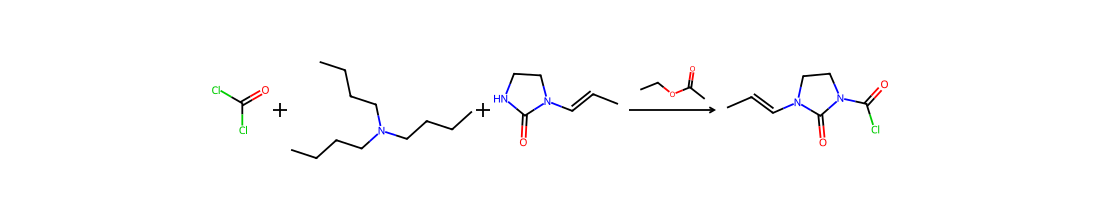
uspto-grants-1980_09 · 10.6084/m9.figshare.5104873.v1 · US04223037
查看
uspto-grants-1988_08 · 10.6084/m9.figshare.5104873.v1 · US04766238
查看