HomeMCPWorkbenchSkills
HomeWorkbenchNotificationsMe
llms.txt · MCP GuidePrivacy Policy · Terms of Service · Supportv1.8.3
  1. Home
  2. /Compound

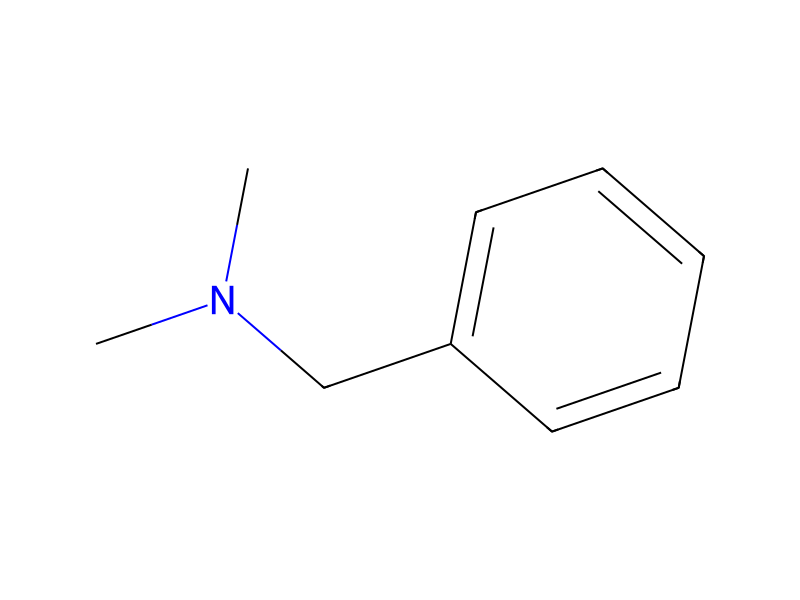
N,N-Dimethylbenzylamine

HCID 7681
New reaction
Print
Basic informationOverviewNames & identifiersPropertiesSafety & regulationChemistry & industryRelated reactionsCompound notes
Substructure searchFind similar structures

Basic information

CAS
103-83-3
Standard SMILES
CN(C)Cc1ccccc1
InChIKey
XXBDWLFCJWSEKW-UHFFFAOYSA-N
Molecular formula
C9H13N
Average molar mass
135.21 g/mol
Monoisotopic mass
135.10479942

Overview

Benzyldimethylamine appears as a colorless to light yellow liquid with an aromatic odor. Slightly less dense than water and slightly soluble in water. Corrosive to skin, eyes and mucous membranes. Slightly toxic by ingestion, skin absorption and inhalation. Used in the manufacture of adhesives and other chemicals.

Names & identifiers

Preferred name
N,N-Dimethylbenzylamine
IUPAC
N,N-dimethyl-1-phenylmethanamine
English name
N,N-Dimethylbenzylamine
Molecular formula
C9H13N
Molecular weight
135.21

Names & synonyms

N,N-DIMETHYLBENZYLAMINE103-83-3BenzyldimethylamineN-BenzyldimethylamineBDMABenzenemethanamine, N,N-dimethyl-Benzyl-N,N-dimethylamineN,N-DimethylbenzenemethanamineBenzylamine, N,N-dimethyl-N-(Phenylmethyl)dimethylamineAraldite accelerator 062N,N-Dimethyl-N-benzylamine
Show more names
N,N-DiMethyl-1-phenylMethanaMineN,N-DIETHYLBENZYLAMINEDabco BDMAN,N-Dimethyl(phenyl)methanamineBENZYLDIETHYLAMINEN-BENZYLDIETHYLAMINEN-Dimethylbenzylamine
Sumine 2015N-Benzyl-N,N-dimethylamineDTXSID8021854TYP7AXQ1YJNSC-5342DTXCID801854RefChem:822589203-149-1

Database identifiers

CAS
103-83-3、28262-13-7
PubChem CID
7681
DTXSID
DTXSID8021854

Properties

Computed structural properties

XLogP
2
Topological polar surface area
3.2 Ų
Hydrogen bond donors
0
Hydrogen bond acceptors
1
Rotatable bonds
2
Heavy atoms
10
Formal charge
0
Complexity
82.7

Experimental & physicochemical properties

Chemical Classes · 2 items

Nitrogen Compounds -> Amines, Aromatic

Corrosives

SpringerMaterials Properties15N nuclear magnetic resonance spectrum
LogP · 2 items

1.91

1.91

Density · 3 items

0.915 at 50 °F (USCG, 1999) - Less dense than water; will float

Relative density (water = 1): 0.9

0.915 @ 10°C

SolubilitySolubility in water, g/100ml: 1.2 (moderate)
Flash Point · 2 items

140 °F

57 °C o.c.

Boiling Point · 3 items

357.8 °F at 760 mmHg (USCG, 1999)

180 °C

181 °C @760 [mm Hg]

Melting Point · 2 items

-103 °F (USCG, 1999)

-75 °C

Vapor Pressure

Safety & regulation

Safety information is for reference only and does not replace the supplier’s Safety Data Sheet (SDS), applicable regulations, or professional assessment.

GHS classification

GHS Classification · 6 items

Danger

H226: Flammable liquid and vapor [Warning Flammable liquids]

P210, P233, P240, P241, P242, P243, P260, P261, P264, P270, P271, P273, P280, P301+P317, P301+P330+P331, P302+P352, P302+P361+P354, P303+P361+P353, P304+P340, P305+P354+P338, P316, P317, P321, P330, P362+P364, P363, P370+P378, P403+P235, P405, and P501 (click each P-code to see the statement)

This chemical does not meet GHS hazard criteria for 0.1% (1 of 850) of reports.

Danger

H226 (99.8%): Flammable liquid and vapor [Warning Flammable liquids]

Hazard information

Regulatory Information · 5 items

Chemical: Benzenemethanamine, N,N-dimethyl-

Benzenemethanamine, N,N-dimethyl- is listed on the EPA's Chemical Data Reporting (CDR) system. Manufacturers and importers of Benzenemethanamine, N,N-dimethyl- are required to report information about their production and use of this chemical to the EPA under the Toxic Substances Control Act (TSCA). (40 eCFR Part 711)

REACH registered substance: Benzyldimethylamine (EC: 203-149-1)

Benzyldimethylamine: Does not have an individual approval but may be used under an appropriate group standard

The New Jersey Worker and Community Right to Know Act requires public and private employers to provide information about hazardous substances at their workplaces. (N.J.S.A. 34:5A-1 et. seq.)

Other Safety InformationEvaluation - Chemicals that are unlikely to require further regulation to manage risks to human health
DOT LabelCorrosive Flammable Liquid
Fire Hazards · 3 items

Special Hazards of Combustion Products: Toxic vapors are generated when heated. (USCG, 1999)

· Flammable/combustible material.

Chemistry & industry

Uses & manufacturing

Uses · 2 items

Used as a curing agent for epoxy resins; [Kanerva, p. 566] Used to manufacture adhesives and other chemicals; [CAMEO]

Plastic Composites Manufacturing [Category: Industry]

U.S. Production2023: 700,000 - <850,000 lb
Consumer UsesCatalyst
Industry UsesCatalyst
Household ProductsInformation on 1 consumer products that contain Benzyldimethylamine in the following categories is provided:
General Manufacturing Information · 2 items

Miscellaneous Manufacturing

Benzenemethanamine, N,N-dimethyl-: ACTIVE

Applications · 2 items

UsesN,N-Dimethylbenzylamine was used in the synthesis of bis[(N,N-dimethylamino)benzyl] selenide. It has been used as catalyst during curing reaction of formulations of diglycidyl ether of bisphenol A and tetrahydrophthalic anhydride. It undergoes directed ortho metalation with butyl lithium. It reacts with methyl iodide to get ammonium salt, which is used as phase transfer catalysts. Further, it is used as a catalyst for the formation of polyurethane foams and epoxy resins.

General DescriptionBenzyldimethylamine appears as a colorless to light yellow liquid with an aromatic odor. Slightly less dense than water and slightly soluble in water. Corrosive to skin, eyes and mucous membranes. Slightly toxic by ingestion, skin absorption and inhalation. Used in the manufacture of adhesives; dehydrohalogenating catalyst; corrosion inhibitor; acid neutralizer; potting compounds; cellulose modifier and quaternary ammonium compounds.

Preparation methods · 1 item

Related reactions

88 records
New reaction record
HRID 53080 reaction equation
HRID 53080As reactant
HRID 115503 reaction equation
HRID 115503As reactant
HRID 151652 reaction equation
HRID 151652As reactant
HRID 159697 reaction equation
HRID 159697As reactant
HRID 166963 reaction equation
HRID 166963As reactant
HRID 182122 reaction equation
HRID 182122As product
HRID 208456 reaction equation
HRID 208456As reactant
HRID 258955 reaction equation
HRID 258955As reactant
PreviousPage 1 of 11

Compound notes

On this pageBasic informationOverviewNames & identifiersPropertiesSafety & regulationChemistry & industryRelated reactionsCompound notes
ChEMBL
CHEMBL45591
ChEBI
CHEBI:231275
UNII
TYP7AXQ1YJ
EC Number
203-149-1
Nikkaji
J36.099F
0.58 [mmHg]
Physical Description · 4 items

Benzyldimethylamine appears as a colorless to light yellow liquid with an aromatic odor. Slightly less dense than water and slightly soluble in water. Corrosive to skin, eyes and mucous membranes. Slightly toxic by ingestion, skin absorption and inhalation. Used in the manufacture of adhesives and other chemicals.

Liquid

Clear to yellow liquid with a strong odor; [NJ-HSFS]

COLOURLESS LIQUID WITH CHARACTERISTIC ODOUR.

Physicochemical properties

Melting point
75 °C · −75 °C (−103 °F; 198 K)
Boiling point
180 to · 180 to 183 °C (356 to 361 °F; 453 to 456 K)
Density
0.91 g/cm3 · 0.91 g/cm3 at 20 °C
vapor pressure
2.4 hPa · 2.4 hPa (20 °C)
refractive index
1.5 · 1.50
Flash point
55 °C · 55 °C (131 °F; 328 K)
storage temp.
30 °C · Store below +30°C.
solubility
water: soluble
pka
1 · pK1:9.02(+1) (25°C)
form
liquid
color
colourless
Odor
strong fish odor
PH
10 · 10 (10g/l, H2O, 20℃)(saturated solution)
explosive limit
0.9 · 0.9-6.3%(V)
Water Solubility
8 g/L · 8 g/L (20 ºC)
Sensitive
Air Sensitive
BRN
1099620 · 1099620
Stability
Stable. Incompatible with strong acids, strong oxidizing agents.
InChI
1S/C9H13N/c1-10(2)8-9-6-4-3-5-7-9/h3-7H,8H2,1-2H3
InChIKey
XXBDWLFCJWSEKW-UHFFFAOYSA-N
SMILES
CN(C)Cc1ccccc1
LogP
1.98 at · 1.98 at 25℃
CAS DataBase Reference
103 · 103-83-3(CAS DataBase Reference)
EWG's Food Scores
3 · 3
FDA UNII
7 AXQ1YJ · TYP7AXQ1YJ
NIST Chemistry Reference
Benzenemethanamine, N,N-dimethyl-(103-83-3)
EPA Substance Registry System
N,N-Dimethylbenzylamine (103-83-3)
UNSPSC Code
12352200 · 12352200
NACRES
26 · NA.26
Symbol(GHS)
2 · GHS02,GHS05,GHS06
Signal word
Danger
Hazard statements
301 · H301-H312+H332-H314-H412-H226
Precautionary statements
501 · P501-P273-P270-P240-P261-P210-P233-P243-P241-P242-P271-P264-P280-P370+P378-P362+P364-P303+P361+P353-P301+P330+P331-P301+P310+P330-P304+P340+P310-P305+P351+P338+P310-P403+P235-P405
PPE
Faceshields, Gloves, Goggles, type ABEK (EN14387) respirator filter
Hazard Codes
C
Risk Statements
10 · 10-20/21/22-34-52/53
Safety Statements
26 · 26-36-45-61
RIDADR
2619 · UN 2619
WGK Germany
2 · 2
RTECS
4500000 · DP4500000
F
10 · 10-13-23
Autoignition Temperature
410 °C · 410 °C
TSCA
TSCA listed
HazardClass
8 · 8
PackingGroup
II
HS Code
2921499090 · 2921499090
Storage Class
3 · 3 - Flammable liquids
Hazard Classifications
3 InhalationAcute · Acute Tox. 3 InhalationAcute Tox. 3 OralAcute Tox. 4 DermalAquatic Chronic 2Eye Dam. 1Flam. Liq. 3Skin Corr. 1B
Toxicity
50 orally · LD50 orally in Rabbit: 290 mg/kg LD50 dermal Rat 695 mg/kg
REACH Registrations
Active

Flammable. Gives off irritating or toxic fumes (or gases) in a fire. Above 57 °C explosive vapour/air mixtures may be formed.

Health Hazards · 2 items

Inhalation may be fatal as a result of spasm, inflammation and edema of the larynx and bronchi, chemical pneumonitis, and pulmonary edema. Symptoms of exposure may include burning sensation, coughing, wheezing, laryngitis, shortness of breath, headache, nausea, and vomitting. (USCG, 1999)

· May cause toxic effects if inhaled or ingested.

Hazards SummaryCorrosive to skin; [Quick CPC] A corrosive substance that can cause pulmonary edema; [ICSC]
DOT ID and Guide2619 132
Reactive GroupAmines, Phosphines, and Pyridines
EC ClassificationSymbol: C; R: 10-20/21/22-34-52/53; S: (1/2)-26-36-45-61
UN ClassificationUN Hazard Class: 8; UN Subsidiary Risks: 3; UN Pack Group: II
Reactivity Profile · 1 item

BENZYLDIMETHYLAMINE neutralizes acids on exothermic reactions to form salts plus water. May be incompatible with isocyanates, halogenated organics, peroxides, phenols (acidic), epoxides, anhydrides, and acid halides. Flammable gaseous hydrogen is generated by amines in combination with strong reducing agents, such as hydrides. May attack some plastics (USCG, 1999).

Chemical DangersDecomposes on burning. This produces toxic fumes including nitrogen oxides. Reacts with acids. Reacts violently with strong oxidants.

Safety & protection

Fire Fighting · 2 items

Excerpt from ERG Guide 132 [Flammable Liquids - Corrosive]:

Use water spray, powder, alcohol-resistant foam, carbon dioxide. In case of fire: keep drums, etc., cool by spraying with water.

First Aid Measures · 4 items

Fresh air, rest. Half-upright position. Artificial respiration may be needed. Refer for medical attention.

Remove contaminated clothes. Rinse skin with plenty of water or shower. Refer for medical attention .

First rinse with plenty of water for several minutes (remove contact lenses if easily possible), then refer for medical attention.

Rinse mouth. Do NOT induce vomiting. Refer for medical attention .

Accidental Release Measures · 2 items

· CALL 911. Then call emergency response telephone number on shipping paper. If shipping paper not available or no answer, refer to appropriate telephone number listed on the inside back cover.

· ELIMINATE all ignition sources (no smoking, flares, sparks or flames) from immediate area.

First Aid · 2 items

INHALATION: Remove victim to fresh air and call a physician at once; administer oxygen until physician arrives.

General First Aid:

Safe StorageFireproof. Separated from strong oxidants, strong acids and food and feedstuffs.
Exposure Control and Personal Protection· Wear positive pressure self-contained breathing apparatus (SCBA).
Nonfire Spill ResponseExcerpt from ERG Guide 132 [Flammable Liquids - Corrosive]:
Spillage Disposal · 1 item

Personal protection: complete protective clothing including self-contained breathing apparatus. Do NOT let this chemical enter the environment. Collect leaking and spilled liquid in sealable containers as far as possible. Cautiously neutralize remainder. Then wash away with plenty of water.

Isolation and Evacuation · 2 items

Excerpt from ERG Guide 132 [Flammable Liquids - Corrosive]:

Immediate precautionary measure

Eye PreventionWear face shield.
Fire PreventionNO open flames, NO sparks and NO smoking. Above 57 °C use a closed system, ventilation and explosion-proof electrical equipment.
Inhalation RiskNo indication can be given about the rate at which a harmful concentration of this substance in the air is reached on evaporation at 20 °C.

Toxicology

Adverse EffectsDermatotoxin - Skin burns.
Exposure RoutesThe substance can be absorbed into the body by inhalation of its vapour, through the skin and by ingestion.
Signs and Symptoms · 4 items

Sore throat. Cough. Burning sensation. Shortness of breath. Laboured breathing. Symptoms may be delayed.

Pain. Redness. Blisters. Skin burns.

Pain. Redness. Severe deep burns.

Burning sensation. Abdominal pain. Shock or collapse.

ICSC Environmental DataThe substance is harmful to aquatic organisms.
Toxicity DataLCLo (rat) = 1,200 mg/m3/2H

Safety data

F
10-13-23
PPE
Faceshields, Gloves, Goggles, type ABEK (EN14387) respirator filter
wgk
2
tsca
TSCA listed
rtecs
DP4500000
ridadr
UN 2619
hs_code
2921499090
Toxicity
LD50 orally in Rabbit: 290 mg/kg LD50 dermal Rat 695 mg/kg
risk_code
10-20/21/22-34-52/53
Signal word
Danger
Symbol(GHS)
GHS02,GHS05,GHS06
hazard_code
C
safety_code
26-36-45-61
hazard_class
8
Storage Class
3 - Flammable liquids
packing_group
II
Hazard statements
H301-H312+H332-H314-H412-H226
REACH Registrations
Active
Hazard Classifications
Acute Tox. 3 InhalationAcute Tox. 3 OralAcute Tox. 4 DermalAquatic Chronic 2Eye Dam. 1Flam. Liq. 3Skin Corr. 1B
Autoignition Temperature
410 °C
Precautionary statements
P501-P273-P270-P240-P261-P210-P233-P243-P241-P242-P271-P264-P280-P370+P378-P362+P364-P303+P361+P353-P301+P330+P331-P301+P310+P330-P304+P340+P310-P305+P351+P338+P310-P403+P235-P405

Preparation25% Aqueous Dimethylamine, 1088 grams Benzyl Chloride, 126.6 grams In the apparatus of Example 1, the benzyl chloride was added dropwise over a two-hour period to the amine (molar ratio 1 to 6) at a rate sufficient to maintain the temperature below 40°C. Stirring was continued at room temperature for an additional hour to insure completion of the reaction denoted by the equation below. Thereafter the reaction mixture was cooled in a separatory funnel while standing in a refrigerator maintained at 5° C. and separated into two layers. The upper oily layer, weighing 111.5g, was removed and steam distilled until no further oleaginous component was observed in the distillate as it came over. The crude distillate was found to contain 103.5g of N,N-dimethylbenzylamine (76.1% of theory), 3.3g of dimethylamine and no quaternary salts. The dimethylamine was distilled off below 29°C under atmospheric pressure from the N,N-dimethylbenzylamine (bp 82°C/18mmHg).

Upstream & downstream products

Upstream raw materials

Benzyl chlorideBenzylamineaminoformic acidDimethylamineFormamide, N-methyl-N-(phenylmethyl)-BenzeneMethanaMine, 2-chloro-N,N-diMethyl-N,N-dimethylbenzylamine N-oxideN-MethylbenzylamineDimethylamine hydrochloride2-ChlorobenzaldehydeBenzonitrileN,N-DimethylbenzamideBenzyl alcohol

Downstream products

Diethyl 3,5-di-tert-butyl-4-hydroxybenzyl phosphateBRETYLIUM TOSYLATEBenzyldodecyldimethylammonium bromidedioctadecyl [[3,5-bis(1,1-dimethylethyl)-4-hydroxyphenyl]methyl]phosphonateBenzyltrimethylammonium bromideDi-micro-chlorobis[2-[(dimethylamino)methyl]phenyl-c,n]dipalladiumDimethyldifluorosilane2-Iodobenzyl chloride