
uspto-grants-1998_03 · 10.6084/m9.figshare.5104873.v1 · US05728701
查看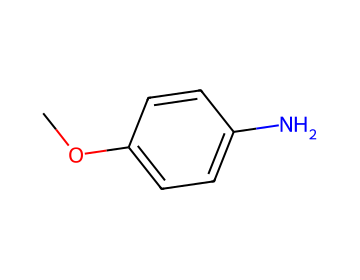
IDENTITY
COMPUTED
PROPERTIES
log Kow = 0.95
0.95
0.95
Amine-like odor
1.071 at 135 °F (NTP, 1992) - Denser than water; will sink
1.071 at 57 °C/4 °C
1.07 g/cm³
Relative density of the vapour/air-mixture at 20 °C (air = 1): 1.00
1.071 @ 57°C
1.07
White solid
Fused crystalline mass
Crystals, plates from aqueous solution
Yellow to brown, crystalline solid
less than 1 mg/mL at 68 °F (NTP, 1992)
Soluble in acetone, benzene; very soluble in ether, ethanol
In water, 2.10X10+4 mg/L at 20 °C
21 mg/mL at 20 °C
Solubility in water, g/100ml at 20 °C: 2.2 (moderate)
Moderate
41 °F (NTP, 1992)
5 °C
122 °C (251.6 °F) (closed cup)
122 °C
469 °F at 760 mmHg (NTP, 1992)
243 °C
243.00 °C. @ 760.00 mm Hg
243 °C
243 °C @760 [mm Hg]
475 °F
When heated to decomposition it emits toxic fumes of /nitrogen oxides./
135 °F (NTP, 1992)
57.2 °C
57.2 °C
57 °C
57.2 °C
135 °F
4.25 (NTP, 1992) - Heavier than air; will sink (Relative to Air)
4.28 (Air = 1)
Relative vapor density (air = 1): 4.3
less than 0.1 mmHg at 68 °F (NTP, 1992)
0.03 [mmHg]
3.0X10⁻² mm Hg at 20 °C
Vapor pressure, Pa at 20 °C: 2
(77 °F): 0.006 mmHg
Index of refraction: 1.5559 at 60 °C/D
GHS
Danger
H300: Fatal if swallowed [Danger Acute toxicity, oral];H310: Fatal in contact with skin [Danger Acute toxicity, dermal];H330: Fatal if inhaled [Danger Acute toxicity, inhalation];H373 **: May causes damage to organs through prolonged or repeated exposure [Warning Specific target organ toxicity, repeated exposure];H400: Very toxic to aquatic life [Warning Hazardous to the aquatic environment, acute hazard]
P260, P262, P264, P270, P271, P273, P280, P284, P301+P316, P302+P352, P304+P340, P316, P319, P320, P321, P330, P361+P364, P391, P403+P233, P405, and P501 (click each P-code to see the statement)
Danger
HAZARDS
Chemical: Benzenamine, 4-methoxy-
Status: Active Update: 18-05-2018 https://echa.europa.eu/registration-dossier/-/registered-dossier/17660;Status: Active Update: 03-07-2017 https://echa.europa.eu/registration-dossier/-/registered-dossier/19981
4-Anisidine: Does not have an individual approval but may be used under an appropriate group standard
The New Jersey Worker and Community Right to Know Act requires public and private employers to provide information about hazardous substances at their workplaces. (N.J.S.A. 34:5A-1 et. seq.)
IMAP assessments - p-Anisidine and its hydrochloride: Human health tier II assessment
Poison
This chemical is flammable. (NTP, 1992)
Combustible. Gives off irritating or toxic fumes (or gases) in a fire. Finely dispersed particles form explosive mixtures in air.
Combustible.
Excerpt from NIOSH Pocket Guide for p-Anisidine:;Exposure Routes: Inhalation, skin absorption, ingestion, skin and/or eye contact;Symptoms: Headache, dizziness; cyanosis; red blood cell Heinz bodies;Target Organs: Blood, kidneys, liver, cardiovascular system, central nervous system (NIOSH, 2024)
Bladder cancer in animals observed in chronic feeding studies; Methemoglobinemia has been reported in exposed workers. Listed in the table Examples of Industrial Chemicals for Which Methemoglobin Formation is NOT the Principal Cause of Toxicity; [ACGIH] IARC classifies p-Anisidine as 3 (Not classifiable as to carcinogenicity to humans) and o-Anisidine as 2B (possibly carcinogenic to humans). A skin, eye, and respiratory tract irritant; Can induce methemoglobinemia; [ICSC]
2431 153
Ethers;Amines, Aromatic
Symbol: T+, N; R: 26/27/28-33-50; S: (1/2)-28-36/37-45-61
UN Hazard Class: 6.1; UN Pack Group: III
DHEW/NCI; Bioassay of p-Anisidine hydrochloride for Possible Carcinogenicity (1978) Technical Rpt Series No. 116 DHEW Pub No. (NIH) 78-1371 /p-Anisidine hydrochloride/
SAFETY
Fires involving this compound can be controlled with a dry chemical, carbon dioxide or Halon extinguisher. A water spray may also be used. (NTP, 1992)
Use water spray, foam, powder, carbon dioxide.
Fresh air, rest. Refer for medical attention.
Remove contaminated clothes. Rinse and then wash skin with water and soap.
Rinse with plenty of water (remove contact lenses if easily possible).
Rinse mouth. Give one or two glasses of water to drink. Refer for medical attention .
EYES: First check the victim for contact lenses and remove if present. Flush victim's eyes with water or normal saline solution for 20 to 30 minutes while simultaneously calling a hospital or poison control center. Do not put any ointments, oils, or medication in the victim's eyes without specific instructions from a physician. IMMEDIATELY transport the victim after flushing eyes to a hospital even if no symptoms (such as redness or irritation) develop.;SKIN: IMMEDIATELY flood affected skin with water while removing and isolating all contaminated clothing. Gently wash all affected skin areas thoroughly with soap and water. If symptoms such as redness or irritation develop, IMMEDIATELY call a physician and be prepared to transport the victim to a hospital for treatment.;INHALATION: IMMEDIATELY leave the contaminated area; take deep breaths of fresh air. If symptoms (such as wheezing, coughing, shortness of breath, or burning in the mouth, throat, or chest) develop, call a physician and be prepared to transport the victim to a hospital. Provide proper respiratory protection to rescuers entering an unknown atmosphere. Whenever possible, Self-Contained Breathing Apparatus (SCBA) should be used; if not available, use a level of protection greater than or equal to that advised under Protective Clothing.;INGESTION: DO NOT INDUCE VOMITING. If the victim is conscious and not convulsing, give 1 or 2 glasses of water to dilute the chemical and IMMEDIATELY call a hospital or poison control center. Be prepared to transport the victim to a hospital if advised by a physician. If the victim is convulsing or unconscious, do not give anything by mouth, ensure that the victim's airway is open and lay the victim on his/her side with the head lower than the body. DO NOT INDUCE VOMITING. IMMEDIATELY transport the victim to a hospital. (NTP, 1992)
(General first aid procedures);Eye: Irrigate immediately - If this chemical contacts the eyes, immediately wash (irrigate) the eyes with large amounts of water, occasionally lifting the lower and upper lids. Get medical attention immediately.;Skin: Soap wash immediately - If this chemical contacts the skin, immediately wash the contaminated skin with soap and water. If this chemical penetrates the clothing, immediately remove the clothing, wash the skin with soap and water, and get medical attention promptly.;Breathing: Respiratory support;Swallow: Medical attention immediately - If this chemical has been swallowed, get medical attention immediately.
Separated from strong oxidants, strong bases, acids, chloroformates and food and feedstuffs. Provision to contain effluent from fire extinguishing. Store in an area without drain or sewer access.
Provision to contain effluent from fire extinguishing.
Biological Exposure Indices (BEI) [ACGIH] - Methemoglobin in blood = 1.5% of hemoglobin during or at end of shift. [ACGIH]
Use dry chemical, carbon dioxide, or alcohol foam extinguishers. Vapors are heavier than air and will collect in low areas. Vapors may travel long distances to ignition sources and flashback. Vapors in confined areas may explode when exposed to fire. Storage containers and parts of containers may rocket great distances, in many directions. If material or contaminated runoff enters waterways, notify downstream users of potentially contaminated waters. Notify local health and fire officials and pollution control agencies. From a secure, explosion-proof location, use water spray to cool exposed containers. If cooling streams are ineffective (venting sound increases in volume and pitch, tank discolors or shows any signs of deforming), withdraw immediately to a secure position ... The only respirators recommended for fire fighting are self-contained breathing apparatuses that have full facepieces and are operated in a pressure-demand or other positive-pressure mode. /Anisidines/
If material is involved in fire: Extinguish fire using agent suitable for type of surrounding fire. (Material itself does not burn or burns with difficulty.) Keep run-off water out of sewers and water sources. /Anisidines/
Store in tightly closed containers in a cool, dark, well-ventilated area. Protect against sunlight and strong oxidizers. Metal containers involving the transfer of this chemical should be grounded and bonded. Where possible, automatically pump liquid from drums or other storage containers to process containers. Drums must be equipped with self-closing valves, pressure vacuum bungs, and flame arresters. Use only non-sparking tools and equipment, especially when opening and closing containers of this chemical. Sources of ignition, such as smoking and open flames, are prohibited where this chemical is used, handled, or stored in a manner that could create a potential fire or explosion hazard. A regulated, marked area should be established where this chemical is handled, used, or stored ... /Anisidines/
Spill handling: Evacuate persons not wearing protective equipment from area of spill or leak until clean-up is complete. Remove all ignition sources. Collect powdered material in the most convenient and safe manner and deposit in sealed containers. Ventilate area after clean-up is complete. If material or contaminated runoff enters waterways, notify downstream users of potentially contaminated waters. It may be necessary to contain and dispose of this chemical as a hazardous waste. Contact your Department of Environmental Protection or your regional office of the federal EPA for specific recommendations. /Anisidines/
Do NOT let this chemical enter the environment. Sweep spilled substance into containers; if appropriate, moisten first to prevent dusting then remove to safe place.
Environmental considerations - land spill: Dig a pit, pond, lagoon, holding area to contain fluid or solid material. /SRP: If time permits, pits, ponds, lagoons, soak holes, or holding areas should be sealed with an impermeable flexible membrane liner./ Cover solids with a plastic sheet to prevent dissolving in rain or fire fighting water. Dike surface flow using soil, sand bags, foamed polyurethane, or foamed concrete. Absorb bulk liquid with fly ash, cement powder or commercial respondents. /Anisidines/
Environmental considerations - water spill: Use natural barriers or oil spill control booms to limit spill travel. Use natural deep water pockets, excavated lagoons, or sand bag barriers to trap material at bottom. Remove trapped material with suction hoses. /Anisidines/
For more Cleanup Methods (Complete) data for p-Anisidine (6 total), please visit the HSDB record page.
SMALL SPILLS AND LEAKAGE: Should a spill occur while you are handling this chemical, FIRST REMOVE ALL SOURCES OF IGNITION, then you should dampen the solid spill material with 60-70% ethanol and transfer the dampened material to a suitable container. Use absorbent paper dampened with 60-70% ethanol to pick up any remaining material. Seal the absorbent paper, and any of your clothes, which may be contaminated, in a vapor-tight plastic bag for eventual disposal. Solvent wash all contaminated surfaces with 60-70% ethanol followed by washing with a soap and water solution. Do not reenter the contaminated area until the Safety Officer (or other responsible person) has verified that the area has been properly cleaned.;STORAGE PRECAUTIONS: You should protect this chemical from exposure to light. Keep the container tightly closed under an inert atmosphere, and store it in an explosion-proof refrigerator. STORE AWAY FROM SOURCES OF IGNITION. (NTP, 1992)
SRP: The most favorable course of action is to use an alternative chemical product with less inherent propensity for occupational harm/injury/toxicity or environmental contamination. Recycle any unused portion of the material for its approved use or return it to the manufacturer or supplier. Ultimate disposal of the chemical must consider: the material's impact on air quality; potential migration in soil or water; effects on animal and plant life; and conformance with environmental and public health regulations.
Dissolve in combustible solvent (alcohols, benzene, tec.) and spray solution into furnace equipped with afterburner and scrubber, or burn spill residue on sand and soda ash absorbent in a furnace. /Anisidines/
Personal protection: filter respirator for organic gases and particulates adapted to the airborne concentration of the substance. Do NOT let this chemical enter the environment. Sweep spilled substance into covered containers. If appropriate, moisten first to prevent dusting. Then store and dispose of according to local regulations.
TOXICITY
Blood, kidneys, liver, cardiovascular system, central nervous system
P-Anisidine is the most toxic of the three isomers of anisidine and causes blood damage upon oral ingestion, inhalation or skin contact. If heated strongly, it may release very toxic fumes of nitrogen oxides. (Wikipedia)
EC50; Species: Daphnia magna (water flea); Conditions: freshwater, static; Concentration: 180 ug/L for 48 hr; Effect: intoxication, immobilization /formulated product/
EC50; Species: Daphnia magna (water flea, age 6-24 hr); Conditions: freshwater, static, 20 °C, pH > or =7.0; Concentration: 52000 ug/L (25000-109000 ug/L) for 24 hr; Effect: intoxication, immobilization /formulated product/
EC50; Species: Daphnia magna (water flea, age 6-24 hr); Conditions: freshwater, static, 20 °C, pH > or =7.0; Concentration: 1900 ug/L (1300-2800 ug/L) for 48 hr; Effect: intoxication, immobilization /formulated product/
LC50; Species: Daphnia magna (water flea); Conditions: freshwater, static; Concentration: 330 ug/L for 48 hr /formulated product/
For more Ecotoxicity Values (Complete) data for p-Anisidine (6 total), please visit the HSDB record page.
TERRESTRIAL FATE: Based on a classification scheme(1), an estimated Koc value of 45(SRC), determined from a log Kow of 0.95(2) and a regression-derived equation(3), indicates that p-anisidine is expected to have very high mobility in soil(SRC). The pKa of p-anisidine is 5.36(4), indicating that it will partially exist in the cation form in the environment and cations generally adsorb more strongly to soils containing organic carbon and clay than their neutral counterparts(5). Volatilization of the neutral form of p-anisidine from moist soil surfaces is not expected to be an important fate process(SRC) given a Henry's Law constant of 6.60X10⁻⁸ atm-cu m/mole(6). Volatilization from moist soil is not expected for the cationic form of p-anisidine because cations do not volatilize(SRC). p-Anisidine is not expected to volatilize from dry soil surfaces(SRC) based upon a vapor pressure of 3.00X10⁻² mm Hg at 20 °C(7). p-Anisidine readily biodegrades in aerobic activated sludge as indicated by screening tests with 65.3% degradation after 2 weeks(8) and 100% after 4 weeks using 60 mg/L test concn(9). In a mixed-culture of soil microorganisms, p-anisidine degraded completely after 64 days(10).
AQUATIC FATE: Based on a classification scheme(1), an estimated Koc value of 45(SRC), determined from a log Kow of 0.95(2) and a regression-derived equation(3), indicates that p-anisidine is not expected to adsorb to suspended solids and sediment(SRC). Volatilization from water surfaces is not expected for the neutral species(4) based upon a Henry's Law constant of 6.60X10⁻⁸ atm-cu m/mole(5). According to a classification scheme(6), an estimated BCF of 3.2(SRC), from its log Kow(2) and a regression-derived equation(3), suggests the potential for bioconcentration in aquatic organisms is low(SRC). p-Anisidine degraded the 82% in river water and 2% in seawater after 3 days during Cultivation Method screening tests(7-8).
ATMOSPHERIC FATE: According to a model of gas/particle partitioning of semivolatile organic compounds in the atmosphere(1), p-anisidine, which has a vapor pressure of 3.00X10⁻² mm Hg at 20 °C(2), is expected to exist solely as a vapor in the ambient atmosphere. Vapor-phase p-anisidine is degraded in the atmosphere by reaction with photochemically-produced hydroxyl radicals(SRC); the half-life for this reaction in air is estimated to be 4.1 hours(SRC), calculated from its rate constant of 9.4X10⁻¹¹ cu cm/molecule-sec at 25 °C(SRC) that was derived using a structure estimation method(3). p-Anisidine absorbs light at 300 nm(4) and therefore it may undergo direct photolysis by sunlight(SRC).
Methemoglobinemia - The presence of increased methemoglobin in the blood; the compound is classified as secondary toxic effect;ACGIH Carcinogen - Not Classifiable.
The substance can be absorbed into the body by inhalation of its vapour, through the skin and by ingestion.
inhalation, skin absorption, ingestion, skin and/or eye contact
oral ingestion, inhalation or skin contact
p-Anisidine reacts with secondary oxidation products such as aldehydes and ketones in fats and oils. (Wikipedia)
Cough. Blue lips, fingernails and skin. Dizziness. Headache.
MAY BE ABSORBED! Further see Inhalation.
Redness.
Nausea. Further see Inhalation.
headache, dizziness; cyanosis; red blood cell Heinz bodies
The following link will take the user to the National Toxicology Program (NTP) Test Agent Search Results page, which tabulates all of the "Standard Toxicology & Carcinogenesis Studies", "Developmental Studies", and "Genetic Toxicity Studies" performed with this chemical. Clicking on the "Testing Status" link will take the user to the status (i.e., in review, in progress, in preparation, on test, completed, etc.) and results of all the studies that the NTP has done on this chemical. /p-Anisidine hydrochloride/[Available from: http://ntp-apps.niehs.nih.gov/ntp_tox/index.cfm?fuseaction=ntpsearch.searchresults&searchterm=20265-97-8]
Anisidine (isomer not specified) has been identified in the effluent from chemical industries located in Kingsport, TN (Sept 1974), Morristown, TN (Sept 1974) and on the Upper Catawba River, TN (Aug 1974)(1). p-Anisidine has been identified in the effluent from a chemical industry located on the Upper Catawba River, TN (Aug 1973)(1). p-Anisidine has been identified in the effluent from an organics and plastics industry(2) and from oil refineries in the US(3).
The substance is toxic to aquatic organisms. It is strongly advised not to let the chemical enter into the environment.
The Koc of p-anisidine is estimated as 45(SRC), using a log Kow of 0.95(1) and a regression-derived equation(2). According to a classification scheme(3), this estimated Koc value suggests that p-anisidine is expected to have very high mobility in soil. The pKa of p-anisidine is 5.36(4), indicating that this compound will partially exist in the cation form in the environment and cations generally adsorb more strongly to soils containing organic carbon and clay than their neutral counterparts(5).
REGULATORY
Chemical: Benzenamine, 4-methoxy-
Status: Active Update: 18-05-2018 https://echa.europa.eu/registration-dossier/-/registered-dossier/17660;Status: Active Update: 03-07-2017 https://echa.europa.eu/registration-dossier/-/registered-dossier/19981
4-Anisidine: Does not have an individual approval but may be used under an appropriate group standard
The New Jersey Worker and Community Right to Know Act requires public and private employers to provide information about hazardous substances at their workplaces. (N.J.S.A. 34:5A-1 et. seq.)
This action promulgates standards of performance for equipment leaks of Volatile Organic Compounds (VOC) in the Synthetic Organic Chemical Manufacturing Industry (SOCMI). The intended effect of these standards is to require all newly constructed, modified, & reconstructed SOCMI process units to use the best demonstrated system of continuous emission reduction for equipment leaks of VOC, considering costs, non air quality health & environmental impact & energy requirements. Anisidine is produced, as an intermediate or a final product, by process units covered under this subpart. /Anisidine/
PHARMACOLOGY
P-METHOXYANILINE YIELDS P-AMINOPHENOL IN RABBIT ... & P-METHOXY-N-METHYLANILINE IN RABBIT. /FROM TABLE/
The substance can be absorbed into the body by inhalation of its vapor, through the skin and by ingestion.
Cytoplasm;Extracellular
USES
Both ortho and para isomers are used to produce azo dyes, while only the ortho form is used to produce synthetic guaiacol; [ACGIH]
Azo dyestuffs, intermediate
CHEM INTERMED FOR VAT RED 29 (CI 71140), DISPERSE ORANGE 15 (CI 10350) & AZOIC COUPLING COMPONENT 13 (CI 37595)
Production volumes for non-confidential chemicals reported under the Inventory Update Rule. [Table#3301]
Reduction of p-nitroanisole; methylation of p-nitrophenol followed by reduction; or the action of methanol and caustic on p-nitrochlorobenzene with subsequent reduction
p-Chloronitrobenzene and methanol ether formation and nitro reduction.
Reduction of p-nitroanisole with iron filings and hydrochloric acid or methylation of p-aminophenol.
Mn3+ - or Ce4+ -mediated oxidation of nitrobenzene.
For its industrial production 4-nitroanisole is reduced either with sodium sulfide or with hydrogen in the presence of precious-metal catalysts or Raney nickel.
Benzenamine, 4-methoxy-: ACTIVE
ALIASES
REACTIONS
uspto-grants-1998_03 · 10.6084/m9.figshare.5104873.v1 · US05728701
查看
uspto-grants-1998_03 · 10.6084/m9.figshare.5104873.v1 · US05728835
查看
uspto-grants-1998_03 · 10.6084/m9.figshare.5104873.v1 · US05728835
查看
uspto-grants-1998_03 · 10.6084/m9.figshare.5104873.v1 · US05728835
查看
uspto-grants-1998_03 · 10.6084/m9.figshare.5104873.v1 · US05731438
查看
uspto-grants-1998_03 · 10.6084/m9.figshare.5104873.v1 · US05733914
查看
uspto-grants-1998_03 · 10.6084/m9.figshare.5104873.v1 · US05733914
查看
uspto-grants-1988_02 · 10.6084/m9.figshare.5104873.v1 · US04727084
查看