HomeMCPWorkbenchSkills
HomeWorkbenchNotificationsMe
llms.txt · MCP GuidePrivacy Policy · Terms of Service · Supportv1.8.3
  1. Home
  2. /Compound

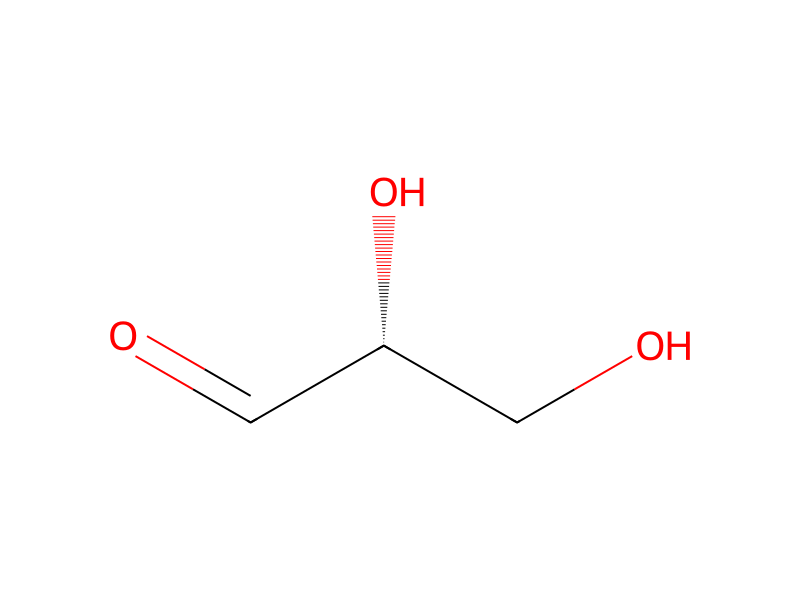
(+)-Glyceraldehyde

HCID 79014
New reaction
Print
Basic informationOverviewNames & identifiersPropertiesSafety & regulationChemistry & industryRelated reactionsCompound notes
Substructure searchFind similar structures

Basic information

CAS
453-17-8
Standard SMILES
O=C[C@H](O)CO
InChIKey
MNQZXJOMYWMBOU-VKHMYHEASA-N
Molecular formula
C3H6O3
Average molar mass
90.08 g/mol
Monoisotopic mass
90.03169405

Overview

D-glyceraldehyde is the D-enantiomer of glyceraldehyde. It has a role as a mouse metabolite, a Saccharomyces cerevisiae metabolite, an Escherichia coli metabolite and a human metabolite. It is an enantiomer of a L-glyceraldehyde.

Names & identifiers

Preferred name
(+)-Glyceraldehyde
IUPAC
(2R)-2,3-dihydroxypropanal
English name
D-Glyceraldehyde
Molecular formula
C3H6O3
Molecular weight
90.08

Names & synonyms

D-glyceraldehyde453-17-8(2R)-2,3-DIHYDROXYPROPANALGlyceraldehyde, D-D-aldotrioseD-glyceroseD-2,3-dihydroxypropanalD-2,3-dihydroxypropionaldehyde(+)-glyceraldehyde41A680M0WBGlyTouCan:G72943USNSC-91534
Show more names
D-Glyceraldehyde (>98.0% (HPLC), viscousD-Glyceraldehyde (>80%)
CHEBI:17378DTXSID70196464RefChem:583858DTXCID80118955G72943US207-217-1D-(+)-GlyceraldehydeTriose

Database identifiers

CAS
453-17-8
PubChem CID
79014
DTXSID
DTXSID70196464
ChEBI
CHEBI:17378
UNII
41A680M0WB
EC Number
207-217-1
Nikkaji
J9.119G

Properties

Computed structural properties

XLogP
-1.6
Topological polar surface area
57.5 Ų
Hydrogen bond donors
2
Hydrogen bond acceptors
3
Rotatable bonds
2
Heavy atoms
6
Formal charge
0
Complexity
43.3

Experimental & physicochemical properties

Chemical ClassesOther Classes -> Aldehydes
DrugsPharmaceuticals -> Listed in ZINC15
Physical DescriptionLight brown viscous liquid; [Sigma-Aldrich MSDS]

Physicochemical properties

Melting point
127 · 127-129 C
alpha
25 · D25 +8.7° (c = 2 in H2O); D15 +21.2° (c = 18)
Boiling point
17 · bp17 127-129°; bp10 123-126°
Density
1.272 · 1.272±0.06 g/cm3(Predicted)
refractive index
20 · n20/D 1.494
Flash point
113 °C · 113 °C - closed cup
storage temp.
2 · 2-8°C
solubility
DMSO, Methanol (Slightly), Water (Slightly)
pka
12.6 · 12.60±0.20(Predicted)

Safety & regulation

Safety information is for reference only and does not replace the supplier’s Safety Data Sheet (SDS), applicable regulations, or professional assessment.

Hazard information

Hazards SummarySee 3-Hydroxy-2,2-dimethylpropionaldehyde, Isobutyraldehyde, and Propionaldehyde.

Toxicology

Carcinogen ClassificationNo indication of carcinogenicity to humans (not listed by IARC).

Safety data

F
10-23
PPE
Eyeshields, Gloves
wgk
3
hs_code
2912491000
risk_code
36/37/38
hazard_code
Xi
safety_code
26-27-36/37/39
Storage Class
10 - Combustible liquids

Chemistry & industry

Applications · 3 items

DescriptionD-(+)-Glyceraldehyde is an intermediate in carbohydrate metabolism. It is phosphorylated by triose kinase to produce D-glyceraldehyde 3-phosphate, an intermediate in glycolysis, gluconeogenesis, photosynthesis, and other metabolic pathways.

UsesD-Glyceraldehyde is the simplest of all aldoses and have been shown to be the one of the carbonyl metabolite of dietary fructose.

UsesD-(+)-Glyceraldehyde can be utilized as a reactant in the synthesis of: (S)-homophenylalanine by ruthenium oxidation of a 3-amino-1,2-diol generated via coupling of an amine, and α-hydroxyaldehyde.β- and γ-allenols via metal-catalyzed cyclization. Allenols are used as a key precursor for the preparation of enantiopure dihydropyrans and tetrahydrooxepines.Isopropylidene D-glyceraldehyde intermediate, which controls the chirality in the total synthesis of prostaglandins (PGE1).

Upstream & downstream products

Upstream raw materials

L-Fructose, 1-(dihydrogen phosphate)1,2-Propanediol, 3,3-dimethoxy-, (R)- (9CI)Triose phosphate1-hydroxy-3-(phosphonooxy)acetoneDL-GLYCERALDEHYDE(R)-(+)-2,2-Dimethyl-1,3-dioxolane-4-carboxaldehydeL-GlyceraldehydeMethylglyoxal1,2:5,6-Bis-O-(1-methylethylidene)-D-mannitol

Related reactions

3 records
New reaction record
HRID 893062 reaction equation
HRID 893062As reactant
HRID 1835175 reaction equation
HRID 1835175As reactant
HRID 1973676 reaction equation
HRID 1973676As reactant

Compound notes

On this pageBasic informationOverviewNames & identifiersPropertiesSafety & regulationChemistry & industryRelated reactionsCompound notes
form
liquid (viscous)
color
Clear Colourless to Light Brown
optical activity
8.7 · +8.7
Merck
13 · 13,4494
BRN
1720474 · 1720474
InChI
1S/C3H6O3/c4-1-3(6)2-5/h1,3,5-6H,2H2/t3-/m0/s1
InChIKey
MNQZXJOMYWMBOU-VKHMYHEASA-N
SMILES
OC[C@@H](O)C=O
CAS DataBase Reference
453 · 453-17-8(CAS DataBase Reference)
FDA UNII
41 A680M0WB · 41A680M0WB
NIST Chemistry Reference
2 · Propanal, 2,3-dihydroxy-, (r)-(453-17-8)
Comptox DTXSID
70196464 · DTXSID70196464
UNSPSC Code
12352200 · 12352200
NACRES
22 · NA.22
PPE
Eyeshields, Gloves
Hazard Codes
Xi
Risk Statements
36 · 36/37/38
Safety Statements
26 · 26-27-36/37/39
WGK Germany
3 · 3
F
10 · 10-23
HS Code
2912491000 · 2912491000
Storage Class
10 · 10 - Combustible liquids
Formaldehyde
GLYCOLALDEHYDE
1,3-Dihydroxyacetone

Downstream products

(R)-LactateD-RiboseFurfural1-deoxyfructose

Additional notes

DefinitionChEBI: The D-enantiomer of glyceraldehyde.