
uspto-grants-1998_03 · 10.6084/m9.figshare.5104873.v1 · US05728686
查看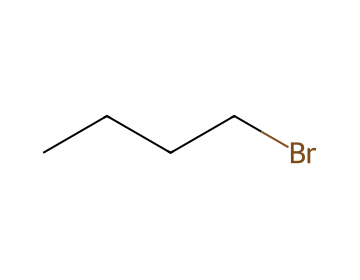
IDENTITY
COMPUTED
PROPERTIES
log Kow = 2.75
1.276 at 68 °F (USCG, 1999) - Denser than water; will sink
1.2686 at 25 °C/4 °C
1.2586 @25 °C
0.606 mPa-sec at 25 °C
Colorless to pale straw-colored liquid
Slightly soluble in carbon tetrachloride; soluble in chloroform; miscible with ethanol, ether, acetone
In water, 8.69X10+2 mg/L at 25 °C
65 °F (USCG, 1999)
18 °C
65 °F (18 °C) (Open cup)
214 °F at 760 mmHg (USCG, 1999)
101.3 °C at 760 mm Hg
101.3 °C @760 [mm Hg]
-170 °F (USCG, 1999)
-112 °C
Heat fusion at melting point = 6.6944X10+6 J/kmol
-112.3 °C
4.72 (Air= 1)
77.55 mmHg (USCG, 1999)
42.0 [mmHg]
41.97 mm Hg at 25 °C
41.97 [mm Hg] @25 °C
25.90 mN/m at 25 °C
Index of refraction = 1.4398 at 20 °C/D
GHS
Danger
H225 (69.7%): Highly Flammable liquid and vapor [Danger Flammable liquids];H226 (26.4%): Flammable liquid and vapor [Warning Flammable liquids];H315 (96.7%): Causes skin irritation [Warning Skin corrosion/irritation];H319 (78.3%): Causes serious eye irritation [Warning Serious eye damage/eye irritation];H335 (90.8%): May cause respiratory irritation [Warning Specific target organ toxicity, single exposure; Respiratory tract irritation];H351 (48.4%): Suspected of causing cancer [Warning Carcinogenicity];H360FD (45.7%): May damage fertility; May damage the unborn child [Danger Reproductive toxicity];H373 (44.5%): May causes damage to organs through prolonged or repeated exposure [Warning Specific target organ toxicity, repeated exposure];H411 (62.9%): Toxic to aquatic life with long lasting effects [Hazardous to the aquatic environment, long-term hazard]
P203, P210, P233, P240, P241, P242, P243, P260, P261, P264, P264+P265, P271, P273, P280, P302+P352, P303+P361+P353, P304+P340, P305+P351+P338, P318, P319, P321, P332+P317, P337+P317, P362+P364, P370+P378, P391, P403+P233, P403+P235, P405, and P501 (click each P-code to see the statement)
Aggregated GHS information provided per 337 reports by companies from 22 notifications to the ECHA C&L Inventory. Each notification may be associated with multiple companies.;Information may vary between notifications depending on impurities, additives, and other factors. The percentage value in parenthesis indicates the notified classification ratio from companies that provide hazard codes. Only hazard codes with percentage values above 10% are shown. For more detailed information, please visit ECHA C&L website.
HAZARDS
Chemical: Butane, 1-bromo-
Butane, 1-bromo- is listed on the EPA's Chemical Data Reporting (CDR) system. Manufacturers and importers of Butane, 1-bromo- are required to report information about their production and use of this chemical to the EPA under the Toxic Substances Control Act (TSCA). (40 eCFR Part 711)
Status: Active Update: 20-11-2018 https://echa.europa.eu/registration-dossier/-/registered-dossier/12474
Butane, 1-bromo-: HSNO Approval: HSR001087 Approved with controls
The New Jersey Worker and Community Right to Know Act requires public and private employers to provide information about hazardous substances at their workplaces. (N.J.S.A. 34:5A-1 et. seq.)
Flammable Liquid
Special Hazards of Combustion Products: Toxic fumes of hydrogen bromide.;Behavior in Fire: May form explosive mixtures with air in fire. (USCG, 1999)
· HIGHLY FLAMMABLE: Will be easily ignited by heat, sparks or flames.;· Vapors may form explosive mixtures with air.;· Vapors may travel to source of ignition and flash back.;· Most vapors are heavier than air. They will spread along the ground and collect in low or confined areas (sewers, basements, tanks, etc.).;· Vapor explosion hazard indoors, outdoors or in sewers.;· Those substances designated with a (P) may polymerize explosively when heated or involved in a fire.;· Runoff to sewer may create fire or explosion hazard.;· Containers may explode when heated.;· Many liquids will float on water.
· HIGHLY FLAMMABLE: Will be easily ignited by heat, sparks or flames.;· Vapors may form explosive mixtures with air.;· Vapors may travel to source of ignition and flash back.;· Most vapors are heavier than air. They will spread along the ground and collect in low or confined areas (sewers, basements, tanks, etc.).;· Vapor explosion hazard indoors, outdoors or in sewers.;· Those substances designated with a (P) may polymerize explosively when heated or involved in a fire.;· Runoff to sewer may create fire or explosion hazard.;· Containers may explode when heated.;· Many liquids will float on water.
Dangerous fire hazard when exposed to heat, flame or oxidizers.
Irritating to the eyes, nose, throat, and upper respiratory tract. Symptoms of exposure include burning sensation, coughing, wheezing, laryngitis, shortness of breath, headache, nausea, and vomiting. Irritating to the skin. (USCG, 1999)
· May cause toxic effects if inhaled or absorbed through skin.;· Inhalation or contact with material may irritate or burn skin and eyes.;· Fire will produce irritating, corrosive and/or toxic gases.;· Vapors may cause dizziness or asphyxiation, especially when in closed or confined areas.;· Runoff from fire control or dilution water may cause environmental contamination.
· May cause toxic effects if inhaled or absorbed through skin.;· Inhalation or contact with material may irritate or burn skin and eyes.;· Fire will produce irritating, corrosive and/or toxic gases.;· Vapors may cause dizziness or asphyxiation, especially when in closed or confined areas.;· Runoff from fire control or dilution water may cause environmental contamination.
Flammable liquid; [Hawley] Irritating to the skin of mice and the eyes of rabbits; Did not induce sensitization by application to the ear of mice and determined by local lymph node assay; Degeneration of vacuolar liver cells was observed in 28 day feeding study with rats; Evidence of mutagenicity in Salmonella typhimurium and Chinese hamster cells; [HSDB] A skin, eye, nose, throat, and respiratory tract irritant; [CAMEO] Causes somnolence and ataxia in lethal-dose feeding studies of rats; [RTECS]
1126 130
1126 130
Halogenated Organic Compounds
Highly Flammable
1-BROMOBUTANE is incompatible with strong bases and oxidizers (USCG, 1999).
Lower (2.6%), Upper (6.6%)
/GUIDE 130: FLAMMABLE LIQUIDS (Non-Polar/Water-Immiscible/Noxious)/ Fire or Explosion: HIGHLY FLAMMABLE: Will be easily ignited by heat, sparks or flames. Vapors may form explosive mixtures with air. Vapors may travel to source of ignition and flash back. Most vapors are heavier than air. They will spread along ground and collect in low or confined areas (sewers, basements, tanks). Vapor explosion hazard indoors, outdoors or in sewers. Those substances designated with a (P) may polymerize explosively when heated or involved in a fire. Runoff to sewer may create fire or explosion hazard. Containers may explode when heated. Many liquids are lighter than water.
/GUIDE 130: FLAMMABLE LIQUIDS (Non-Polar/Water-Immiscible/Noxious)/ Health: May cause toxic effects if inhaled or absorbed through skin. Inhalation or contact with material may irritate or burn skin and eyes. Fire will produce irritating, corrosive and/or toxic gases. Vapors may cause dizziness or suffocation. Runoff from fire control or dilution water may cause pollution.
/GUIDE 130: FLAMMABLE LIQUIDS (Non-Polar/Water-Immiscible/Noxious)/ Public Safety: CALL Emergency Response Telephone Number on Shipping Paper first. If Shipping Paper not available or no answer, refer to appropriate telephone number listed on the inside back cover. As an immediate precautionary measure, isolate spill or leak area for at least 50 meters (150 feet) in all directions. Keep unauthorized personnel away. Stay upwind. Keep out of low areas. Ventilate closed spaces before entering.
/GUIDE 130: FLAMMABLE LIQUIDS (Non-Polar/Water-Immiscible/Noxious)/ Protective Clothing: Wear positive pressure self-contained breathing apparatus (SCBA). Structural firefighters' protective clothing will only provide limited protection.
For more DOT Emergency Guidelines (Complete) data for 1-BROMOBUTANE (8 total), please visit the HSDB record page.
SAFETY
Excerpt from ERG Guide 130 [Flammable Liquids (Water-Immiscible / Noxious)]:;CAUTION: The majority of these products have a very low flash point. Use of water spray when fighting fire may be inefficient.;SMALL FIRE: Dry chemical, CO2, water spray or regular foam. If regular foam is ineffective or unavailable, use alcohol-resistant foam.;LARGE FIRE: Water spray, fog or regular foam. If regular foam is ineffective or unavailable, use alcohol-resistant foam. Avoid aiming straight or solid streams directly onto the product. If it can be done safely, move undamaged containers away from the area around the fire.;FIRE INVOLVING TANKS, RAIL TANK CARS OR HIGHWAY TANKS: Fight fire from maximum distance or use unmanned master stream devices or monitor nozzles. Cool containers with flooding quantities of water until well after fire is out. Withdraw immediately in case of rising sound from venting safety devices or discoloration of tank. ALWAYS stay away from tanks in direct contact with flames. For massive fire, use unmanned master stream devices or monitor nozzles; if this is impossible, withdraw from area and let fire burn. (ERG, 2024)
· CALL 911. Then call emergency response telephone number on shipping paper. If shipping paper not available or no answer, refer to appropriate telephone number listed on the inside back cover.;· Keep unauthorized personnel away.;· Stay upwind, uphill and/or upstream.;· Ventilate closed spaces before entering, but only if properly trained and equipped.
· ELIMINATE all ignition sources (no smoking, flares, sparks or flames) from immediate area.;· All equipment used when handling the product must be grounded.;· Do not touch or walk through spilled material.;· Stop leak if you can do it without risk.;· Prevent entry into waterways, sewers, basements or confined areas.;· A vapor-suppressing foam may be used to reduce vapors.;· Absorb or cover with dry earth, sand or other non-combustible material and transfer to containers.;· Use clean, non-sparking tools to collect absorbed material.;Large Spill;· Dike far ahead of liquid spill for later disposal.;· Water spray may reduce vapor, but may not prevent ignition in closed spaces.
· CALL 911. Then call emergency response telephone number on shipping paper. If shipping paper not available or no answer, refer to appropriate telephone number listed on the inside back cover.;· Keep unauthorized personnel away.;· Stay upwind, uphill and/or upstream.;· Ventilate closed spaces before entering, but only if properly trained and equipped.
· ELIMINATE all ignition sources (no smoking, flares, sparks or flames) from immediate area.;· All equipment used when handling the product must be grounded.;· Do not touch or walk through spilled material.;· Stop leak if you can do it without risk.;· Prevent entry into waterways, sewers, basements or confined areas.;· A vapor-suppressing foam may be used to reduce vapors.;· Absorb or cover with dry earth, sand or other non-combustible material and transfer to containers.;· Use clean, non-sparking tools to collect absorbed material.;Large Spill;· Dike far ahead of liquid spill for later disposal.;· Water spray may reduce vapor, but may not prevent ignition in closed spaces.
INHALATION: Move victim to fresh air. If breathing has stopped, give artificial respiration. If breathing is difficult, give oxygen.;EYES OR SKIN: Flush with water for at least 15 minutes.;INGESTION: If conscious, have victim drink water and induce vomiting. If unconscious, do nothing except keep victim warm. Call a physician. (USCG, 1999)
General First Aid:;· Call 911 or emergency medical service.;· Ensure that medical personnel are aware of the material(s) involved, take precautions to protect themselves and avoid contamination.;· Move victim to fresh air if it can be done safely.;· Administer oxygen if breathing is difficult.;· If victim is not breathing:;-- DO NOT perform mouth-to-mouth resuscitation; the victim may have ingested or inhaled the substance.;-- If equipped and pulse detected, wash face and mouth, then give artificial respiration using a proper respiratory medical device (bag-valve mask, pocket mask equipped with a one-way valve or other device).;-- If no pulse detected or no respiratory medical device available, provide continuous compressions. Conduct a pulse check every two minutes or monitor for any signs of spontaneous respirations.;· Remove and isolate contaminated clothing and shoes.;· For minor skin contact, avoid spreading material on unaffected skin.;· In case of contact with substance, remove immediately by flushing skin or eyes with running water for at least 20 minutes.;· For severe burns, immediate medical attention is required.;· Effects of exposure (inhalation, ingestion, or skin contact) to substance may be delayed.;· Keep victim calm and warm.;· Keep victim under observation.;· For further assistance, contact your local Poison Control Center.;· Note: Basic Life Support (BLS) and Advanced Life Support (ALS) should be done by trained professionals.;Specific First Aid:;· Wash skin with soap and water.
General First Aid:;· Call 911 or emergency medical service.;· Ensure that medical personnel are aware of the material(s) involved, take precautions to protect themselves and avoid contamination.;· Move victim to fresh air if it can be done safely.;· Administer oxygen if breathing is difficult.;· If victim is not breathing:;-- DO NOT perform mouth-to-mouth resuscitation; the victim may have ingested or inhaled the substance.;-- If equipped and pulse detected, wash face and mouth, then give artificial respiration using a proper respiratory medical device (bag-valve mask, pocket mask equipped with a one-way valve or other device).;-- If no pulse detected or no respiratory medical device available, provide continuous compressions. Conduct a pulse check every two minutes or monitor for any signs of spontaneous respirations.;· Remove and isolate contaminated clothing and shoes.;· For minor skin contact, avoid spreading material on unaffected skin.;· In case of contact with substance, remove immediately by flushing skin or eyes with running water for at least 20 minutes.;· For severe burns, immediate medical attention is required.;· Effects of exposure (inhalation, ingestion, or skin contact) to substance may be delayed.;· Keep victim calm and warm.;· Keep victim under observation.;· For further assistance, contact your local Poison Control Center.;· Note: Basic Life Support (BLS) and Advanced Life Support (ALS) should be done by trained professionals.;Specific First Aid:;· Wash skin with soap and water.
· Wear positive pressure self-contained breathing apparatus (SCBA).;· Structural firefighters' protective clothing provides thermal protection but only limited chemical protection.
· Wear positive pressure self-contained breathing apparatus (SCBA).;· Structural firefighters' protective clothing provides thermal protection but only limited chemical protection.
To fight fire use carbon dioxide, dry chemical, mist or spray.
If material on fire or involved in fire: Do not extinguish fire unless flow can be stopped. Use water in flooding quantities as fog. Solid streams of water may be ineffective. Cool all affected containers with flooding quantities of water. Use alcohol foam, dry chemical or carbon dioxide. Keep run-off water out of sewers and water sources.
Materials which are toxic as stored or which can decomp into toxic components... should be stored in a cool well ventilated place, out of the direct rays of the sun, away from areas of high fire hazard, and should be periodically inspected. Incompatible materials should be isolated...
Excerpt from ERG Guide 130 [Flammable Liquids (Water-Immiscible / Noxious)]:;ELIMINATE all ignition sources (no smoking, flares, sparks or flames) from immediate area. All equipment used when handling the product must be grounded. Do not touch or walk through spilled material. Stop leak if you can do it without risk. Prevent entry into waterways, sewers, basements or confined areas. A vapor-suppressing foam may be used to reduce vapors. Absorb or cover with dry earth, sand or other non-combustible material and transfer to containers. Use clean, non-sparking tools to collect absorbed material.;LARGE SPILL: Dike far ahead of liquid spill for later disposal. Water spray may reduce vapor, but may not prevent ignition in closed spaces. (ERG, 2024)
SRP: At the time of review, criteria for land treatment or burial (sanitary landfill) disposal practices are subject to significant revision. Prior to implementing land disposal of waste residue (including waste sludge), consult with environmental regulatory agencies for guidance on acceptable disposal practices.
If material on fire or involved in fire: Do not extinguish fire unless flow can be stopped. Use water in flooding quantities as fog. Solid streams of water may be ineffective. Cool all affected containers with flooding quantities of water. Use alcohol foam, dry chemical or carbon dioxide. Keep run-off water out of sewers and water sources.
Excerpt from ERG Guide 130 [Flammable Liquids (Water-Immiscible / Noxious)]:;IMMEDIATE PRECAUTIONARY MEASURE: Isolate spill or leak area for at least 50 meters (150 feet) in all directions.;LARGE SPILL: Consider initial downwind evacuation for at least 300 meters (1000 feet).;FIRE: If tank, rail tank car or highway tank is involved in a fire, ISOLATE for 800 meters (1/2 mile) in all directions; also, consider initial evacuation for 800 meters (1/2 mile) in all directions. (ERG, 2024)
Immediate precautionary measure;· Isolate spill or leak area for at least 50 meters (150 feet) in all directions.;Large Spill;· Consider initial downwind evacuation for at least 300 meters (1000 feet).;Fire;· If tank, rail tank car or highway tank is involved in a fire, ISOLATE for 800 meters (1/2 mile) in all directions; also, consider initial evacuation for 800 meters (1/2 mile) in all directions.
Immediate precautionary measure;· Isolate spill or leak area for at least 50 meters (150 feet) in all directions.;Large Spill;· Consider initial downwind evacuation for at least 300 meters (1000 feet).;Fire;· If tank, rail tank car or highway tank is involved in a fire, ISOLATE for 800 meters (1/2 mile) in all directions; also, consider initial evacuation for 800 meters (1/2 mile) in all directions.
0.16 [ppm]
51 [ppm]
310 [ppm]
Approved respirator, chemical safety goggles, rubber gloves. (USCG, 1999)
Personnel Protection: ... Wear appropriate chemical protective gloves, boots and goggles.
TOXICITY
EYES: irrigate opened eyes for several minutes under running water. INGESTION: do not induce vomiting. Rinse mouth with water (never give anything by mouth to an unconscious person). Seek immediate medical advice. SKIN: should be treated immediately by rinsing the affected parts in cold running water for at least 15 minutes, followed by thorough washing with soap and water. If necessary, the person should shower and change contaminated clothing and shoes, and then must seek medical attention. INHALATION: supply fresh air. If required provide artificial respiration.
Hepatoxic, immunotoxic when ingested orally. Can cause lung damage and mucous membranes over extended periods/chronic exposures. Can cause skin and eye irritation. Not a carcinogen nor a mutagen nor a teratogen.
LC50 Pimephales promelas (Fathead minnow) 36.7 mg/L/4 day /Conditions of bioassay not specified in source examined/
TERRESTRIAL FATE: Based on a classification scheme(1), an estimated Koc value of 80(SRC), determined from a structure estimation method(2), indicates that 1-bromobutane is expected to have high mobility in soil(SRC). Volatilization of 1-bromobutane from moist soil surfaces is expected to be an important fate process(SRC) given an estimated Henry's Law constant of 8.7X10⁻³ atm-cu m/mole(SRC), derived from its vapor pressure, 42.0 mm Hg(3), and water solubility, 8.69X10+2 mg/L(4). 1-Bromobutane is expected to volatilize from dry soil surfaces(SRC) based upon a vapor pressure of 42.0 mm Hg(3). Limited data on the biodegradation of 1-bromobutane showed bacterial degradation has been observed(5,6).
AQUATIC FATE: Based on a classification scheme(1), an estimated Koc value of 80(SRC), determined from a structure estimation method(2), indicates that 1-bromobutane is not expected to adsorb to suspended solids and sediment(SRC). Volatilization from water surfaces is expected(3) based upon an estimated Henry's Law constant of 8.7X10⁻³ atm-cu m/mole(SRC), derived from its vapor pressure, 42.0 mm Hg(4), and water solubility, 8.69X10+2 mg/L(5). Using this Henry's Law constant and an estimation method(3), volatilization half-lives for a model river and model lake are 3.5 hours and 4.7 days, respectively(SRC). According to a classification scheme(6), an estimated BCF of 26(SRC), from its log Kow of 2.75(7) and a regression-derived equation(8), suggests the potential for bioconcentration in aquatic organisms is low(SRC). 1-Bromobutane was found to degrade in sediment slurry under anaerobic conditions(9).
ATMOSPHERIC FATE: According to a model of gas/particle partitioning of semivolatile organic compounds in the atmosphere(1), 1-bromobutane, which has a vapor pressure of 42.0 mm Hg at 25 °C(2), is expected to exist solely as a vapor in the ambient atmosphere. Vapor-phase 1-bromobutane is degraded in the atmosphere by reaction with photochemically-produced hydroxyl radicals(SRC); the half-life for this reaction in air is estimated to be 6.4 days(SRC), calculated from its rate constant of 2.50X10⁻¹² cu cm/molecule-sec at 25 °C(3). 1-Bromobutane does not contain chromophores that absorb at wavelengths >290 nm and therefore is not expected to be susceptible to direct photolysis by sunlight(SRC).
Neurotoxin - Acute solvent syndrome;Occupational hepatotoxin - Secondary hepatotoxins: the potential for toxic effect in the occupational setting is based on cases of poisoning by human ingestion or animal experimentation.
Oral (L626) ; inhalation (L626) ; dermal (L626)
1-bromobutane reacts quickly with hepatic glutathione (GSH) leading to its rapid depletion. This can cause liver damage and has been shown to increase serum levels of alanine aminotransferase and aspartate aminotransferase. Hepatic contents of thiobarbituric acid reactive substances can also be significantly increased. Splenic GSH levels can also be significantly reduced by single treatment with 1-bromobutane. S-Butyl GSH conjugates were detected in spleen from 6 hr after treatment. Oral 1-bromobutane significantly suppressed the antibody response to a T-dependent antigen and the production of splenic intracellular interlukin-2.
Skin irritation if contacts skin, redness and itching of skin and eyes. Acute exposure may lead to coughing, shortness of breath, headache, nausea, vomiting
1-Bromobutane may be formed by the chlorination of sewage effluents, but not during the biological phase of sewage treatment, biological degradation of solid wastes, or incineration of municipal refuse or industrial sludges and slurries(1).
Using a structure estimation method based on molecular connectivity indices(1), the Koc of 1-bromobutane can be estimated to be 80(SRC). According to a classification scheme(2), this estimated Koc value suggests that 1-bromobutane is expected to have high mobility in soil.
1-Bromobutane (CAS # 109-65-9) was evaluated for acute oral toxicity. The test substance was administered once orally by gavage to fasted male and female Sprague-Dawley rats. Dosage and mortality data are as follows: 1000 mg/kg (0/5 M, 0/5 F); 1967.9 mg/kg (0/5 M, 0/5 F); 3872.6 mg/kg (5/5 M, 4/5 F); 7620.8 mg/kg (5/5 M, 5/5 F); and 15,000 mg/kg (5/5 M, 5/5 F). The LD50 of male rats was determined to be 2761 mg/kg body weight, and the LD50 of females was 3161 mg/kg body weight. Clinical signs at all dose levels, included slight depression, rough coat, tremors, and red stain on eyes and/or nose. At 1967.9 mg/kg and above, soft feces, ataxia, labored respiration, and urine stains were noted. At 3872.6 mg/kg and 7620.8 mg/kg, salvation, lacrimation, prostration, and hunching were noted. Gross pathology at 3872.6 mg/kg and above, revealed bright red discoloration of the lungs, fluid in the thoracic cavity, dark-black urinary bladder, and material in the stomach and intestine (dark red, greenish, oily black, compound-like).
1-Bromobutane's production and use as an alkylating agent and in synthesis(1,2) may result in its release to the environment through various waste streams(SRC).
REGULATORY
Chemical: Butane, 1-bromo-
Butane, 1-bromo- is listed on the EPA's Chemical Data Reporting (CDR) system. Manufacturers and importers of Butane, 1-bromo- are required to report information about their production and use of this chemical to the EPA under the Toxic Substances Control Act (TSCA). (40 eCFR Part 711)
Status: Active Update: 20-11-2018 https://echa.europa.eu/registration-dossier/-/registered-dossier/12474
Butane, 1-bromo-: HSNO Approval: HSR001087 Approved with controls
The New Jersey Worker and Community Right to Know Act requires public and private employers to provide information about hazardous substances at their workplaces. (N.J.S.A. 34:5A-1 et. seq.)
PHARMACOLOGY
The hydrolysis of inorganic bromine in the liver following treatment with brominated hydrocarbons was studied. White-mice were administered ...n-butyl-bromide by inhalation in concentrations of 0.75-25 mmol/mL for up to 60 minutes. ...Concentrations of inorganic bromide in the liver were higher in animals that inhaled saturated, brominated hydrocarbons /(including n-butyl bromide)/ than in those that inhaled the unsaturated compounds. The degree of hydrolysis was also higher with the saturated compounds than with the unsaturated compounds. /It was concluded/ that liver tissue damage is probably caused directly by the brominated hydrocarbons rather than by hydrobromic-acid since this acid is released very slowly during hydrolysis.
Rabbits and rats dosed with 1-bromobutane excrete in urine, in addition to butylmercapturic acid, (2-hydroxybutyl)mercapturic acid, (3-hydroxybutyl)mercapturic acid and 3-(butylthio)lactic acid. Although both species excrete both the hydroxybutylmercapturic acids, only traces of the 2-isomer are excreted by the rabbit. The 3-isomer has been isolated from rabbit urine as the dicyclohexylammonium salt. 3-(Butylthio)lactic acid is formed more readily in the rabbit; only traces are excreted by the rat. Traces of the sulphoxide of butylmercapturic acid have been found in rat urine but not in rabbit urine. In the rabbit about 14% and in the rat about 22% of the dose of 1-bromobutane is excreted in the form of the hydroxymercapturic acids. Slices of rat liver incubated with S-butylcysteine or butylmercapturic acid form both (2-hydroxybutyl)mercapturic acid and (3-hydroxybutyl)mercapturic acid, but only the 3-hydroxy acid is formed by slices of rabbit liver. S-Butylglutathione, S-butylcysteinylglycine and S-butylcysteine are excreted in bile by rats dosed with 1-bromobutane. Rabbits and rats dosed with 1,2-epoxybutane excrete (2-hydroxybutyl)mercapturic acid to the extent of about 4% and 11% of the dose respectively. The following have been synthesized: N-acetyl-S-(2-hydroxybutyl)-l-cysteine [(2-hydroxybutyl)mercapturic acid] and N-acetyl-S-(3-hydroxybutyl)-l-cysteine [(3-hydroxybutyl)mercapturic acid] isolated as dicyclohexylammonium salts, N-toluene-p-sulphonyl-S-(2-hydroxybutyl)-l-cysteine, S-butylglutathione and N-acetyl-S-butylcysteinyl-glycine ethyl ester.
Rabbits and rats dosed with 1-bromobutane excrete in urine, in addition to butylmercapturic acid, (2-hydroxybutyl)mercapturic acid, (3-hydroxybutyl)mercapturic acid and 3-(butylthio)lactic acid. In the rabbit about 14% and in the rat about 22% of the dose of 1-bromobutane is excreted in the form of the hydroxymercapturic acids. 1-bromobutane also forms glutathione conjugates. Three kinds of GSH conjugates, including S-butyl GSH, S-butyl cysteine, and (hydroxybutyl)mercapturic acid, have been identified in mice livers after oral dosing with 375-1500 mg/kg of the compound.
/n-Butyl bromide administered orally (at the LD50) was deposited mainly in the brain, liver, and perirenal cellular system, and excreted primarily by the lungs./
USES
Used as an alkylating agent and in the preparation of drugs; [HSDB]
In synthesis
Alkylating agent.
In preparation of drugs
2023: 1,000,000 - <2,500,000 lb;2022: 550,000 - <700,000 lb;2021: 700,000 - <850,000 lb;2020: 1,000,000 - <2,500,000 lb
(1986) 10 thousand - 500 thousand pounds
(1990) > 500 thousand - 1 million pounds
(1994) 10 thousand - 500 thousand pounds
(1998) >1 million - 10 million pounds
(2002) >1 million - 10 million pounds
Intermediate;Not Known or Reasonably Ascertainable;Other
Preparation from n-butyl alcohol and a hydrobromic-sulfuric acid mixture.
Grade: 99% /pure/.
Not Known or Reasonably Ascertainable;Petrochemical Manufacturing;All Other Basic Organic Chemical Manufacturing;Pesticide, Fertilizer, and Other Agricultural Chemical Manufacturing
Butane, 1-bromo-: ACTIVE
ALIASES
REACTIONS
uspto-grants-1998_03 · 10.6084/m9.figshare.5104873.v1 · US05728686
查看
uspto-grants-1998_03 · 10.6084/m9.figshare.5104873.v1 · US05731322
查看
uspto-grants-1993_09 · 10.6084/m9.figshare.5104873.v1 · US05248447
查看
uspto-grants-2010_06 · 10.6084/m9.figshare.5104873.v1 · US07727997B2
查看
uspto-grants-2010_06 · 10.6084/m9.figshare.5104873.v1 · US07727997B2
查看
uspto-grants-2010_06 · 10.6084/m9.figshare.5104873.v1 · US07727997B2
查看
uspto-grants-2010_06 · 10.6084/m9.figshare.5104873.v1 · US07745438B2
查看
uspto-grants-1988_08 · 10.6084/m9.figshare.5104873.v1 · US04764640
查看