
uspto-grants-1998_03 · 10.6084/m9.figshare.5104873.v1 · US05733914
查看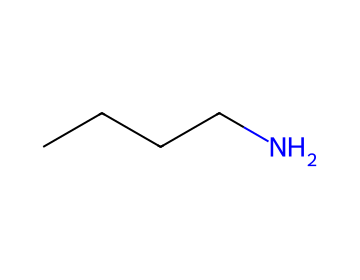
IDENTITY
COMPUTED
PROPERTIES
0.97
log Kow = 0.97
0.97
0.86
Amine odor
... Fishy, ammonia-like odor.
0.741 at 68 °F (USCG, 1999) - Less dense than water; will float
0.7327 at 25 °C/4 °C
Relative density (water = 1): 0.74
0.732-0.740
0.74
0.7327 @ 20°C
0.574 mPa s at 25 °C
CLEAR, COLORLESS LIQUID
Soluble (>=10 mg/ml) (NTP, 1992)
1000000
Miscible with alcohol, ether
In water, 1X10+6 mg/L (miscible) at 25 °C
1000 mg/mL at 20 °C
Solubility in water: miscible
It may corrode some metals in the presence of water.
10 °F (NTP, 1992)
strong at 3-10 ppm. [ACGIH] 10 °F
30 °F (-1 °C) (Open Cup)
-12 °C (10 °F) closed cup.
-12 °C c.c.
10 °F
172.4 °F at 760 mmHg (NTP, 1992)
77
78 °C
77.00 to 78.00 °C. @ 760.00 mm Hg
78 °C
78 °C
When heated to decomposition it emits toxic fumes of /nitrogen oxides/.
Products of decomposition include carbon monoxide, carbon dioxide, hydrocarbons, and toxic oxides of nitrogen as well as toxic amine vapors. Ammonia vapors are liberated upon decomposition.
-58 °F (NTP, 1992)
-49.1
-50 °C
-50 °C
-50 °C
-58 °F
2.52 (NTP, 1992) - Heavier than air; will sink (Relative to Air)
2.5 (AIR = 1)
Relative vapor density (air = 1): 2.5
2.52
GHS
Danger
H225: Highly Flammable liquid and vapor [Danger Flammable liquids];H302: Harmful if swallowed [Warning Acute toxicity, oral];H312: Harmful in contact with skin [Warning Acute toxicity, dermal];H314: Causes severe skin burns and eye damage [Danger Skin corrosion/irritation];H332: Harmful if inhaled [Warning Acute toxicity, inhalation]
P210, P233, P240, P241, P242, P243, P260, P261, P264, P270, P271, P280, P301+P317, P301+P330+P331, P302+P352, P302+P361+P354, P303+P361+P353, P304+P340, P305+P354+P338, P316, P317, P321, P330, P362+P364, P363, P370+P378, P403+P235, P405, and P501 (click each P-code to see the statement)
Danger
HAZARDS
Chemical: 1-Butanamine
Commission Regulation (EC) No 1565/2000 (Repealed by Com. Implementing Reg. (EU) No 872/2012)
1-Butanamine is listed on the EPA's Chemical Data Reporting (CDR) system. Manufacturers and importers of 1-Butanamine are required to report information about their production and use of this chemical to the EPA under the Toxic Substances Control Act (TSCA). (40 eCFR Part 711)
Status: Active Update: 27-03-2023 https://echa.europa.eu/registration-dossier/-/registered-dossier/13605;Status: Active Update: 29-10-2021 https://echa.europa.eu/registration-dossier/-/registered-dossier/25391
1-Butanamine: HSNO Approval: HSR001090 Approved with controls
The New Jersey Worker and Community Right to Know Act requires public and private employers to provide information about hazardous substances at their workplaces. (N.J.S.A. 34:5A-1 et. seq.)
Evaluation - Chemicals that are unlikely to require further regulation to manage risks to environment
Flammable Liquid Corrosive
Special Hazards of Combustion Products: Toxic oxides of nitrogen may form in fire.;Behavior in Fire: Vapor is heavier than air and may travel to a source of ignition and flash back. Containers may explode in fire. (USCG, 1999)
· Flammable/combustible material.;· May be ignited by heat, sparks or flames.;· Vapors may form explosive mixtures with air.;· Vapors may travel to source of ignition and flash back.;· Most vapors are heavier than air. They will spread along the ground and collect in low or confined areas (sewers, basements, tanks, etc.).;· Vapor explosion hazard indoors, outdoors or in sewers.;· Those substances designated with a (P) may polymerize explosively when heated or involved in a fire.;· Runoff to sewer may create fire or explosion hazard.;· Containers may explode when heated.;· Many liquids will float on water.
Highly flammable. Gives off irritating or toxic fumes (or gases) in a fire. Vapour/air mixtures are explosive.
Flammable
Inhalation causes irritation, nausea, vomiting, headache, faintness, severe coughing and chest pains; can cause lung edema. Ingestion causes severe irritation of mouth and stomach. Contact with eyes causes severe irritation and edema of the cornea. Contact with skin causes burns; absorption through skin may cause nausea, vomiting and shock. (USCG, 1999)
· May cause toxic effects if inhaled or ingested.;· Contact with substance may cause severe burns to skin and eyes.;· Fire will produce irritating, corrosive and/or toxic gases.;· Vapors may cause dizziness or asphyxiation, especially when in closed or confined areas.;· Runoff from fire control or dilution water may cause environmental contamination.
Liquid will burn skin; [CHRIS] Highly corrosive to skin; [Quick CPC] n-Butylamine can cause severe skin and eye burns as well as respiratory tract irritation and, potentially, pulmonary edema. [ACGIH] A corrosive substance that can cause pulmonary edema; [ICSC]
1125 132
1125 132
Amines, Phosphines, and Pyridines
Symbol: F, C; R: 11-20/21/22-35; S: (1/2)-3-16-26-29-36/37/39-45
UN Hazard Class: 3; UN Subsidiary Risks: 8; UN Pack Group: II
European Chemicals Bureau; IUCLID Dataset, Butylamine (CAS # 109-73-9) (2000) gives information on usage patterns, ecotoxicity, and toxicity provided to the European Union by industry.
Anon; Dangerous Prop Ind Mater Rep, 6(2): 45-48 (1986) Safety of butylamine
Canadian Centre for Occupational Health and Safety p.1 (1990). Chemical safety information sheet.
SAFETY
Excerpt from ERG Guide 132 [Flammable Liquids - Corrosive]:;Some of these materials may react violently with water.;SMALL FIRE: Dry chemical, CO2, water spray or alcohol-resistant foam.;LARGE FIRE: Water spray, fog or alcohol-resistant foam. If it can be done safely, move undamaged containers away from the area around the fire. Dike runoff from fire control for later disposal. Do not get water inside containers.;FIRE INVOLVING TANKS, RAIL TANK CARS OR HIGHWAY TANKS: Fight fire from maximum distance or use unmanned master stream devices or monitor nozzles. Cool containers with flooding quantities of water until well after fire is out. Withdraw immediately in case of rising sound from venting safety devices or discoloration of tank. ALWAYS stay away from tanks in direct contact with flames. For massive fire, use unmanned master stream devices or monitor nozzles; if this is impossible, withdraw from area and let fire burn. (ERG, 2024)
Use water in large amounts, powder, alcohol-resistant foam, carbon dioxide. In case of fire: keep drums, etc., cool by spraying with water.
Fresh air, rest. Half-upright position. Artificial respiration may be needed. Refer for medical attention.
Remove contaminated clothes. Rinse skin with plenty of water or shower. Refer for medical attention .
First rinse with plenty of water for several minutes (remove contact lenses if easily possible), then refer for medical attention.
Rinse mouth. Do NOT induce vomiting. Refer for medical attention .
· CALL 911. Then call emergency response telephone number on shipping paper. If shipping paper not available or no answer, refer to appropriate telephone number listed on the inside back cover.;· Keep unauthorized personnel away.;· Stay upwind, uphill and/or upstream.;· Ventilate closed spaces before entering, but only if properly trained and equipped.
· ELIMINATE all ignition sources (no smoking, flares, sparks or flames) from immediate area.;· All equipment used when handling the product must be grounded.;· Do not touch or walk through spilled material.;· Stop leak if you can do it without risk.;· Prevent entry into waterways, sewers, basements or confined areas.;· A vapor-suppressing foam may be used to reduce vapors.;· Absorb with earth, sand or other non-combustible material.;· For hydrazine, absorb with DRY sand or inert absorbent (vermiculite or absorbent pads).;· Use clean, non-sparking tools to collect absorbed material.;Large Spill;· Dike far ahead of liquid spill for later disposal.;· Water spray may reduce vapor, but may not prevent ignition in closed spaces.
EYES: First check the victim for contact lenses and remove if present. Flush victim's eyes with water or normal saline solution for 20 to 30 minutes while simultaneously calling a hospital or poison control center. Do not put any ointments, oils, or medication in the victim's eyes without specific instructions from a physician. IMMEDIATELY transport the victim after flushing eyes to a hospital even if no symptoms (such as redness or irritation) develop.;SKIN: IMMEDIATELY flood affected skin with water while removing and isolating all contaminated clothing. Gently wash all affected skin areas thoroughly with soap and water. IMMEDIATELY call a hospital or poison control center even if no symptoms (such as redness or irritation) develop. IMMEDIATELY transport the victim to a hospital for treatment after washing the affected areas.;INHALATION: IMMEDIATELY leave the contaminated area; take deep breaths of fresh air. If symptoms (such as wheezing, coughing, shortness of breath, or burning in the mouth, throat, or chest) develop, call a physician and be prepared to transport the victim to a hospital. Provide proper respiratory protection to rescuers entering an unknown atmosphere. Whenever possible, Self-Contained Breathing Apparatus (SCBA) should be used; if not available, use a level of protection greater than or equal to that advised under Protective Clothing.;INGESTION: DO NOT INDUCE VOMITING. Corrosive chemicals will destroy the membranes of the mouth, throat, and esophagus and volatile chemicals have a high risk of being aspirated into the victim's lungs during vomiting. Thus, the risk of increasing the medical problems by inducing vomiting of a volatile corrosive chemical is very high. If the victim is conscious and not convulsing, give 1 or 2 glasses of water to dilute the chemical and IMMEDIATELY call a hospital or poison control center. IMMEDIATELY transport the victim to a hospital. If the victim is convulsing or unconscious, do not give anything by mouth, ensure that the victim's airway is open and lay the victim on his/her side with the head lower than the body. DO NOT INDUCE VOMITING. IMMEDIATELY transport the victim to a hospital. (NTP, 1992)
General First Aid:;· Call 911 or emergency medical service.;· Ensure that medical personnel are aware of the material(s) involved, take precautions to protect themselves and avoid contamination.;· Move victim to fresh air if it can be done safely.;· Administer oxygen if breathing is difficult.;· If victim is not breathing:;-- DO NOT perform mouth-to-mouth resuscitation; the victim may have ingested or inhaled the substance.;-- If equipped and pulse detected, wash face and mouth, then give artificial respiration using a proper respiratory medical device (bag-valve mask, pocket mask equipped with a one-way valve or other device).;-- If no pulse detected or no respiratory medical device available, provide continuous compressions. Conduct a pulse check every two minutes or monitor for any signs of spontaneous respirations.;· Remove and isolate contaminated clothing and shoes.;· For minor skin contact, avoid spreading material on unaffected skin.;· In case of contact with substance, remove immediately by flushing skin or eyes with running water for at least 20 minutes.;· For severe burns, immediate medical attention is required.;· Effects of exposure (inhalation, ingestion, or skin contact) to substance may be delayed.;· Keep victim calm and warm.;· Keep victim under observation.;· For further assistance, contact your local Poison Control Center.;· Note: Basic Life Support (BLS) and Advanced Life Support (ALS) should be done by trained professionals.;Specific First Aid:;· For corrosives, in case of contact, immediately flush skin or eyes with running water for at least 30 minutes. Additional flushing may be required.
(General first aid procedures);Eye: Irrigate immediately - If this chemical contacts the eyes, immediately wash (irrigate) the eyes with large amounts of water, occasionally lifting the lower and upper lids. Get medical attention immediately.;Skin: Water flush immediately - If this chemical contacts the skin, immediately flush the contaminated skin with water. If this chemical penetrates the clothing, immediately remove the clothing and flush the skin with water. Get medical attention promptly.;Breathing: Respiratory support;Swallow: Medical attention immediately - If this chemical has been swallowed, get medical attention immediately.
Fireproof. Separated from food and feedstuffs. See Chemical Dangers.
VAPORS ARE HEAVIER THAN AIR & MAY TRAVEL CONSIDERABLE DISTANCE TO SOURCE OF IGNITION & FLASH BACK.
· Wear positive pressure self-contained breathing apparatus (SCBA).;· Wear chemical protective clothing that is specifically recommended by the manufacturer when there is NO RISK OF FIRE.;· Structural firefighters' protective clothing provides thermal protection but only limited chemical protection.
2.0 [ppm]
Use water spray, dry chemical, "alcohol resistant" foam, or carbon dioxide. Use water spray to keep fire-exposed containers cool. Approach fire from upwind to avoid hazardous vapors and toxic decomposition products.
Do not use a solid stream of water because the stream will scatter and spread the fire. ... Fire fighters should wear self-contained breathing apparatus and full set of protective clothing.
If material on fire or involved in fire: Do not extinguish fire unless flow can be stopped. Use water in flooding quantities as fog. Solid streams of water may be ineffective. Cool all affected containers with flooding quantities of water. Apply water from as far a distance as possible. Use "alcohol" foam, dry chemical or carbon dioxide.
Fire Fighting: Use self-contained breathing apparatus with a full facepiece operated in pressure-demand or other positive pressure mode.
Store in closed containers in a cool, dry, well-ventilated area.
Outside or detached storage is preferred. Separate from oxidizing materials, acids, and sources of halogens. Store in a cool, dry, well-ventilated location.
Evacuate and restrict persons not wearing protective equipment from area of spill or leak until cleanup is complete. Remove all ignition sources. Establish forced ventilation to keep levels below explosive limit. Absorb liquids in vermiculite, dry sand, earth, peat, carbon, or a similar material and deposit in sealed containers. It may be necessary to contain and dispose of this chemical as a hazardous waste. If material or contaminated runoff enters waterways, notify downstream users of potentially contaminated waters. Contact your Department of Environmental Protection or your regional office of the federal EPA for specific recommendations. If employees are required to clean-up spills, they must be properly trained and equipped. OSHA 1910.120(q) may be applicable. /Butyl Amines/
Evacuate danger area! Consult an expert! Ventilation. Collect leaking and spilled liquid in sealable containers as far as possible. Absorb remaining liquid in sand or inert absorbent and remove to safe place. Do NOT let this chemical enter the environment. Personal protection: chemical protection suit including self-contained breathing apparatus.
1. Remove all ignition sources. 2. Ventilate area of spill or leak. 3. For small quantities, absorb on paper towels. Evaporate in a safe place (such as fume hood). Allow sufficient time for evaporating vapors to completely clear the hood ductwork. ... butylamine should not be allowed to enter a confined space, such as sewer, because of the possibility of an explosion. Sewers designed to preclude the formation of explosive concentrations of butylamine vapors are permitted.
Environmental considerations-land spill: Dig a pit, pond, lagoon, holding area to contain liquid or solid material. /SRP: If time permits, pits, ponds, lagoons, soak holes, or holding areas should be sealed with an impermeable flexible membrane liner./ Dike surface flow using soil, sand bags, foamed polyurethane, or foamed concrete Absorb bulk liquid with fly ash, cement powder, or commercial sorbents. Apply appropriate foam to diminish vapor and fire hazard. Neutralize with sodium bisulfate (NaHSO4).
For more Cleanup Methods (Complete) data for N-BUTYLAMINE (6 total), please visit the HSDB record page.
Excerpt from ERG Guide 132 [Flammable Liquids - Corrosive]:;ELIMINATE all ignition sources (no smoking, flares, sparks or flames) from immediate area. All equipment used when handling the product must be grounded. Do not touch or walk through spilled material. Stop leak if you can do it without risk. Prevent entry into waterways, sewers, basements or confined areas. A vapor-suppressing foam may be used to reduce vapors. Absorb with earth, sand or other non-combustible material. For hydrazine, absorb with DRY sand or inert absorbent (vermiculite or absorbent pads). Use clean, non-sparking tools to collect absorbed material.;LARGE SPILL: Dike far ahead of liquid spill for later disposal. Water spray may reduce vapor, but may not prevent ignition in closed spaces. (ERG, 2024)
SRP: The most favorable course of action is to use an alternative chemical product with less inherent propensity for occupational exposure or environmental contamination. Recycle any unused portion of the material for its approved use or return it to the manufacturer or supplier. Ultimate disposal of the chemical must consider: the material's impact on air quality; potential migration in soil or water; effects on animal, aquatic, and plant life; and conformance with environmental and public health regulations.
Incineration; incinerator is equipped with a scrubber or thermal unit to reduce NOx emissions. Alternatively it may be poured into sodium bisulfate, neutralized and flushed with water.
/Absorb small spills with paper and/ burn the paper in a suitable location away from combustible materials. Large quantities can be reclaimed or collected & atomized in suitable combustion chamber equipped with appropriate effluent gas cleaning device.
TOXICITY
Eyes, skin, respiratory system
LC50 Leuciscus idus /Freshwater fish, Ide or Orfe/ 171 mg/L/96 hr; freshwater.
LC50 Brine shrimp 30-70 ppm for 24 hr. /static bioassay/
EC50; Species: Anabaena subcylindrica (Blue-green algae, axenic, 1-3x 10+7 cells/mL); Conditions: freshwater, static, 25 °C, pH 7.2; Concentration: 0.012 ug/cell for < or = 3 hr; Effect: decreased nitrogen fixation
EC50; Species: Anabaena subcylindrica (Blue-green algae, axenic, 1-3x 10+7 cells/mL); Conditions: freshwater, static, 25 °C, pH 7.2; Concentration: 1.8x10⁻⁸ ug/cell for < or = 3 hr; Effect: decreased photosynthesis, oxygen production
For more Ecotoxicity Values (Complete) data for N-BUTYLAMINE (13 total), please visit the HSDB record page.
TERRESTRIAL FATE: Based on a classification scheme(1), Koc values ranging from 15 to 107(2) indicate that n-butylamine is expected to have high mobility in soil(SRC). The pKa of n-butylamine is 10.78(3) indicating that this compound will exist almost entirely in the cation form in the environment and therefore volatilization from moist soil surfaces is not expected to be an important fate process(SRC). The potential for volatilization of n-butylamine from dry soil surfaces may exist(SRC) based upon a vapor pressure of 92.9 mm Hg(4). Numerous screening studies indicate that n-butylamine will biodegrade readily(5-8); n-butylamine reached 67% of its theoretical BOD in 12 days using an activated sludge inoculum(5).
AQUATIC FATE: Based on a classification scheme(1), a Koc value range of 15 to 107 in soil and sediment(2), indicates that n-butylamine is not expected to adsorb to suspended solids and sediment(SRC). A pKa of 10.78(3) indicates n-butylamine will exist almost entirely in the cation form at pH values of 5 to 9 and therefore volatilization from water surfaces is not expected to be an important fate process(4). According to a classification scheme(5), an estimated BCF of 3(SRC), from its log Kow(6) and a regression-derived equation(7), suggests the potential for bioconcentration in aquatic organisms is low(SRC). Numerous screening studies indicate that n-butylamine will biodegrade readily(8-11); n-butylamine reached 67% of its theoretical BOD in 12 days using an activated sludge inoculum(8).
ATMOSPHERIC FATE: According to a model of gas/particle partitioning of semivolatile organic compounds in the atmosphere(1), n-butylamine, which has a vapor pressure of 92.9 mm Hg at 25 °C(2), is expected to exist solely as a vapor in the ambient atmosphere. Vapor-phase n-butylamine is degraded in the atmosphere by reaction with photochemically-produced hydroxyl radicals(SRC); the half-life for this reaction in air is estimated to be 11 hours(SRC) from its estimated rate constant of 3.4X10⁻¹¹ cu cm/molecule-sec at 25 °C(3).
n-Butylamine has been detected to occur naturally in the following foods: kale, 7 ppm; pickles: cucumbers in aromatic vinegar, 0.6 ppm, cucumbers pickled with mustard, 5.3 ppm; cheese: Tilsiter, 3.7 ppm, Camembert and Limburger, not detected; brown bread, 1.1 ppm(1). Not detected in: spinach, red cabbage, cauliflower, white beet, carrot, red beet, large raddish, red radish, celery(1). n-Butylamine has been identified as a volatile component of boiled beef, concn unknown(2).
Dermatotoxin - Skin burns.;Toxic Pneumonitis - Inflammation of the lungs induced by inhalation of metal fumes or toxic gases and vapors.
The substance can be absorbed into the body by inhalation of its vapour, through the skin and by ingestion.
inhalation, skin absorption, ingestion, skin and/or eye contact
... The presence of volatile aliphatic amines ... in human breast milk and amniotic fluid /was measured/ to assess their role in neonatal hypergastrinemia. These volatile nitrogenous amino acid metabolites have been previously demonstrated to stimulate gastrin release in in vivo and in vitro laboratory preparations. ... The present study ... demonstrated that these gastrin-stimulatory volatile amines were present in significant concentrations in breast milk during the first several weeks after parturition and in amniotic fluid. The individual amines that were identified in both human milk and amniotic fluid samples were methylamine, dimethylamine, ethylamine, trimethylamine, propylamine, isobutylamine, and butylamine. This study provides indirect evidence to support the possibility that the hypergastrinemia measured in the fetus/neonate during the period immediately before and after birth may be attributable, in part, to the ingestion of fluid containing high concentrations of gastrin-stimulating amines.
/AQUATIC SPECIES/ Of 78 binary mixtures of equitoxic concns of 13 amines, the ethyl amine-aniline mixture (I-II) showed the greatest (32-fold) toxicity potentiation in a /freshwater algae/ Scenedesmus subspicatus reproduction test. ... Combining I with Butylamine ... potentiated the toxicity 8-fold.
OCCURS NATURALLY IN MULBERRY LEAVES.
Sore throat. Cough. Burning sensation. Headache. Flushing of the face. Vomiting. Dizziness. Shortness of breath. Laboured breathing. Symptoms may be delayed.
MAY BE ABSORBED! Pain. Redness. Blisters. Skin burns.
Pain. Redness. Severe deep burns. Loss of vision.
Burning sensation. Abdominal pain. Diarrhoea. Nausea. Vomiting. Shock or collapse.
irritation eyes, skin, nose, throat; headache; skin flush, burns
In 16 finished water concentrates collected from advanced waste treatment plants across the US, n-butylamine was detected, but not quantified, in 1087 of 2097 detection instances(1). In a laboratory study, n-butylamine was detected in the automobile exhaust of two gasoline fueled vehicles, concn not specified(2).
The substance is harmful to aquatic organisms.
REGULATORY
Chemical: 1-Butanamine
Commission Regulation (EC) No 1565/2000 (Repealed by Com. Implementing Reg. (EU) No 872/2012)
1-Butanamine is listed on the EPA's Chemical Data Reporting (CDR) system. Manufacturers and importers of 1-Butanamine are required to report information about their production and use of this chemical to the EPA under the Toxic Substances Control Act (TSCA). (40 eCFR Part 711)
Status: Active Update: 27-03-2023 https://echa.europa.eu/registration-dossier/-/registered-dossier/13605;Status: Active Update: 29-10-2021 https://echa.europa.eu/registration-dossier/-/registered-dossier/25391
1-Butanamine: HSNO Approval: HSR001090 Approved with controls
The New Jersey Worker and Community Right to Know Act requires public and private employers to provide information about hazardous substances at their workplaces. (N.J.S.A. 34:5A-1 et. seq.)
This action promulgates standards of performance for equipment leaks of Volatile Organic Compounds (VOC) in the Synthetic Organic Chemical Manufacturing Industry (SOCMI). The intended effect of these standards is to require all newly constructed, modified, and reconstructed SOCMI process units to use the best demonstrated system of continuous emission reduction for equipment leaks of VOC, considering costs, non air quality health and environmental impact and energy requirements. n-Butylamine is produced, as an intermediate or a final product, by process units covered under this subpart.
Persons in charge of vessels or facilities are required to notify the National Response Center (NRC) immediately, when there is a release of this designated hazardous substance, in an amount equal to or greater than its reportable quantity of 1000 lb or 454 kg. The toll free number of the NRC is (800) 424-8802. The rule for determining when notification is required is stated in 40 CFR 302.4 (section IV. D.3.b).
Butylamine is designated as a hazardous substance under section 311(b)(2)(A) of the Federal Water Pollution Control Act and further regulated by the Clean Water Act Amendments of 1977 and 1978. These regulations apply to discharges of this substance. This designation includes any isomers and hydrates, as well as any solutions and mixtures containing this substance.
PHARMACOLOGY
Monoamine oxidase and diamine oxidase (histaminase) occur widely in animal tissues ... it is assumed that they play an important part in "detoxication" of amines not normally present /in the body/. /Aliphatic amines/
... Recovered little ... n-butylamine in the urine after oral administration of the hydrochloride of this compound to humans ...
Amines are well absorbed from gut & respiratory tract. /Aliphatic amines/
Cytoplasm;Extracellular
USES
Used as an intermediate in the synthesis of dyes, drugs, rubber additives, emulsifiers, tanning agents, and insecticides; also used as a vulcanizing accelerator for rubber and as a curing agent for polymers; [NIOSH Guidelines for Chemical Hazards]
Plastic Composites Manufacturing [Category: Industry]
Monobutylamine is an intermediate for the production of plasticizers (e.g., the rubber accelerator dibutylthiourea), agrochemicals (e.g., DuPont's fungicide benomyl), pharmaceuticals (e.g., the antidiabetic tolbutamide), emulsifying agents, dyes, and UV absorbers.
Int for pharmaceuticals, dyestuffs, synthetic tanning agents, rubber chemicals, insecticides, emulsifying agents, and synthetic tanning agents
CHEM INT FOR RUBBER ACCELERATORS, EG, DIBUTYLTHIOUREA, VULCANIZING AGENTS, ANTIOXIDANTS-EG, NICKEL DIBUTYLTHIOCARBAMATE, BENOMYL, A CARBAMATE FUNGICIDE, TOLBUTAMIDE, A HYPOGLYCEMIC AGENT
FLAVOR USEFUL IN SEAFOOD & CHOCOLATE
2023: 1,000,000 - <5,000,000 lb;2022: 10,000,000 - <50,000,000 lb;2021: 10,000,000 - <50,000,000 lb;2020: 1,000,000 - <5,000,000 lb
(1978) 1.86X10+9 G
(1982) 1.11X10+9 G
Production volumes for non-confidential chemicals reported under the Inventory Update Rule. [Table#1456]
This chemical is listed as a High Production Volume (HPV) (65FR81686). Chemicals listed as HPV were produced in or imported into the U.S. in >1 million pounds in 1990 and/or 1994. The HPV list is based on the 1990 Inventory Update Rule. (IUR) (40 CFR part 710 subpart B; 51FR21438).
CHEM INT FOR RUBBER-PROCESSING CHEMICALS, (EG, ACCELERATORS, VULCANIZING AGENTS, & ANTIOXIDANTS), 50%; CHEM INT FOR PESTICIDES, 50% (1982)
Intermediate;Not Known or Reasonably Ascertainable
REACTION OF AMMONIA & N-BUTYL ALCOHOL AT ELEVATED TEMPERATURE AND PRESSURE IN THE PRESENCE OF A SILICA-ALUMINA CATALYST; REDUCTIVE AMINATION OF N-BUTYRALDEHYDE (NON-US PROCESS)
... By reduction of butyraldoxime ... Usually mfr by catalytic alkylation of ammonia with butyl alc: Davies et al, US patent 2,609,394 (1954 to ICI); Hindley, Fisher, US patent 2,782,237 (1957 to British Celanese); Lemon, Myerly, US patent 3,022,349 (1962 to Union Carbide); Shirley, Speranza US patent 3,128,311 (1964 to Jefferson Chem). Mfr from butyraldehyde & ammonia in presence of Raney nickel: Brimer et al, US patent 2,518,659 (1950 to Eastman Kodak).
Catalytic alkylation of ammonia with butyl alcohol.
Flavouring Agent -> FLAVOURING_AGENT -> JECFA Functional Classes
Flavoring Agents -> JECFA Flavorings Index
Flavouring Agent -> FLAVOURING_AGENT -> JECFA Functional Classes
All Other Basic Organic Chemical Manufacturing
1-Butanamine: ACTIVE
Aziridines are hydrogenated in the presence of typical hydrogenation catalysts to give alkyl amines.
ALIASES
REACTIONS
uspto-grants-1998_03 · 10.6084/m9.figshare.5104873.v1 · US05733914
查看
uspto-grants-2006_08 · 10.6084/m9.figshare.5104873.v1 · US07087632B2
查看
uspto-grants-2006_08 · 10.6084/m9.figshare.5104873.v1 · US07098340B2
查看
uspto-grants-2010_06 · 10.6084/m9.figshare.5104873.v1 · US07727997B2
查看
uspto-grants-2010_06 · 10.6084/m9.figshare.5104873.v1 · US07727997B2
查看
uspto-grants-2010_06 · 10.6084/m9.figshare.5104873.v1 · US07727997B2
查看
uspto-grants-2010_06 · 10.6084/m9.figshare.5104873.v1 · US07737285B2
查看
uspto-grants-2010_06 · 10.6084/m9.figshare.5104873.v1 · US07737285B2
查看