
uspto-grants-1982_08 · 10.6084/m9.figshare.5104873.v1 · US04346161
查看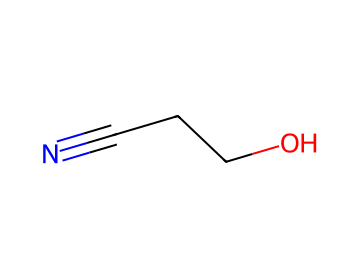
IDENTITY
COMPUTED
PROPERTIES
log Kow= -0.94
-0.94
1.047 at 68 °F (USCG, 1999) - Denser than water; will sink
1.0404 @ 25 °C
Relative density (water = 1): 1.04
WATER-WHITE LIQUID
Straw-colored liquid
greater than or equal to 100 mg/mL at 68 °F (NTP, 1992)
Miscible in ethanol; soluble in chloroform; slightly soluble in ethyl ether.
Miscible with acetone, methyl ethyl ketone, ethanol, chloroform, and diethyl ether; insoluble in benzene, carbon tetrachloride, and naphtha.
Miscible with acetone, methyl ethyl ketone, ethyl alcohol. Slightly sol in ether (2.3% w/w @ 15 °C). Insol in benzene, petr ether, carbon disulfide, carbon tetrachloride.
In water, 1X10+6 mg/l @ 20 °C
Solubility in water: miscible
greater than 265 °F (NTP, 1992)
265 °F (129 °C) (Open cup)
129 °C o.c.
442 °F at 760 mmHg (slight decomposition) (NTP, 1992)
221 °C
WHEN HEATED OR ON CONTACT WITH ACID OR ACID FUMES, IT EMITS HIGHLY TOXIC FUMES OF CYANIDES.
228 °C
-51 °F (NTP, 1992)
-46 °C
-46 °C
2.5 (NTP, 1992) - Heavier than air; will sink (Relative to Air)
2.45 (AIR= 1)
Relative vapor density (air = 1): 2.45
0.08 mmHg at 77 °F ; 20 mmHg at 243 °F (NTP, 1992)
0.08 [mmHg]
0.08 MM HG @ 25 °C
Vapor pressure, Pa at 25 °C: 10.7
Index of refraction: 1.4248 @ 20 °C/D
Ethylene cyanohydrin is a colorless to yellow-brown liquid with a weak odor. Sinks and mixes with water. (USCG, 1999)
Straw-colored liquid; [Hawley] Colorless to yellow-brown liquid; [CAMEO]
COLOURLESS-TO-YELLOW LIQUID.
GHS
This chemical does not meet GHS hazard criteria for 75.4% (144 of 191) of all reports.
Warning
H315 (24.6%): Causes skin irritation [Warning Skin corrosion/irritation];H319 (24.6%): Causes serious eye irritation [Warning Serious eye damage/eye irritation];H335 (24.1%): May cause respiratory irritation [Warning Specific target organ toxicity, single exposure; Respiratory tract irritation]
P261, P264, P264+P265, P271, P280, P302+P352, P304+P340, P305+P351+P338, P319, P321, P332+P317, P337+P317, P362+P364, P403+P233, P405, and P501 (click each P-code to see the statement)
Aggregated GHS information provided per 191 reports by companies from 7 notifications to the ECHA C&L Inventory. Each notification may be associated with multiple companies.;Reported as not meeting GHS hazard criteria per 144 of 191 reports by companies.;There are 6 notifications provided by 47 of 191 reports by companies with hazard statement code(s).;Information may vary between notifications depending on impurities, additives, and other factors. The percentage value in parenthesis indicates the notified classification ratio from companies that provide hazard codes. Only hazard codes with percentage values above 10% are shown. For more detailed information, please visit ECHA C&L website.
HAZARDS
Chemical: Propanenitrile, 3-hydroxy-
Status: Active Update: 02-10-2019 https://echa.europa.eu/registration-dossier/-/registered-dossier/23661;Status: Cease Manufacture Update: 30-04-2018 https://echa.europa.eu/registration-dossier/-/registered-dossier/24268
Hydracrylonitrile: Does not have an individual approval but may be used under an appropriate group standard
The New Jersey Worker and Community Right to Know Act requires public and private employers to provide information about hazardous substances at their workplaces. (N.J.S.A. 34:5A-1 et. seq.)
Poison
Special Hazards of Combustion Products: Toxic gases are generated when heated.;Behavior in Fire: Decomposes, generating toxic gases (USCG, 1999)
Combustible. Gives off irritating or toxic fumes (or gases) in a fire.
DANGEROUS, WHEN EXPOSED TO HEAT OR FLAME. ...WILL REACT WITH WATER OR STEAM TO PRODUCE...FLAMMABLE VAPORS.
Liquid causes eye irritation. If swallowed, may cause severe kidney injury. (USCG, 1999)
A skin and eye irritant; Releases hydrogen cyanide when heated or in contact with acids/water; [ICSC] An eye irritant; [HSDB] Reacts with water evolving toxic flammable gases; An eye irritant; [CAMEO] An irritant; Harmful by ingestion, inhalation, or skin absorption; [Aldrich MSDS] See NITRILES.
Ethylene cyanohydrin is an indirect food additive for use only as a component of adhesives.
Alcohols and Polyols;Nitriles
D003; A solid waste containing a cyanide cmpd may become characterized as a hazardous waste when subjected to testing for reactivity as stipulated in 40 CFR 261.23, and if so characterized, must be managed as a hazardous waste. ... Cyanide bearing waste which, when exposed to pH conditions between 2 and 12.5, can generate toxic gases, vapors or fumes in a quantity sufficient to present a danger to human health or the environment. /Cyanide cmpd/
ETHYLENE CYANOHYDRIN reacts violently with mineral acids, amines and inorganic bases. It also reacts violently with chlorosulfonic acid, sulfuric acid, oleum and sodium hydroxide. It is incompatible with bases, oxidizing agents, moisture and heat. It is corrosive to mild steel. (NTP, 1992)
The substance may polymerize under the influence of organic bases. Decomposes on heating and on contact with acids, acid fumes and water. This produces highly toxic fumes including hydrogen cyanide. Reacts violently with strong oxidants.
Lower flammable limit: 2.3% by volume; Upper flammable limit: 12.1% by volume
SAFETY
Fire Extinguishing Agents Not to Be Used: Water or foam may cause frothing.;Fire Extinguishing Agents: Carbon dioxide or dry chemical for small fires; alcohol- type foam for large fires. (USCG, 1999)
Use powder, alcohol-resistant foam, carbon dioxide.
Fresh air, rest.
Rinse skin with plenty of water or shower.
First rinse with plenty of water for several minutes (remove contact lenses if easily possible), then refer for medical attention.
Rinse mouth.
EYES: First check the victim for contact lenses and remove if present. Flush victim's eyes with water or normal saline solution for 20 to 30 minutes while simultaneously calling a hospital or poison control center. Do not put any ointments, oils, or medication in the victim's eyes without specific instructions from a physician. IMMEDIATELY transport the victim after flushing eyes to a hospital even if no symptoms (such as redness or irritation) develop.;SKIN: IMMEDIATELY flood affected skin with water while removing and isolating all contaminated clothing. Gently wash all affected skin areas thoroughly with soap and water. If symptoms such as redness or irritation develop, IMMEDIATELY call a physician and be prepared to transport the victim to a hospital for treatment.;INHALATION: IMMEDIATELY leave the contaminated area; take deep breaths of fresh air. If symptoms (such as wheezing, coughing, shortness of breath, or burning in the mouth, throat, or chest) develop, call a physician and be prepared to transport the victim to a hospital. Provide proper respiratory protection to rescuers entering an unknown atmosphere. Whenever possible, Self-Contained Breathing Apparatus (SCBA) should be used; if not available, use a level of protection greater than or equal to that advised under Protective Clothing.;INGESTION: DO NOT INDUCE VOMITING. If the victim is conscious and not convulsing, give 1 or 2 glasses of water to dilute the chemical and IMMEDIATELY call a hospital or poison control center. Be prepared to transport the victim to a hospital if advised by a physician. If the victim is convulsing or unconscious, do not give anything by mouth, ensure that the victim's airway is open and lay the victim on his/her side with the head lower than the body. DO NOT INDUCE VOMITING. IMMEDIATELY transport the victim to a hospital. (NTP, 1992)
Separated from acids, bases and oxidants. Cool. Dry. Keep in a well-ventilated room.
Closed containers may rupture violently when heated.
Use water spray, dry chemical, "alcohol resistant" foam, or carbon dioxide. Water or foam may cause frothing. Use water spray to keep fire-exposed containers cool. Fight fire from protected location or maximum possible distance. Approach fire from upwind to avoid hazardous vapors and toxic decomposition products.
Store in a cool, dry, well-ventilated location. Separate from oxidizing materials. Outside or detached storage is preferred.
Stop or control the leak, if this can be done without undue risk. Use water spray to cool and disperse vapors, protect personnel, and dilute spills to form nonflammable mixtures. Absorb in noncombustible material for proper disposal.
SMALL SPILLS AND LEAKAGE: If you should spill this chemical, use absorbent paper to pick up all liquid spill material. Seal the absorbent paper, as well as any of your clothing which may be contaminated, in a vapor-tight plastic bag for eventual disposal. Wash any surfaces you may have contaminated with a soap and water solution. Do not reenter the contaminated area until the Safety Officer (or other responsible person) has verified that the area has been properly cleaned.;STORAGE PRECAUTIONS: You should store this chemical under refrigerated temperatures, and protect it from moisture. (NTP, 1992)
SRP: At the time of review, criteria for land treatment or burial (sanitary landfill) disposal practices are subject to significant revision. Prior to implementing land disposal of waste residue (including waste sludge), consult with environmental regulatory agencies for guidance on acceptable disposal practices.
Personal protection: filter respirator for organic gases and vapours adapted to the airborne concentration of the substance. Collect leaking and spilled liquid in sealable containers as far as possible. Absorb remaining liquid in sand or inert absorbent. Then store and dispose of according to local regulations.
SRP: The scientific literature for the use of contact lenses in industry is conflicting. The benefit or detrimental effects of wearing contact lenses depend not only upon the substance, but also on factors including the form of the substance, characteristics and duration of the exposure, the uses of other eye protection equipment, and the hygiene of the lenses. However, there may be individual substances whose irritating or corrosive properties are such that the wearing of contact lenses would be harmful to the eye. In those specific cases, contact lenses should not be worn. In any event, the usual eye protection equipment should be worn even when contact lenses are in place.
SRP: Local exhaust ventilation should be applied wherever there is an incidence of point source emissions or dispersion of regulated contaminants in the work area. Ventilation control of the contaminant as close to its point of generation is both the most economical and safest method to minimize personnel exposure to airborne contaminants.
TOXICITY
Antidotes to cyanide poisoning include hydroxocobalamin and sodium nitrite, which release the cyanide from the cytochrome system, and rhodanase, which is an enzyme occurring naturally in mammals that combines serum cyanide with thiosulfate, producing comparatively harmless thiocyanate. Oxygen therapy can also be administered. (L97)
Exposure to high levels of cyanide for a short time harms the brain and heart and can even cause coma, seizures, apnea, cardiac arrest and death. Chronic inhalation of cyanide causes breathing difficulties, chest pain, vomiting, blood changes, headaches, and enlargement of the thyroid gland. Skin contact with cyanide salts can irritate and produce sores. (L96, L97)
TERRESTRIAL FATE: Based on a classification scheme(1), an estimated Koc value of 1(SRC), determined from a structure estimation method(2), indicates that ethylene cyanohydrin is expected to have very high mobility in soil(SRC). Volatilization of ethylene cyanohydrin from moist soil surfaces is not expected to be an important fate process(SRC) given an estimated Henry's Law constant of 4.3X10⁻¹⁰ atm-cu m/mole(SRC), using a fragment constant estimation method(3). Ethylene cyanohydrin is not expected to volatilize from dry soil surfaces(SRC) based upon a vapor pressure of 0.0802 mm Hg(4). Biodegradation in soil may be an important environmental fate process as ethylene cyanohydrin is confirmed to be biodegradable according to the standard test of the Japanese Ministry of Industry and Trade (MITI)(5).
AQUATIC FATE: Based on a classification scheme(1), an estimated Koc value of 1(SRC), determined from a structure estimation method(2), indicates that ethylene cyanohydrin is not expected to adsorb to suspended solids and sediment in water(SRC). Volatilization from water surfaces is not expected(3) based upon an estimated Henry's Law constant of 4.3X10⁻¹⁰ atm-cu m/mole(SRC), developed using a fragment constant estimation method(4). Using this Henry's Law constant and an estimation method(3), volatilization half-lives for a model river and model lake are 67 hrs and 33 days, respectively(SRC). According to a classification scheme(5), an estimated BCF of 3.2(SRC), from its log Kow of -0.94(6) and a regression-derived equation(7), suggests the potential for bioconcentration in aquatic organisms is low. Biodegradation in water may be an important environmental fate process as ethylene cyanohydrin is confirmed to be biodegradable according to the standard test of the Japanese Ministry of Industry and Trade (MITI)(8).
ATMOSPHERIC FATE: According to a model of gas/particle partitioning of semivolatile organic compounds in the atmosphere(1), ethylene cyanohydrin, which has a vapor pressure of 0.0802 mm Hg at 25 °C(2), is expected to exist solely as a vapor in the ambient atmosphere. Vapor-phase ethylene cyanohydrin is degraded in the atmosphere by reaction with photochemically-produced hydroxyl radicals(SRC); the half-life for this reaction in air is estimated to be 21 days(SRC), calculated from its rate constant of 0.75X10⁻¹² cu cm/molecule-sec at 25 °C(SRC) determined using a structure estimation method(3).
Other Poison - Chemical Asphyxiant
The substance can be absorbed into the body by inhalation of its vapour and by ingestion.
Oral (L96) ; inhalation (L96) ; dermal (L96)
Cyanide is an inhibitor of cytochrome c oxidase in the fourth complex of the electron transport chain (found in the membrane of the mitochondria of eukaryotic cells). It complexes with the ferric iron atom in this enzyme. The binding of cyanide to this cytochrome prevents transport of electrons from cytochrome c oxidase to oxygen. As a result, the electron transport chain is disrupted and the cell can no longer aerobically produce ATP for energy. Tissues that mainly depend on aerobic respiration, such as the central nervous system and the heart, are particularly affected. Cyanide is also known produce some of its toxic effects by binding to catalase, glutathione peroxidase, methemoglobin, hydroxocobalamin, phosphatase, tyrosinase, ascorbic acid oxidase, xanthine oxidase, succinic dehydrogenase, and Cu/Zn superoxide dismutase. Cyanide binds to the ferric ion of methemoglobin to form inactive cyanmethemoglobin. (L97)
Redness.
Redness. Pain.
Cyanide poisoning is identified by rapid, deep breathing and shortness of breath, general weakness, giddiness, headaches, vertigo, confusion, convulsions/seizures and eventually loss of consciousness. (L96, L97)
Using a structure estimation method based on molecular connectivity indices(1), the Koc for ethylene cyanohydrin can be estimated to be about 1(SRC). According to a classification scheme(2), this estimated Koc value suggests that ethylene cyanohydrin is expected to have very high mobility in soil.
LIQ CAUSES EYE IRRITATION. IF SWALLOWED, MAY CAUSE SEVERE KIDNEY INJURY.
/IT IS/...CONSIDERED TO BE MODERATELY HAZARDOUS BY INGESTION AND SKIN CONTACT AND SLIGHTLY HAZARDOUS BY INHALATION.
This material seems to be of a very low order of toxicity compared to some nitriles.
Ethylene cycanohydrin's production and use as a chemical intermediate and a solvent(1) may result in its release to the environment through various waste streams(SRC).
AEROBIC: Ethylene cyanohydrin is confirmed to be biodegradable according to the standard test of the Japanese Ministry of Industry and Trade (MITI) that employs a mixed inoculum obtained from freshwater, soil, and sludge(1).
No indication of carcinogenicity to humans (not listed by IARC).
REGULATORY
Chemical: Propanenitrile, 3-hydroxy-
Status: Active Update: 02-10-2019 https://echa.europa.eu/registration-dossier/-/registered-dossier/23661;Status: Cease Manufacture Update: 30-04-2018 https://echa.europa.eu/registration-dossier/-/registered-dossier/24268
Hydracrylonitrile: Does not have an individual approval but may be used under an appropriate group standard
The New Jersey Worker and Community Right to Know Act requires public and private employers to provide information about hazardous substances at their workplaces. (N.J.S.A. 34:5A-1 et. seq.)
Ethylene cyanohydrin is an indirect food additive for use only as a component of adhesives.
D003; A solid waste containing a cyanide cmpd may become characterized as a hazardous waste when subjected to testing for reactivity as stipulated in 40 CFR 261.23, and if so characterized, must be managed as a hazardous waste. ... Cyanide bearing waste which, when exposed to pH conditions between 2 and 12.5, can generate toxic gases, vapors or fumes in a quantity sufficient to present a danger to human health or the environment. /Cyanide cmpd/
PHARMACOLOGY
Apparently, when the hydroxyl group is in the beta position relative to the nitrile group, the compound is not hydrolyzed in the body to release cyanide.
Cyanide is rapidly alsorbed through oral, inhalation, and dermal routes and distributed throughout the body. Cyanide is mainly metabolized into thiocyanate by either rhodanese or 3-mercaptopyruvate sulfur transferase. Cyanide metabolites are excreted in the urine. (L96)
USES
Used as a solvent for cellulose acetate and ethylcellulose, in organic synthesis, and to stimulate sprouting in potatoes; [Hawley]
Solvent for certain cellulose esters and inorganic salts; organic intermediate for acrylates.
Synthesis of acrylonitrile
/It is/ prepared by interaction of ethylene chlorohydrin and alkali cyanide.
Obtained by reacting ethylene oxide with hydrogen cyanide or from hydratin of acrylonitrile.
Propanenitrile, 3-hydroxy-: ACTIVE
It was used as feedstock in the production of acrylic acid and acrylates.
ALIASES
REACTIONS
uspto-grants-1982_08 · 10.6084/m9.figshare.5104873.v1 · US04346161
查看
Training data from https://doi.org/10.1039/C8SC04228D (2/10) · 10.1039/C8SC04228D
查看
Training data from https://doi.org/10.1039/C8SC04228D (9/10) · 10.1039/C8SC04228D
查看
Training data from https://doi.org/10.1039/C8SC04228D (9/10) · 10.1039/C8SC04228D
查看
Training data from https://doi.org/10.1039/C8SC04228D (6/10) · 10.1039/C8SC04228D
查看
uspto-grants-2012_06 · 10.6084/m9.figshare.5104873.v1 · US08193384B2
查看
uspto-grants-2012_06 · 10.6084/m9.figshare.5104873.v1 · US08193384B2
查看
uspto-grants-1980_11 · 10.6084/m9.figshare.5104873.v1 · US04231782
查看