Hydracrylonitrile → 2-Cyanoethyl N,N-diisopropylchlorophosphoramidite
Reaction equation

[OH:1][CH2:2][CH2:3][C:4]#[N:5].C(N(C(C)C)CC)(C)C.[CH:15]([N:18]([CH:22]([CH3:24])[CH3:23])[P:19](Cl)[Cl:20])([CH3:17])[CH3:16]>C1COCC1>[CH:15]([N:18]([CH:22]([CH3:24])[CH3:23])[P:19]([Cl:20])[O:1][CH2:2][CH2:3][C:4]#[N:5])([CH3:17])[CH3:16]Participants
Reactant 3

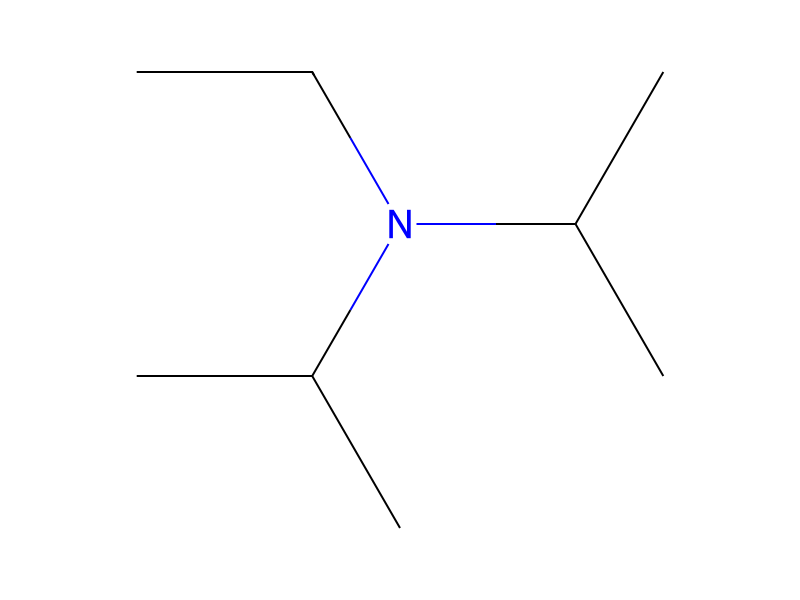

Product 1

Reagents, catalysts & solvents 1
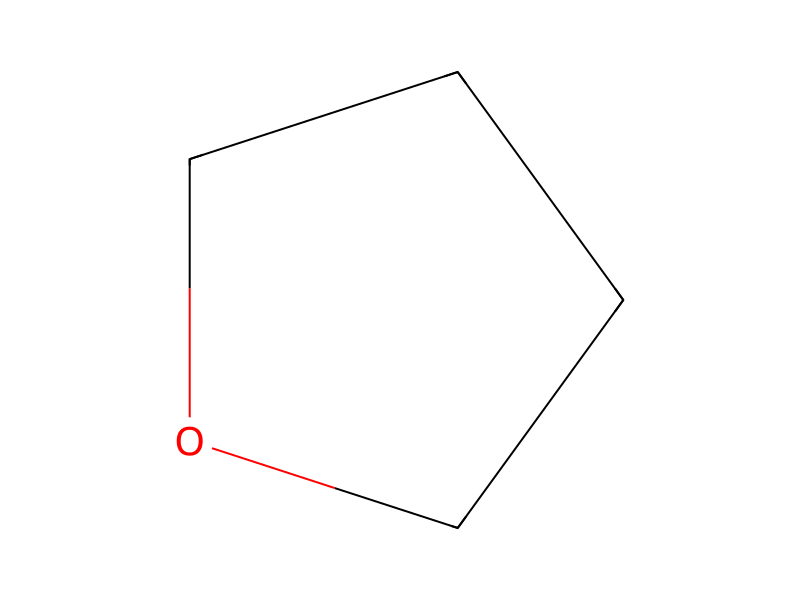
Procedure
FIG. 15 illustrates the synthesis of bifunctional diphosphitylating, triphosphitylating, and tetraphosphitylating reagents (66, 69, 72). For the preparation of 66, phosphorus trichloride (21, 875 μL, 10 mmol) and diisopropylethylamine (1,747 μL, 10 mmol) were added to anhydrous THF. Diisopropylamine (1,400 μL, 10 mmol) was added dropwise in 10 min to the solution mixture and the mixture was stirred for 45 min at 0° C. to yield diisopropylphosphoramidodichloridite (29). Then 3-hydroxypropionitrile (22, 683 μL, 10 mmol) and diisopropylethylamine (1,747 μL, 10 mmol) were added dropwise to the solution of 29 in anhydrous THF during 10 min period. The stirring was continued for 25 min at 0° C. to afford 2-cyanoethyl diisopropylphosphoramidochloridite (24). Water (180 μL, 10 mmol) and diisopropylethylamine (1,747 μL, 10 mmol) were added dropwise in 10 min period to the solution. The mixture was stirred for 10 min at 0° C. to yield 2-cyanoethyl diisopropylamine hydroxyphosphite (25). Then 29 (1 eq, 10 mmol) that was prepared at the same time in a separate reaction vessel, was added dropwise in 10 min period to the solution containing 25. The mixture was stirred for 25 min at 0° C. to yield diisopropylphosphoramidochloridite-O-2-cyanoethyl diisopropylphosphoramidite 66 (bifunctional diphosphitylating reagent). The reaction mixture containing diphosphitylating reagent 66 was immediately used in coupling reactions with polymer-bound p-acetoxybenzyl alcohol 78. Further stability studies on 66 using mass spectrometry methods showed that the compound remained stable after 2 months storage at −20° C.
Sources & evidence
- ORD record
- ord-1661404558ff4d7fbada96c977d90b36
- Source dataset
- uspto-grants-2012_06
- Patent number
- US08193384B2
Reaction notes
Loading…