HomeMCPWorkbenchSkills
HomeWorkbenchNotificationsMe
llms.txt · MCP GuidePrivacy Policy · Terms of Service · Supportv1.8.3
  1. Home
  2. /Compound

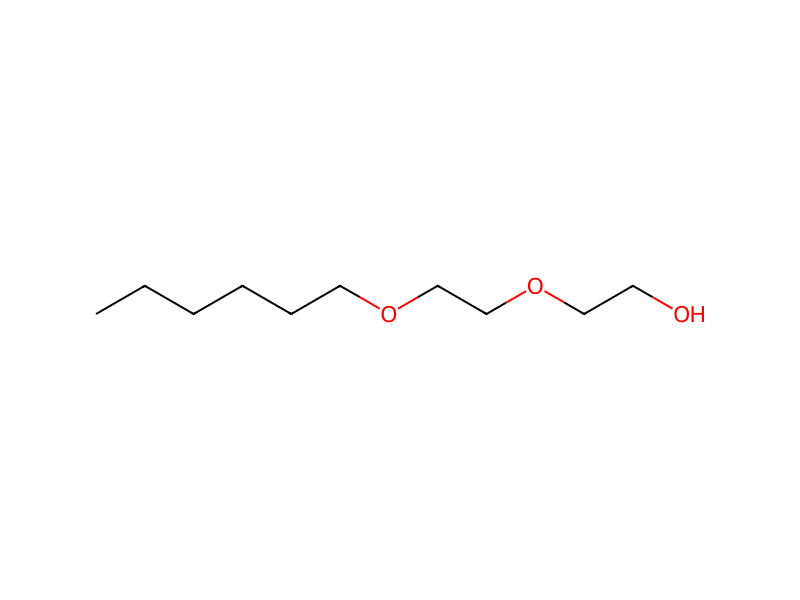
Diethylene glycol monohexyl ether

HCID 8199
New reaction
Print
Basic informationOverviewNames & identifiersPropertiesSafety & regulationChemistry & industryRelated reactionsCompound notes
Substructure searchFind similar structures

Basic information

CAS
112-59-4
Standard SMILES
CCCCCCOCCOCCO
InChIKey
GZMAAYIALGURDQ-UHFFFAOYSA-N
Molecular formula
C10H22O3
Average molar mass
190.28 g/mol
Monoisotopic mass
190.15689456

Overview

Diethylene glycol n-hexyl ether is a water-white liquid. (USCG, 1999)

Names & identifiers

Preferred name
Diethylene glycol monohexyl ether
IUPAC
2-(2-hexoxyethoxy)ethanol
English name
2-(2-Hexyloxyethoxy)ethanol
Molecular formula
C10H22O3
Molecular weight
190.28

Names & synonyms

Diethylene glycol monohexyl ether112-59-4Hexyl carbitol2-(2-(hexyloxy)ethoxy)ethanolHexol carbitoln-Hexyl carbitoln-Hexoxyethoxyethanol3,6-Dioxadodecanol-1HexylkarbitolDiethylene glycol n-hexyl etherDIETHYLENE GLYCOL HEXYL ETHEREthanol, 2-[2-(hexyloxy)ethoxy]-
Show more names
HEDGdeghe2-(2-N-HEXYLOXYETHOXY)ETHANOLC6E2hexyldigolNSC 403666hexylcarbitolHEXYLDIGLYCOL
2-[2-(hexyloxy)ethoxy]ethanolDiethylene glycol mono(n-hexyl) etherEthanol, 2-((2-hexyloxy)ethoxy)-2-((2-Hexyloxy)ethoxy)ethanolDTXSID40269213,6-Dioxa-1-dodecanolEthanol, 2-(2-(hexyloxy)ethoxy)-Z6X09N6YJL

Database identifiers

CAS
112-59-4
PubChem CID
8199
DTXSID
DTXSID4026921
ChEMBL
CHEMBL2131110
UNII
Z6X09N6YJL
EC Number
203-988-3
Nikkaji

Properties

Computed structural properties

XLogP
1.7
Topological polar surface area
38.7 Ų
Hydrogen bond donors
1
Hydrogen bond acceptors
3
Rotatable bonds
10
Heavy atoms
13
Formal charge
0
Complexity
86.2

Experimental & physicochemical properties

SolventsSolvents -> Glycol Ethers (E Series)
SpringerMaterials PropertiesBoiling point
LogP · 3 items

log Kow = 1.70

1.70

1.7

Density · 4 items

0.9346 at 68 °F (USCG, 1999) - Less dense than water; will float

0.9346 at 25 °C/4 °C

Relative density (water = 1): 0.935

0.935 @25 °C

Viscosity8.6 cP at 20 °C
Color/FormWater-white liquid
Solubility · 2 items

In water, 17,000 mg/L at 20 °C

Solubility in water, g/100ml at 20 °C: 1.7

Flash Point · 4 items

285 °F (USCG, 1999)

Flash point equals 285 °F

271 °F (OPEN CUP)

140.6 °C o.c.

Boiling Point · 5 items

Safety & regulation

Safety information is for reference only and does not replace the supplier’s Safety Data Sheet (SDS), applicable regulations, or professional assessment.

GHS classification

GHS Classification · 6 items

Danger

H312: Harmful in contact with skin [Warning Acute toxicity, dermal]

P264+P265, P280, P302+P352, P305+P354+P338, P317, P321, P362+P364, and P501 (click each P-code to see the statement)

Danger

H312 (100%): Harmful in contact with skin [Warning Acute toxicity, dermal]

P261, P264+P265, P271, P280, P302+P352, P304+P340, P305+P354+P338, P317, P319, P321, P362+P364, P403+P233, P405, and P501 (click each P-code to see the statement)

Hazard information

Regulatory Information · 4 items

Chemical: Ethanol, 2-[2-(hexyloxy)ethoxy]-

Ethanol, 2-[2-(hexyloxy)ethoxy]- is listed on the EPA's Chemical Data Reporting (CDR) system. Manufacturers and importers of Ethanol, 2-[2-(hexyloxy)ethoxy]- are required to report information about their production and use of this chemical to the EPA under the Toxic Substances Control Act (TSCA). (40 eCFR Part 711)

REACH registered substance: 2-(2-hexyloxyethoxy)ethanol (EC: 203-988-3)

Diethylene glycol mono-N-hexyl ether: Does not have an individual approval but may be used under an appropriate group standard

Other Safety InformationIMAP assessments - Ethoxylates of aliphatic alcohols (>C6): Human health tier II assessment
Fire Hazards · 2 items

Special Hazards of Combustion Products: Irritating vapors and toxic gases, such as carbon dioxide and carbon monoxide, may be formed when involved in fire. (USCG, 1999)

Combustible.

Fire PotentialCombustible
Health HazardsExposure can cause irritation of eyes, nose and throat. (USCG, 1999)

Chemistry & industry

Uses & manufacturing

Uses · 4 items

Used as a solvent for coatings and degreasing; [HSDB]

Metal Degreasing [Category: Clean]

High-boiling solvent

SOLVENT (EG, FOR SURFACE COATINGS & CLEANING SOLNS)

U.S. Production · 6 items

2023: 1,000,000 - <8,500,000 lb

(1979) PROBABLY GREATER THAN 4.54X10+6 GRAMS

(1981) PROBABLY GREATER THAN 4.54X10+6 GRAMS

Production volumes for non-confidential chemicals reported under the Inventory Update Rule. [Table#5440]

(2006): 1,612 million lb annual capacity /Glycol ethers/

This chemical is listed as a High Production Volume (HPV) (65FR81686). Chemicals listed as HPV were produced in or imported into the U.S. in >1 million pounds in 1990 and/or 1994. The HPV list is based on the 1990 Inventory Update Rule. (IUR) (40 CFR part 710 subpart B; 51FR21438).

Consumer UsesSolvent
Industry UsesIntermediate
Methods of Manufacturing · 2 items

REACTION OF ETHYLENE OXIDE WITH 1-HEXANOL (PRODUCT IS ISOLATED FROM THE REACTION MIXT BY VACUUM DISTILLATION); REACTION OF DIETHYLENE GLYCOL WITH 1-HEXANOL

Ethylene glycol monoethers are usually produced by reaction of ethylene oxide with the appropriate alcohol. A mixture of homologues is obtained ... The glycol monoethers can be converted to diethers by alkylation with common alkylating agents, such as dimethyl sulfate or alkyl halides ( Williamson synthesis). Glycol dimethyl ethers are formed by treatment of dimethyl ether with ethylene oxide. /Ethylene Glycol Monoethers/

Household ProductsInformation on 2 consumer products that contain Diethylene glycol monohexyl ether in the following categories is provided:
Use Classification · 2 items

EPA Safer Chemical Functional Use Classes -> Solvents

Safer Chemical Classes -> Yellow triangle - The chemical has met Safer Choice Criteria for its functional ingredient-class, but has some hazard profile issues

Related reactions

0 records
New reaction record
No related reactions yet

Compound notes

On this pageBasic informationOverviewNames & identifiersPropertiesSafety & regulationChemistry & industryRelated reactionsCompound notes
J36.821K

498.4 °F at 760 mmHg (USCG, 1999)

boiling point equals 498 ° F

258 °C at 760 mm Hg; 192 °C at 100 mm Hg

259.1 °C

259.1 °C @760 [mm Hg]

DecompositionWhen heated to decomposition it emits acrid smoke and fumes.
Melting Point · 4 items

-27.4 °F (USCG, 1999)

-28 °C

-33.3 °C

-33.3 °C

Vapor DensityRelative vapor density (air = 1): 6.6

Physicochemical properties

Melting point
40 °C · −40 °C (lit.)
Boiling point
258 °C · 258 °C
Density
0.94 · 0.94
vapor pressure
0.01 hPa · <0.01 hPa (20 °C)
refractive index
1.44 · 1.44
Flash point
141 °C · 141 °C
storage temp.
30 °C · Store below +30°C.
solubility
17 g/l · 17g/l
pka
14.37 · 14.37±0.10(Predicted)
form
clear liquid
color
Colorless to Light yellow
PH
5 · 5-7 (200g/l, H2O, 20℃)
explosive limit
1.1 · 1.1-6.3%(V)
Water Solubility
Soluble in water.
Sensitive
Hygroscopic
BRN
1743959 · 1743959
Henry's Law Constant
5.7 · 5.7×102 mol/(m3Pa) at 25℃, Duchowicz et al. (2020)
InChI
1S/C10H22O3/c1-2-3-4-5-7-12-9-10-13-8-6-11/h11H,2-10H2,1H3
InChIKey
GZMAAYIALGURDQ-UHFFFAOYSA-N
SMILES
CCCCCCOCCOCCO
LogP
1.7 · 1.7
CAS DataBase Reference
112 · 112-59-4(CAS DataBase Reference)
FDA UNII
6 X09N6YJL · Z6X09N6YJL
EPA Substance Registry System
Diethylene glycol monohexyl ether (112-59-4)
UNSPSC Code
12352104 · 12352104
NACRES
23 · NA.23
Symbol(GHS)
5 · GHS05,GHS07
Signal word
Danger
Hazard statements
312 · H312-H318
Precautionary statements
280 · P280-P302+P352+P312-P305+P351+P338-P362+P364-P501
PPE
Eyeshields, Faceshields, Gloves, type ABEK (EN14387) respirator filter
Hazard Codes
Xn
Risk Statements
21 · 21-41-38
Safety Statements
26 · 26-36/37-46-36/37/39
WGK Germany
1 · 1
RTECS
2625000 · KL2625000
Autoignition Temperature
210 °C · 210 °C
TSCA
TSCA listed
HS Code
29094400 · 29094400
Storage Class
10 · 10 - Combustible liquids
Hazard Classifications
4 DermalEye · Acute Tox. 4 DermalEye Dam. 1
Hazardous Substances Data
112 · 112-59-4(Hazardous Substances Data)
Toxicity
50 orally · LD50 orally in Rabbit: 2400 mg/kg LD50 dermal Rabbit 1395 mg/kg
REACH Registrations
Active
Hazards Summary · 1 item

A skin and eye irritant; [CAMEO] Acute health effects are not expected unless workers are exposed to mist or heated liquid; [CHEMINFO] Dermal LD50 (rabbits) = 2000 mg/kg; In oral or dermal doses > 800-1000 mg/kg/day, causes CNS depression, liver and kidney injury, but no significant developmental toxicity; No effects on fertility at 1000 mg/kg/day; [Reference #1] See GLYCOL ETHERS.

Reactive GroupEthers
EC ClassificationSymbol: Xn; R: 21-41; S: (2)-26-36/37-46
EPA Safer ChemicalChemical: Diethylene glycol hexyl ether
Reactivity AlertsPeroxidizable Compound
Reactivity Profile · 1 item

Ethers, such as DIETHYLENE GLYCOL N-HEXYL ETHER can act as bases. They form salts with strong acids and addition complexes with Lewis acids. The complex between diethyl ether and boron trifluoride is an example. Ethers may react violently with strong oxidizing agents. In other reactions, which typically involve the breaking of the carbon-oxygen bond, ethers are relatively inert.

Chemical DangersThe substance can presumably form explosive peroxides. Reacts violently with strong oxidants.

Safety & protection

Fire Fighting · 2 items

Fire Extinguishing Agents Not to Be Used: Water.

Use water spray, powder, foam, carbon dioxide.

First Aid Measures · 4 items

Fresh air, rest.

Remove contaminated clothes. Rinse skin with plenty of water or shower.

First rinse with plenty of water for several minutes (remove contact lenses if easily possible), then refer for medical attention.

Rinse mouth. Give one or two glasses of water to drink.

First AidGet medical attention.
Safe StorageSeparated from strong oxidants.
Disposal Methods · 1 item

SRP: The most favorable course of action is to use an alternative chemical product with less inherent propensity for occupational exposure or environmental contamination. Recycle any unused portion of the material for its approved use or return it to the manufacturer or supplier. Ultimate disposal of the chemical must consider: the material's impact on air quality; potential migration in soil or water; effects on animal, aquatic, and plant life; and conformance with environmental and public health regulations.

Spillage DisposalVentilation. Collect leaking and spilled liquid in sealable containers as far as possible. Personal protection: face shield.
Preventive Measures · 2 items

SRP: The scientific literature for the use of contact lenses in industry is conflicting. The benefit or detrimental effects of wearing contact lenses depend not only upon the substance, but also on factors including the form of the substance, characteristics and duration of the exposure, the uses of other eye protection equipment, and the hygiene of the lenses. However, there may be individual substances whose irritating or corrosive properties are such that the wearing of contact lenses would be harmful to the eye. In those specific cases, contact lenses should not be worn. In any event, the usual eye protection equipment should be worn even when contact lenses are in place.

...BECAUSE OF ITS TOXICITY, /IT/ SHOULD BE HANDLED WITH CARE & CAUTION TO PREVENT EYE CONTACT. IT WOULD SEEM WISE ALSO TO EXERCISE CARE TO AVOID PROLONGED OR REPEATED INHALATION EXPOSURE, ESP IF IT IS HANDLED HOT OR IF OPERATIONS CALL FOR AGITATED OR NEBULIZATION SO THAT FOG OR MIST IS GENERATED.

Eye PreventionWear safety goggles.
Fire PreventionNO open flames.
Inhalation RiskA harmful contamination of the air will not or will only very slowly be reached on evaporation of this substance at 20 °C.
Skin PreventionProtective gloves.
Ingestion PreventionDo not eat, drink, or smoke during work.

Toxicology

Environmental Fate · 3 items

TERRESTRIAL FATE: Based on a classification scheme(1), an estimated Koc value of 200(SRC), determined from a log Kow of 1.70(2) and a regression-derived equation(3), indicates that diethylene glycol hexyl ether is expected to have moderate mobility in soil(SRC). Volatilization of diethylene glycol hexyl ether from moist soil surfaces is not expected to be an important fate process(SRC) given an estimated Henry's Law constant of 1.7X10⁻⁸ atm-cu m/mole(SRC), derived from its vapor pressure, 1.18X10⁻³ mm Hg(4), and water solubility, 1.7X10+4 mg/L(5). Diethylene glycol hexyl ether is not expected to volatilize from dry soil surfaces(SRC) based upon its vapor pressure(4). Biodegradation of diethylene glycol hexyl ether may take place based on a study using pure culture Pseudomonas sp 4-5-3 which degraded diethylene glycol hexyl ether 34% in 7 days at 30 °C(6).

AQUATIC FATE: Based on a classification scheme(1), an estimated Koc value of 200(SRC), determined from a log Kow of 1.70(2) and a regression-derived equation(3), indicates that diethylene glycol hexyl ether is expected to adsorb to suspended solids and sediment(SRC). Volatilization from water surfaces is not expected(3) based upon an estimated Henry's Law constant of 1.7X10⁻⁸ atm-cu m/mole(SRC), derived from its vapor pressure, 1.18X10⁻³ mm Hg(4), and water solubility, 1.7X10+4 mg/L(5). According to a classification scheme(6), an estimated BCF of 4(SRC), from its log Kow(2) and a regression-derived equation(7), suggests the potential for bioconcentration in aquatic organisms is low(SRC). Biodegradation of diethylene glycol hexyl ether may take place based on a study using pure culture Pseudomonas sp 4-5-3 which degraded diethylene glycol hexyl ether 34% in 7 days at 30 °C(8).

ATMOSPHERIC FATE: According to a model of gas/particle partitioning of semivolatile organic compounds in the atmosphere(1), diethylene glycol hexyl ether, which has an estimated vapor pressure of 1.18X10⁻³ mm Hg at 25 °C(2), is expected to exist solely as a vapor in the ambient atmosphere. Vapor-phase diethylene glycol hexyl ether is degraded in the atmosphere by reaction with photochemically-produced hydroxyl radicals(SRC); the half-life for this reaction in air is estimated to be 9.5 hours(SRC), calculated from its rate constant of 4.0X10⁻¹¹ cu cm/molecule-sec at 25 °C(SRC) that was derived using a structure estimation method(3). Alcohols and ethers do not contain chromophores that absorb at wavelengths >290 nm and therefore diethylene glycol hexyl ether is not expected to be susceptible to direct photolysis by sunlight(4).

Adverse EffectsNeurotoxin - Acute solvent syndrome
Exposure RoutesThe substance can be absorbed into the body through the skin.
Signs and Symptoms · 3 items

Redness. Pain.

Redness. Pain.

Abdominal pain. Nausea. Vomiting. Diarrhoea.

Soil Adsorption/Mobility · 1 item

The Koc of diethylene glycol hexyl ether is estimated as 200(SRC), using a log Kow of 1.70(1) and a regression-derived equation(2). According to a classification scheme(3), this estimated Koc value suggests that diethylene glycol hexyl ether is expected to have moderate mobility in soil(SRC).

Human Toxicity Excerpts · 3 items

/SIGNS AND SYMPTOMS/ IT IS MILDLY TO MODERATELY IRRITATING TO THE SKIN BUT SHOULD CAUSE NO SERIOUS INJURY UNLESS THE EXPOSURE IS PROLONGED & SEVERE.

/SIGNS AND SYMPTOMS/ 1. CENTRAL NERVOUS DEPRESSION... 3. NAUSEA, VOMITING, & SOMETIMES DIARRHEA. 4. ...HEADACHE. LATER ABDOMINAL & LUMBAR PAIN & COSTOVERTEBRAL ANGLE TENDERNESS. 5. TRANSIENT POLYURIA & THEN OLIGURIA, PROGRESSING TO ANURIA. 6. ACUTE RENAL FAILURE... /DIETHYLENE GLYCOL & ITS MONOETHERS/

/SIGNS AND SYMPTOMS/ ... PATHOLOGICAL LESIONS MAY APPEAR IN BRAIN, LUNGS, LIVER, MENINGES & HEART. /DIETHYLENE GLYCOL & ITS MONOETHERS/

Artificial Pollution SourcesDiethylene glycol hexyl ether's production and use as a high boiling solvent(1) may result in its release to the environment through various waste streams(SRC).
Environmental BiodegradationAEROBIC: Diethylene glycol hexyl ether was shown to biodegrade 34% in 7 days at 30 °C using a pure culture of Pseudomonas sp 4-5-3(1).
Environmental Bioconcentration · 1 item

An estimated BCF of 4 was calculated in fish for diethylene glycol hexyl ether(SRC), using a log Kow of 1.70(1) and a regression-derived equation(2). According to a classification scheme(3), this BCF suggests the potential for bioconcentration in aquatic organisms is low(SRC).

Volatilization from Water/Soil · 1 item

The Henry's Law constant for diethylene glycol hexyl ether is estimated as 1.7X10⁻⁸ atm-cu m/mole(SRC) derived from its vapor pressure, 1.18X10⁻⁸ mm Hg(1), and water solubility, 1.7X10+4 mg/L(2). This Henry's Law constant indicates that diethylene glycol hexyl ether is expected to be essentially nonvolatile from water surfaces(3). Diethylene glycol hexyl ether is not expected to volatilize from dry soil surfaces(SRC) based upon its vapor pressure(1).

Non-Human Toxicity Excerpts · 4 items

/LABORATORY ANIMALS: Acute Exposure/ RATS EXPOSED TO ESSENTIALLY SATURATED VAPORS GENERATED AT ROOM TEMPERATURE FOR 8 HR EXPERIENCED NO SIGNIFICANT ILL EFFECTS & ALL SURVIVED.[Bingham, E.; Cohrssen, B.; Powell, C.H.; Patty's Toxicology Volumes 1-9 5th ed. John Wiley & Sons. New York, N.Y. (2001)., p. V7 209]

/LABORATORY ANIMALS: Acute Exposure/ IT IS SEVERELY IRRITATING TO THE EYE AND MAY CAUSE MARKED CORNEAL INJURY WHICH MAY BE SLOW IN HEALING.[Bingham, E.; Cohrssen, B.; Powell, C.H.; Patty's Toxicology Volumes 1-9 5th ed. John Wiley & Sons. New York, N.Y. (2001)., p. V7 208]

/LABORATORY ANIMALS: Acute Exposure/ The acute handling hazards of /diethylene glycol monohexyl ether (DGHE)/ was investigated. Acute peroral LD50 values in the rat were ... 4.92 mL/kg (males) and 3.73 mL/kg (females). Acute percutaneous LD50 values in the rabbit were 2.14 mL/kg (males) and 2.37 mL/kg (females). There were neither deaths nor signs of toxicity or irritancy during or following a 6-hr exposure of rats to a statically generated substantially saturated vapor atmosphere from ... DGHE at ambient temperature. Occluded dermal application with 0.5 ml test material for 4-hr in rabbits produced moderate inflammation of several days duration, and half of the animals developed necrosis; ... there was minor erythema and edema of about 24-hr duration. In the more demanding conditions of the acute percutaneous toxicity study (24-hr occlusions with up to 4.0 mL/kg) ... DGHE produced persistent erythema, edema, necrosis, and ecchymoses. Rabbit eye irritation studies showed severe effects (conjunctivitis and corneal injury).[Ballantyne B and Myers RC; Vet Hum Toxicol 29 (5): 361-6 (1987)]

/GENOTOXICITY/ Diethylene glycol monohexyl ether (DEGHE) was investigated for the potential to produce genotoxic effects using three in vitro and two in vivo tests. No mutagenic activity occurred in either the absence or presence of metabolic activation with a Salmonella typhimurium reverse assay using strains TA98, TA100, TA1535, TA1537 and TA1538. In a Chinese hamster ovary (CHO) forward gene mutation test (HGPRT locus) there was an increase in the mutation frequencies, which were relatively small compared with the solvent control values, somewhat inconsistent between duplicate cultures and occurred particularly in the presence of metabolic activation. Linear regression analysis indicated a marginally significant trend for dosage versus mutation frequency, suggesting that DEGHE was weakly positive in this test. A sister chromatid exchange test in CHO cells showed no significant dosage-related effects in the presence or absence of metabolic activation. A peripheral blood micronucleus test in mice by dosing with an ip injection of DEGHE did not show any potential for DEGHE to increase the incidence of micronucleated polychromatophilic erythrocytes. In a first femoral bone marrow chromosome aberration test in the rat by peroral dosing, DEGHE did not cause any increase in aberrations for 12-hr and 24-hr samples with males and females or with females at 48-hr sampling. However, with males at 48 hr the two lowest doses showed an increased number of aberrations, but not at the high doses. A repeat study in males with a larger number of doses and 24-h and 48-h samples did not replicate this finding. It is concluded that DEGHE may have limited weak mutagenic activity in vitro but is devoid of clastogenic potential.[Ballantyne B and Vergnes JS; J Appl Toxicol 21 (6): 449-60 (2001)]

Environmental Abiotic Degradation · 1 item

The rate constant for the vapor-phase reaction of diethylene glycol hexyl ether with photochemically-produced hydroxyl radicals has been estimated as 4.0X10⁻¹¹ cu cm/molecule-sec at 25 °C(SRC) using a structure estimation method(1). This corresponds to an atmospheric half-life of about 9.5 hours at an atmospheric concentration of 5X10+5 hydroxyl radicals per cu cm(1). Diethylene glycol hexyl ether is not expected to undergo hydrolysis in the environment due to the lack of functional groups that hydrolyze under environmental conditions(2). Alcohols and ethers do not contain chromophores that absorb at wavelengths >290 nm and therefore diethylene glycol hexyl ether is not expected to be susceptible to direct photolysis by sunlight(3).

Safety data

PPE
Eyeshields, Faceshields, Gloves, type ABEK (EN14387) respirator filter
wgk
1
tsca
TSCA listed
rtecs
KL2625000
hs_code
29094400
Toxicity
LD50 orally in Rabbit: 2400 mg/kg LD50 dermal Rabbit 1395 mg/kg
risk_code
21-41-38
Signal word
Danger
Symbol(GHS)
GHS05,GHS07
hazard_code
Xn
safety_code
26-36/37-46-36/37/39
Storage Class
10 - Combustible liquids
Hazard statements
H312-H318
REACH Registrations
Active
Hazard Classifications
Acute Tox. 4 DermalEye Dam. 1
Autoignition Temperature
210 °C
Precautionary statements
P280-P302+P352+P312-P305+P351+P338-P362+P364-P501
Hazardous Substances Data
112-59-4(Hazardous Substances Data)
General Manufacturing Information · 2 items

All Other Basic Organic Chemical Manufacturing

Ethanol, 2-[2-(hexyloxy)ethoxy]-: ACTIVE

Applications

UsesUsed as a solvent for coatings and degreasing.

General DescriptionWater-white liquid.

Upstream & downstream products

Upstream raw materials

Diethylene glycolToluene1-BromohexaneSodium