
Lithium Bromide
Completing data — refresh the page later to see the latest
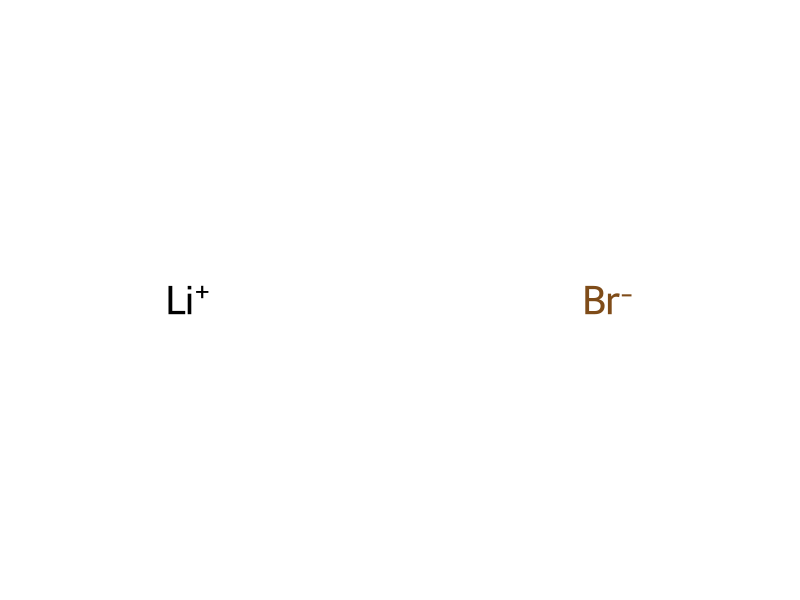
Basic information
- CAS
7550-35-8- Standard SMILES
[Br-].[Li+]- InChIKey
AMXOYNBUYSYVKV-UHFFFAOYSA-M- Molecular formula
- BrLi
- Average molar mass
- 86.9 g/mol
- Monoisotopic mass
- 85.93434165
Overview
Lithium bromide is a lithium salt in which the counterion is bromide. The anhydrous salt forms cubic crystals similar to common salt. It is a bromide salt and a lithium salt.
Names & identifiers
- Preferred name
- Lithium Bromide
- IUPAC
- lithium bromide
- English name
- Lithium bromide
- Molecular formula
- BrLi
- Molecular weight
- 86.85
Names & synonyms
Lithium bromide7550-35-8Lithium monobromideLithium bromide (LiBr)bromolithiumLITHIUM BROMATUM864G646I84CHEBI:63042DTXSID20892222RefChem:55513DTXCID801079305231-439-8
Show more names
LITHIUM HALIDEAnhydrous lithiuM broMideithium bromideLithiumbromide,dihydrateLITHIUM BROMIDE ANYDROUSLithium bromide, extra pure, 99.999%Lithium bromide anhydrous, free-flowing, Redi-Dri, ReagentPlus, >=99%
LITHIUMBROMIDELiBrlithium;bromideBrLiLithium bromide anhydrousLITHIUM BROMIDE, ANHYDROUSMFCD00011077LIthium bromide solution
Database identifiers
- CAS
7550-35-8- PubChem CID
- 82050
- DTXSID
DTXSID20892222- ChEBI
CHEBI:63042- UNII
- 864G646I84
- EC Number
- 231-439-8
- Nikkaji
- J43.853G
Properties
Computed structural propertiesFilling in
- Topological polar surface area
- 0 Ų
- Hydrogen bond donors
- 0
- Hydrogen bond acceptors
- 1
- Rotatable bonds
- 0
- Heavy atoms
- 2
- Formal charge
- 0
- Complexity
- 2
Experimental & physicochemical properties
Chemical ClassesMetals -> Metals, Inorganic Compounds
SpringerMaterials Propertiesdielectric constant
Density3.464 @25 °C
Melting Point550 °C
Physical Description
Dry Powder; Wet Solid; Dry Powder
Highly deliquescent white solid; [Merck Index] White powder, crystals, or beads; Hygroscopic; [Alfa Aesar MSDS]
Physicochemical properties
- Melting point
- 550 °C · 550 °C (lit.)
- Boiling point
- 1265 °C · 1265 °C
- Density
- 1.57 g/mL · 1.57 g/mL at 25 °C
- vapor pressure
- 1 hPa · 1 hPa ( 748 °C)
- Flash point
- 1265 °C · 1265°C
- storage temp.
- Inert atmosphere,Room Temperature
Safety & regulation
Safety information is for reference only and does not replace the supplier’s Safety Data Sheet (SDS), applicable regulations, or professional assessment.
GHS classification
GHS Classification
Warning
H302 (98.2%): Harmful if swallowed [Warning Acute toxicity, oral]
P261, P264, P264+P265, P270, P272, P280, P301+P317, P302+P352, P305+P351+P338, P321, P330, P332+P317, P333+P317, P337+P317, P362+P364, and P501 (click each P-code to see the statement)
Aggregated GHS information provided per 279 reports by companies from 14 notifications to the ECHA C&L Inventory. Each notification may be associated with multiple companies.
Danger
H302: Harmful if swallowed [Warning Acute toxicity, oral]
Hazard information
Regulatory Information
Chemical: Lithium bromide (LiBr)
Lithium bromide (LiBr) is listed on the EPA's Chemical Data Reporting (CDR) system. Manufacturers and importers of Lithium bromide (LiBr) are required to report information about their production and use of this chemical to the EPA under the Toxic Substances Control Act (TSCA). (40 eCFR Part 711)
Status: Active Update: 13-03-2019 https://echa.europa.eu/registration-dossier/-/registered-dossier/13642
Lithium bromide: Does not have an individual approval but may be used under an appropriate group standard
Other Safety InformationIMAP assessments - Lithium bromide (LiBr): Human health tier I assessment
Hazards Summary
Causes flaccid paralysis with appropriate anesthesia, tetany, and arrhythmias in oral lethal-dose studies of mice; [RTECS] High doses may cause CNS depression and disturbed blood electrolyte balance; Chronic exposure may cause skin eruptions and adverse CNS effects; [Merck Index] A skin and strong eye irritant; Harmful by ingestion; [Alfa Aesar MSDS] See Lithium and Bromine.
Hazard Classes and Categories
Chemistry & industry
Pharmacology
Metabolism/Metabolites
Bromine is mainly absorbed via inhalation, but may also enter the body through dermal contact. Bromine salts can be ingested. Due to its reactivity, bromine quickly forms bromide and may be deposited in the tissues, displacing other halogens. (L626)
FDA Pharmacological Classification
LITHIUM BROMATUM
Mood Stabilizer [EPC]
Uses & manufacturing
UsesUsed as a humectant and sedative/hypnotic; [Merck Index]
U.S. Production2023: 100,000 - <250,000 lb
Consumer UsesNot Known or Reasonably Ascertainable
Industry UsesIntermediate
General Manufacturing Information
Petroleum Refineries
Lithium bromide (LiBr): ACTIVE
Applications
DescriptionLithium bromide (LiBr) is the chemical compound of lithium and bromine. It has extreme hygroscopic, making it a suitable desiccant in the air conditioning systems. It can also be used in absorption chilling together with water. It is also useful in the organic synthesis such as forming adduct with some pharmaceuticals. In medical fields, it can be used as a sedative and used for the treatment of bipolar disorder. It can be manufactured by the treatment of lithium carbonate with hydrobromic acid.
UsesLithium bromide is used in absorption, refrigeration and air-conditioning systems. A highly concentrated solution of the salt is an efficient absorbent of water vapor. The vapor pressure of such solution is very low. Other applications include the use of the salt as a swelling agent for wool, hair and other organic fibers; as a catalyst in dehydrohalogenation reactions; and as a sedative and hypnotic in medicine.
Related reactions
948 records


Compound notes
Loading…