트리에탄올아민 보레이트
Triethanolamine borate
HCID 84862
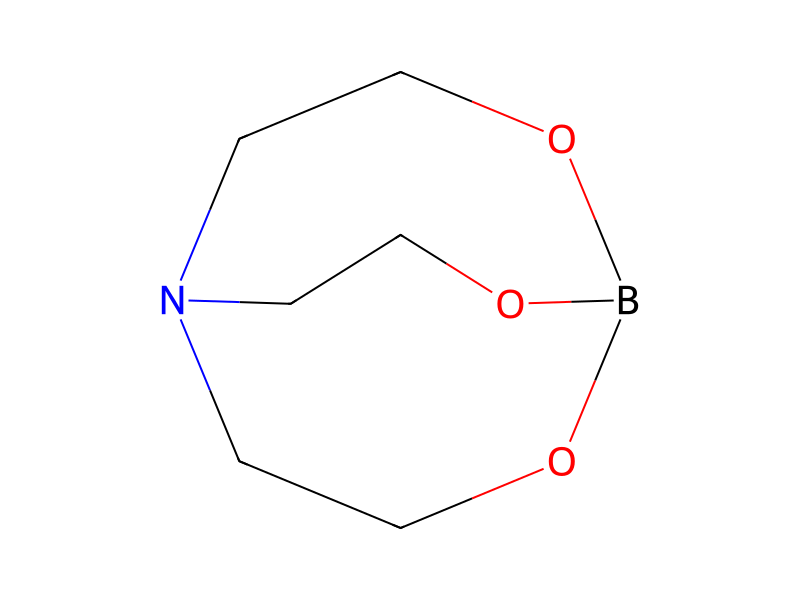
기본 정보
- CAS
15277-97-1- 표준 SMILES
C1CN2CCOB(O1)OCC2- InChIKey
NKPKVNRBHXOADG-UHFFFAOYSA-N- 분자식
- C6H12BNO3
- 평균 분자량
- 156.98 g/mol
- 단동위원소 질량
- 157.0910234
이름 및 식별자
- 우선 이름
- Triethanolamine borate
- IUPAC
- 2,8,9-trioxa-5-aza-1-borabicyclo[3.3.3]undecane
- 현지명
- 트리에탄올아민 보레이트
- 영어명
- Triethanolamine borate
- 분자식
- C6H12BNO3
- 분자량
- 156.98
이름 및 동의어
283-56-72,8,9-Trioxa-5-aza-1-borabicyclo[3.3.3]undecaneBoratraneBoratranAtracor TBORIC ACID, TRIS(2-AMINOETHYL) ESTERNSC 52202,2',2''-Nitrilotriethanol cyclic borateEINECS 206-003-52N1AHN0X56Boron, ((2,2',2''-nitrilotris(ethanolato))(3-))-BRN 0774536
이름 더 보기
트리에탄올아민보레이트2,8,9-트라이옥사-5-아자-1-보라바이사이클로[3.3.3]언데케인C6H12BNO3atracortTRIETHANOLAMINE BORATETriethanolaMine borate 97%TRIS(HYDROXYETHYL)AMINE BORATETRIHYDROXYTRIETHYLAMINE BORATE2,2',2''-Nitrilotriethyl borate
ARBORITE BINDER 75NSC-5220Ethanol, 2,2',2''-nitrilotri-, cyclic borate4-04-00-01529 (Beilstein Handbook Reference)2,8,9-Trioxa-5-aza-1-borabicyclo(3.3.3)undecaneEthanol, 2,2',2''-nitrilotri-, cyclic ester with boric acid (H3BO3) (1:1)TRIETHANOLAMINE BORATE (ESTER)Ethanol, 2,2',2''-nitrilotri-, cyclic borate (7CI)
데이터베이스 식별자
- CAS
15277-97-1、283-56-7- PubChem CID
- 84862
- DTXSID
DTXSID701355429- UNII
- 2N1AHN0X56
- EC Number
- 206-003-5、239-317-6
- Nikkaji
- J25F
물성
구조 계산 물성
- 극성 표면적
- 30.9 Ų
- 수소 결합 공여자 수
- 0
- 수소 결합 수용자 수
- 4
- 회전 가능 결합 수
- 0
- 무거운 원자 수
- 11
- 형식 전하
- 0
- 복잡도
- 111
물리화학적 성질
- 녹는점
- 235 · 235-237 °C(lit.)
- 끓는 점
- 149.6 · 149.6±39.0 °C(Predicted)
- 밀도
- 1.13 · 1.13±0.1 g/cm3(Predicted)
- 저장 조건
- Room Temperature, under inert atmosphere
- 용해도
- 아세톤, 벤젠에 약간 용해됨
- 산도 계수 (pKa)
- 6.4 · 6.40±0.20(Predicted)
- 물리적 상태
- 가루
- 색상
- 하얀색
- 냄새
- 냄새 없는
- BRN
- 774536 · 774536
- InChI
- InChI=1S/C6H12BNO3/c1-4-9-7-10-5-2-8(1)3-6-11-7/h1-6H2
- InChIKey
- NKPKVNRBHXOADG-UHFFFAOYSA-N
- SMILES
- B12OCCN(CCO1)CCO2
화학적 성질
White to off-white solid
안전 및 규제
안전 정보는 참고용이며, 공급업체의 물질안전보건자료(SDS), 관련 법규 및 전문가 평가를 대체하지 않습니다.
GHS 분류
GHS Classification
This chemical does not meet GHS hazard criteria for 26.1% (23 of 88) of reports.
Danger
H315 (29.5%): Causes skin irritation [Warning Skin corrosion/irritation]
P261, P264, P264+P265, P271, P280, P302+P352, P304+P340, P305+P351+P338, P305+P354+P338, P317, P319, P321, P332+P317, P337+P317, P362+P364, P403+P233, P405, and P501 (click each P-code to see the statement)
Aggregated GHS information provided per 88 reports by companies from 4 notifications to the ECHA C&L Inventory. Each notification may be associated with multiple companies.
Warning
유해성 정보
Regulatory Information2,8,9-Trioxa-5-aza-1-borabicyclo[3.3.3]undecane: Does not have an individual approval but may be used as a component in a product covered by a group standard. It is not approved for use as a chemical in its own right.
Hazard Classes and Categories
Skin Irrit. 2 (29.5%)
Skin Irrit. 2 (100%)
안전 데이터
- wgk
- 3
- rtecs
- YJ8968050
- 독성
- LD ivn-mus: >100 mg/kg EJMCA5 13,207,78
- HS 번호
- 2916399090
- risk_code
- 36/37/38
- hazard_code
- Xi
- safety_code
- 26-36/37
- F 고인화성물질
- 10-21
- Hazard Classifications
- Eye Irrit. 2Skin Irrit. 2STOT SE 3
- 스토리지 클래스
- 11 - Combustible Solids
화학 및 산업
용도 및 제조
General Manufacturing InformationBoron, [[2,2',2''-(nitrilo-.kappa.N)tris[ethanolato-.kappa.O]](3-)]-, (T-4)-: ACTIVE
응용 분야
용도Triethanolamine Borate is an intermediate in the synthesis of Silatrane (S433000) which can be used as a reversible cholinesterase inhibitor. Silatrane and its derivatives can also be used as antitumor agents.
일반 설명Triethanolamine borate can be formed from the 1:1 aqueous solution of boric acid and triethanolamine. It is used as buffer.
제조 방법
triethanolamine borate synthesis: Adding trimethyl borate into the reaction bottle62.7g (0.6mol), 74.6g (0.5mol) of triethanolamine and 300g of toluene are slowly heated to reflux for 1 hour at room temperature, then distillate is distilled out under normal pressure (65-100°C) while reaction is carried out, sampling is carried out by GC detection, after the reaction is finished, reduced pressure concentration is carried out until no liquid distillation is carried out, acetonitrile is added for recrystallization, filtration and drying are carried out, 68g of white solid is obtained, HPLC (high performance liquid chromatography) is 98.8%, and the yield is 86.6%.
상·하류 제품 정보
상류 원료
관련 반응
0건
아직 관련 반응이 없습니다