
uspto-grants-2004_03 · 10.6084/m9.figshare.5104873.v1 · US06706743B2
查看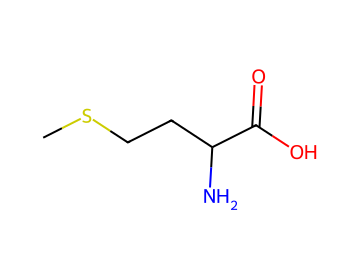
IDENTITY
COMPUTED
PROPERTIES
Relative density (water = 1): 1.3
32.7 mg/mL at 25 °C
Solubility in water, g/100ml at 20 °C: 4.8
Soluble in water; Insoluble in ether
Soluble (in ethanol)
300.00 to 301.00 °C. @ 760.00 mm Hg
281 °C
281 °C
Solid; [Merck Index] Colorless or white solid; [ICSC] White powder; [Sigma-Aldrich MSDS]
Solid
COLOURLESS CRYSTALS OR WHITE POWDER.
White crystalline platelets or powder; Characteristic aroma
GHS
This chemical does not meet GHS hazard criteria for 99% (197 of 199) of all reports.
Not Classified;Reported as not meeting GHS hazard criteria by 197 of 199 companies (only 1% companies provided GHS information). For more detailed information, please visit ECHA C&L website.
Aggregated GHS information provided per 199 reports by companies from 4 notifications to the ECHA C&L Inventory.;Reported as not meeting GHS hazard criteria per 197 of 199 reports by companies.;There are 2 notifications provided by 2 of 199 reports by companies with hazard statement code(s).;Information may vary between notifications depending on impurities, additives, and other factors. The percentage value in parenthesis indicates the notified classification ratio from companies that provide hazard codes. Only hazard codes with percentage values above 10% are shown. For more detailed information, please visit ECHA C&L website.
HAZARDS
Chemical: DL-Methionine
Commission Regulation (EC) No 1565/2000 (Repealed by Com. Implementing Reg. (EU) No 872/2012)
Methionine is listed on the EPA's Chemical Data Reporting (CDR) system. Manufacturers and importers of Methionine are required to report information about their production and use of this chemical to the EPA under the Toxic Substances Control Act (TSCA). (40 eCFR Part 711)
Methionine: Does not have an individual approval but may be used under an appropriate group standard
IMAP assessments - DL-Methionine: Human health tier I assessment;IMAP assessments - DL-Methionine: Environment tier I assessment
Gives off irritating or toxic fumes (or gases) in a fire.
Causes pigmented or nucleated red blood cells, changes in leukocyte counts, and changes in liver, bladder, and spleen weights in repeated-dose oral studies of rats; [RTECS] No listed effects of short-term or long-term exposure; [ICSC] Safe when used as a flavoring agent in food; [JECFA] May cause irritation; [Sigma-Aldrich MSDS]
Chemical: DL-Methionine; Green circle - The chemical has been verified to be of low concern based on experimental and modeled data.
Decomposes on heating. This produces toxic fumes of sulfur oxides and nitrous oxides.
Not Classified
SAFETY
Use water spray, powder, foam, carbon dioxide.
Fresh air, rest.
Rinse skin with plenty of water or shower.
First rinse with plenty of water for several minutes (remove contact lenses if easily possible), then refer for medical attention.
Rinse mouth.
Separated from strong oxidants. Well closed.
Sweep spilled substance into covered containers. Carefully collect remainder. Then store and dispose of according to local regulations.
Wear safety spectacles.
Do not eat, drink, or smoke during work.
Use local exhaust.
TOXICITY
The substance can be absorbed into the body by ingestion.
REGULATORY
Chemical: DL-Methionine
Commission Regulation (EC) No 1565/2000 (Repealed by Com. Implementing Reg. (EU) No 872/2012)
Methionine is listed on the EPA's Chemical Data Reporting (CDR) system. Manufacturers and importers of Methionine are required to report information about their production and use of this chemical to the EPA under the Toxic Substances Control Act (TSCA). (40 eCFR Part 711)
Methionine: Does not have an individual approval but may be used under an appropriate group standard
PHARMACOLOGY
Cytoplasm;Extracellular
USES
An essential amino acid; Used therapeutically as an antidote for acetaminophen poisoning and a urinary acidifier; [Merck Index] Used as a flavoring agent and nutritional supplement; [FDA]
2021: 246,400 lb
Not Known or Reasonably Ascertainable
EPA Safer Chemical Functional Use Classes -> Enzymes and Enzyme Stabilizers
Safer Chemical Classes -> Green circle - The chemical has been verified to be of low concern
Flavouring Agent -> FLAVOURING_AGENT -> JECFA Functional Classes
Flavoring Agents -> JECFA Flavorings Index
Cosmetics -> Hair conditioning; Antistatic; Skin conditioning
Not Known or Reasonably Ascertainable
Methionine: ACTIVE
ALIASES
REACTIONS
uspto-grants-2004_03 · 10.6084/m9.figshare.5104873.v1 · US06706743B2
查看
Training data from https://doi.org/10.1039/C8SC04228D (2/10) · 10.1039/C8SC04228D
查看
Training data from https://doi.org/10.1039/C8SC04228D (2/10) · 10.1039/C8SC04228D
查看
Training data from https://doi.org/10.1039/C8SC04228D (2/10) · 10.1039/C8SC04228D
查看
Training data from https://doi.org/10.1039/C8SC04228D (9/10) · 10.1039/C8SC04228D
查看
Training data from https://doi.org/10.1039/C8SC04228D (9/10) · 10.1039/C8SC04228D
查看
Training data from https://doi.org/10.1039/C8SC04228D (9/10) · 10.1039/C8SC04228D
查看
Training data from https://doi.org/10.1039/C8SC04228D (9/10) · 10.1039/C8SC04228D
查看