Carbamol
HCID 8827
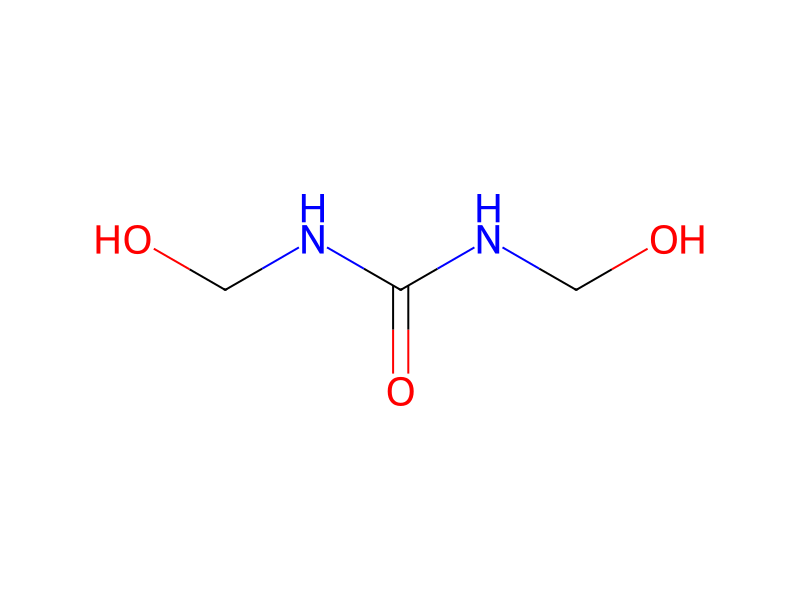
Basic information
- CAS
140-95-4- Standard SMILES
O=C(NCO)NCO- InChIKey
QUBQYFYWUJJAAK-UHFFFAOYSA-N- Molecular formula
- C3H8N2O3
- Average molar mass
- 120.11 g/mol
- Monoisotopic mass
- 120.05349212
Overview
Oxymethurea is a member of ureas.
Names & identifiers
- Preferred name
- Carbamol
- IUPAC
- 1,3-bis(hydroxymethyl)urea
- English name
- Dimethylolurea
- Molecular formula
- C3H8N2O3
- Molecular weight
- 120.11
Names & synonyms
1,3-Bis(hydroxymethyl)ureaN,N'-Bis(hydroxymethyl)ureaCarbamolRefChem:857848Dimethylolurea140-95-4OxymethureaN,N'-DimethylolureaMethuralProtesine DMU1,3-DimethylolureaMetural
Show more names
Methurin
Urea, N,N'-bis(hydroxymethyl)-Finish ENKnittex ASLUreol PCSI PasteCauriteUrofixKaurit S
Database identifiers
- CAS
140-95-4- PubChem CID
- 8827
- DTXSID
DTXSID6025141- ChEMBL
CHEMBL3185052- ChEBI
CHEBI:134755- UNII
- N68H97CAWG
- EC Number
- 205-444-0
- Nikkaji
- J10.647J
Properties
Computed structural properties
- XLogP
- -1.8
- Topological polar surface area
- 81.6 Ų
- Hydrogen bond donors
- 4
- Hydrogen bond acceptors
- 3
- Rotatable bonds
- 2
- Heavy atoms
- 8
- Formal charge
- 0
- Complexity
- 66.9
Experimental & physicochemical properties
Chemical ClassesOther Uses -> Biocides/Disinfectants
SpringerMaterials Properties15N nuclear magnetic resonance spectrum
Vapor Pressure0.00000399 [mmHg]
Physical DescriptionLiquid
Collision Cross Section151.7 Ų [M+Na]+ [CCS Type: DT; Buffer gas: N2; Ionization: ESI+; Dataset: TOXCAST; Source Identifier: DTXSID6025141]
Physicochemical properties
- Melting point
- 125 °C · 125 °C (dec.)(lit.)
- Boiling point
- 224.08 °C · 224.08°C (rough estimate)
- Density
- 1.34 · 1.34
- refractive index
- 1.461 · 1.4610 (estimate)
- Flash point
- 100 °C · 100 °C
- storage temp.
- 2 · 2-8°C
Safety & regulation
Safety information is for reference only and does not replace the supplier’s Safety Data Sheet (SDS), applicable regulations, or professional assessment.
GHS classification
GHS Classification
This chemical does not meet GHS hazard criteria for 48.4% (104 of 215) of reports.
Warning
H319 (51.2%): Causes serious eye irritation [Warning Serious eye damage/eye irritation]
P264+P265, P280, P305+P351+P338, and P337+P317 (click each P-code to see the statement)
Aggregated GHS information provided per 215 reports by companies from 7 notifications to the ECHA C&L Inventory.
Hazard information
Regulatory Information
Chemical: Urea, N,N'-bis(hydroxymethyl)-
Urea, N,N'-bis(hydroxymethyl)- is listed on the EPA's Chemical Data Reporting (CDR) system. Manufacturers and importers of Urea, N,N'-bis(hydroxymethyl)- are required to report information about their production and use of this chemical to the EPA under the Toxic Substances Control Act (TSCA). (40 eCFR Part 711)
REACH registered substance: 1,3-bis(hydroxymethyl)urea (EC: 205-444-0)
Carbamol: Does not have an individual approval but may be used under an appropriate group standard
Hazards Summary
A formaldehyde releaser, dimethylol urea can cause allergic contact dermatitis in workers handling durable press chemical finishes used on fabrics for wrinkle resistance; Cases were reported in the 1950s before the textile industry started using finishes releasing less formaldehyde; [Kanerva, p. 397-408]
Hazard Classes and CategoriesEye Irrit. 2 (51.2%)
Toxicology
Adverse EffectsSkin Sensitizer - An agent that can induce an allergic reaction in the skin.
Chemistry & industry
Uses & manufacturing
Uses
Used in the production of urea-formaldehyde resins and as a textile finish; [Kanerva, p. 405]
Using Disinfectants or Biocides [Category: Clean]
U.S. Production2023: 75,000 - <500,000 lb
Industry UsesIntermediate
General Manufacturing Information
Wood Product Manufacturing
Urea, N,N'-bis(hydroxymethyl)-: ACTIVE
Applications
UsesIn the textile industry in cotton crease- and shrink-proofing, finishing, drying, sizing; in tanning; pesticides; in photographic developers.
Uses1,3-Bis(hydroxymethyl)urea is used in preparation method of insulating waterborne polyurethane dispersion coating for electronic and electrical components.
Upstream & downstream products
Upstream raw materials
Downstream products
Additional notes
DefinitionChEBI: Oxymethurea is a member of ureas.
Related reactions
0 records
No related reactions yet