HomeMCPWorkbenchSkills
HomeWorkbenchNotificationsMe
llms.txt · MCP GuidePrivacy Policy · Terms of Service · Supportv1.8.3
  1. Home
  2. /Compound

Malonic acid, disodium salt

HCID 8865
New reaction
Print

Completing data — refresh the page later to see the latest
Basic informationOverviewNames & identifiersPropertiesSafety & regulationChemistry & industryRelated reactionsCompound notes
Substructure searchFind similar structures

Basic information

CAS
141-95-7
Standard SMILES
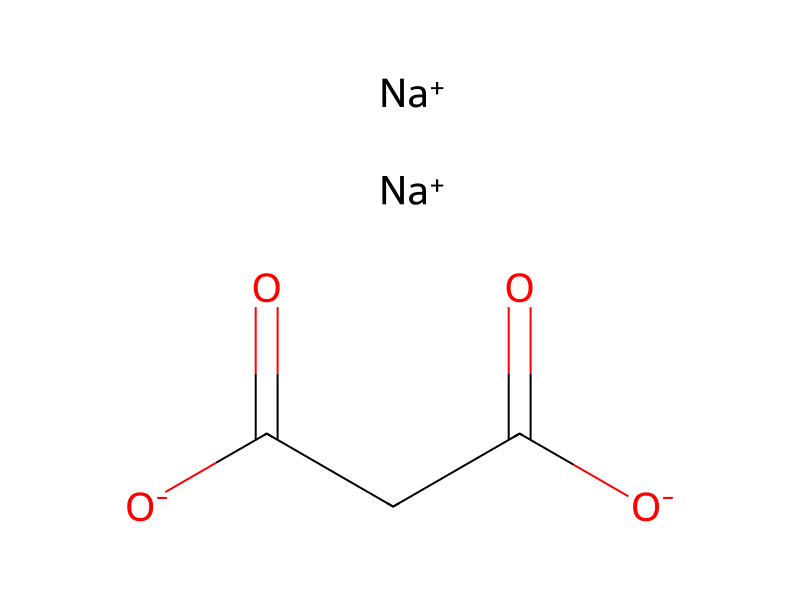
O=C([O-])CC(=O)[O-].[Na+].[Na+]
InChIKey
PRWXGRGLHYDWPS-UHFFFAOYSA-L
Molecular formula
C3H2Na2O4
Average molar mass
148.02 g/mol
Monoisotopic mass
147.9748471

Overview

Sodium malonate is the organic sodium salt formed between sodium and malonic acid (molar ratio 2:1). It contains a malonate(2-).

Names & identifiers

Preferred name
Malonic acid, disodium salt
IUPAC
disodium;propanedioate
English name
Malonic acid disodium salt
Molecular formula
C3H2Na2O4
Molecular weight
148.03

Names & synonyms

Malonic acid, disodium saltRefChem:135058Sodium malonateDisodium malonate141-95-7Malonic acid disodium saltdisodium propanedioatePROPANEDIOIC ACID, DISODIUM SALTdisodium;propanedioatePropanedioic acid, sodium salt (1:2)Sodium malonate dibasicMalonic acid, sodium salt
Show more names
Malonic Acid SodiumSODIUM MALONITESodiumpropanedioateDisodiumMalonate>disodium:propanedioatemalonicacid,sodiumsaltPropanedioic acid, sodiuM
MALONICACIDDISODIUMSALTMFCD00002708Propanedioic acid, sodium saltDicarboxymethane disodium saltCarboxyacetic Acid disodium salt9QWE64M39HPropanedioic Acid disodium salt23549-97-5

Database identifiers

CAS
141-95-7、23549-97-5
PubChem CID
8865
DTXSID
DTXSID8059712
ChEMBL
CHEMBL359504
ChEBI
CHEBI:62983
UNII
9QWE64M39H
EC Number
205-514-0、923-174-8
Nikkaji
J22.511H

Properties

Computed structural propertiesFilling in

Topological polar surface area
80.3 Ų
Hydrogen bond donors
0
Hydrogen bond acceptors
4
Rotatable bonds
0
Heavy atoms
9
Formal charge
0
Complexity
72.1

Experimental & physicochemical properties

Chemical ClassesMetals -> Organic Acids, Metal Salts
Physical DescriptionWhite crystalline solid; [Sigma-Aldrich MSDS]

Physicochemical properties

Density
2.08 g/cm3 · 2.08 g/cm3
solubility
2 O: · H2O: 1 M at 20 °C, clear, colorless
form
Powder
color
White to Almost white
PH
pH (50g/l, 25℃) : 8.0~10.0
Water Solubility
Soluble in water (148 g/L at 20°C).
BRN
3917013 · 3917013
Stability
Stable. Incompatible with strong oxidizing agents.
InChI
InChI=1S/C3H4O4.2Na/c4-2(5)1-3(6)7;;/h1H2,(H,4,5)(H,6,7);;/q;2*+1/p-2
InChIKey
PRWXGRGLHYDWPS-UHFFFAOYSA-L
SMILES
C([O-])(=O)CC([O-])=O.[Na+].[Na+]
CAS DataBase Reference
141 · 141-95-7(CAS DataBase Reference)
FDA UNII
9 QWE64M39H · 9QWE64M39H
EPA Substance Registry System
Propanedioic acid, disodium salt (141-95-7)
UNSPSC Code
12352100 · 12352100
NACRES
22 · NA.22
PPE
95 · Eyeshields, Gloves, type N95 (US)
Safety Statements
22 · 22-24/25
WGK Germany
3 · 3
RTECS
1750000 · OO1750000
TSCA
TSCA listed
HS Code
2917.19 · 2917.19.7050
Storage Class
11 · 11 - Combustible Solids
Toxicity
50 · mouse,LD50,intraperitoneal,1550mg/kg (1550mg/kg),LUNGS, THORAX, OR RESPIRATION: OTHER CHANGESBEHAVIORAL: CONVULSIONS OR EFFECT ON SEIZURE THRESHOLDCARDIAC: OTHER CHANGES,Archives Internationales de Pharmacodynamie et de Therapie. Vol. 79, Pg. 461, 1949.

Safety & regulation

Safety information is for reference only and does not replace the supplier’s Safety Data Sheet (SDS), applicable regulations, or professional assessment.

GHS classification

GHS Classification · 3 items

This chemical does not meet GHS hazard criteria for 100% (22 of 22) of all reports.

Not Classified

Aggregated GHS information provided per 22 reports by companies from 1 notifications to the ECHA C&L Inventory.

Hazard information

Regulatory Information · 2 items

Chemical: Propanedioic acid, disodium salt

Propanedioic acid, disodium salt: Does not have an individual approval but may be used under an appropriate group standard

Other Safety InformationIMAP assessments - Propanedioic acid, disodium salt: Human health tier I assessment
Hazards SummaryCauses convulsions, cardiac changes, and lung changes in intraperitoneal and intravenous lethal-dose studies of mice (intraperitoneal LD50 = 1,550 mg/kg); [RTECS] May cause irritation; [Sigma-Aldrich MSDS] See Malonic acid.
Hazard Classes and CategoriesNot Classified

Safety data

PPE
Eyeshields, Gloves, type N95 (US)
wgk
3
tsca
TSCA listed
rtecs
OO1750000
hs_code
2917.19.7050
Toxicity
mouse,LD50,intraperitoneal,1550mg/kg (1550mg/kg),LUNGS, THORAX, OR RESPIRATION: OTHER CHANGESBEHAVIORAL: CONVULSIONS OR EFFECT ON SEIZURE THRESHOLDCARDIAC: OTHER CHANGES,Archives Internationales de Pharmacodynamie et de Therapie. Vol. 79, Pg. 461, 1949.
safety_code
22-24/25
Storage Class
11 - Combustible Solids

Chemistry & industry

Uses & manufacturing

General Manufacturing InformationPropanedioic acid, sodium salt (1:2): ACTIVE
Applications · 2 items

UsesMalonic acid disodium salt is used in organic Synthesis, pharmaceuticals, agrochemicals and dye stuffs.

UsesSodium malonate dibasic can be use in the synthesis of sodium carbonate and sodium oxalate via wet oxidation and catalytic wet oxidation. It can also be used to synthesize malonato-bridged manganese(II)complexes like [Mn(mal)(H2O)2]n and [Mn2(mal)2(4,4′-bipy)(H2O)2]n,(bipy =bipyridine, mal =malonate), which have the tendency to show weak anti-ferromagnetic effect.

Upstream & downstream products

Upstream raw materials

Chloroacetic acidCyanoacetic acid

Downstream products

Diisopropyl malonatePhenylmalonic acidDimethyl malonateMalonic acid di-n-butyl esterIsoprothiolaneDiethyl malonateMalonic acid

Additional notes

DefinitionChEBI: The organic sodium salt formed between sodium and malonic acid (molar ratio 2:1).

Related reactions

9 records
New reaction record
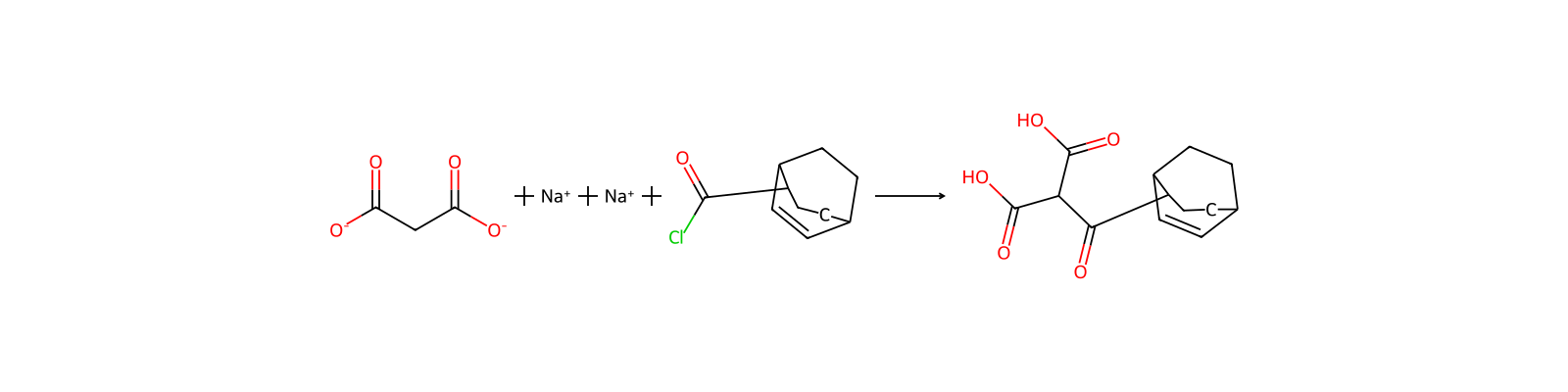
HRID 733500 reaction equation
HRID 733500As reactant
HRID 843188 reaction equation
HRID 843188As reactant
HRID 843189 reaction equation
HRID 843189As reactant
HRID 1385850 reaction equation
HRID 1385850As reactant
HRID 1385851 reaction equation
HRID 1385851As reactant
HRID 1700835 reaction equation
HRID 1700835As reactant
HRID 1700836 reaction equation
HRID 1700836As reactant
HRID 1702217 reaction equation
HRID 1702217As reactant
PreviousPage 1 of 2

Compound notes

On this pageBasic informationOverviewNames & identifiersPropertiesSafety & regulationChemistry & industryRelated reactionsCompound notes