
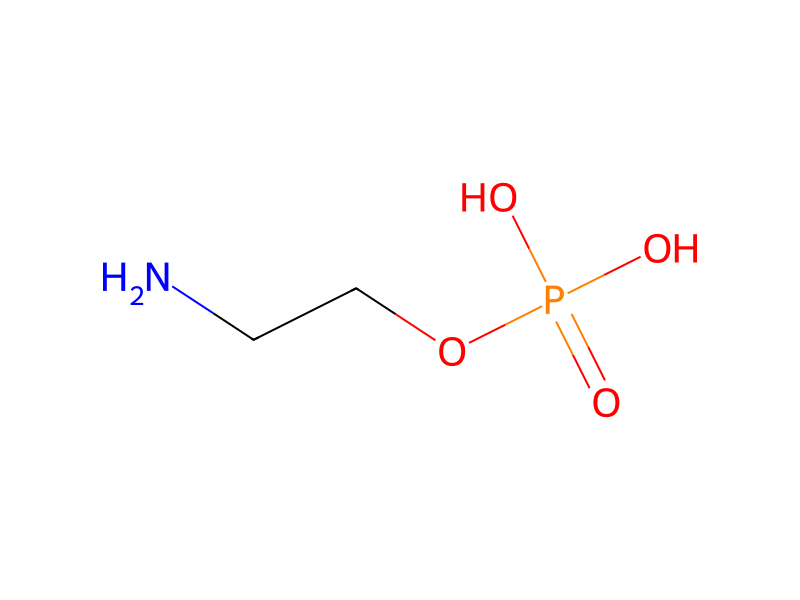
Grundinformationen
- Standard-SMILES
NCCOP(=O)(O)O- InChIKey
SUHOOTKUPISOBE-UHFFFAOYSA-N- Summenformel
- C2H8NO4P
- Durchschnittliche Molmasse
- 141,06 g/mol
- Monoisotopische Masse
- 141,01909473
Namen und Bezeichner
- Bevorzugter Name
- Phosphoethanolamine
- IUPAC
- 2-aminoethyl dihydrogen phosphate
- Lokaler Name
- 2-Aminoethyldihydrogenphosphat
- Englischer Name
- O-Phosphorylethanolamine
- Summenformel
- C2H8NO4P
- Molmasse
- 141.06
Namen und Synonyme
O-Phosphorylethanolamine2-Aminoethyl dihydrogen phosphate1071-23-4O-PhosphoethanolaminePhosphorylethanolaminephosphoethanolamineColamine phosphateethanolamine phosphateEthanolamine O-phosphatePhosphonoethanolaminePhosphorylcolamineMono(2-aminoethyl) phosphate
Weitere Namen anzeigen
PHOSPHORYL COLAMINEPe 104NSC 254167NSC 25416)PHOSPHOCOLAMINEFosforilcolamine
COLAMINE PHOSPHORIC ACIDColaminphosphoric acid(2-aminoethoxy)phosphonic acidmonoaminoethyl phosphate2-amino-ethanol phosphateEthanolamine acid phosphateEthanol, 2-amino-, dihydrogen phosphate (ester)phosphoryl-ethanolamine
Datenbank-Bezeichner
- CAS
1071-23-4- PubChem CID
- 1015
- DTXSID
DTXSID5061453- ChEMBL
CHEMBL146972- ChEBI
CHEBI:17553- UNII
- 78A2BX7AEU
- EC Number
- 213-988-5
- Nikkaji
- J12.176B
Eigenschaften
Berechnete Struktureigenschaften
- XLogP
- -4,8
- Polarare Oberfläche (TPSA)
- 92,8 Ų
- H-Brücken-Donoren
- 3
- H-Brücken-Akzeptoren
- 5
- Frei drehbare Bindungen
- 3
- Schwere Atome
- 8
- Formalladung
- 0
- Komplexität
- 98
Experimentelle und physikochemische Eigenschaften
Solubility72 mg/mL
Melting Point
241-243 °C
241 - 243 °C
Physical DescriptionSolid
Collision Cross Section
121.6 Ų [M-H]- [CCS Type: DT; Method: single field calibrated with Agilent tune mix (Agilent)]
123 Ų [M-H]- [CCS Type: DT; Method: single field calibrated with ESI Low Concentration Tuning Mix (Agilent)];123.2 Ų [M-H]- [CCS Type: DT; Method: single field calibrated with ESI Low Concentration Tuning Mix (Agilent)]
123.4 Ų [M-H]-
Physikochemische Eigenschaften
- Schmelzpunkt
- 241 · 241-243 °C(lit.)
- Siedepunkt
- 335.8 · 335.8±44.0 °C(Predicted)
- Dichte
- 1.554 · 1.554±0.06 g/cm3(Predicted)
- storage temp.
- 30 °C · Store below +30°C.
- Wasserlöslichkeit
- Soluble in water
- Löslichkeit
- PBS (pH 7.2): 10 mg/ml
- pka
- 1 · pK1:5.838(+1);pK2:10.638(0) (25°C)
- Aggregatzustand
- powder to crystal
- Farbe
- White to Light yellow
- BRN
- 1758916 · 1758916
- InChI
- InChI=1S/C2H8NO4P/c3-1-2-7-8(4,5)6/h1-3H2,(H2,4,5,6)
- InChIKey
- SUHOOTKUPISOBE-UHFFFAOYSA-N
- SMILES
- C(OP(O)(O)=O)CN
- CAS Datenbank
- 1071 · 1071-23-4(CAS DataBase Reference)
- EPA chemische Informationen
- 2 · Ethanol, 2-amino-, dihydrogen phosphate (ester) (1071-23-4)
Sicherheit und Regulatorisches
GHS-Klassifizierung
GHS Classification
This chemical does not meet GHS hazard criteria for 3.7% (3 of 80) of reports.
Danger
H314 (92.5%): Causes severe skin burns and eye damage [Danger Skin corrosion/irritation];H318 (38.8%): Causes serious eye damage [Danger Serious eye damage/eye irritation]
P260, P264, P264+P265, P280, P301+P330+P331, P302+P361+P354, P304+P340, P305+P354+P338, P316, P317, P321, P363, P405, and P501 (click each P-code to see the statement)
Aggregated GHS information provided per 80 reports by companies from 6 notifications to the ECHA C&L Inventory. Each notification may be associated with multiple companies.;Reported as not meeting GHS hazard criteria per 3 of 80 reports by companies.;There are 5 notifications provided by 77 of 80 reports by companies with hazard statement code(s).;Information may vary between notifications depending on impurities, additives, and other factors. The percentage value in parenthesis indicates the notified classification ratio from companies that provide hazard codes. Only hazard codes with percentage values above 10% are shown. For more detailed information, please visit ECHA C&L website.
Gefahrenhinweise
Regulatory InformationPhosphorylethanolamine: Does not have an individual approval but may be used under an appropriate group standard
Hazard Classes and CategoriesSkin Corr. 1B (92.5%);Eye Dam. 1 (38.8%)
Regulatorische Informationen
Regulatory InformationPhosphorylethanolamine: Does not have an individual approval but may be used under an appropriate group standard
Sicherheitsdaten
- wgk
- 3
- tsca
- TSCA listed
- ridadr
- UN 3261 8/PG 2
- hs_code
- 29221990
- RTECS-Nr.
- KJ5830000
- risk_code
- 25-34
- Toxizität
- LD50 orally in Rabbit: 5820 mg/kg
- hazard_code
- T,C
- safety_code
- 26-36/37/39-45-27
- hazard_class
- 8
- packing_group
- III
- Speicherklasse
- 11 - Combustible Solids
Chemie und Industrie
Pharmakologische Informationen
Tissue LocationsPlacenta
Cellular LocationsCytoplasm;Endoplasmic reticulum
Metabolite Pathways
Fabry disease;Gaucher Disease;Globoid Cell Leukodystrophy;Krabbe disease;Lamivudine Metabolism Pathway;Metachromatic Leukodystrophy (MLD);Phosphatidylcholine Biosynthesis;Phosphatidylcholine Biosynthesis PC(11D3/11D3);Phosphatidylcholine Biosynthesis PC(11D3/11D5);Phosphatidylcholine Biosynthesis PC(11D3/11M3);Total 1853 pathways, visit the HMDB page for details
Verwendung und Herstellung
General Manufacturing InformationEthanol, 2-amino-, 1-(dihydrogen phosphate): ACTIVE
Anwendungen
VerwendenO-PHOSPHORYLETHANOLAMINEe is used in the synthesis of Sphingomyelin, a type of sphingolipid found in animal cell membrane.
Anbieter50 Anbieter
梯希爱(上海)化成工业发展有限公司021-67121386 · [email protected]
上海阿拉丁生化科技股份有限公司400-6206333 13167063860 · [email protected]
Shandong chuangyingchemical Co., Ltd.18853181302 · [email protected]
山东新高度生物医药科技有限公司13583306133 · [email protected]
合肥翰刚医药科技有限公司+8618062405514 · [email protected]
武汉欣扬瑞和化学科技有限公司153-07155313 15307155313 · [email protected]
河北创海生物科技有限公司+86-86-13131129325 · [email protected]
环生美森医药技术(山东)有限公司0531-88762217 18301471076 · [email protected]
Dayang Chem (Hangzhou) Co.,Ltd.+86-0571-88938639 17705817739 · [email protected]
Syntechem Co.,Ltd[email protected]
上海迈瑞尔生化科技有限公司4006356688 18621169109 · [email protected]
武汉易泰科技有限公司上海分公司18930552037 · [email protected]
上海晶抗生物工程有限公司021-54721350 13524668266 · [email protected]
安耐吉化学&3A(安徽泽升科技股份有限公司)400-0056266 · [email protected]
成都普思生物科技股份有限公司028-85370565-229 18080489829 · [email protected]
MedBio脉铂医药021-69568360 18916172912 · [email protected]
上海隆盛化工有限公司58099637 13585536065 · [email protected]
武汉丰泰威远科技有限公司+86-27-8746-5837 +86-18627785180 · [email protected]
武汉丰泰威远科技有限公司027-87465837 19945049750 · [email protected]
玛雅试剂+86 (573) 82222445 (0)18006601000 452520369 · [email protected]
HONG KONG IPURE BIOLOGY CO.,LIMITED86 18062405514 18062405514 · [email protected]
四川库利南科技有限公司400-1166-196 18981987031 · [email protected]
天津希恩思生化科技有限公司400 638 7771 · [email protected]
Hebei Qige Biological Technology Co. Ltd+86 +8618733132031
上海源叶生物科技有限公司13636370518 · [email protected]
艾科试剂4008-755-333 18080918076 · [email protected]
TCI AMERICA800-4238616 · [email protected]
TOKYO CHEMICAL INDUSTRY CO., LTD.03-36680489 · [email protected]
TCI Europe320-37350700 · [email protected]
上海陶素生化科技有限公司021-33632979 · [email protected]
安徽科迪达化工有限公司0554-2106669 · [email protected]
四川省维克奇生物科技有限公司028-81700200 18116577057 · [email protected]
成都零六生物科技有限公司400-1166-196 13458535857 · [email protected]
雷丁试剂0510-85629785 18013409632 · [email protected]
上海麦克林生化科技股份有限公司15221275939 15221275939 · [email protected]
杭州杰恒化工有限公司0571-87396432 · [email protected]
凯试(上海)科技有限公司021-50135380 · [email protected]
湖北巨胜科技有限公司027-59599241 18871490274 · [email protected]
Sigma-Aldrich西格玛奥德里奇(上海)贸易有限公司021-61415566 800-8193336 · [email protected]
TargetMol中国(陶术生物)021-021-33632979 15002134094 · [email protected]
武汉天植生物技术有限公司18607101326 15172504745 · [email protected]
上海昕凯医药科技有限公司21-619849051-1 18521059765 · [email protected]
上海陶术生物科技股份有限公司+1-781-999-5354; +1-00000000000 · [email protected]
九鼎化学(上海)科技有限公司4009209199 · [email protected]
Wuhan ChemNorm Biotech Co.,Ltd.+86-27-8439 4403 18971486879 · [email protected]
Alfa Chemistry+1-5166625404 · [email protected]
sgtlifesciences pvt ltd+91-8790379245 · [email protected]
EMMX Biotechnology LLC888-539-0666 · [email protected]
湖北阡陌生物科技有限公司0711-3812399 18062309155 · [email protected]
山东西亚化学有限公司4009903999 13395398332 · [email protected]
Ergänzende Hinweise
DefinitionChEBI: The ethanolamine mono-ester of phosphoric acid, and a metabolite of phospholipid metabolism. This phosphomonoester shows strong structural similarity to the inhibitory neurotransmitter GABA, and is decreased in post-mortem Alzheimer's disease brain.
Zugehörige Reaktionen
2

Verknüpfte Notizen
Wird geladen…