Sodium pyruvate, BioXtra, >=99%
HCID 10154024
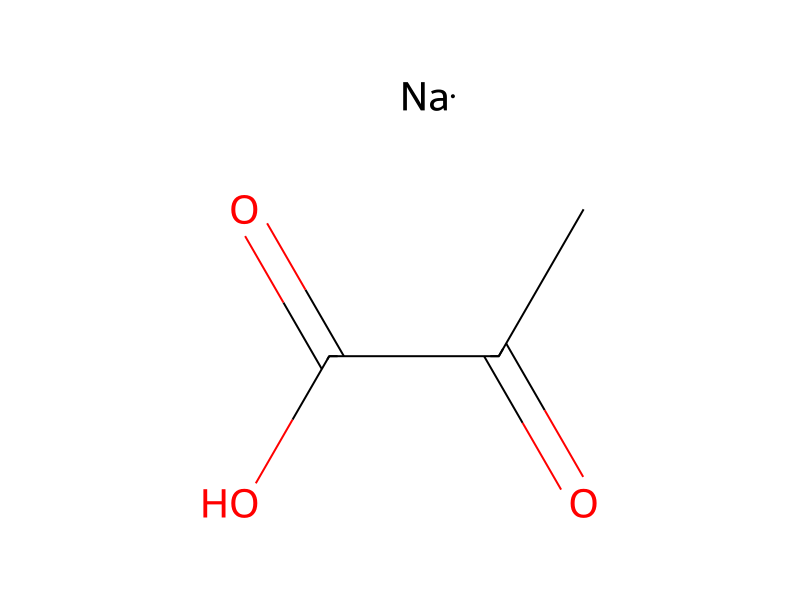
Grundinformationen
- CAS
113-24-6- Standard-SMILES
CC(=O)C(=O)O.[Na]- InChIKey
DAQHMCWYXJEOCG-UHFFFAOYSA-N- Summenformel
- C3H4NaO3
- Durchschnittliche Molmasse
- 111,05 g/mol
Namen und Bezeichner
- Bevorzugter Name
- Sodium pyruvate, BioXtra, >=99%
- Englischer Name
- Sodium pyruvate
- Summenformel
- C3H5NaO3
- Molmasse
- 112.06
Namen und Synonyme
Sodium pyruvate, p.a., 99%SCHEMBL30123187Sodium pyruvate, BioXtra, >=99%Sodium pyruvate, purum, >=99.0% (NT)Sodium pyruvate, ReagentPlus(R), >=99%Sodium pyruvate, SAJ special grade, >=95.0%Sodium pyruvate, Vetec(TM) reagent grade, 98%Sodium pyruvate, powder, BioXtra, suitable for mouse embryoSodium pyruvate, Hybri-Max(TM), powder, suitable for hybridomaSodium pyruvate, anhydrous, free-flowing, Redi-Dri(TM), ReagentPlus(R), >=99%Sodium pyruvate, powder, BioReagent, suitable for cell culture, suitable for insect cell culture, >=99%PYRUVATE
Weitere Namen anzeigen
PYRUVIC ACID SODIUM SALTSODIUM 2-OXOPROPANOATEpyruvic acid sodiumSodiuM pyruvat2-KETOPROPIONIC ACID SODIUM SALTPYR NAp.A.,100gbinrongsuannaSodium pyruate
Datenbank-Bezeichner
- CAS
113-24-6- PubChem CID
- 10154024
Eigenschaften
Berechnete Struktureigenschaften
- Polarare Oberfläche (TPSA)
- 54,4 Ų
- H-Brücken-Donoren
- 1
- H-Brücken-Akzeptoren
- 3
- Frei drehbare Bindungen
- 1
- Schwere Atome
- 7
- Formalladung
- 0
- Komplexität
- 84
Physikochemische Eigenschaften
- Schmelzpunkt
- 300 °C · >300 °C (lit.)
- Siedepunkt
- 300 ℃ · >300℃
- Dichte
- 1 · 1,267g/cm
- Dampfdruck
- 0 Pa · 0Pa at 20℃
- Brechungsindex
- 1 · 1,426-1,43
- storage temp.
- 2 · 2-8°C
- Löslichkeit
- 2 O: · H2O: 100 mg/mL
- Aggregatzustand
- solution
- Farbe
- White to Pale Yellow
- PH
- pH(100g/l, 25℃) : 4.0~8.0
- Biologische Quelle
- synthetic (organic)
- Wasserlöslichkeit
- Soluble in water.
- BRN
- 3568341 · 3568341
- Stabilität
- Stable. Incompatible with strong oxidizing agents.
- Kosmetik-Inhaltsstoffe Funktionen
- SKIN CONDITIONING
- InChI
- 1S/C3H4O3.Na/c1-2(4)3(5)6;/h1H3,(H,5,6);/q;+1/p-1
Sicherheit und Regulatorisches
Sicherheitsangaben dienen nur zur Orientierung und ersetzen weder das Sicherheitsdatenblatt (SDB) des Lieferanten noch geltende Vorschriften oder eine fachliche Bewertung.
Sicherheitsdaten
- wgk
- 3
- tsca
- TSCA listed
- hs_code
- 29183000
- risk_code
- 36/38-36/37/38
- hazard_code
- Xi
- safety_code
- 37/39-26-24/25-36
- Speicherklasse
- 11 - Combustible Solids
- Hazard Classifications
- Eye Irrit. 2Skin Sens. 1B
Chemie und Industrie
Anwendungen
BeschreibungSodium pyruvate is the sodium salt of pyruvate. It is frequently supplemented to the cell culture medium to act as a source of energy since it is a key intermediate during the production of the high-energy ATP molecules inside cells. For example, it can be used as a carbon source for bacteria. It may also protect cell against hydrogen peroxide, an oxidant to scavenger oxygen radicals. It is an important metabolic intermediate in many essential metabolic pathways such as carbohydrate metabolism. For example, it is converted into acetyl coenzyme A and enters into the TCA cycle (Kreb’s cycle) in organisms. It is also involved in the amino acid metabolism in organisms.
VerwendenSodium pyruvate is used in cell culture media as an additional source of energy. It acts as an antioxidant and finds protective effects against oxygen radicals. It serves as an intermediate in many metabolic pathways such as sugar metabolism. It is converted into acetyl coenzyme A and enters the trichloroacetic acid cycle. In addition, it is involved with amino acid metabolism and initiates the Kreb's cycle. It plays an important role as a free radical scavenger.
Darstellung
synthetischeThe preparation of sodium pyruvate is as follows:Synthesis of pyruvate, a salt of a compound of formula (II) by ozonolysis of methacrylic acid, a compound of formula (II) A solution of methacrylic acid obtained in Example la or lb (15.31 g, 178 mmol) in dichloromethane/methanol (5 % methanol, 50 ml) was cooled to -78 0C and a stream of ozone was passed through until the solution turned blue. Dimethylsulfide (12.41 g, 200 mmol) was added and the mixture was allowed to reach room temperature. Excess dimethylsulfide was removed by passing a stream of nitrogen through the reaction mixture. The reaction mixture was evaporated in vacuo at 30 0C. To the residue was added water (100 ml) and then slowly added a solution of aq. NaOH (IM, 178 ml). The mixture was concentrated and left for crystallisation at 4 °C. The white crystalline material obtained was filtered and washed with acetone (3x100 ml). Yield: 14.50 g (92 %). Purity: 95 %.
Vor- und nachgelagerte Produkte
Zugehörige Reaktionen
0
Noch keine zugehörigen Reaktionen